

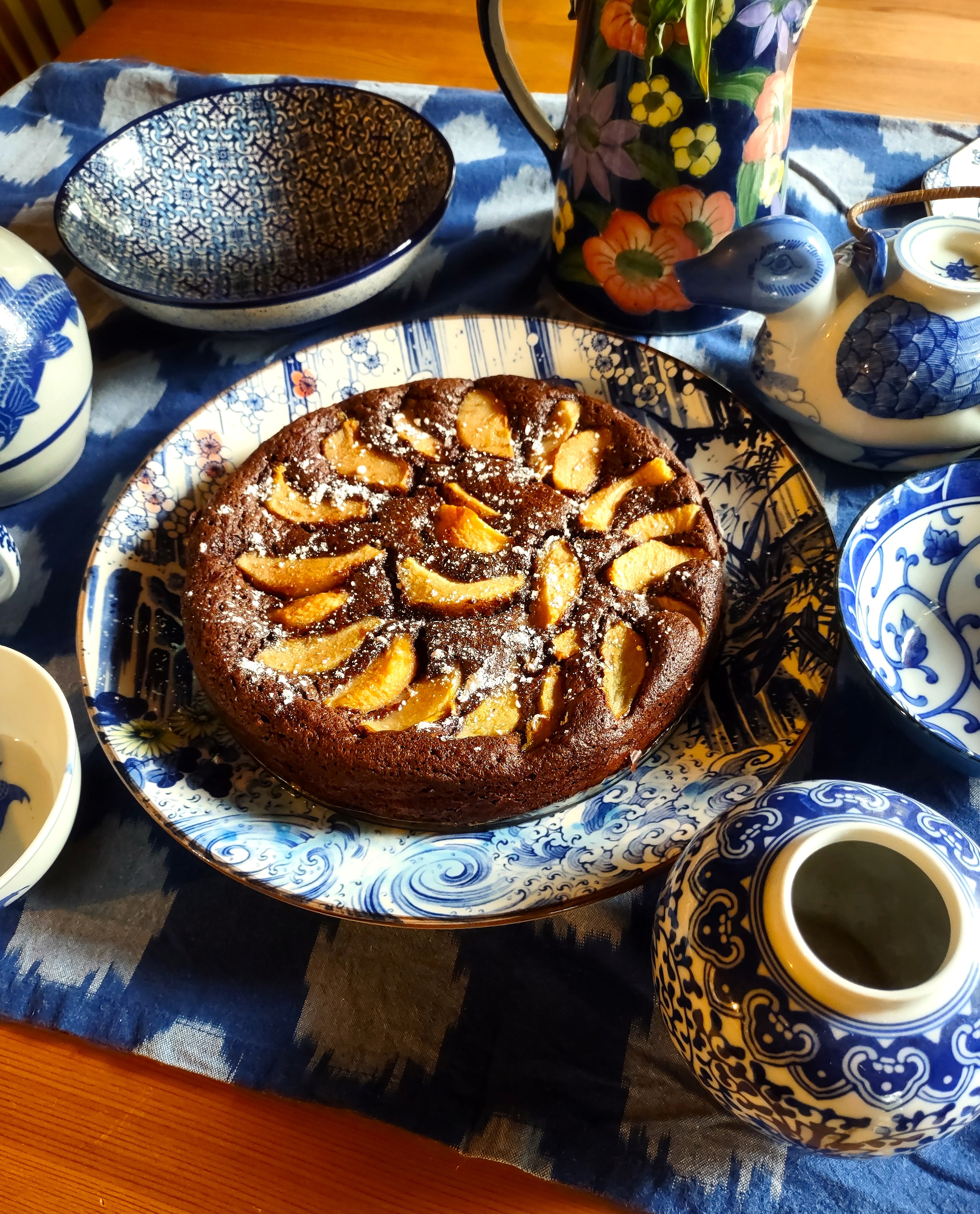
I was just reaching into a high cupboard for a platter — the one with the fish towards the top of this photograph — reaching for a platter to unmold a dessert I baked late morning for a dinner tomorrow evening. And suddenly all I could see was blue. Without ever really intending to, I have accumulated a collection of blue and white porcelain, pottery, serving dishes, little bowls I’ve bought in places like Granada and Porto and wrapped in t-shirts in my suitcase. These pieces are perhaps a third of what I have, not counting two sets of dinnerware, one (incomplete because I never intended to have matching stuff, and also because John once dropped most of the plates when his sleeve caught on a chair-back as he was clearing the table) of Wedgwood Midwinter Moon and one of John’s mother’s Blue Willow, passed on to us at the end of her life.
Clay ties itself
in knots for you.
Clay ties itself in knots. It’s rolled out, turned on a wheel, is glazed, fired, finished. I love the pieces made by hand — the vase at the back with blue fish leaping around its circumference, bought for me when John and Forrest went to Ucluelet at least 30 years ago and brought home gifts for the rest of us. I love the blue duck teapot, perfect for one or two cups, found in Vancouver’s Chinatown for a few dollars more than 35 years ago. I love the little Portuguese plates in the foregound, chosen from stacks in a small shop below our hotel room in Evora in 2015, wrapped, yes, in t-shirts, and brought home intact.
This is how we entertain our Shadow.
How stone moves in to stake a claim in the valley
a silk invasion, oblique, polite…
It’s the colour I love most. Drawn to blues like sun to shadow, drawn to blue and white china like Oscar Wilde, who had an enviable collection. But he also said “”I find it harder and harder every day to live up to my blue china”, a sentiment I understand: the aesthetic quality of these unmatched pieces on my table remind me of my own failings. When was the last time I laid a table nicely for guests? Too long.
But today? I opened a cupboard and saw the beauty. I carefully took down the teapot and platter, moved a few other plates and bowls from the sideboard in the living room, a mug from John’s hand (he’d finished his coffee!) Every piece has a story. Some came to us from our parents, were gifts (the little Chinese pot, the one I love to fill with grape hyacinths in spring, was given to us by the late Lala Heine-Koehn as a wedding gift in 1979), the octagonal plate on the far right was John’s grandmother’s, and the tiny white bowl near the top left is what John calls “foundational”, meaning that when we met, in 1979, I had only a few fish bowls in my kitchen cupboards, the ones you could buy in Chinatown for less than a dollar, and which sort of formed my sense of what beauty and function could look like.
Clay ties itself in knots for you. When you hold a pot or a bowl or a vase, when you cradle a plate in your hand, you are adding to the patina of its history. It has a pulse, if you pay attention. And that pulse is also yours.
From clay we learn to lose our train of thought
in satin whirlpools’ marbling weight
– what was I saying?
Oh, and the dessert? It’s a chocolate, walnut, and pear torte, and it looks beautiful on the blue fish platter.
Note: the lines of poetry are Jen Hadfield’s, from “The Porcelain Cliff”
 ...Theresa Kishkan