
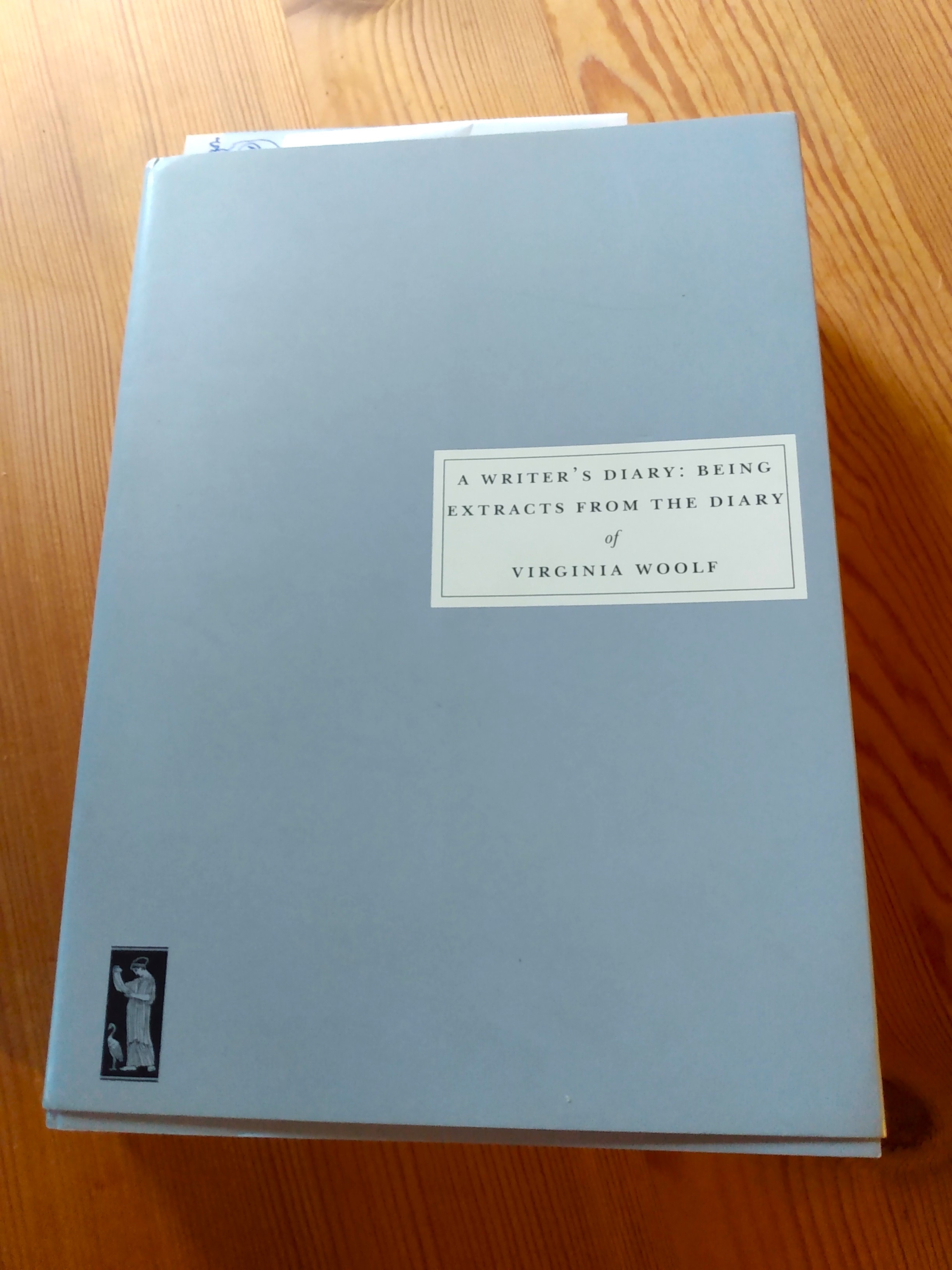
I keep Virginia Woolf’s A Writer’s Diary on my desk. Many mornings I look through its pages to see what she was thinking in 1921 or 1925 or even as late as March, 1941, with her own death just weeks away. She has been my writing companion since I first read The Waves in 1972 or 3. I’ve written before that a kind friend who was both a librarian and a bookseller once gave me a first edition of this book, with cover design by Vanessa Bell, and I treasured it. I lent it to a promising student in a course I once taught in Victoria in 1978 and then I never saw her, or the book, again. But never mind. This Persephone Books edition has endpapers based on that cover design and it serves me well. Some mornings I use it as a kind of divination. What advice will Virginia have for me, what will I learn about both writing and about faith, about confidence, about perseverance?
This morning, as she was finishing The Waves, in late December, 1930:
What it wants is presumably unity; but it is I think rather good (I am talking to myself over the fire about The Waves). Suppose I could run all the scenes together more?–by rhythm chiefly. So as to avoid those cuts; so as to make the blood run like a torrent from end to end–I don’t want the waste that the breaks give; I want to avoid chapters;that indeed is my achievement, if any, here: a saturated, unchopped completeness; changes of scene, of mind, of person, done without spilling a drop. Now if it could be worked over with heat and currency, that’s all it wants.
Yesterday and the day before I printed out hard copies of all the writing I’ve done in the past 4 years: a novel, a novella (sort of my own Mrs. Dalloway, a day in the life of a woman planning a party), one very long essay (35,000 words), and 6 shorter essays. I put them all in an accordion file folder and then, as I was about to tuck the folder away, I thought, Wow, this is quite heavy. So I weighed it. 5 pounds. 5 pounds of writing from the past 4 years. To be honest, the novella was begun earlier but then put aside, and for a lot of reasons that made sense (and still make sense), it was the perfect thing to work on in those early lonely days of the pandemic when my thoughts regularly turned to the cherished past. This work is very much mine. And that poses something of a dilemma because it seems that none of it is particularly publishable. One of the essays appeared in a literary magazine and another was part of an anthology. But the other work: I have a list in a notebook of publishers sent to, of silences and rejections, and it has grown to a rather shocking length. Which tells me something, if I am paying attention. In late October, on a train from Bordeaux to Paris, I took advantage of the free WiFi to send queries to those who hadn’t responded. And it was a little surreal to read replies coming in as we passed fields shorn of their crops and chateaux on distant hills. No, and no, and no.
So on a shelf near my desk, an accordion folder with 5 pounds of text. And a new essay well-underway, one that tries to wrangle some feelings into order, what it was like to finally encounter the animals I first learned about when I was 19 (nearly 50 years ago), on a mild morning in October at Font-de-Gaume in the Vézère valley in France. In a book I’m reading, The First Signs, paleo-anthropologist Genevieve von Petzinger talks about the period when our early ancestors became us. When they used signs and made images that were sophisticated records and responses to the world. And when we entered Font-de-Gaume on that morning, I think I knew I’d found my own people. I stood in the dark, looking at the drawing of a male reindeer bending forward and licking the forehead of a smaller reindeer, probably a female. There is tenderness in this moment, and also such artistic skill. The stag’s tongue is engraved. I am writing about that moment. I am writing something that will probably join the other pages in a file folder on a low shelf, a note on its flap: Unpublished work. But maybe what happens after is irrelevant. I wrote the story of a woman planning a party, I wrote about the strange legacy I carry of having been the subject of an artist’s obsession, I wrote about stitching a life back together after a surgical misadventure, about swimming and the origins of string, about kingfishers and Russian atrocities in Ukraine, about a family rupture that made me see the past 40 years in a very different light, a dim sad one, and in every sentence I wrote there was love.
John took this photograph of the entrance to Font-de-Gaume. It’s an opening, a door into the dark. But I found such beauty there and a kind of deep solace. This morning, reading divination in the words of Virginia Woolf, this is what I have.


 ...Theresa Kishkan