the gentle art

I was beginning to think I was jinxed because The Gentle Art of Swedish Death Cleaning was never available at the Sechelt Library; it was always checked out. For some months I’ve been thinking that I need to sort and winnow the overflowing rooms in this house I’ve lived in for 43 years. The books alone are, well, too many. We have a room with double-sided shelves, filled. I have a study with shelves built into one full wall and there’s no room to squeeze in another thin volume of poetry. Speaking of poetry, John has shelves upstairs with so many that he has also made piles on small tables and the floor. We never got rid of children’s books and good thing because now there are grandchildren. My mind is firmly analog, I guess, and although I use the internet (of course), I love to sit with books and look things up. There’s nothing like an atlas, for instance, or maybe 3 so you can cross-reference, sitting with them on your knee, tracing the distances from one city to another, tracing the river courses, figuring out borders. You need 3 because those borders are always shifting and it’s interesting to think about that historically, over time. And dictionaries: same.

But yesterday the library’s copy of The Gentle Art of Swedish Death Cleaning was on the shelf and I brought it home. I read most of it before sleep last night so is it any wonder I dreamed of filling boxes with…books? The author advises one room at a time. I’d like to try. I’d like to take in large bags and fill them with clothing, shoes I’ll never wear again, pots I haven’t cooked it for years, maybe even the fish-poacher Floyd St. Clair gave me when he was doing his own version of Swedish death cleaning. I remember I’d gone to have an early dinner with him and his partner David Watmough with my older son Forrest before heading down to Kits Point to see a performance at Bard on the Beach. We were using the bus and we were going to return to North Vancouver to sleep at the home of another friend after the play. So I had the fish-poacher in a large bag that I had to tuck under my seat in the tent and then carry back on the bus. That’s one item I could death clean but do I want to? Not yet. Floyd and David have been dead for years and I miss them still. (Everything in this house holds a memory.) Giving away the fish-poacher would seem so disloyal, unloving.

I could death clean the dresser holding table linens but then what happens when we need enough table cloths for all the tables put end to end for a really large gathering? (Will we have a large gathering again?) I could death clean the silver. The author recommends saving only enough plates and cutlery for the places you can set at your table. But what if? What if?

We don’t have a basement. Instead, we’ve filled our utility room with boxes of old boots, a tent, an inflatable dinghy, canning jars, two wine racks (filled, more or less, but you wouldn’t death clean wine, would you?), two vacuums, and, and, and. We’ve also filled our print shop, purpose-built to hold one printing press, then another, and cabinets of type, a table for laying out freshly printed pages, a cabinet for ink, etc. But as well as another vacuum, there’s also a wall of boxes of books, mostly copies of my own books, bought when they went out of print or else a publisher wrote to say they’re taking up too much warehouse space. Who could say no? Not me. No one wants to think of their books being shredded. But honestly, was it wise to think that somehow I could sell the books myself? I am no entrepreneur. (If you’re interested in any of them, just ask me. $5 a copy, plus postage.)

When I went to the library yesterday and found The Gentle Art of Swedish Death Cleaning on the shelf, I was thrilled. I looked at the first couple of pages and was filled with resolve. As I was leaving, I stopped at the trolley in the library lobby to see what books were being discarded, taken out of circulation. I’ve found treasures there, most recently some children’s books in French to have here for my Gatineau grandsons. Yesterday there were several copies of my book Euclid’s Orchard, the ones the library kept in their book club sets. I loved visiting a couple of book clubs who read that book, several members using library copies (while others had bought the book and asked me to sign it for them). Reader, I hesitated. I knew I had at least one box of Euclid’s Orchard in the print shop in the precarious stack against the east wall. Did I really need any more? I hesitated, as I said. But somehow The Gentle Art of Swedish Death Cleaning gave me to strength I needed to walk right past. And maybe I don’t want a copy (or two) of one of my own books with Discarded stamped on it. It’s a bit like finding one of my books listed on ABE, described as being “Unread, with fulsome personal inscription from author to fellow writer”.

One room at a time. That’s what the author advises. I don’t know where to start. But at least I haven’t added to the problem. Not since yesterday.
summer shortbread

summer shortbread

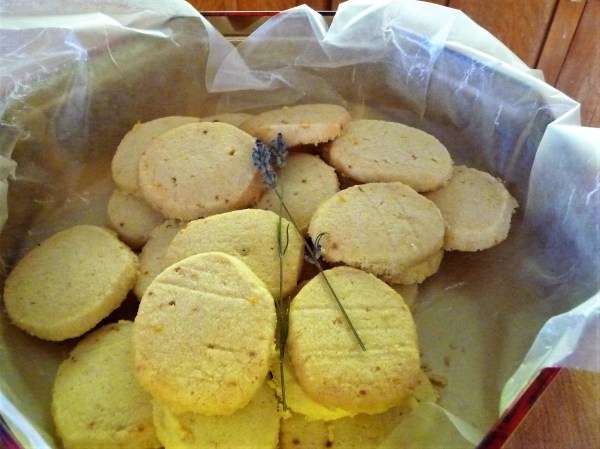
Tonight we are going for dinner with our friends at Oyster Bay. I haven’t looked at the tide table but I’ll take my bathing suit just in case. When the tide comes in, the bay is the most beautiful place to swim. You are swimming over the remains of fish weirs and oyster beds and there’s feral asparagus, remnants of the cultivated crops grown by the local market garden, self-seeded in the rich muck along the shores. My friend gathers it in spring in her canoe and those dinners are spectacular. Tonight’s will be, too. And I offered to bring dessert—a gooseberry fool flavoured with a little rose-water, and lavender and lemon shortbreads. I made them with rice flour for those in our party who don’t eat gluten and as I was mixing and shaping, I wondered at what point you can call something that you’ve always made in honour of the person who gave you the recipe (well, her son actually, who is in his 80s now) but who would probably not recognize the recipe any longer, well (realizing I’ve lost control of this sentence), how long you still name the recipe for that person? When Alistair MacKay,who was once my husband’s French professor at UBC and who, with his colleague Floyd St. Clair (partner of David Watmough), became dear friends, gave me his mother’s recipe for shortbread, he asked that I call it “Mrs. MacKay’s Shortbread”. And I do, most happily. It is excellent. I’ve passed along the recipe to others and told them they too must call it by its true name. (It was a hit in Amsterdam last Christmas, apparently.) But when I add rosemary or lemon zest or fierce Chamayo chili bought from a man selling bags of it on the roadside in New Mexico, is it still “Mrs. MacKay’s Shortbread”? Yes, I think it is. So “Mrs. MacKay’s Shortbread, with variations for the times we live in, the flavours we crave, the spice we want in winter, the flowers we have available in summer”.

Back to Oyster Bay. I am married to a poet and have lived with him for nearly 40 years, surrounded by poetry. He says he is often surprised to find records of our daily life in the pages of this blog. Surprised by what I remember or pay attention to. Mostly he’s glad, I think. And similarly, I am often surprised to find our daily life in his work. Surprised and delighted and grateful. Here’s part of the first section of one of my favourite poems, John’s “Mud Bottom”, set on Oyster Bay some years ago now but still vital and true.

                                                          I should put on old runners

to walk the creek’s last clarity, its main channel
down the estuary utterly exposed,
brazen and pungent in the sun. Its bed
of clay and hard sand is the only footing
in acres of slippery, deep mud. Its few round stones

in shroud and sweep of seaweed hair are the blind heads
of seekers pushing upstream.
They would be worth knowing, knowing

what a husband knows.
A river, a marriage, living
are deep-pulling puzzlements their whole length.

—from “Mud Bottom”, in Water Stair, Oolichan Books, 2000.

I wanted nothing so much

We’ve had to dismantle our vegetable garden after some drain field problems over Christmas necessitated repairs to the field. Digging up the raspberry canes, perennial herbs and greens, the roses kept safe from deer behind the garden fence, and trying to remember where the clumps of crocus and tulips were to ease them out of their winter sleep, I kept remembering what it was like to make the garden in the first place. I was young (but felt old!), had two, then three small children, and we were finishing our house, bit by bit. In early summer, after the children were in bed, I’d go out and dig furrows with a pick. The soil was rubble, really — I believe it was called “porous fill”, brought in by the guys doing the drain field to cover the lines and level the surface.  I gathered seaweed and begged manure from friends with chickens or horses. Every bloom or cabbage was like a miracle.

The garden evolved, not in a tidy or planned way, but lovingly, carelessly. I loved working out there, surrounded by bees in the oregano, snakes sunning themselves on warm soil, finding tiny frogs in the peas, hungry for aphids. Taking it apart, we kept saying, “Let’s treat this as an opportunity to organize things, make better use of the space.” And we do, we will. The repairs are finished and now we are in the process of figuring out where to place beds, where to settle the raspberry canes back into the rich soil. “Rich”, because I’ve dug hundreds of pounds of seaweed in over the years, buckets of compost, and most recently, half a dump-truck load of mushroom manure (the other half-load waiting for spring under a tarp, to be used for potted tomato plants, etc.).

Walking around in the mud this morning, in the rain, I kept remembering those early efforts to make beauty. I need to remember that it all happened in its own time because the place is a mess right now! The first thing we did was put the compost box in place and pace out paths, replant the small Merton Beauty apple tree at the far end. In a few minutes I’ll go out to help John pound in fence posts so we can restring the deer fence. But here’s a small offering for Sunday morning, a poem I wrote, probably the last poem I ever wrote, maybe 25 years ago, after my dear friend, the late Floyd St. Clair, gave me the gift of a an opera (La Rondine). I’d listen to Magda sing of love and her dreams and see the swallows courting above our garden and it was all part of an complex emotional landscape I found myself immersed in.

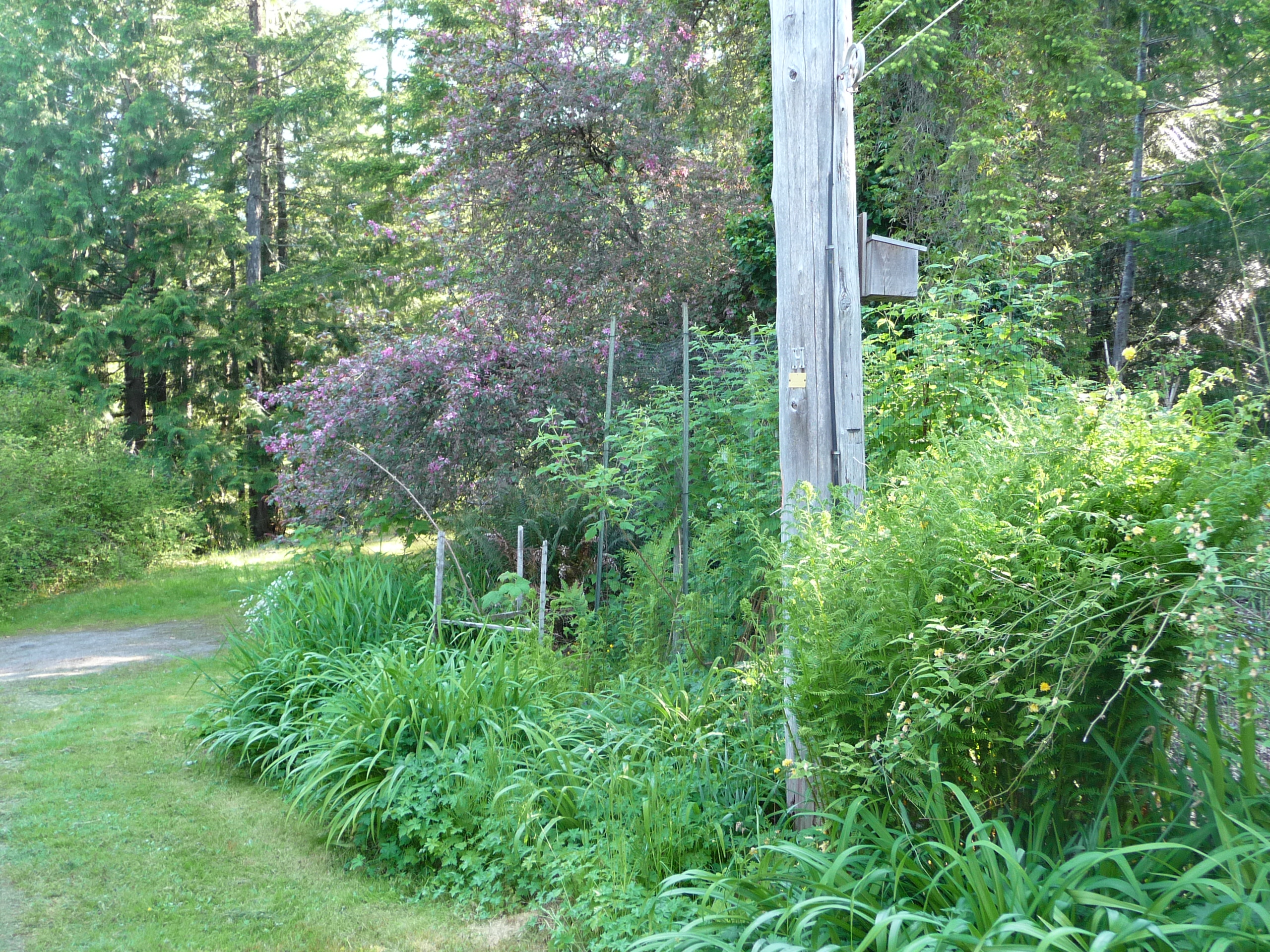
last of the pink crabapple

La Rondine

Standing on the garden path, forgetting
what I’ve come for, scissors in hand
and a small blue bowl,
I watch the swallows reel and turn.

On two fenceposts of the garden,
                                  little houses
wait for the nests of dry grass and feathers,
the round opening of home.
In the years before the swallows,
I came out
in the dark, paused in my thin white nightdress
among the new vines of peas, listening
with one ear for the baby,
one ear for owls. Going back
to the house where one lamp burned,
softened by moths, I wanted nothing
so much as flowers and children,
                                 baskets
of vegetables, my husband turning to me
as I entered our bed, cool from the garden.

Now I feel old among the broadbeans
and the rows of potatoes.
The swallows whirl and call in flight
as ardently as Magda
sang the high sweet notes
                          of youth and love
and I clip rosemary, fill my small blue bowl
with remembrance.
So much still undone, children half-grown.
The swallows fall from the sky
                               so sudden
it takes my breath
                      away,
sometimes their wing-tips just touching,
like fingers.