We know autumn is coming. The sun comes over Mount Hallowell an hour and a half later than it did when we drank our coffee on the upper deck and thought about all the things we would accomplish in summer. So much of it is still undone, at least from my perspective. Garden unweeded, relationships untended, some of them. But the pantry shelves are lined with preserves, the tomato plants are still producing their beautiful red fruits, I’ve filled a basket with squash,
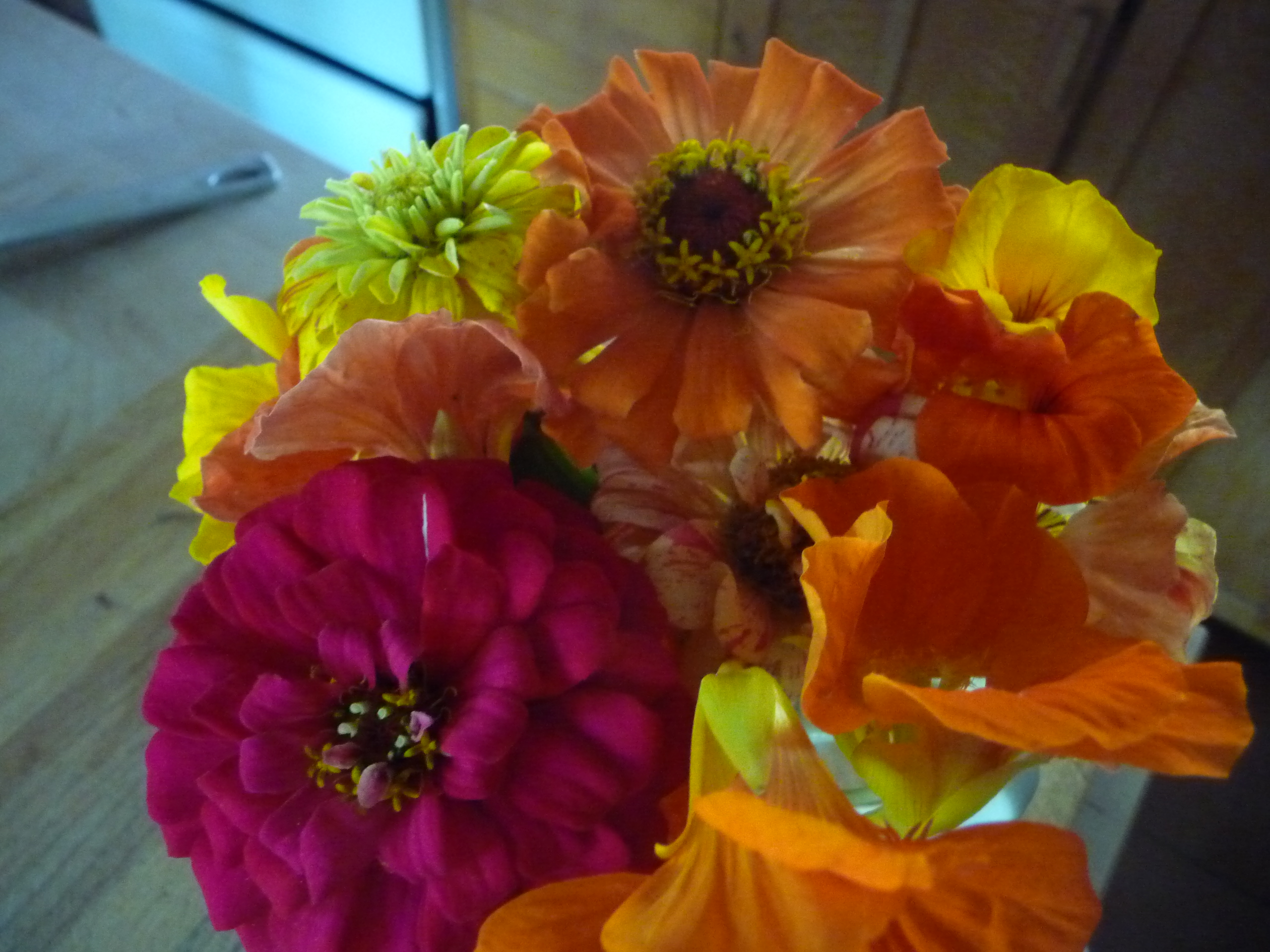
and the flowers bloom as though frost was simply a rumour — as it is at this point in the year.
The beautiful changes as a forest is changed
By a chameleon’s tuning his skin to it;
As a mantis, arranged
On a green leaf, grows
Into it, makes the leaf leafier, and proves
Any greenness is deeper than anyone knows.
(from “The Beautiful Changes” by Richard Wilbur)
On Long Beach the other day, I thought of the way I wanted to write the novella I’ve recently begun, a reflective (and reflexive) book about a brother and a sister and a river. It will pay homage to writers who’ve explored the same territory — Sheila Watson and Ethel Wilson. I’m thinking of Lytton and the place where the Thompson River meets the Fraser, how it looks this time of year, the sumac turning red and the rabbitbrush vivid yellow on the roadside between Lytton and Spences Bridge. The beautiful changes. It’s always exciting to be at the start of something — a season, a story. And to feel the cadences of both begin to pull me in.
Sometimes books we’ve read in the past call to us again, asking to be re-read, re-experienced, savoured in new ways, and old. Ethel Wilson’s books are like that for me. They are so, well of this province where I live, where I’ve travelled extensively, always finding places that call up such yearning in me. Years ago I had the honour of having one of my novels shortlisted for the Ethel Wilson Fiction Prize — it was 2005, for A Man in a Distant Field, published by Dundurn in 2004 — and I re-read EW’s Swamp Angel to pay homage to her particular quiet genius.
And now it’s Hetty Dorval I’m half-way through and trying to make last as long as possible. It’s a novella, 92 pages in this MacMillan Laurentian Library Edition I found in Russell Books in Victoria a few weeks ago. I”ve had other copies of Hetty Dorval but it’s the kind of book you want to give to others, wanting them to love it too, maybe even enough to take to the highway to travel to Lytton to try, as I did, to figure out which house was Hetty’s. I don’t think it was this one but this is the house I have in mind when I read of Frankie Burnaby’s clandestine visits to Hetty. It’s old enough, though Ethel Wilson stresses the bungalow was “all alone above the river, just east of Lytton.”
probably not Hetty Dorval’s bungalow…
In some ways, this is an old-fashioned book. It was first published in 1947 and its narrative takes place in the 1930s. But Ethel Wilson was also so modern. Or maybe I mean timeless. She had a profound love for the natural world and she understood how it was an important shaping force of character. When Frankie Burnaby meets Hetty Dorval on the road from Lillooet to Lytton in late September when Frankie is 13, the two of them form a bond of sorts when they see a skein of geese flying south:
The valley of the Fraser lay broad below, lit by the September afternoon, and the geese, not too high, were now nearly overhead, travelling fast. The fluid arrow was an acute angle wavering and changing, one line straggling out far behind the other. It cleft the skies, and as always I felt an exultation, an uprush within me joining that swiftly moving company and that loud music of the wild geese. As we gazed, the moving arrow of great birds passed out of sight on its known way to the south, leaving only the memory of sight and sound in the still air. We drew a long breath.
I love how the “I” of this paragraph unconsciously includes the other, whom she has just met. And despite all that happens to both of them, I can’t help but thinking that the experience of seeing the geese together has linked them one to the other.
As I said, I’m trying to make the book last. I’m a little more than half-way through and I’ve just read these two sentences:
My genius of place is a god of water. I have lived where two rivers flow together, and beside the brattling noise of China Creek which tumbles past our ranch house and turns our water wheel…

 We know autumn is coming. The sun comes over Mount Hallowell an hour and a half later than it did when we drank our coffee on the upper deck and thought about all the things we would accomplish in summer. So much of it is still undone, at least from my perspective. Garden unweeded, relationships untended, some of them. But the pantry shelves are lined with preserves, the tomato plants are still producing their beautiful red fruits, I’ve filled a basket with squash,


 ...Theresa Kishkan