

Yesterday I had a virtual visit to a class reading my novella, The Weight of the Heart. (Thank you, Richard Pickard!) In the course of the discussion, I found myself admitting that the 1970s had been foundational to me — as a writer, as a person figuring out how to live on this earth. I found out the things I wanted and I tried to build a life that would include them. I didn’t realize then how pottery was part of that, pots built by BC potters, using earth and pigment, but looking around my house this morning (begun not quite in the 1970s but close: we started building our house in 1981 after buying the land a year before and spending a year figuring out where we wanted the house and how we would proceed…), I can see the evidence.
This red raku tea bowl was made by Wayne Ngan in the early 1970s. My then-sister-in-law Rosemary Kent (herself a potter) owned a small art gallery in Bastion Square in Victoria. They often had pieces made by Wayne. He’d come to Victoria from his home on Hornby Island with new pots. I fell in love with this one but couldn’t begin to afford it (I was a university student) and Rosemary surprised me with it at Christmas. The glaze is heart-stoppingly beautiful.

This wide shallow bowl was also made by Wayne. I saw it at Rosemary’s gallery and realized that I could buy it with unexpected scholarship money, received after I’d already paid my tuition with earnings from my summer job at Butchart Gardens. You can’t really see it but there’s some blue in the slip used to create the design. We used to eat salad from this bowl regularly, particularly when friends came for dinner (it holds a lot of salad!) and I remember how surprised people were when the last helping of greens had been lifted from the bowl and we could see that engaging little face!
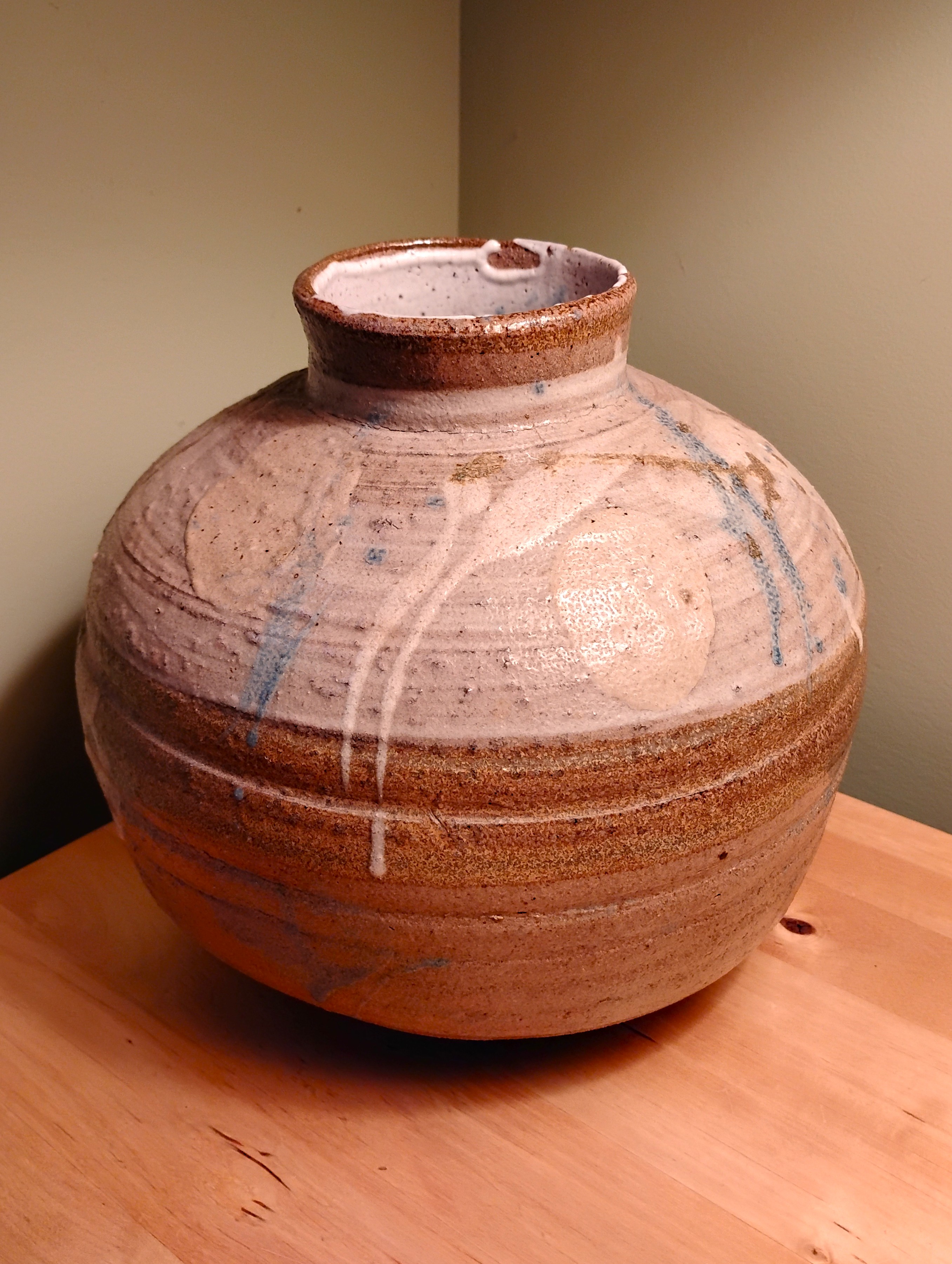
I am not entirely sure if this pot was made by Wayne Ngan. I bought it from a couple who’d set up a table at a huge swap meet at the site of the old Tillicum drive-in theatre (now the Tillicum Mall) in Victoria. They’d come from Hornby Island and were selling everything to spend a year in Europe. They had pots by various artists, including Gordon Hutchens, and they assured me that this large vessel was made by Wayne. It doesn’t have a seal so I can’t confirm it. But it’s heavy in the way so many pots were then and sometimes I put dried rushes or flowers in it. When I lifted it up to check once again for a seal, there was a stick of driftwood sticking out of, left over from wind-chimes I made a few summers ago with my grandchildren, also emblems of the 1970s!

These wind-chimes hang by our front door and a rose has sent out a tendril to join the music before winter. Sometimes I see Anna’s hummingbirds paused on it between sips from the feeder which hangs just to its right.
Sometimes I just take one of the pots in my hands and hold it. There’s life to them, life in their shapeliness, their inner space. In a wonderful interview with Spencer Bailey on the podcast Time Sensitive, the potter Edmund De Waal says this:
I think it’s completely my grounding, really, which is that the making of one vessel and then making another vessel, taking it off the wheel, making another one, has an extraordinary element of rhythm within it. But at the heart of the rhythm, of course, is this interior space of a vessel, which is a breath. And so, there’s an embodiment there. It’s almost a breathing into the vessel. I don’t want to sound like God or Prometheus, but, for me, a vessel, it’s a container of breath.
Surrounded by things made of earth, shaped by hands, I am in the foundational time again, the one I wrote about in my novella, Winter Wren. What mattered then matters now. The quiet of a west-facing house, the view at dusk, finding a way to live a life in which these things have a place, a place known and loved and cared for. I think it’s completely my grounding, really…Yes, and yes, and yes.
 ...Theresa Kishkan