I look up

I look up and she’s looking back. I know this is a female because I just watched her pee, squatting, then kicking up moss when she was finished.
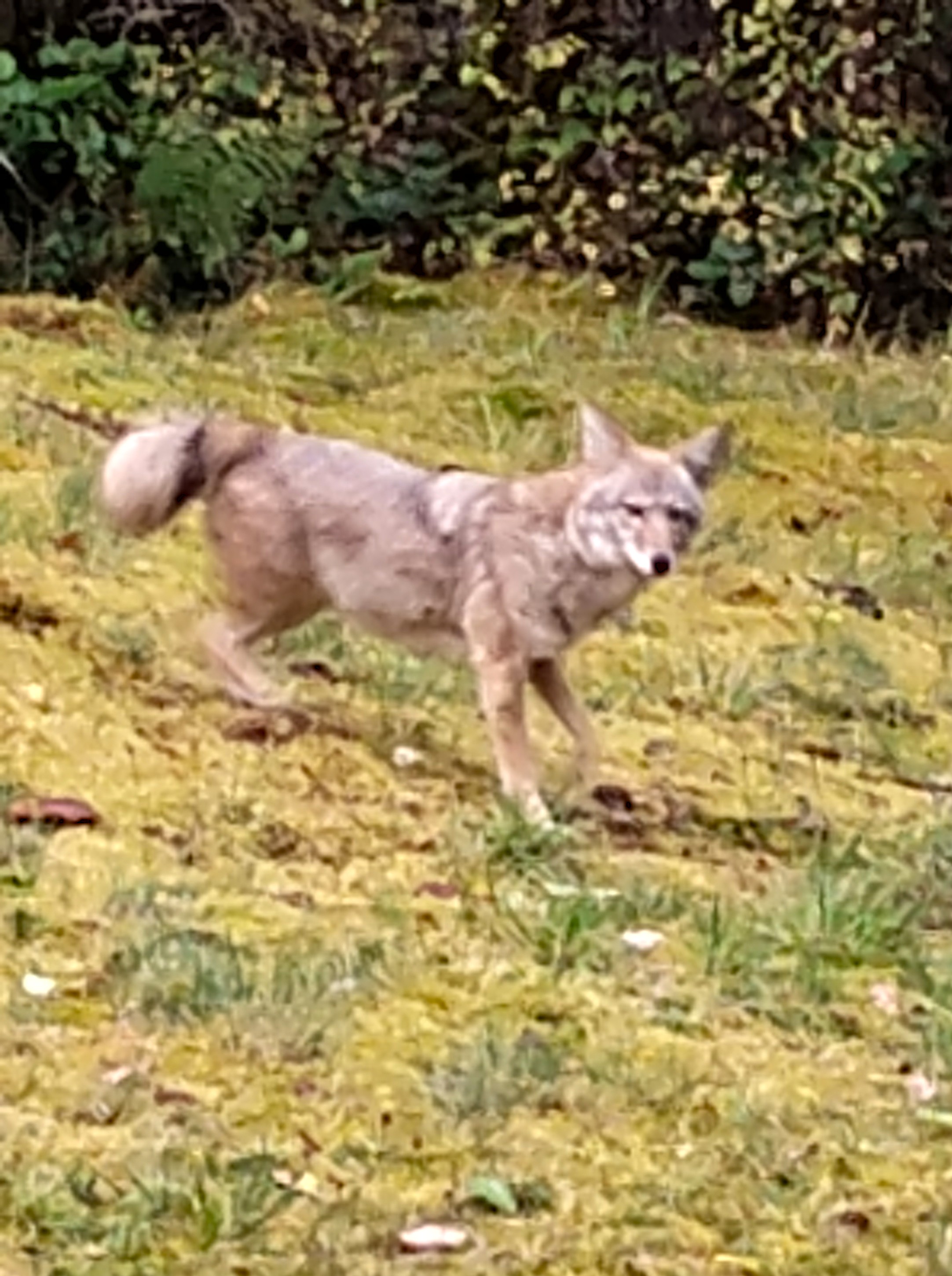
This is not the coyote who came the day before yesterday, the one with the really big ears and a grey-ish coat, a slight limp.

I don’t know if they’re this year’s pups, now grown, the ones sent away to fend for themselves. But they like the moss, sniffing around for mouse remains we sweep off the upper deck after a good night’s hunting for the cat. (He leaves us morsels: stomachs, kidneys, sometimes a perfect whole mouse.) And the cat is wary, stirring from his sleep to listen.

I look up. Last week it was a bear at the top of the steps, peering in the sliding doors.

I could see the white blaze on its chest and wondered if it was somehow related to a bear that visited years ago, maybe 15, or even if it might be that bear (they can live for 20-30 years). That one came for crabapples, as this one did (I saw it swaying in high branches the other evening), sitting like a dog by the little pool under the tree after feasting.

I think of Gary Snyder’s “this poem is for bear”:

honey-eater
forest apple
light-foot
Old man in the fur coat, Bear! come out!

I think of this bear in its heavy coat, the coyotes shaggy and wild, the deer we surprised on the drive the other day, the one ambling up as if she had all the time in the world, the grouse in the salal, the otter swimming towards me in the lake the other morning, the single merganser fishing along the shore, the chickadees waiting at the door for seeds, so eager they perch on my outstretched palm. I look up, I think of them, and I look at Gary’s poem again.

“As for me I am a child of the god of the mountains.”


coyote time

morning-visitor

Just now John called me to the kitchen because he was watching two coyotes trot through what used to be our orchard. They were moving along the perimeter, between open ground and the forest. Our cat, Winter, has been very skittish lately, wanting to go out and then wanting back in again very quickly so I’ve half-expected to hear coyotes in the night. For many years, we’ve heard them in the woods to the south of our house, a mating pair, and we’ve seen the offspring from time to time, including the pup in the image above a few years ago. The pair we just saw might be the constant couple or else a new pair but this is obviously part of their territory because I sometimes see one or more passing my study window. I’m here now, with a camera ready.

Here’s a passage from the title essay of my collection, Euclid’s Orchard:

At my desk, I look up to see two large brindled coyotes lope out of the bush and across the grass in front of my study. In the past, I’ve heard coyotes in the woods just south of our house and suspect there’s a den there used year after year. Once, reading in bed late at night, my husband and I heard a pair mating— the rhythmic grunts and growls, the high-pitched squeals, a passionate duet, tempo changing until all we could hear was an urgent expressive finale, and then silence. Though running, these two also seemed at ease in their surroundings, coming out of the woods where there’s a rough game trail used by deer and elk, and crossing the grass as though they’d done it many times before, on their way to the orchard. I called my husband to see, but by the time we opened the back door, they’d disappeared.

“…a coyote is singing a long low passage.”

Last night I woke around 3:00 to hear coyotes singing in the woods. Or the orchard. Hard to tell in moonlight the location of music, particularly coyote music, which is cast to the air in a kind of magic. I thought of my essay, “Euclid’s Orchard”, which also hears the music and tries to make sense of it. Not only its location but its meaning, over time.

From “Euclid’s Orchard”:

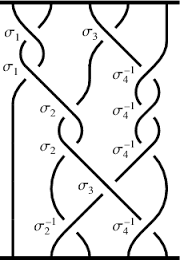
Braid groups, harmonic analysis: The whole is greater than the part. (5th axiom of Euclid)

braid groupsA mid-summer evening, clear moonlight. Down in the orchard, the coyotes have gone under the fence with their young. How many? I’ve seen one, heard several others. I’ve imagined them on the soft grass, tumbling like my children used to play, rolling down the slope over tiny sweet wild strawberries, over the heart-shaped violet leaves, the deep pockets of moss, while around them snakes hid under the lupines. But now in the quiet, I am shaken out of my dreaming because a coyote is singing a long low passage. A lump forms in my throat as I look out into the night, the sky dusty with stars, a three-quarter moon hanging so perfect over the hidden lake that I think of a stage-set, an arranged scene created by strings and wishful thinking. A jagged line of dark horizon and the vertical trees, the line of them rising, then descending as the bar changes, a page of music, the arpeggiated chords, the implied bassline. A pause, a comma of silence. Another coyote joins in, then at least two more. It’s a part-song, a madrigal. Each voice is on pitch but one is low, another high, and several braid themselves in and around the melody line.

See, see, mine own sweet jewel,
See what I have here for my darling:
A robin-redbreast and a starling.
These I give both, in hope to move thee–
And yet thou say’st I do not love thee.

What feast have the parents provided—a flying squirrel, a clutch of frogs, robin nestlings fallen from a tree, a cat from the summer neighbours sound asleep in their beds? See what I have here for my darling—I hear the riso in the father’s line, his extravagant vibrato; and then the sospiroin hope to move thee, as the mother nudges the twitching body towards her eager pups. For she knows, oh, she knows, that by summer’s end, her young will have gone their own way, far from the natal den in the woods just south of the orchard, forgetting the braided perfection of the family body and its unravelling, the strands unplucked and loose, and yet thou say’st I do not love thee.