the summer plates are put away

summer plate

The last guests of summer have just headed down the driveway on their way to the ferry, then Edmonton. In July, two groups visited. In August, family arrived on the 5th and they left two weeks later, another group arriving a day later, and then another overlapping for a week, and staying until this morning. School starts on Tuesday so that’s their signal to head home. The washing machine is whirring with towels and sheets. I put the summer plates into the cupboard, the stack of 15 ready for next summer. We set them on the table for every meal, along with the silver we use for larger groups because there’s lots of it and why wouldn’t you use the best cutlery for your family?

It was a summer of daily swims (and those will continue for me into October when I’ll reluctantly begin my pool swims 4 mornings a week), large meals–prawns, halibut, salmon, platters of lamb kebabs, garden salad, and last night the traditional send-off meal for Brendan and Cristen: prime rib with Yorkshire pudding, roast potatoes with rosemary, and nectarine upside-down cake with homemade strawberry ice-cream–outings to Francis Point where the kids explored tide-pools and saw a pod of orcas passing, visits to the thrift stores by everyone who came this summer, family dinners at the Backeddy Pub where I walked grandchildren down to look at the boats and seastars on the rocks while we waited for our food to arrive. We had our archery lessons from Grandpa John, the Gatineau kids hung their drawings outside in a grand gallery, they hung their painted halibut on a piece of driftwood from the pergola over the outside table, and the Victoria and Edmonton girls organized many plays on the mossy area they called Big Rock Field. Aunty Angie showed the kids how to make beaded lizards and that was the craft of summer, 20 or more tucked into the car this morning to drive to Edmonton.
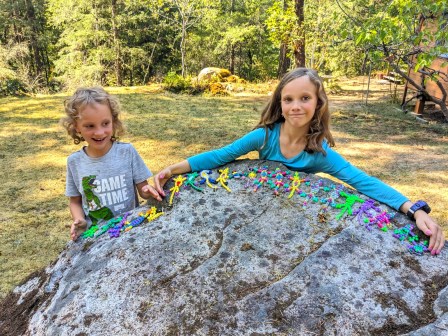
lizards

Somehow in the midst of the wild rumpus that is family life, I wrote the first draft of an essay. It’s 4000 words at present but I think it will be longer once I’ve figured out the gaps. It’s something that kept me up at night, working at my desk in a dark sleeping house, trying to find a way to tease out strands of a very complicated tangle of thinking: the war in Ukraine, the morning kingfishers at my swimming hole, the horror I feel at the local signs of climate change, and the the Cave of the Swimmers at Wadi Sura in the Egyptian Sahara (which sort of straddles two of the other strands, swimming and climatic shift). I printed out the draft and set it up at the dining table (which of course won’t be used for a bit) in order to see how the fragments cohere, or don’t. This will be an essay that I physically cut and paste to find the best arrangement of its parts. Sometimes I write like this, though not always, and I love the physicality of “editing” with scissors and tape.
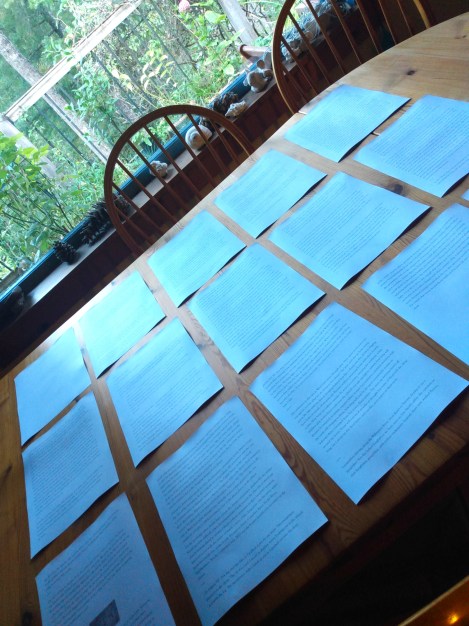
fragments

So the summer plates are put away. The seasonal shift is in the air. The Steller’s jays have become accustomed to more seeds than usual because the children loved to feed them and 3 are haunting the posts on the deck, calling loudly, one with a peculiar whistle I’ve heard this summer for the first time. A bucket of crabapples waits for me to figure out what to do with it, a basket holding a quilt in progress will come out to the kitchen and another basket of fabric asks for something to be done with it (blues, of course), and I’m thinking of a quilt to remind me of 4 months of daily swims under a sky that was almost always clear.
redux: “What would the world be, once bereft” (Hopkins)

Note: This was written 2 years ago. And this morning? I obsessively read the news out of Ukraine following the destruction of Kakhovka dam by Russia (and the bothsideism of the coverage is driving me crazy; read Timothy Snyder for clear thinking about this), I watch for smoke to fill our skies if the wind changes from Vancouver Island. In a few minutes I’ll go for my morning swim and maybe for half an hour the sky will be blue, my heart-rate normal.

It is a very unsettling time to be human. To be trees, to be weeds, to be vast areas of the western North American continent currently on fire. To be a reader of documents detailing atrocity. We are in the middle of a heat wave here on the Pacific west coast. Yesterday I closed the door of my greenhouse at 8:30 (leaving the roof vent open) and it was 44. Outside, 32 in the shade. We swim in the mornings and that’s a blessing but the idea of a late dip is unthinkable because the place where we swim, where we’ve gone for more than 40 years, is packed with people. The man who rakes the sand and takes away the garbage said this morning that he was taking away 200 cans from yesterday. Those are the ones left, mostly in the bins but some on the beach. Many people take their cans and other stuff away with them. I was awake for a lot of the night, hearing boats on the lakes, traffic on the highway at 2:30 a.m., and even gunshot around 5.

On my desktop, a copy of Canada’s Residential Schools: Missing Children and Unmarked Burials, Volume 4 of the Final Report of the Truth and Reconciliation Commission of Canada. It’s overwhelming in both its detail and its clarity. The statistical information is shattering. One example: the percentage of enrolment from 1891-1909 who died at two institutions, Old Sun’s Boarding School and Peigan Anglican School: 47.4 and 49.2 respectively. I was thinking about that in the night, listening to the noise of summer, and wondering how our country can ever reconcile goodness with this terrible legacy.

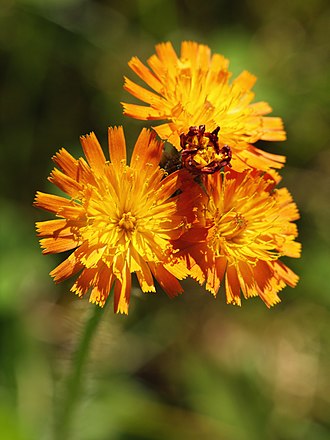
The other morning when we drove out, I saw a sign on the bottom of our driveway, put there by the Ministry of Transportation and Highways, to alert people to herbicide spraying along the gravel shoulders. The target? Orange hawkweed. It’s a pretty wildflower, introduced to North America somehow, called fox-and-cubs in Europe where it’s a native plant. We’ve lived here for 40 years and it’s always been part of the roadside flora. I notice these plants and I notice their pollinators — bees, butterflies, etc. I contacted the Ministry of Transportation to register my objection and had the usual round of back and forth, some of it on Twitter, and it’s like talking to logs. Glyphosate, I said? Really? It’s implicated in so many cancers, significantly non-Hodgkin’s lymphoma and blood-related cancers. That’s for humans. What about songbirds, what about butterflies, what about the snakes who lie in the sunny gravel on summer mornings? Oh we have to control it, was the response. A species that can take people to space and back, can decode the human genome, develop safe vaccines within a year for a deadly virus, compose symphonies, is still committed to toxic herbicides on our public highways. I think of Inversnaid, written in 1881 by Gerard Manley Hopkins after a visit to the poem’s namesake village on the shores of Loch Lomond.

What would the world be, once bereft
Of wet and of wildness? Let them be left,
O let them be left, wildness and wet;
Long live the weeds and the wilderness yet.

I’m looking out now to sun on a cascara and arbutus and blue sky without a cloud in it. A chicken is roasting, dusted with herbes de Provence, and some new potatoes in a separate pan, for salad. Yesterday I made the mistake of waiting until late afternoon to begin preparations for dinner: chiles rellenos, for which the peppers had to be broiled and skinned, filled with chorizo and cheese, battered and baked with sauce from the freezer. By the time they were ready, I was too hot to be hungry. Tonight dinner will come from the fridge.

John was awake in the night too and at one point I said to him, “I’m scared.” Not of the dark, not because of the relative isolation of our house where gunshot is unexpected to say the least, but of the future. Mine, his, the planet’s. We’ve talked about climate change for decades now and as New Mexico, Idaho, Arizona, and California burn, as the rivers and lakes dry up, as we face the consequences of our species’ ability to grow at an unsustainable rate, to consume, to refuse to adjust our expectations, I don’t look forward to what the future brings or takes away. What would the world be? I wonder if it’s too late to imagine.