“one foot bare to the weather”

This morning I have been thinking of the soft landscape around my grandfather’s village in Ukraine and how my photographs from a 2019 visit helped me to write the Ukrainian sections of my novel, Easthope. In the novel, the main character visits a village very like my grandfather’s, though her family history is not mine, and what she discovers there, the long threads of connection, some snipped, some tangled and knotted, inspire her to paint her way into a greater understanding. Her name is Tessa (and if you’ve read my other novels, you might recognize her as the child in The Age of Water Lilies) and I’ve given her an adjacent life, if that makes sense. She and her husband live in a house on the Doriston Highway, the first house John and I looked at in 1979 when we were trying to work out a way to live here (though we didn’t quite know that then; we thought we could spend summers, maybe a week or two in other months of the year too). We didn’t buy that house but Tessa and Marsh inherited it. Fiction lets you do that. And so it goes. She paints. (I can’t.) Marsh has a refurbished Columbia River gillnetter. (I don’t.) Tessa’s Ukrainian relations are not mine.

My novel is out on submission and maybe one day it will be published. I keep opening the file to read particular passages, maybe just to make sure they’re still there. That Tessa is still there, making her art, in the house on the Doriston Highway, the one with a secret room off the studio, filled with….Oh, you’ll have to wait to find out.

As the date for the show at the Arts Centre approached, Tessa found herself painting daily. Not work she intended to include in the show—those choices had been made with Sandra and she was happy with the selection they’d decided on—but new work. The dream of the
Sovytsya River, her grandfather floating away. She’d painted Stepaniya brushing her hair, baby Olena tucked into a basket. Over them, silver fir and beech. She’d cut a scrap of pink wool and carefully edged it with satin ribbon and if you lifted the edge, you could see Olena’s smocked nightdress and a tiny stuffed duck she’d made of yellow felt. Her grandfather floated on his back, eyes closed, and ahead of him, in the undulating surface of the water, she made a little pocket. She thought about how to do this for days and opted for cotton and adhesive, painting the cotton the same colour as the river. Silk thread, green as waterweed, allowed you to open the pocket. Inside: a tiny photograph of her grandparents and their 9 children in front of their house in Drumheller, the dry hills behind them. A chicken strutted in front of them and a washtub hung on the outside wall of the house. She was also working on a big canvas of a lean-to in the woods beyond West Lake, a woodcutter’s axe propped on a stump. And she was making sketches for a diptych: on the left, a portrait of the boot Richard had found in the woods, battered, with copper nails holding what was left of a sole in place; on the right, a series of images of a man’s life, from birth, to migration across a wild sea, to the skid row of a big city, to a remote forest, and finally a death under the roots of a fallen fir, one foot shod in a leather boot (she would use leather embedded in impasto, with tiny copper furniture tacks tapped in), one foot bare to the weather.
some brought flowers

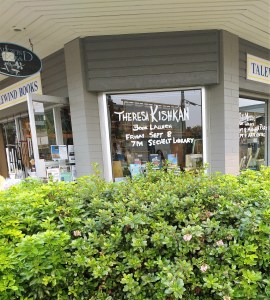
So, Euclid’s Orchard is well and truly launched.Maybe it began to feel like it was actually in the world when I saw the sign in Talewind Books earlier in the week,

window

and certainly when my publisher Mona Fertig and her husband arrived for lunch yesterday on their way back from Savary Island,

lunch

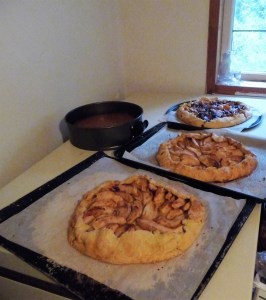
and, well, the day before that, when I baked the desserts that were waiting to be packed up for transport down to Sechelt.

just desserts

Two apple galettes (“One apple tree remains under my care. It’s a Merton Beauty, bought as a tiny plant at a produce store in Sechelt.”), a peach and blueberry galette (“…that road led back to the foot of Poignant Mountain, forgotten and then found, lard pails stained by blueberries…”), and a dense chocolate torte that uses 2 Tbsp. of flour so it’s easy to make it gluten-free with rice flour for those who don’t eat wheat. A round of Brie, a jar of last year’s pepper jelly, fierce with Vietnamese peppers, and a few Merton Beauties to have with the cheese.

The Sechelt Library opened its doors, set up chairs, long tables for those desserts, tea and coffee, and lots of posters of Euclid’s Orchard‘s vivid cover. I wondered to Margaret Hodgins (the Chief Librarian) if anyone would actually come but by the time she introduced me, people were spilling out of the doors. It was so wonderful to talk about my book and read passages to people I’ve known forever and new faces too. To talk about how math came late to me, after a visit to Brendan when he was at the Mathematical Sciences Research Institute above Berkeley in 2013—he’d told us that he and Cristen were expecting a baby and I saw for the first time how we move forward in time, how we anticipate the future and how the past is hovering still, as potent as anything, that we are everywhere and nowhere simultaneously, and that Brendan knew equations that might help me to know this more deeply. To know him more deeply, as a man, as a father. And it was the Sechelt Library that had the copy of Joy of Math dvds that I brought home and diligently watched on my computer screen, understanding about 30% of the material but realizing how beautiful the structures are. (At least one person came to me afterwards to say that he was going to have a look at the Joy of Math. T. Kishkan, math recruiter?) I’d asked for a screen to have behind me as I read and on it a series of images passed quietly, some of them photographs from the book, and others of those strange presences who hovered as I was writing the essays: my grandmother and her first husband in the early days of their marriage; my grandfather’s sisters (I think they must be); the dusty streets of Drumheller, circa 1913, when my grandmother arrived with her 5 children after a long ocean voyage; an ultrasound of a beloved grandchild; my mother in a garden as a small girl; a funeral gathering by the house my father grew up in, though three years before he was born. I felt them in the room as I felt them last fall.

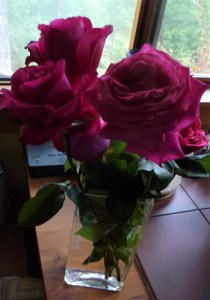
Anyway, it was wonderful, all of it. Some brought flowers.

jane's bouquet

roses

harrisons on the woodstove

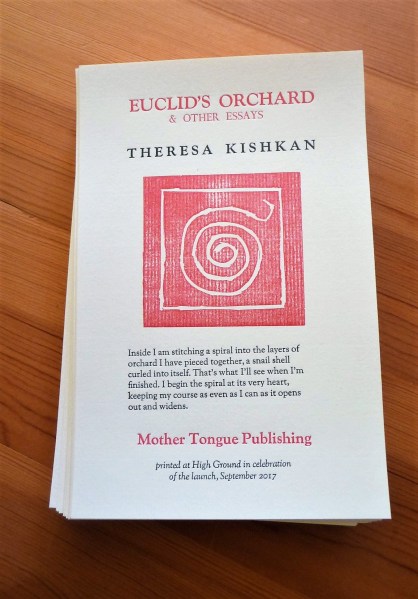
After the reading, Bev Shaw sold books and tucked a copy of the little keepsake John printed into them. (It helps to have a husband who is a letterpress printer, among his other accomplishments.)

keepsake with linocut

People ate and talked and I thought how the whole evening was a gift. A year ago, I wasn’t sure how the future would unfold because of what tests and scans had revealed. That’s all in the past now, part of the never-ending story that I am constantly listening to, trying to tell.


Prospect

In Victoria on the weekend, I spent a happy half-hour in Russell Books on Fort Street. It was hard to know where to start so I simply browsed at random and came away with a bag of unexpected treasures, one of them Anne Truitt’s Prospect: The Journal of an Artist.

When my third child, Angelica, was born in 1985, I wondered if I’d ever write again. I’d published two collections of poetry in my twenties, and a chapbook, and when my sons were tiny, I somehow found time to slowly but steadily write enough poems for a third book. John and I were building a house in those years and the word “busy” doesn’t even begin to describe the days but poems would begin, often in the night, and bit by slow bit I’d work on them, gradually complete drafts, and revise. It may be the rosy glow of memory that has me remembering that I often thought of my life as seamless, moving from washing diapers to making soup to cobbling together lines of poetry.

A third child tipped the balance, though. In part this was because there were added elements to the domestic routine beyond simply childcare and daily household work. Forrest began to attend a pre-school in our small community and that entailed driving back and forth  several days a week from our home at the north end of the Sechelt Peninsula to the village where all the services are located. And when he began kindergarten a year or so after Angie’s birth, then Brendan went to pre-school; and somehow there was never enough time to sit at my desk and find my way to writing. Yet I was quite certain that elements of daily life were potent elements of what could be art, if I could only find a way to put them together. The smell of fresh laundry, the act of making bread, the transformation of homely vegetables into soup, the basket of cottons crying out to be quilts, the beauty of my sleeping children, my husband, the way moonlight illuminated our dark trees or stars pierced the night sky over Sakinaw Lake – I wanted so much to do them justice. Somehow. Someday. And I wanted to engage in the physicality of art and its potential materials, though I didn’t know quite how to begin.

I can’t remember when I bought Anne Truitt’s Daybook but it was certainly during those early years of motherhood. She was an American painter and sculptor (1921-2004) and she wrote beautifully, powerfully, of the sources of her work and her own process of making art.

“I sat for a long while in one of the rectangular courtyards, listening to the fountain. Feeling the artists all around me, I slowly took an unassuming place (for two of my own sculptures were somewhere in the museum) among the people whose lives, as all lives do, had been distilled into objects that outlasted them. Quilts, pin cushions, chairs, tables, houses, sculptures, paintings, tilled and retilled fields, gardens, poems—all of validity and integrity. Like earthworms, whose lives are spent making more earth, we human beings also spend ourselves into the physical. A few of us leave behind objects judged, at least temporarily, worthy of preservation by the culture into which we were born. The process is, however, the same for us all. Ordered into the physical, in time we leave the physical, and leave behind us what we have made in the physical.

She wrote honestly and convincingly of the difficulties of balancing art and motherhood while convinced that the two had areas of compatibility and were connected to the reservoirs of her creativity. Every couple of months, I’d reach for Daybook and read a page at random, finding in it both wisdom and solace. I’d like to say that I always had faith I’d begin to write again once my children were all in school but in truth I had nights of despair when I couldn’t imagine ever knowing how to make a sentence, let alone a paragraph, a chapter, or (oh how?) a book.

I’ve been reading Prospect this week. Written when the artist was in her seventies, preparing for a series of important retrospectives of her work, it is as rich and intelligent as Daybook. Truitt remembers the process of making her early sculptures and she captures so marvellously the moments when one conceives of a work, in this instance her wooden sculpture First:

“And, suddenly, the whole landscape of my childhood flooded into my inner eye: plain white clapboard fences and houses, barns, solitary trees in flat fields, all set in the wide winding tidewaters around Easton. At one stroke, the yearning to express myself transformed into a yearning to express what this landscape meant to me, not for my own emotional release but for the release of a radiance illuminating it behind and beyond appearance. I saw that I could trust that radiance, could rely on its presence, even in the humblest object.”

There are many thousands of books in Russell Books. It would take weeks to go through the shelves properly and a more methodical person would work out a system which would involve using those ladders which leaned against the tall columns of books. But somehow on Saturday morning, in between the flurry of activities leading up to Brendan and Cristen’s wedding that afternoon, I found the one book that I needed to remind me of those early years and to offer some guidance for the work ahead.