“There are so many things I want to say.”

echoes

Yesterday we were headed down to the lake for my swim, maybe one of the last lake swims of the year because the air temperature was 8 degrees celsius and the water wasn’t much warmer, and we were talking about the big dye lot I’d done the day before. Actually, as we were on our way to the lake, one last length of fabric was waiting to be dyed–coarse linen I’d batiked salmon onto and then immersed in indigo a few years ago. It was the last of the dye and it didn’t really take. So I thought I’d overdye the linen and see if I could enhance the colour a bit. So we were talking about how the whole experience surprises me over and over again. I know one can approach indigo (and other natural dyes) in a systematic and scientific way, taking ph readings and so on, but my method (if you can call it that) is to give myself up to the process. I tie, sometimes I clamp with little squares of plywood and dollar store clamps (or clothes pegs), sometimes I use wax to make images for surface design. I wrap fabric around pvc pipe or wooden poles. I gather fabric around beach stones and tie them into place, sometimes randomly, sometimes in a grid, and then I prepare a vat of dye. The vat is a big plastic tub that’s otherwise used for garden work and I set it up on a long cedar bench by the vegetable garden. That way I can immerse the fabric into the vat and wait for 20 minutes or so, removing it to rest and oxidize on the bench before repeating the whole thing 6 or 7 times. While the fabric is immersed or while it’s resting, I can check out the cabbages (huge savoys I started from seed bought in the Mercado do Bolhão in Porto in March) or just look at the roses growing over the garden gate.

apricot roses

I never know what to expect. Or perhaps I mean that I don’t expect anything. I don’t know enough about this pursuit to have expectations. I don’t have confidence in my own grasp of technique. And I am always thrilled with what happens–the surprises of pattern, the intensity or not of blue, how string can mimic ripple or eelgrass, how the wrapped stones become snow angels or owl wings or jellyfish. If I knew enough to manipulate more decisively, would I be happier? I don’t think so.

As we went down to the lake, I wondered how the things I’d been preoccupied with all spring and summer found their way into the fabric. Those jellyfish drawn to the light of our boat anchored in Hemming Bay on East Thurlow Island, the ripples generated as a trout surfaced for insects while I swam on a September morning in Ruby Lake, the turbulence of my heart and mind echoing the waterways of the planet, and the memory of a walk on the Brem River estuary in April, watching for grizzly tracks. It’s like writing, said John. We think we are writing about one thing and we discover something else entirely. But the difference, I said, is that when I’m writing, I don’t have expectations necessarily but I do have some confidence in my ability, my knowledge of technique. I know the hoard of imagery and experience I’m trying to access. This is so different somehow. I’m reminded of Ann Hamilton’s wonderful essay, “Making Not Knowing”:

One doesn’t arrive — in words or in art — by necessarily knowing where one is going. In every work of art something appears that does not previously exist, and so, by default, you work from what you know to what you don’t know. You may set out for New York but you may find yourself as I did in Ohio. You may set out to make a sculpture and find that time is your material. You may pick up a paint brush and find that your making is not on canvas or wood but in relations between people. You may set out to walk across the room but getting to what is on the other side might take ten years. You have to be open to all possibilities and to all routes — circuitous or otherwise.

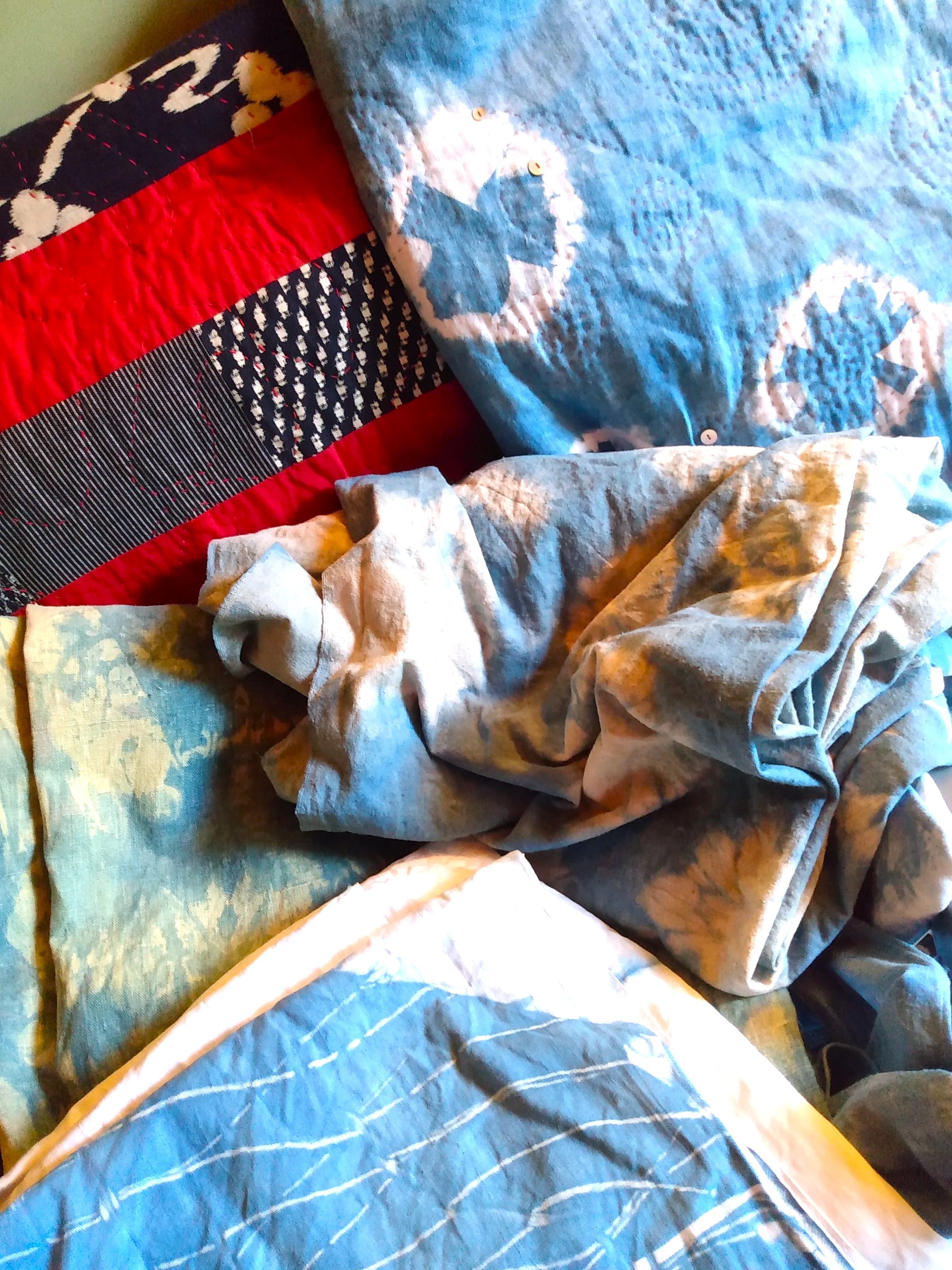
I was dyeing linen and cotton with indigo dye. I was thinking about the life I am living with its beauty, its damage (to myself and others), the lost opportunities, the blessings, the disappointments. In the woods behind the garden shed, a pileated woodpecker was pecking so loudly I thought John must be hammering boards together. In my heart, both joy and bitterness. The disposable gloves kept slipping so that I have rings of blue around my wrists. There are so many things I want to say. This morning, a basket of blue fabric, washed with mild detergent, ready for the winter. I have gathered my sharp needles, my strong thread, the tiny golden scissors shaped like a crane.
basket of blue

reading in the night

daybook

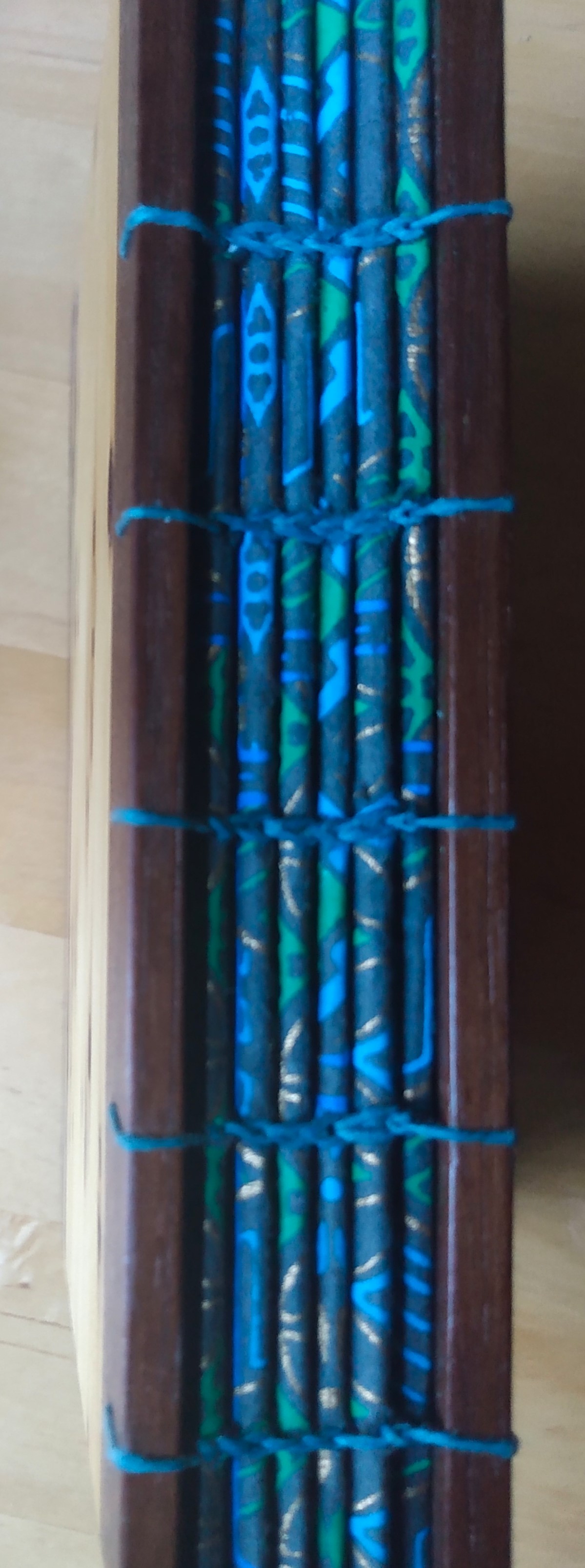
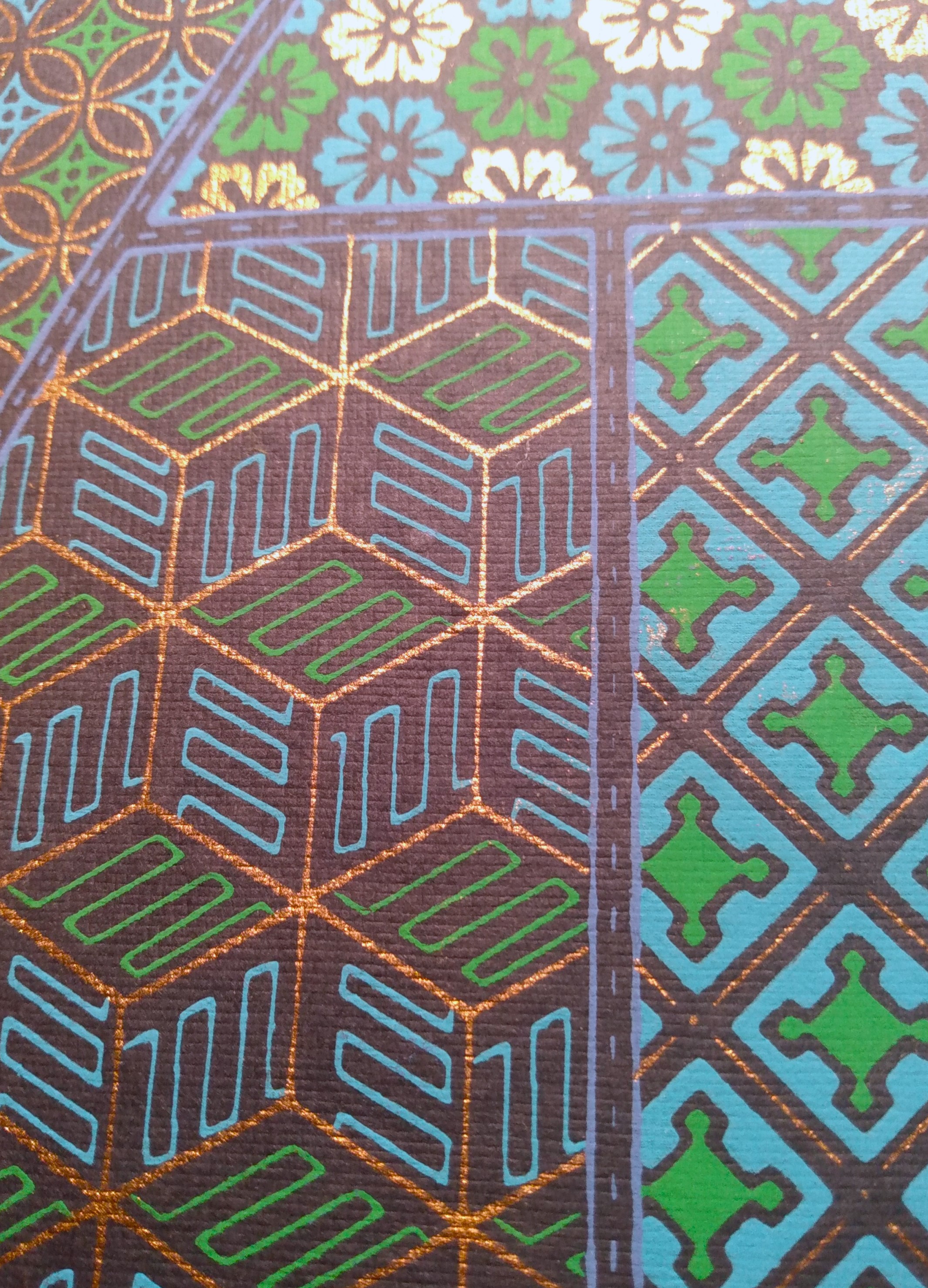
I don’t really keep a regular journal. I’d like to be that person, and maybe I once was, or at least I was when I lived in Ireland, when I travelled in Europe as a young woman with a backpack and a little notebook tucked into one side pouch. On trains, I’d be noting every detail. In Ireland, it was as though I had my finger on my own pulse on a daily basis. Reading those old journals is interesting to me but in some ways it’s also excruciating to realize how self-absorbed I was, perhaps out of necessity. I was my own company for the most part because I travelled alone, lived alone. A few years ago I bought the little book in the photograph at a Christmas craft market in Madeira Park. It was handmade by a woman in Roberts Creek. The cover is yellow cedar, edged with black walnut. The binding is Coptic stitched, sewn with waxed Irish linen thread, each signature quarter-wrapped with screen-printed Indian cotton paper.

I

signature

I wanted to write in it regularly and I wanted what I wrote to be worthy of its beauty, the time and care its maker took to create it. And I do try to write in it from time to time but reading back, I see that I’ve been trying to work out my relationship to writing and publishing and it makes me kind of sad to recognize how unresolved those things are for me. Partly this is because the work I’ve been doing is personal and I wonder how it would be of use or interest to anyone else. And partly it’s because I’m no longer young and the writing world feels to be like a place for young writers, their concerns and their values. Reading back, I see that I’ve been pondering this for at least 2 years, without any clear notion of what to do about it. Maybe there isn’t the kind of clarity I’m hoping for.

At night lately, when I’ve been awake, I’ve been re-reading the artist Anne Truitt’s 3 books, bought many years ago, read with great interest, and still of great interest to me. Daybook, Turn, and Prospect, each of them subtitled “The Journal of an Artist.” I first discovered Daybook about 30 years ago, a young(er) woman returning to writing after the intense early years of motherhood. Her quiet and elegant entries about her life, her work, well, they spoke to me with such depth and warmth. I remember looking for images of her sculpture and not really understanding it. But when I learned there were other books, later on, I bought them and found in them that same quiet exactitude. I still don’t entirely understand her sculpture but I see more and more resonance in it and I respect the artist. She writes, in Prospect, that after she’d figured out how to put the wood together for her columns, and how to mix the paints to the right consistence so that she could layer the works with repeated coats so that the radiance of the paint itself was released, “the sculptures had become what I have been making ever since: proportions of structural form counterpointed by proportions of metaphorical color–essentially paintings in three dimensions.”

Truitt is one of 3 artists I’ve become interested in over the years. Ann Hamilton and Magdalena Abakanowicz are the other two. I am drawn to the materiality of their work, the complexity of it as it moves easily between (and over) methods and outcomes. I look at Abakanowicz’s magnificent Abakans textiles and realize how one-dimensional my own work is. Ann Hamilton’s indigo work, so multi-layered and rich. I wonder if it’s too late to somehow draw the threads of my thinking and doing together in some organic way that I haven’t yet found. Maybe too late but maybe not? To that end, I’ve been trying to figure out how to knit netting because somehow that feels like the right direction to take.

I’ve just learned that there’s a 4th Truitt book, edited by her daughter (Anne Truitt died in 2004), Yield, and I can’t wait to read it, can’t wait to have her company in the dark hours when every regret, every blank journal page or self-absorbed notebook, accumulates in the heart and mind to remind me of what I haven’t accomplished in my life, either through neglect or too little confidence or even a lack of courage.

endpaper

redux: “time is your material”

Note: It’s always about time, always about finding it and using it well.


yellow

In the night I had to stop myself from getting up to come down to work on my current essay “blueprint”. thinking that it was high time I had a proper sleep. I didn’t go back to sleep right away but listened to the mouse that was making tiny sounds in the sunroom just off my bedroom and to the sleeping sounds of the cat (who brought the mouse in to show us the previous night and then dropped it in his excitement). I thought about the essay with a deep curiosity for where it might take me, and how. I know some things about it, of course, but I don’t know how they will come together. Because it’s partly a piecing together of how the plans for our house were imagined and made, I’ve made a little set of questions for John to answer, as he drew the plans. I’m not sure I remember exactly how I did the plans, he said yesterday as we sat by the fire after lunch. That’s ok, I assured him. Your not remembering is important too. He thought he’d done a lot of drafts on lined yellow paper and I’m hoping those turn up somewhere.

Our life here was never really planned. We met, married, wondered where we might live. There was a lovely old rented house but it was falling down around us and the owner had plans. We looked briefly at houses in Vancouver and realized it would be huge debt and we didn’t really want to live there anyway. We bought this land, thinking we’d camp on it, maybe forever. And then we realized that we could build something. And one thing led to another.

We had a baby and I enrolled in the MFA program at UBC. It didn’t work for me for a lot of reasons. I’d thought I could get that degree and perhaps teach. But that didn’t happen. I love Ann Hamilton‘s essay, “Making Not Knowing”, for its wise musings about how artists find their way into their true work:

You may set out for New York, but you may find yourself, as I did, in Ohio. You may set out to make a sculpture and find that time is your material.

I thought I’d teach, and write poetry. Instead, I helped to build a house and wrote prose. I’m still writing prose and although I sometimes miss the brief quick heat of writing a poem, I’ve learned that prose, particularly the essay, has a wide and generous capacity to hold everything you ever wanted it to. Everything you ever needed it to. Like the expandable string bags I first saw in France, pulled from a pocket in a market and filled with cheese, a head of chicory, a little pot of stoneground mustard, a baton or two, some butter wrapped in greaseproof paper, a melon, a bottle of wine, an essay will gladly perform the same function.

It’s important to me right now to think about my work and why it matters to me. I spent many years just finding time to write and now I have all the time in the world, though maybe not enough of it. I feel both urgency and patience. In a way it’s a perfect combination. I know what I want to do won’t go away if I let myself stay in bed rather than coming downstairs in the dark to write a page by lamplight. I used to think I wasn’t a real writer because I didn’t make outlines and didn’t work in a particular way. I’ve seen the photographs of sticky notes on bulletin boards and I know that it must provide terrific guidance for some writers but it’s not my process and I’m relieved to acknowledge to myself that I don’t have to do it that way. It’s a good thing I never taught writing, apart from a few workshops here and there, because I don’t have a system to pass along.

Imagine those bags, though. You hold one, wondering what you will choose at the market under the bright umbrellas. You didn’t make a list. But following your nose, you find the heaps of freshly-picked basil, a tumble of tomatoes so ripe you can imagine their juices puddling on the cutting board, little rounds of cheeses wrapped in vine leaves, spices from North Africa, brown eggs laid that morning, a tablecloth of brilliant yellow cotton printed with irises, branches of blossoming thyme that have brought bees from the hillsides with them, and somehow, somehow it all fits in your string bag.

But not knowing, waiting and finding—though they may happen accidentally—aren’t accidents. They involve work and research. Not knowing isn’t ignorance. (Fear springs from ignorance.) Not knowing is a permissive and rigourous willingness to trust, leaving knowing in suspension, trusting in possibility without result, regarding as possible all manner of response.

“…time is your material.”

yellow

In the night I had to stop myself from getting up to come down to work on my current essay “blueprint”. thinking that it was high time I had a proper sleep. I didn’t go back to sleep right away but listened to the mouse that was making tiny sounds in the sunroom just off my bedroom and to the sleeping sounds of the cat (who brought the mouse in to show us the previous night and then dropped it in his excitement). I thought about the essay with a deep curiosity for where it might take me, and how. I know some things about it, of course, but I don’t know how they will come together. Because it’s partly a piecing together of how the plans for our house were imagined and made, I’ve made a little set of questions for John to answer, as he drew the plans. I’m not sure I remember exactly how I did the plans, he said yesterday as we sat by the fire after lunch. That’s ok, I assured him. Your not remembering is important too. He thought he’d done a lot of drafts on lined yellow paper and I’m hoping those turn up somewhere.

Our life here was never really planned. We met, married, wondered where we might live. There was a lovely old rented house but it was falling down around us and the owner had plans. We looked briefly at houses in Vancouver and realized it would be huge debt and we didn’t really want to live there anyway. We bought this land, thinking we’d camp on it, maybe forever. And then we realized that we could build something. And one thing led to another.

We had a baby and I enrolled in the MFA program at UBC. It didn’t work for me for a lot of reasons. I’d thought I could get that degree and perhaps teach. But that didn’t happen. I love Ann Hamilton‘s essay, “Making Not Knowing”, for its wise musings about how artists find their way into their true work:

You may set out for New York, but you may find yourself, as I did, in Ohio. You may set out to make a sculpture and find that time is your material.

I thought I’d teach, and write poetry. Instead, I helped to build a house and wrote prose. I’m still writing prose and although I sometimes miss the brief quick heat of writing a poem, I’ve learned that prose, particularly the essay, has a wide and generous capacity to hold everything you ever wanted it to. Everything you ever needed it to. Like the expandable string bags I first saw in France, pulled from a pocket in a market and filled with cheese, a head of chicory, a little pot of stoneground mustard, a baton or two, some butter wrapped in greaseproof paper, a melon, a bottle of wine, an essay will gladly perform the same function.

It’s important to me right now to think about my work and why it matters to me. I spent many years just finding time to write and now I have all the time in the world, though maybe not enough of it. I feel both urgency and patience. In a way it’s a perfect combination. I know what I want to do won’t go away if I let myself stay in bed rather than coming downstairs in the dark to write a page by lamplight. I used to think I wasn’t a real writer because I didn’t make outlines and didn’t work in a particular way. I’ve seen the photographs of sticky notes on bulletin boards and I know that it must provide terrific guidance for some writers but it’s not my process and I’m relieved to acknowledge to myself that I don’t have to do it that way. It’s a good thing I never taught writing, apart from a few workshops here and there, because I don’t have a system to pass along.

Imagine those bags, though. You hold one, wondering what you will choose at the market under the bright umbrellas. You didn’t make a list. But following your nose, you find the heaps of freshly-picked basil, a tumble of tomatoes so ripe you can imagine their juices puddling on the cutting board, little rounds of cheeses wrapped in vine leaves, spices from North Africa, brown eggs laid that morning, a tablecloth of brilliant yellow cotton printed with irises, branches of blossoming thyme that have brought bees from the hillsides with them, and somehow, somehow it all fits in your string bag.

But not knowing, waiting and finding—though they may happen accidentally—aren’t accidents. They involve work and research. Not knowing isn’t ignorance. (Fear springs from ignorance.) Not knowing is a permissive and rigourous willingness to trust, leaving knowing in suspension, trusting in possibility without result, regarding as possible all manner of response.