patterns, ideas

I’m reading G.H. Hardy’s A Mathematician’s Apology, an elegant essay written towards the end of Hardy’s long and illustrious career in pure mathematics. I’m enjoying it very much. It allows me some insight (I hope) into the mind and work of my son, Brendan, who works in the field of optimal transportation as well as mathematical economics and physics.

This essay begins with a statement that locates its writer in age rather than youth. “It is a melancholy experience for a professional mathematician to find himself writing about mathematics. The function of a mathematician is to do something, to prove new theorems, to add to mathematics, and not to talk about what he or other mathematicians have done.” There are of course parallels with many other areas of human investigation and creative practice. Young writers write, don’t they? They tend not to think too much about exposition or justification. Painters, too.  They plunge into the work they are called to do and it’s only later, in retropect, that they attempt to figure out the patterns of this work, its context (if it’s lucky enough to have one — or many…), the connections between their work and that of their peers or predecessors.

But I’m thinking how lucky I am to have found this book which gives me some insights in the workings of an intelligence so mysterious to me. I’ve read about half of it and have some questions: all those theorems that I’m coming to, so beautiful in their abstract language, like Greek; when I look at a page of Greek, I can make out perhaps 1/8 of it but I know that using my lexicon, I can probably figure out more. Will this be the case with Euclid’s proof of the existence of an infinity of prime numbers? We’ll see.

There is much that I admire in this essay, even if I don’t necessarily agree with statements like this one: “A mathematician, like a painter or a poet, is a maker of patterns. If his patterns are more permanent than theirs, it is because they are made with ideas.”  I think of William Carlos Williams here and his poetic philosophy of intent:

 — Say it, no ideas but in things —

nothing but the blank faces of the houses

and cylindrical trees

bent, forked by preconception and accident —

split, furrowed, creased, mottled, stained —

secret — into the body of the light! (from Paterson)

Maybe we are all closer than we think we are, closer in our searching for meaning in those blank faces of houses, the cryptic notion of an infinity of prime numbers, and the beautiful patterns of the world that inspire one person to make equations and another to make poems or vast canvasses filled with angels or to translate one to another so that I can sit with a notebook, wondering how to work this illustration of Mendel’s law into both an essay on family history and a quilt.

Dominant and recessive phenotypes. (1) Parental generation. (2) F1 generation. (3) F2 generation.
only child, the beans of Pythagoras, and Anna’s beautiful pie

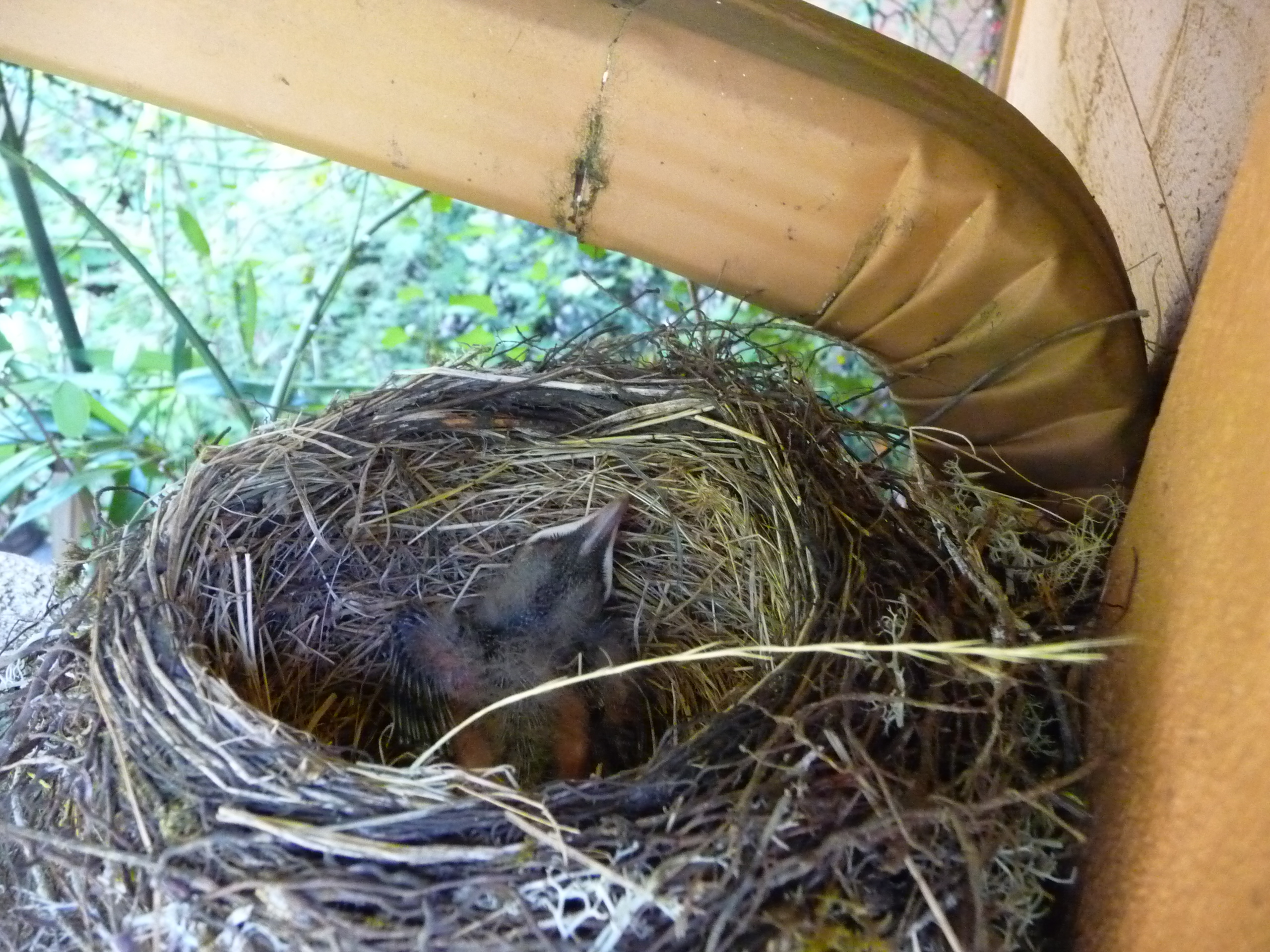
  • There’s one young robin remaining of the three born either late last Sunday or first thing Monday morning. Yesterday I saw two in the nest but one appeared to be completely still on the bottom of the nest as the other one scrambled over it and lifted its beak to the returning parents. Now even that still body is gone.  The last robin seems very animated and robust. Because it’s hot and I feel sorry for the parents who are bringing back food every fifteen or twenty minutes as well as feeding themselves, I’ve been putting worms from the compost box on a small saucer on the ground near the nest. The parents wait nearby and quickly approach the saucer after I’ve left, plucking the worms and taking some to the nest, consuming others themselves. In the reading I’ve done about robin nesting habits and mortality, it seems that it’s not unnusual at all for just a single baby to survive from the original 3 or 4 eggs. (Only 40% of active nests produce young.) And of those initial survivors, not many live past November — 25%. And only half of those live until the next year. I realize how unnusual it was in the summer of 2008  to see a full nest of three babies not only survive their first two weeks but to learn to fly and hang around for several more weeks with their parents. (We could tell the young ones because of their clumsy habits, both in flight and on tree branches, and of course because their colouring was still immature.) Anyway, we’re hopeful that this one baby — a week old today! — finds his wings by this time next week. And in the meantime, there are males singing so brightly in the trees beyond the garden that I suspect  there will be other nests being populated as I write.

only child

  • I’m in the process of writing something which involves trying to grasp some mathematical ideas. It’s not easy. I’m 58 years old and I still have a recurring nightmare about a math exam approaching and I realize in horror that I haven’t kept up with the work and will certainly fail. (This is exactly what happened to me in high school and why I should still be dreaming about it is a mystery.) But I’m determined to figure out a few conjectures and theorems, mainly the Hardy-Weinberg principle (which has to do with population genetics), and so I’m about to begin G.H.Hardy’s A Mathematician’s Apology. Visuals are helpful and I’ve been studying this de Finetti diagram showing the Hardy-Weinberg principle:

De finetti diagram.png

  • And that’s sent me back to Pythagoras, which is interesting, to say the least. So much I’ve forgotten and yet the patterns have their echoes — in quilts, in the geometry of daily life. And I remembered that Pythagoras was a vegetarian but I didn’t know that he wouldn’t eat beans, believing either that they contained the souls of the dead or that souls returned to earth to be reincarnated through them. Tonight we ate a big bowl of broad beans from our garden, silky and sweet-tasting, dressed with unsalted butter and black pepper, and although I can fully believe that Pythagoras left us with a theory still as important now as it was when he proved it (though there’s some suggestion that it goes back even further than c. 570-495 B.C. ), I do think he was wrong about beans.
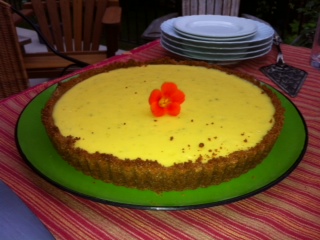
  • Last night we had dinner with friends, a delicious Indian meal on their summery deck, surrounded by baby chicks, ducks, elegant pheasants, and this was what Anna brought to the table for dessert — a key lime pie, with ice-cream or whipped cream (or both). Heaven.

anna's pie(photo: Howard White)