This is the view from the museum in Foz Coa where we are spending a week in a landscape so breathtakingly beautiful that I keep wiping tears from my eyes. I have been reading about this area for a year. Tomorrow we will visit the Paleolithic engravings at Penascosa and this afternoon we’ll drive to Mazouca to see the single horse engraving. And oh the wines! They taste of where we are — the air, the schist, the olive trees shimmering in the light. When John went out for bread this morning, a golden dog was sleeping on the cobbles and old men talked at a table over early glasses of Port with their coffee. Wish you were here. xxx
First we visited the Keats House, a place we’d gone to years ago, quiet in its leafy garden, and then we found the Freud Museum, a fascinating hoard of time and reflection — his, his daughter Anna’s, ours…In the small shop, I bought a book from an earlier exhibit designed around Freud’s 1936 letter/essay, “A Disturbance of Memory on the Acropolis”, a significant strand running through my forthcoming book, The Art of Looking Back. So the past welcomes us, offers us its own solace, takes us by the hand and murmurs, “You too?”
It would have been even better if the woman leaving the performance beside me hadn’t fallen against me and brought me down too, sprawled on the pavement outside the Harold Pinter Theatre, other play-goers pulling me up, asking over and over if I was ok, and the woman who caused me to fall clutching her broken phone, saying how sorry she was, and me saying to John that I felt like an asshole as we walked to the Tube. But what a play — and what fine performances. And I am thinking about the stories, how each one was vivid, unexpected, and haunting. How the intimate stage allowed us to listen, and feel shock, and wistfulness, and how the lights went out then, and are about to here, now.
Creatures of habit, we return to old haunts: Marchmont Street, the curve of Cartwright Gardens and this tiny flat, mezes near the British Museum last night. This morning, Sagarika Sundaram’s ravishing creations at the Alison Jacques Gallery. Layers of felted wool, some areas spliced open, long threads on some pieces begging to held and followed. They made my own hands twitchy to make something. Tonight, a play. Tomorrow night, a play. Right now? Rain on the huge plane trees. Ombra mai fu. xxx
Note: this was posted in late October, 2021. Today I am finishing up some chores before getting ready in earnest for a few weeks away. In Portugal next week, we are looking forward to driving the N222 in our rental car from Porto to Vila Nova de Foz Coa and I know it will be full of surprises.
___________________
Sometimes it seems that, like an ancient Greek, I write mostly about the dead and death. If this is so, I can only add that it is done with a sense of urgency which belongs uniquely to life. (John Berger, from Photocopies)
Yesterday we had a long drive home from Victoria, in rain, with two ferry crossings. Because of Covid, I wasn’t comfortable about going up onto the passenger decks where people seem to have forgotten social distancing. So mostly I sat in the car, reading John Berger’s Photocopies. I have most of his books but found this one in Vancouver, where we spent a couple of nights before heading to the Island. Photocopies is subtitled Encounters and it is a series of moments, encounters, yes, with people as diverse as a young girl on an Irish bus to Turkish painters in Paris, farmers in the French Alps talking as they buried a stillborn calf, a woman taking a photograph of Berger and herself under a plum tree. Each encounter is beautifully remembered and presented. I’d read one, sigh, adjust the car seat to take the pressure off my tailbone, fractured in 2018 and never completely healed, and turn to the next section.
I am thinking these days about the dead. Mostly my own, because there are a lot of them, and there are times when they make themselves known, in dreams, in memory, or just during the dailiness of my life. In Victoria this is particularly true. It was stormy along Dallas Road where we stayed and I spent time watching the waves crash over the railings onto the wide sidewalk where people were taken by surprise, laughing and jumping back. At the other end of Dallas Road, near the Ross Bay Cemetery, my family lived for 4 years during my early childhood. We were free-range children and simply sent out on summer mornings, on weekend mornings, and told not to come back until lunch. I rode my bike along the leafy lanes of the Cemetery and I watched storms casually toss logs onto Dallas Road as the rain poured down on my yellow raincoat. Maybe you remember the type? There were clasps down the front instead of a zipper and the raincoat itself was made of heavy rubber. It was hard to ride a bike while wearing it but not impossible. My mother would send us on errands for various elderly neighbours and we’d ride along May Street to the store on the corner of May and Moss and buy a bottle of milk or a loaf of bread. When we delivered our packages, the elderly women in particular would invite us in for a glass of milk and a slice of cake or Peak Frean biscuits kept in tins decorated with the great castles of England. Their houses were so tidy and quiet, a clock ticking, a cat sleeping on a needlework cushion by the fire. I remember photographs on mantles, men in uniform on horses or in regiments, and it wasn’t until much later that I realized that some of the women were widows and their tidy living rooms were testaments to the past.
That’s in part the Victoria I remember when we drive out to explore the Chinese Cemetery at Harling Point or to visit a friend in Oak Bay, passing streets where other friends, now dead, lived, held parties, opened their doors and hearts when I was heartbroken. Even sitting in the window of the Surf Motel on Dallas Road, I saw the dead. A boy I’d once walked to the end of Ogden Point with who died in his twenties. The shadow of Charles Newcombe, whose house is just along from the Surf, and who sailed in the wild waters of the Strait of Juan De Fuca. Wawadiťła at Thunderbird Park near the museum where I once leaned my small bike against a bench and watched Mungo Martin at work on cedar. I wish I could remember whether it was a pole or doors. I don’t. But I remember the scent of the cedar as it curled away from his knife or adze like butter. And I remember his kindness.
I am thinking of my dead, my parents, who both died in Victoria, and who left me a tangled emotional legacy which I am still unravelling, I am thinking of their parents, my mother’s mostly unknown, but my father’s the subjects of several of the essays in my forthcoming book, Blue Portugal. That’s them in the photograph at the top of this post, with my father in the middle. I took the large portrait down from my wall to try to photograph it and for the first time I noticed my grandmother’s eyes are blue. It’s been colourized of course but I think accurately because the same photographer took two other photographs and I have his or her notes scribbled on the back of images made larger and coloured and I know that the details of the other photographs are true. John and I both have hazel eyes. Two of our three children have blue-grey eyes. John’s father had blue eyes but I didn’t know where the blue-eyed gene was on my side of the family. And now I know.
The road was always full of surprises because the baked soil, the chips of stone, the grasses, the thistles, the lizards, the fossils of sea shells, the wild chicory, the thunder when there was a storm, the silver of the wet olive leaves afterwards, and, next day, the stillness of the early afternoon heat around your ankles as you walked along it, these events were as endless as childhood itself… (from Photocopies)
My roads carry their own surprises: a house still gazing out on the wild sea, the scent of kelp, the cry of gulls rising and falling over the waves, the sound of foghorns in the night, booming in the darkness, warm rocks near Harling Point where gum weed and Douglas asters bloom, as they bloomed when I was a child on a blue bike, my yellow raincoat flapping in the wind.
Note: this was posted last September, when we were on the verge of going to France to visit the Dordorgne Valley and Vézère Valley (the VézèreRiver is a tributary of the Dordogne).
_____________________
This morning, at the beginning of my swim, a little silver trout jumped out of the water just beyond where I was heading, the curve of its body an opening parenthesis to my thinking. I was thinking about last evening, going out to the deck to bring in my towel and bathing suit. I looked down to the grass between our house and the woods and a huge bull elk was looking back. He hadn’t yet lost the velvet on his antlers. The sun had set but the sky was filled with pinky-gold light and he was glowing. He still had his summer coat, golden brown, and as he turned, wondering at the best course of action, it was like a moment out of a painting I’ve always loved, Pisanello’s Vision of St. Eustace.
It’s in the National Gallery in London and when I was in my early 20s, working in Wimbledon, I used to go the museum on its free day (they’re all free days now) to look at it and a few other favourites. Going from room to room was overwhelming but I’d visit the Vision and add several others each time. I was drawn to the dogs, their expressions as they gazed upon the stag carrying a crucifix within its antlers. Not the last time we were in London but the time before, I went to the National Gallery to see if the painting still had its magic for me and oh yes, it did. Sometimes encounters, however distanced in time or space, even from a second-storey deck to the mossy grass below, feel potent. They feel deeply meaningful.
What it did it mean, to see the bull elk looking up at me? I don’t know. Yet. I called to him to go away (I suspect he might have been sniffing out the grape vines growing against the house and I know from experience* that elk can do a lot of damage) and he turned into the woods. I realized then that his harem was just beyond. They crashed away, a lot of them. (A harem is typically around 20 or so cows.)
Within the parentheses of my thinking this morning, the elk, the kingfishers I didn’t see today, the return of the chickadees who nested elsewhere this year but were splashing in the birdbath yesterday as we ate lunch on the deck with friends enroute from Savary Island to Gibsons, the nuthatches waiting in the mountain ash for their turn in the water, the tiny tree frogs, newly hatched and hopping out of the tubs of salad greens, the pots of mint by the greenhouse door, the ferns below the front porch. The elk remind me of walking into Natural History Museum in Dublin decades ago to stand among the skeletons of Megaloceros giganteus, the giant Irish elk (though not actually an elk but most closely related to fallow deer), their huge palmate antlers 11 feet across. It was a moment to feel both small and outside of history. The animals begin to appear in the fossil record 400,000 years ago and the most recent appearance is 8000 years ago. They are beyond us, beyond time, and yet they still exist–as skeletons, as paintings on the walls of caves in France and Spain. In a month, we’ll be France to visit them there. (I’ve wanted to do this since I was 20 and wrote a poem, published in my first poetry collection, about the caves of the Dordogne Valley. When I lamented to John that I would probably never see them, he went upstairs and booked a flight.)
In 2008, in late September, I was drinking coffee on the upper deck, the same one I stood on last night to confront the bull elk below, when I heard the strangest sounds coming from the woods just beyond, the same woods the elk crashed into last evening. Grunting, yes, and a sound like a shrill bugle. And I could hear more, not an echo, but the same sounds a little further away. There was crashing. I called my dad in Victoria (he’d hunted all his life and knew a lot about wildlife) and said, Dad, I’m hearing sounds in the woods and I wonder what they are? I held the phone, an old cordless phone, up to the air. He listened, and then he chuckled. It’s 2 bull elk, he said. They’re rutting and challenging each other for the cows. I remember there was such urgency to the sound. A year later my father died and there are many things I regret but calling him and letting him hear the bulls in my woods is not one of them. He talked about it in the months to come, as he grew weaker, and went into hospital, and never came home.
Sometime in the middle of the 15th century, Pisanello painted a stag with a crucifix held aloft in its antlers. St. Eustace looks in amazement, as do his dogs, though one hound chases a rabbit. The woods are tipped up and when you look closely, you see birds in flight or nesting in dark trees, you see a bear, two more stags, heavy with antlers, and tiny flowers on the forest floor. Sometime around 17,000 years ago, someone, maybe many people, painted animals–horses, giant elk, bears, wildcats–on a cave wall in Lascaux and even though we won’t be able to see the originals of those (though we will visit other caves where we will), I look forward to meeting them with the same astonishment as I met Pisanello’s stag and the elk on the grass below my house last night, the velvet on his antlers golden in the dusk.
This morning, one trout jumped at the beginning of my swim, and another jumped to close my thinking with its silver parenthesis as I finished. On the surface of the water, a maple leaf, some delicate feathers, tiny flies, the first sunlight on the islands beyond.
*elk don’t delicately nibble leaves or browse on clover; they tear trees apart–our old orchard a case in point–and they’ve dragged vines from the side of our house in the past.
Note: it’s our wedding anniversay today. 46 years. Last year we walked from our Marais apartment to a celebratory dinner at a pretty little bistro on Île Saint-Louis in Paris. Another year we spent the night at the Quilchena Hotel with its views of Nicola Lake and the grassy hills. Maybe the oddest anniversary? The one in this post, 5 years ago.
_______________________
Forty-one years ago John and I were married late morning in a room overlooking the sea in Sidney, on Saanich Peninsula. Our parents, my brothers, John’s sister, their partners, and John’s aunt and uncle were present. Friends came later, after lunch, for champagne and nice food. Who knew what the years would bring?
They brought everything. A house we built ourselves, 3 children, books we wrote and books we read, together and apart, a garden, friendships, some travel, lots of happiness and also some sorrow. In sickness and in health the old wedding vows asked you to promise and although that wasn’t part of our own ceremony, it’s been true. There’s been far more health than sickness, thank goodness, but you don’t get to choose.
This morning I’m in my small suite near the UBC Hospital where John is recovering from bilateral hip surgery. That’s the easy part, though having watched him take a few tentative steps on a walker, assisted by a physiotherapist, I know it’s not easy. The more difficult path ahead will be one he’ll have to walk with a paralyzed foot, the result of damage to his sciatic nerve during surgery. We are hopeful that the nerve will regenerate. The process takes 2 years and it’s not inevitable that it will be complete and successful. But we will continue to be hopeful and do what we need to do.
I think of Stanley Kunitz’s beautiful poem, “Touch Me”, the opening lines our lines:
Summer is late, my heart. Words plucked out of the air some forty years ago when I was wild with love and torn almost in two scatter like leaves this night of whistling wind and rain.
Yesterday was warm, like summer, and in the night I kept waking to hear wind and rain against my window. We’ve celebrated our anniversary in many different places–Cox Bay, near Tofino, Vienna, Paris, a motel in Merritt–but mostly at home where we make a special meal and open a bottle of spectacular wine. This is the first time I’ll walk to a hospital with pastries and a book of Chinese poetry to wish my beloved another year of happiness. A few more days in the surgical ward, then the physiotherapist will help John into our car and we’ll drive home for the next chapter of this story.
So let the battered old willow thrash against the windowpanes and the house timbers creak.
Yes, let the timbers creak. They’re strong. We know that because we built the house ourselves.
John was looking out the south window by our bed and I asked, What’s the day like? Clear, I think, was what he replied, because I can see just the thinnest fingernail of a moon in the big trees. He went downstairs to make coffee and I looked for myself, just as the cat jumped onto the bed for his morning snuggle. Just the thinnest fingernail, silver in the trees.
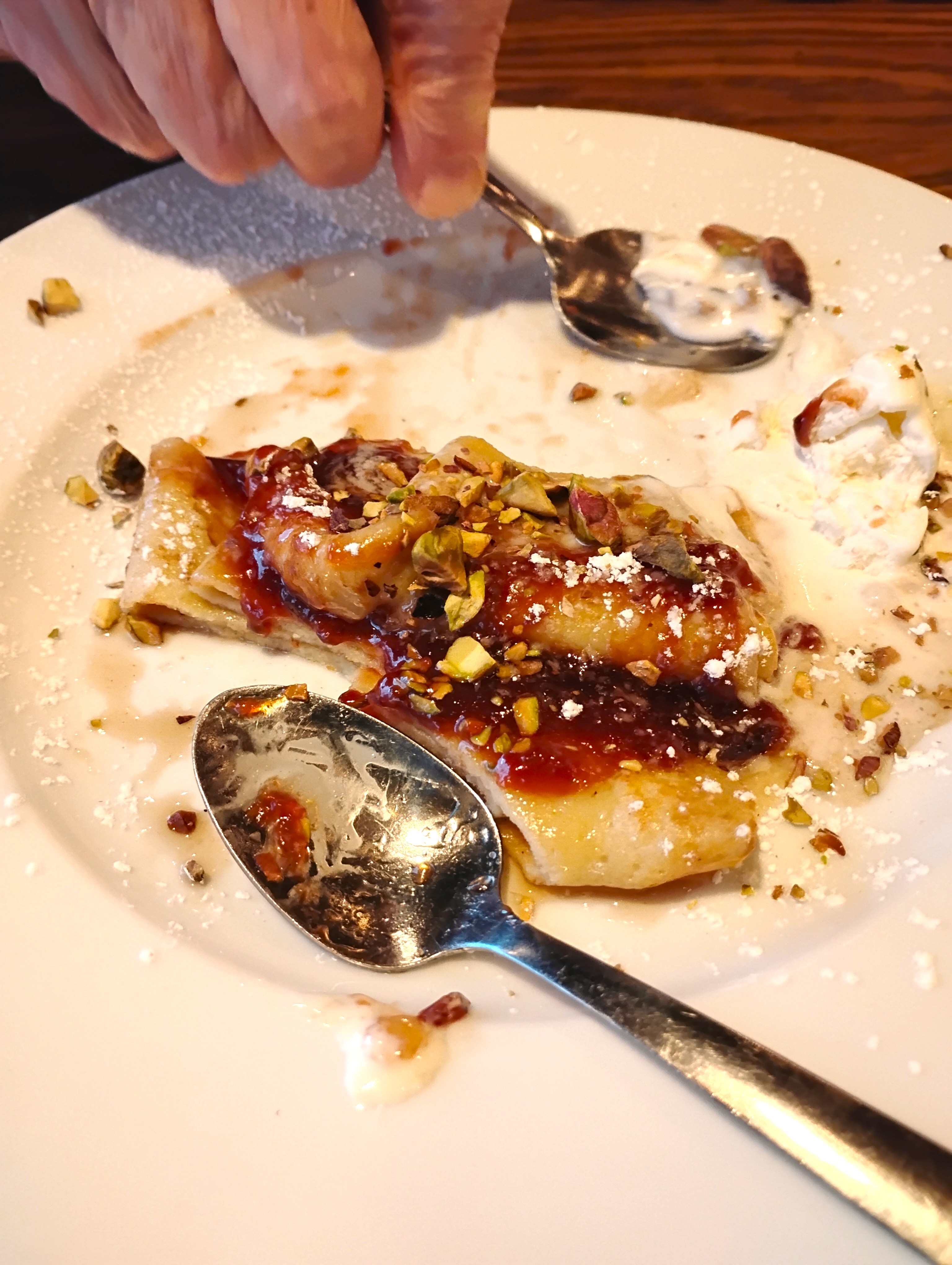
Last evening we went to the Backeddy for an early supper. We’d been down the Coast all day, on errands, and how nice it was to sit by the windows, looking out at the Inlet where the light was fading. Ruby said there’d been whales earlier in the day which reminded me that the last time we were here, Saoirse said there’d been whales that day as well. Instead of whales, we saw gulls on the dock, so many of them, gossiping as the light fell. Ruby brought a sample of the dessert special for us to try, a crepe, with gorgeous compote made of plums from old Egmont, across the Inlet.
It reminded me of Iris Griffith phoning me nearly 4 decades ago to come and pick pie cherries from an ancient tree in front of her house, just down the road from the Backeddy. Get them before the bears, she advised. Iris has been dead now for years but she is everywhere in Egmont, her memory alive in the Museum, the community hall, the taste of fruit from trees planted in the last century, maybe closer to its beginning than its conclusion. She would have known who planted the plum tree.
These are fall days. We’ve been moving plants into the sunroom and the greenhouse for winter–the bougainvilleas, the scented geraniums, the jade trees and other succulents, a Meyer lemon I’ve had for 40 years and a calamondin orange I’ve had for 20. I planted garlic. While I arranged tubs of newly-seeded arugula on the floor of the greenhouse, a tree frog jumped over my wrist.
I keep looking up for a glimpse of geese heading south.So many years I’ve looked up from working outside, often hearing them first, then following the sound, high and lovely, and seeing the long strand of them against the mountain. They are like a string, one that tightens and closes the year. I’m ready for that, the sound and the closure.
Geese appear high over us, pass, and the sky closes. Abandon, as in love or sleep, holds them to their way, clear in the ancient faith: what we need is here. And we pray, not for new earth or heaven, but to be quiet in heart, and in eye, clear. What we need is here.
What we need is here, mostly. Lemons, garlic, plums from old trees, that tiny moon in the dark arms of the firs.
Note: the poem is Wendell Berry’s ‘The Wild Geese”, from his Selected Poems.
(Note: my mum used this word for leftovers. She would make a meal for us of orts. Today I am making a post of orts.)
1.
Coming home from swimming, the sight of the bigleaf maples turning yellow and ochre and pure gold was like seeing sunlight after rain. And there is sunlight too.
2.
On certain days I recognize a state of being that needs Blonde on Blonde. Yesterday, tidying the kitchen before preparing the vegetables for our Thanksgiving dinner for two, I listened again to “Visions of Johanna” as I halved Brussels sprouts to roast with lemon zest and garlic, parsnips cut into chunks to roast alongside the sprouts, with olive oil and rosemary.
In this room the heat pipes just cough The country music station plays soft But there’s nothing, really nothing to turn off
I turned on the oven. The heat pump didn’t cough but it sighed warm air into the room. Like the oven. And the sun.
3.
When we walked on Saturday afternoon, between showers, we wondered if there would be chanterelles. We have a place we look every year and when we looked, there they were, under the ferns, golden in the moss. I used some for a sauce for the duck: sauteed shallots, chanterelles, stock, and then dried cherries soaked in a little sherry. Finished with cream. Reader, it was delicious.
4.
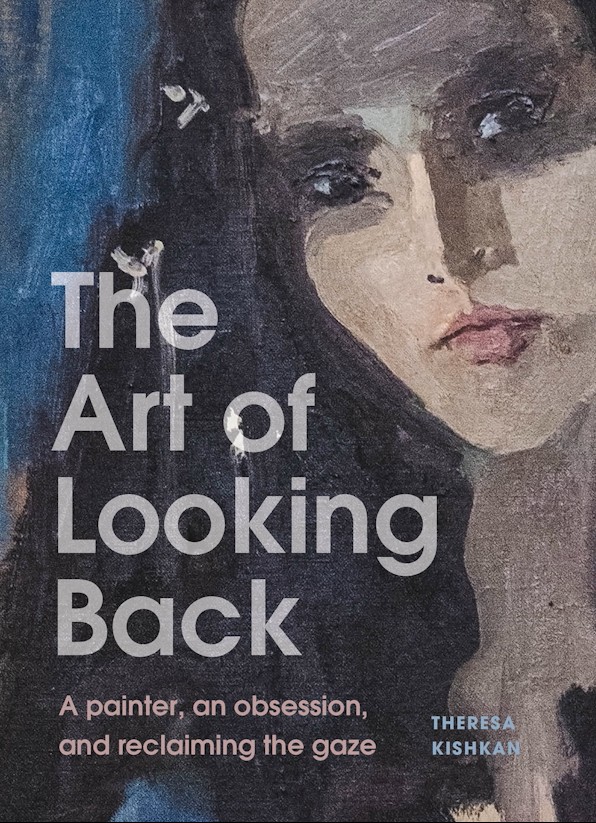
Yesterday the first set of proofs arrived for my forthcoming book, The Art of Looking Back: A painter, an obsession, and reclaiming the gaze. I love everything about the cover and the page design. I love the typeface (Caslon) and the italic chosen for the headings: Minion. Look at the elegant ligatures!
I was listening to “Sad-eyed Lady of the Lowlands” and looking at the cover, remembering that I was listening to the same song when I was lying awake in the night in 1978, wondering what to do about the situation I found myself in, the one I write about in my book. Every line of the song is familiar and yet I am nearly 50 years older. Reading the pages of my book is like living those years again.
Sad-eyed lady of the lowlands Where the sad-eyed prophet says that no man comes My warehouse eyes, my Arabian drums Should I leave them by your gate Or, sad-eyed lady, should I wait?
(I left a letter by the painter’s gate. And no, I didn’t wait.)






 ...Theresa Kishkan