posts

“Wake, butterfly” (Basho)

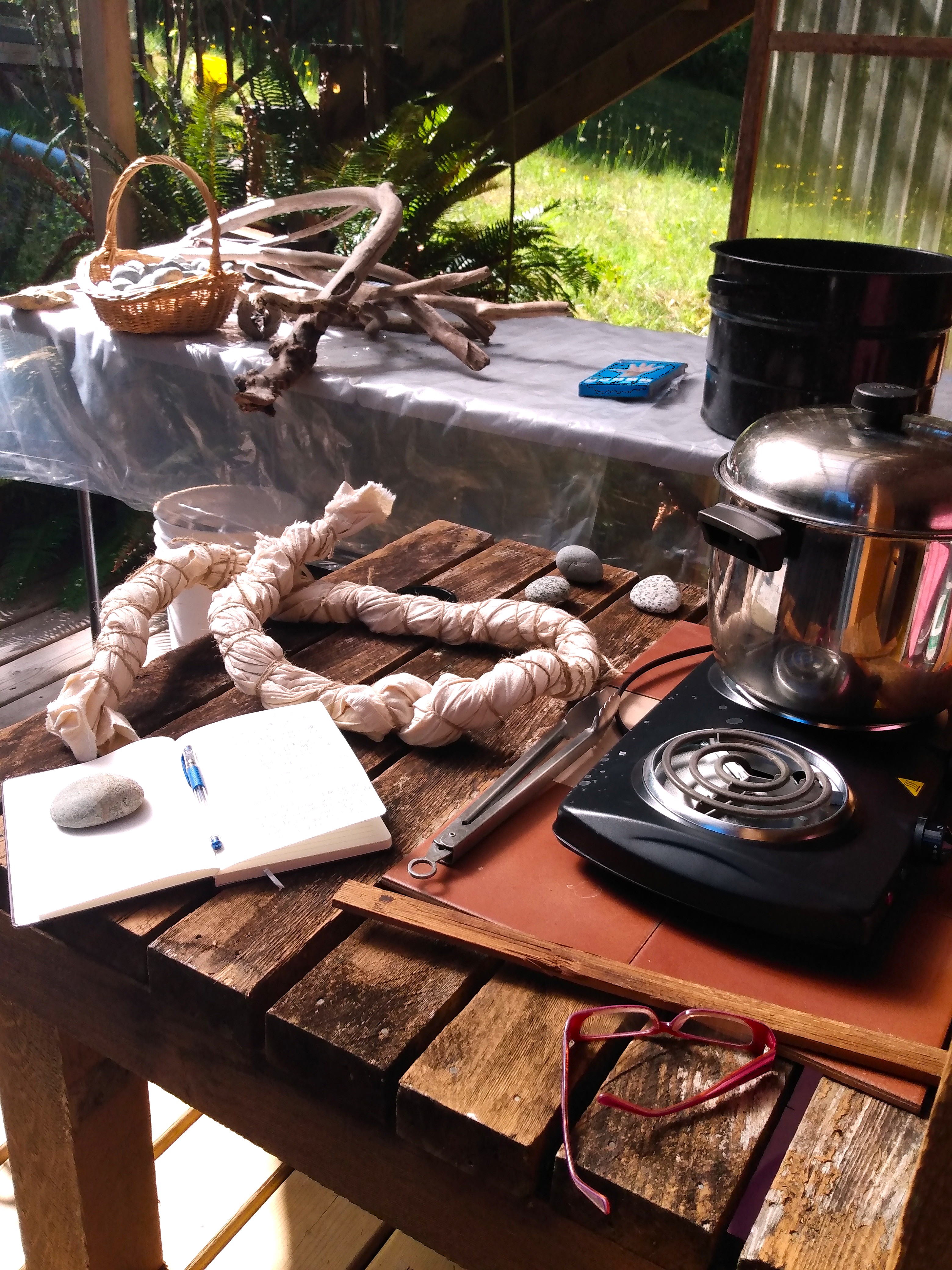
Yesterday I spent some hours dyeing 2 meters of unbleached cotton with the ground roots of Rubia cordifolia, or Indian madder. (There’s another madder, Rubia tinctorum, which is Turkish madder, or dyer’s madder.) I’ve dyed fabric for years with indigo (and once, woad) but I want to know more about colour and how to find it with powders, roots, leaves.

I’ve been reading books on natural dyes, probably 6 or 7 of them, and they kind of vary. There are ones written by true professionals, who advise on chemistry, weights, reactions, etc. and I soon realized I would quietly give up if I have to rely on them. The advice given by one expert contradicts the advice given in a different book. Other books, written by people like me (passionate amateurs…), are helpful, to a point. Some of them breezily advise you to simply experiment. And yes, that’s almost always my process but I found I needed to know a bit more to “simply experiment”.

The reading was helpful to me as I figured out what I needed. I dyed with indigo on a long slab of cedar bench near my vegetable garden and laid out the results on the grass by the bench

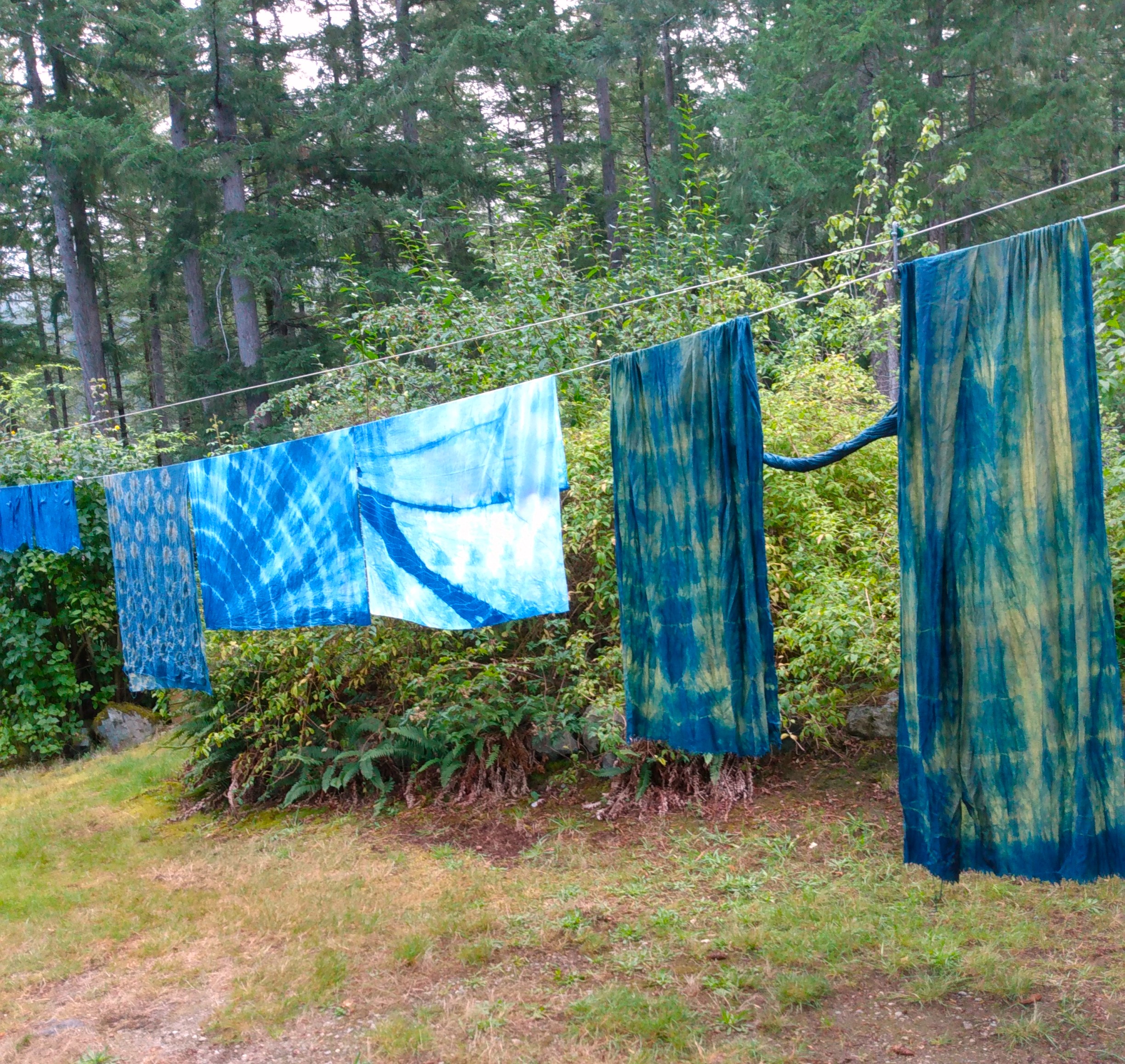
or else on the clothes line:
Indigo is simpler in that you don’t need to use a mordant (a pre-soak that prepares the fabric to accept the dye; different mordants result in different possibilities due to chemical processes). Some cultures consider indigo a sacred blue. (I’m a believer.) But the direction I want to move in, at least for a bit, means more equipment. I read the books carefully to determine what I would absolutely need and what I could do without. A heat source was important and because I wanted to do the work outside (the powders and so on require ventilation), I bought a cheap hotplate. I bought a long folding table (it can double as an extension to our outdoor deck table for large groups of people). At the thrift store, I bought a big stainless steel pot for $3. A colander. I have masks (COVID!) and I have disposable gloves. Lots of buckets — the recycling depot has a place where you can pick them up for free.

So yesterday: the rose madder. I’d prepared the fabric a few days ago, scouring it as required to eliminate sizing, starch, etc. Then I soaked it, over mild heat, in a mordant of potassium aluminum sulfate and soda ash. (I have a jar of homemade iron mordant which is simply old bolts and bits of rusted metal soaked in vinegar and water. Iron “saddens” most colours. I don’t know yet when I’ll want that effect.) I rinsed the fabric, dried it, and tied it with hemp string because I wanted a resist design, one I couldn’t manipulate or predict, but which would surprise me. All that was done and yesterday I weighed the madder powder, deciding on a formula that was sort of in the middle of the ranges advised in the books. Then I added it to water in the thrift pot on the hotplate and heated it to 60C. I put in the fabric, which wasn’t easy because the dye mixture was pretty sludgy, and I weighed it down with a big rock so all of it would be submerged, and I kept checking the temperature with my extra candy thermometer so keep it at 60C. After an hour, I removed the fabric and put it in a bucket of water for a preliminary rinse. Then I cut out the strings, marvelled at the beauty (because I didn’t really know what to expect, which is as it should be), and washed the length with mild soap and a bit of soda ash to fix the dye.

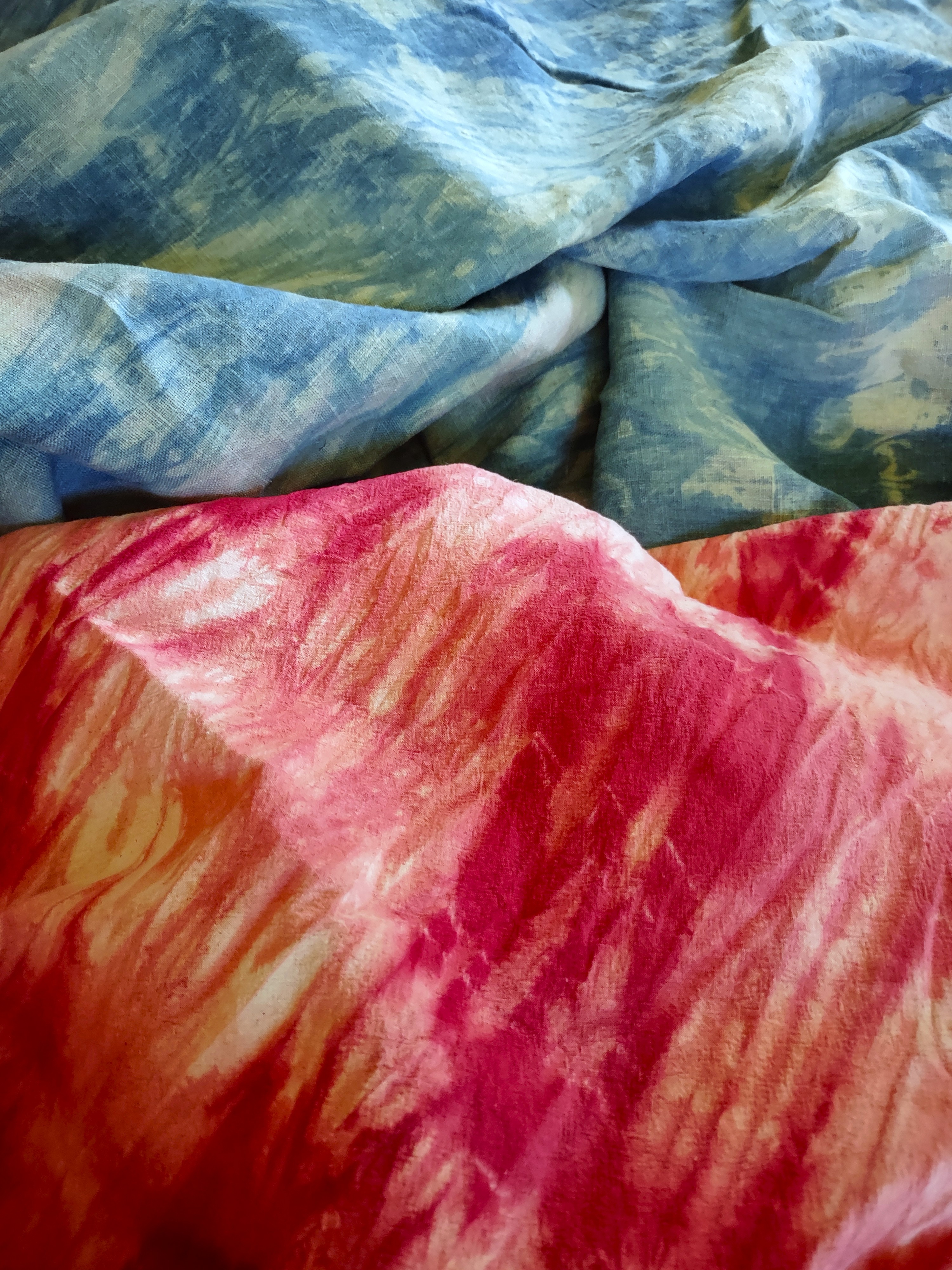
Is it what I hoped for? I didn’t have any hope beyond beauty. And yes, I think it’s beautiful. It’s the pinky-red cloth in the first photograph. The blue is a length of linen I dyed with indigo last fall, 5 meters of it, and I was delighted to discover that both of these fabrics are the same width. So I can cut off 2 meters of the blue and make a quilt, a full-cloth one (not patchwork or a pieced design). The blue actually has undertones of green, not really visible in the first photograph, but the third one shows it drying on the line, on the right-hand side. It was beige to begin with so the results were affected by that. The colour feels to me like my morning lake swims feel: blue green water swirling over me, a full-body immersion. Did I expect that blue-green, the swirls, the marbling? No, I didn’t. But I love it. And the pink? I just came across my husband eating a bowl of raspberries and cream…

Next? Marigold. Or cochineal. There’s so much to learn and I’ve waited so long. Maybe too long. A more supple mind could grasp the chemistry. Instead, I seem to moving in the direction of alchemy. It is what it is.

Wake, butterfly—

it’s late, we’ve miles

to go together.

Note: the poem is Basho’s, translated by Lucien Stryk.

swallow-stitched

1.

Here, and here, and here: a swallow dipping down to the lake surface, the thread of its flight almost visible. As I was swimming on my back, nearly my final lap, the bird almost touched me, almost stitched me into the water. Nearby, a raven calling the same name over and over. It wasn’t mine.

2.

The garden has begun to feed us. Peas, salad greens (and reds, burgundies, and the beautiful pink-edged leaves of Chenopodium giganteum, or magenta spreen), basil for last night’s pesto sauce, and this morning, I noticed the beans are in flower, there are tiny golden squashes forming, small sweet peppers in the greenhouse, tomatoes forming, garlic thriving (the scapes are delicious), every other herb imaginable. In tubs, French fingerling potatoes. When I turned on the sprinkler this morning, I ate a handful of raspberries.

3.

I don’t want to think about world events. Not today.

4.

This is the day I will dye the cloth I’ve scoured and mordanted, tied with hemp string, the day I will immerse it in rose madder, my first attempt at a dye other than indigo. In my dye area, I have marigold, pomegranate, a little jar of cochineal. I have a bag of mahonia wood, as yellow as butter, a jar of old iron bolts and wire soaking in water and vinegar, and still enough indigo for something large. I have a basket of beach stones, some wood brought home from Trail Bay, old sea-battered rope I found in Bute Inlet last April, and a notebook to keep track.

5.

there is a sense of having crossed

over an unhurried river where there was

a drawbridge but no operator and the undulant

grasses on the opposite bank emulate

the whish of a sleep application that could be

the rhythmic wash of rain or of some sinister

approach or the strain of an unutterable

weight from a swinging line of hemp

Note: the lines of poetry are C.D. Wright’s, from her poem “Imaginary Rope”.

“it remembers the storm” (Robinson Jeffers)

It dreams in the deepest sleep, it remembers the storm
       last month or it feels the far storm
Off Unalaska and the lash of the sea-rain.
–Robinson Jeffers, from his poem “Ocean”

For some time now I’ve been wondering what I’ll write next. I finished my novel Easthope in the winter and in the spring I worked on revisions of my memoir The Art of Looking Back: a painter, an obsession, and reclaiming the gaze (due out next year) and then I sat at my desk and wondered. What next?

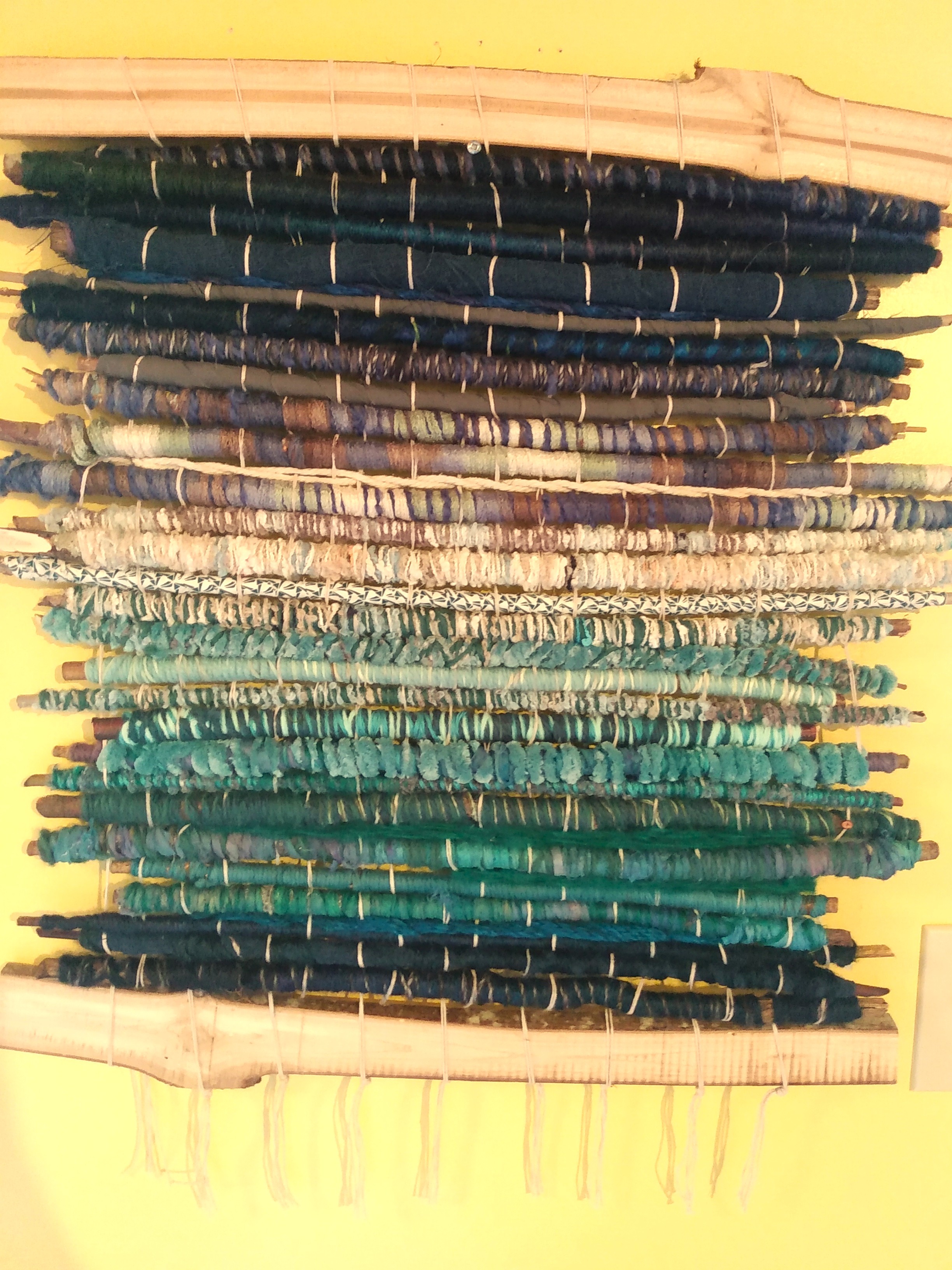
Last week I was in a shop in Sechelt, one that sells consignment household goods as well as some objects created by (mostly) local artisans. I saw a hanging on the wall, labelled “The Ocean is Sleeping”. It’s larger than it looks in the image here: 23 inches long by 21 inches wide.I guess it’s a piece of weaving, a kind of cloth, the warp of string and the weft a series of sticks wrapped in textiles. I looked at it for quite a while, thinking it had something to say to me. I didn’t know what. I didn’t know what until I woke in the night early this week and began to write something. An essay? A book? I don’t know yet. It’s a woven piece, though, using passages from this site and an outer framework, which I’m still devising. These colours are in it. And water. And loss. And maybe something like recovery.

Yesterday I went back to the shop to see if I still liked the hanging. And yes, I did. So Reader, I bought it. John just hung it for me in our dining area because I want to be able to see it all the time (and our dining area is part of our kitchen). Its colours are richer than they look in this photo. The textures are wonderful. Is it sleeping? I don’t know yet. I’m about to find out.

redux: “were you my possible other life?”

Note: I posted this five years ago yesterday. And I am still wondering.

****************************

lake2 (2)

It was not actually raining when we went down for our swim this morning but there was fine mist. The air wasn’t warm though the water, not yet at its summer temperature, felt the same as it’s felt since we first started swimming three weeks ago. Once I’m fully submerged, I forget it’s chilly and do my strokes beyond the ropes delineating the beach area. I’m out of bounds but not really too far out in the lake beyond the shore.

I’ve been thinking about liminal space lately. Maybe we all are. Liminal, from the Latin root limen, meaning threshhold. From my anthropology courses in the last century, I remember that it was a term used for the middle part of a rite of passage, when you have left one stage to transition to another, which you have not quite attained. It’s a space of uncertainty. As we negotiate the new routes and pathways that might allow us to travel safely in our daily lives, so much of what we have known and done is left behind. Or our relationship to our old lives and lifeways has shifted. In the night I lie awake, wondering if I’m prepared for the future, do I have the right guides, have I paid attention to the signs, do I know the dangers and can I meet them with courage and with love? I don’t know yet. The footing feels uncertain, the boundaries unclear.

I recently read Hua Hsu’s profile of Maxine Hong Kingston in the New Yorker and I was struck at several points by Kingston’s apprehension of ghost lives, the ones that are sort of adjacent to our own. As part of a delegation of writers visiting southern China in the 1980s, she travelled with Toni Morrison and Leslie Marmon Silko:

One day, they were on a boat going down the Li River, and Morrison saw a young woman doing laundry along the shore. Morrison waved to her and said, “Goodbye, Maxine.” She gets it, Kingston thought. If immigration hadn’t brought her to the U.S., “that could have been me,” she said. “Were you my possible other life?”

When I was in Ukraine last September with my husband and daughter, we were at a celebration in the Carpathian Mountains where we feasted, sang, laughed, and danced. My daughter leaned to me at the table at one point and said, “That woman looks so much like you.” I looked and did she? I think she did. I recognized myself in her. After a prolonged and lively dance, I sought her out and with the help of another woman who spoke some English I told her what my daughter had said. We touched each other’s face and held each other’s hands. My sister, she said, laughing. So much of that trip was me looking at houses high up mountain slopes or else beyond the fields by the road as we drove to my grandfather’s village, not imagining myself into them, but occupying that space in a way that I can’t explain. I was not the woman in the van but out of my body, up in the soft grass, looking down, a faraway look in my eyes.

in the carpathians

In “The River Door”, the long essay I am just finishing, I realize how this sense I have of being between lives has influenced the way I am structuring the piece. There are three strands of narrative. One of them I’ve justified to the left margin of the page. Another to the right. But there’s also one that hovers between the two perspectives—I could call them early and late, or historical and contrived, imagined, or now and then—and I’ve centered those passages. They’re brief, lyrical, and when I think about them now, I realize they’re thresholds. Step forward, step back, stand for a moment in the space between what you know and what you don’t, the living and the dead (because it’s an essay in part about the Spanish flu), the past and the present.

“They need help desperately at Drumheller,” she said. “The flu seems to have taken a particularly virulent form among the miners. They even believe it’s the Black Death of Medieval Europe all over again. There’s no hospital but the town council has taken over the new school to house the sick.”

Where were they living when the flu arrived? I see them, mid-river, a wagon of their belongings, paused. Paused between homes, between what they’d known and what was to come, the moment a hinge on the river door.

When I read the profile of Maxine Hong Kingston, I kept thinking, Yes, this is so familiar. Leslie Marmon Silko remembered visiting an old storytellers’ hall in southern China and how she realized that Kingston’s work is “storytelling at its highest level, where webs of narrative conjure the ghosts that stand up and reveal all.” I need this kind of storytelling now, to guide me through this liminal space where I no longer feel safe earth under my feet. I am waving goodbye to the woman in the Carpathian Mountains, telling myself hello.

“we can meet there in peace/if we make it” (Gary Snyder)

Early last evening, I was sitting by the sliding doors and I looked down the bank to see a bear in the brush. Not this bear, but probably a relation. I watched it amble up to the surviving cherry from our old orchard, the one I wrote about in Euclid’s Orchard, and then I watched it climb the tree. For such a lumpy animal, it was surprisingly agile. Up, up, and into the unpruned limbs. There must have been a few cherries because it broke off a branch and scooted down the trunk, pausing to eat before strolling away through the tall grass.

There are times when I miss our orchard. I miss our early enthusiasm, our energy. The ground is rocky but we’d dig holes, planting the trees with compost. Apples, cherries, plums, pears, and hazelnuts. We draped them first with old gillnetting from the dump and then we fenced the perimeter. And the trees did produce fruit, though never in the amounts we hoped for, because animals always found a way in. We kept trying to improve the fencing, several kinds of wire, including electric. But bears, deer, and eventually the elk that were reintroduced to the Sechelt Peninsula in the late 1980s to keep the areas under big Hydro lines clear of deciduous growth, anyway, all those animals found our orchard. The bears were particularly destructive, tearing trees apart in their haste to get to the golden pears, the juicy Melba apples.

The rising hills, the slopes,
of statistics
lie before us,
the steep climb
of everything, going up,
up, as we all
go down.

When I look down from the west-facing deck, I can barely make out anything resembling that old orchard. The cherry tree bloomed beautifully this year but other trees have died or become so covered with lichen and moss that they look almost sculptural, little abandoned gods. Last spring, during a difficult time, I went to sit among the trees to try to put some things into perspective. It helped, and it didn’t. It seemed to me that more than almost anything, the orchard was a monument to a life we’d put so much love and energy and attention towards, maybe always towards, and perhaps we never actually accomplished that dream. Last spring, it felt that I’d failed, spectacularly. But watching the bear, who was no doubt the offspring of one of the original bears — a child, a grandchild? — I realized that the orchard is remembered, in the way the beautiful old crabapple tree is remembered by successive generations of those same bears. It’s not what I expected but it’s something sweet.

In the next century
or the one beyond that,
they say,
are valleys, pastures,
we can meet there in peace
if we make it.

We can meet there in peace. If we make it.

**************************

Note: the lines of poetry are Gary Snyder’s, from “For the Children”.

sometimes…

…you could almost forget that the world is hovering on the verge of mass destruction. You could almost. When you walked down to the lake after a night of rain, every surface was fresh. A trout surfaced not far off shore and the loon you’ve been listening to warbled a little from the other side of the lake.

Just as you were stepping into the water, it began to rain. It didn’t matter. When you swam on your back, the raindrops on your face felt sweet. Soft. Many mornings you cry a little as you swim because so many things are heavy in your heart but this morning, your cheeks were damp with rain, not tears.

Sometimes. Sometimes. A bird sang deep in the hardhack. A duck flew close to the surface of the lake. Swimming, I was thinking about the book I am reading, Madeleine Thien’s The Book of Records and how one strand of the narrative is Du Fu’s story, his poems coming to life on the page: riding through woods, drinking with friends, lamenting the indignities of age. I was thinking of his poem, “Rain”, and it was as though I was living in the poem,

Roads not yet glistening, rain slight,
Broken clouds darken after thinning away.
Where they drift, purple cliffs blacken.
And beyond — white birds blaze in flight.

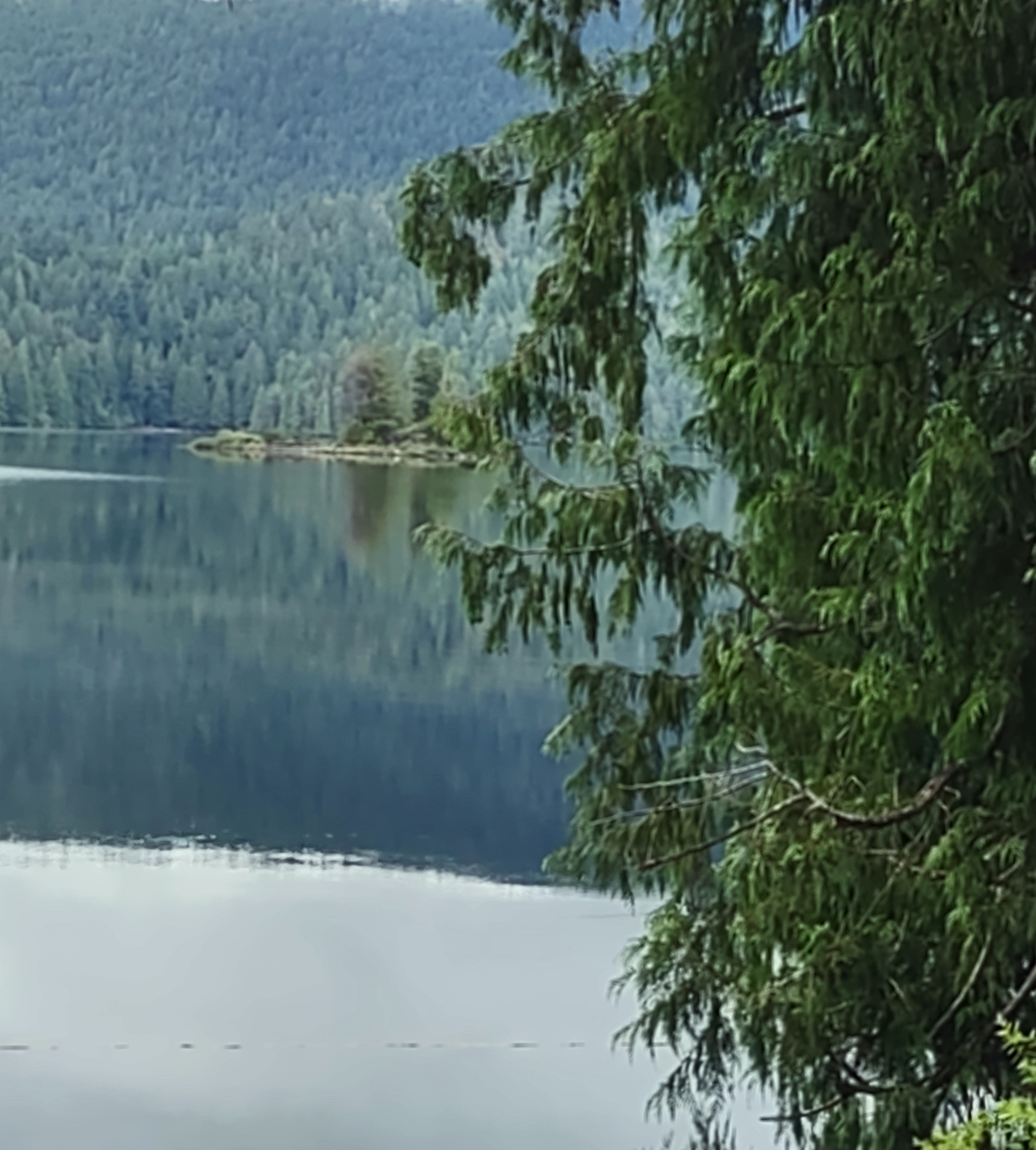
It wasn’t white birds but an unseen sparrow in the hardhack, a duck skimming the surface, a loon beyond the island you can see in the photograph. I have longed for things I will never have and haven’t been grateful enough for what is mine. Above me, the clouds were dark over the mountain but there was blue sky in the direction of our house.

Note: the lines of Du Fu were translated by David Hinton.

redux: It’s a long way from Clare to here

Note: I posted this 8 years ago. I still love this song.

******************

Does this happen to you? That you wake, knowing you dreamed of something deeply important, but you’ve forgotten what? How did you sleep, I asked John just before 7 and he replied, Not well; strange dreams. Given that he is experiencing a new health thing, I wasn’t surprised, but sort of sad, because sleep is the one time we can leave the daily worries and be transported. I knew I’d dreamed of something unsettling too but couldn’t remember just what.

Putting laundry into the washing machine, I found myself singing softly and I realized it was this song:

And then I remembered my dream. John and I were somewhere, don’t know where, and two guys were also there, obviously bored. Never mind, one of them said, we’ll just drive on to Galway. I was pierced, in the dream, and now, that someone could simply drive to Galway, a city I love and have spent a little time exploring. It was the nearest city to me when I lived on an island off the west coast of Ireland and sometimes I got to tag along with someone going there with fish or on other business. Later, in Ireland with my son Forrest in 2001 so I could research Irish history and revisit some special landscapes while I was writing A Man in a Distant Field, Forrest and I spent three nights in Galway. He was just finishing an undergraduate degree in history at the University of Toronto and he’d taken a course in Irish history and was full of information I’d never known. But I knew places and plants and another kind of history so I think we were a good pair that spring. We were blessed with weather. I think it rained the day we arrived in Dublin and it might have rained another day but mostly it was warm and sunny, ideal for following the Ordnance Survey Map I’d ordered from Kennys, a book store and art gallery in Galway, before flying to Ireland. I wrote about that trip in an essay, “Well”, in Phantom Limb, how we used the map to find (or not) sacred sites:

We didn’t see St. Patrick’s Well off the Maam Valley road, nor his bed a little further on. We drove as far as the path to that Well but then it led through a farm yard and the sign told us Do Not Enter. Later in our trip, we ignored the signs and ventured into Hoare Abbey, a field of beehive huts on the Dingle Peninsula, a grove on ogham stones on a private drive, but we hadn’t yet found the courage to climb the gate, and walk up the path, smoothed by centuries of travellers and believers.

near dingle

Forrest found a small map in Galway that took an interested person, or two of them, on a walking tour of medieval sites, many of them hidden in plain view. You looked up and saw a gargoyle, an oriel window, the hall of the Red Earl. We walked, parsing the streets in their layers of occupancy. Streets I’d walked and never thought to look up.

We went to places I’d been but had never known to look at with an historian’s eye. At Sellerna, this megalithic tomb:

at sellerna

The Kilmalkedar church on the Dingle Peninsula:

kilmalkedar

In my dream, this was all somehow in the atmosphere, that a person could simply go to Galway, or by extension, Ireland. But that person wasn’t me. I know I am mourning in a mild way the loss of our trip to Ukraine and London in September, wondering (perhaps) if we will be be able to plan such things again. Things happen. One day you are healthy and vigorous and another day you aren’t. And a song helps, or doesn’t. It’s a long long way from Clare to here, from Galway to here, from the village in Bukovina my grandfather left in 1907, maybe for good reason, maybe not. It’s part of a project I’m working on, a series of essays that might become a book. I didn’t think Ireland was part of it but, well, are dreams instructive? Was I being told to pay attention to where the heart longed towards?

We had to stop while John Smith drove his cattle to their evening pasture, him still in the black wellingtons with a familiar dog at the heels of the last wild-eyed heifer. He waved to us as though to anyone and for a moment I thought to call to him, asking him…but what? Where have the years gone, John Smith, that you are still with the cattle and I am driving with a son the age I was when I lived on the island we’ll see when we park the car and take our picnic to the sand.

forrest

Was I being told to at least look at old photographs and remember that ramble through narrow roads so overhung with fuchsias and hawthornes that we kept having to pluck blossoms from our clothing when we got into the car, or out of it.

I sometimes hear a fiddle play or maybe it’s a notion
I dream I see white horses dance upon that other ocean
It’s a long, long way, it gets further by the day
It’s a long way from Clare to here

rose quotidian

1.

The garden is full of roses: pale pink moss, Munstead Wood, Abraham Darby, Lady of Shalott, New Dawn, unnamed apricot climber, Mme Alfred Carriére, the Lark Ascending, deep pink moss, and Reine des Violettes just in bud. I am filling the jugs. I can almost hear the sound of their petals falling as they age.

2.

We are setting up a dyeing area on a partly-covered deck which once held a hot-tub. I am slow to this work, thinking out the steps, taking books out of the library to help me determine equipment and space. For years I have dyed with indigo and woad on a long cedar bench (what was left of a tree from which boards had been sawn), in the open, wringing the lengths of fabric out on the grass. But I have bags of rose madder, marigold, pomegranate, and enough indigo to dye my bedroom curtains, white linen bought 25 years ago, and worn a little thin. What do I need? I have been thinking out the steps. A big stockpot from the thrift store, tall buckets from the recycling centre, a two-burner hotplate, a long folding table, a rack of metal shelves, big jars saved after we’d eaten the olives, the artichoke hearts. I will start this weekend with a pot of rose madder and enough cotton to make comforters for the bunkbeds I’ve ordered to replace the crib, the cots, the mattresses on the floor.

3.

In the night I was reading Maggie Helwig’s extraordinary book, Encampment: Resistance, Grace, and an Unhoused Community, and thinking how some people enact goodness daily, in the name of a god, or love, or some alchemy I don’t understand. How some people meet others where they are, without the expectation of anything back, but with hope for something better for all. That everyone deserves dignity, some meaningful shelter, enough to eat, respect of person, and that if you believe this, you do the work. She is doing the work.

4.

At the lake this morning, two female mergansers having a serious conversation on a small log by the shore. We watched for for a few minutes. They didn’t stop talking, didn’t stop even as they saw us and swam away to another log, where they turned their backs and continued their discussion. Were they waiting for the mother and her young we’ve seen twice now? Were they talking about their own lack of offspring, perhaps picked off by eagles, ravens, the otter I saw last summer as I swam in the green water? Were they sad or wistful or simply enjoying each other’s company?

5.

White dog roses, pale pink dog roses, a clear pink rugosa opening as I write.

6.

The nation is broken, but hills and rivers remain.
Spring is in the city, grasses and trees are thick.
Touched by the hard times, flowers shed tears.
Grieved by separations, birds are startled in their hearts.
--Du Fu


Note: the lines of Du Fu are translated by Arthur Sze.

this morning honeysuckle is smothering the garden gate: a meditation on measure

At the lake this morning, three mergansers were haunting the shore. They were muttering. Are they the ones from last week, grown, I wondered. John took their photograph. But then, as I was finishing my swim, along came the mother with her 9 young (I think she had a dozen last week), all of them whirling around her as she swam sedately between me and the shore. All of them whirling, learning to feed on the insects and tiny fish in the very shallow water where it meets the sand. Not far away, a raven called, its voice bell-like (my dear friend Charles Lillard called it a “black sanctus”). What do you know about the missing 3 ducklings, I asked. No reply.

On these hot days, I take water to vines, to roses, to the new cabbages in the bed I call “Long Eye”. On Sunday, I opened the garden shed door and startled a small covey of young grouse, not quite old enough to fly but they glided through the salal to a place of safety, their mother calling in agitation from the trail. On one fencepost of the garden, a raven had settled to watch. 1,,2, 3, 4. How many will be left next week? The week after?

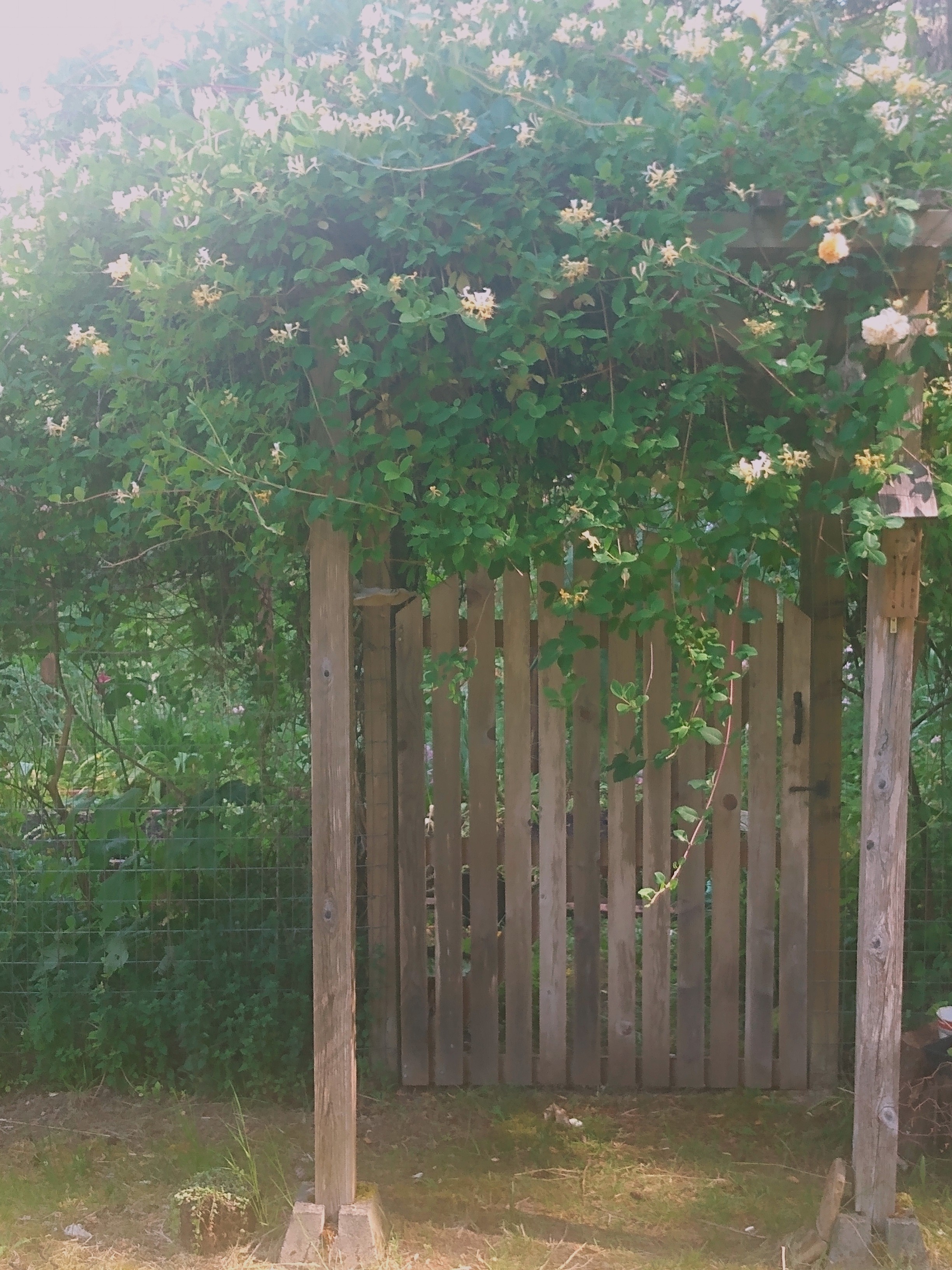
Around the garden gate, the honeysuckle is in full bloom, bees humming, a thicket of sweetness. The unnamed apricot roses find their own way through. And just to one side, the deep pink moss roses have covered the fence.

How do I measure my swim? 40 minutes, mergansers, little trout, light settling in the shallows, the sky turning over and over, a raven, two kingfishers. How do I measure my life?

In the night, the loons down on Sakinaw Lake were hysterical. Something, something, something. I was waiting for the strawberry moon. I was in anguish, thinking of all the harm I’ve done. I almost went downstairs for a parting glass of seaweedy Bowmore but instead, I held my husband’s hand and cried.

So fill to me the parting glass
Good night and joy be to you all

On Day 20, I saw a kingfisher

This year I am counting the days. Counting the days in the body of the lake. From “Kingfisher”, an essay I put up on Medium:

On June 6, 2023, a day I was swimming, Russians blew up a dam in Kakhovka, resulting in wide-spread flooding of the Dnieper River. Farmland, homes, businesses were damaged. Residents downstream were evacuated. At least 60 people lost their lives and others were unaccounted for. Known minefields were washed away, creating uncertainty about the locations of the explosives. Heavy metals sitting at the bottom of the reservoir held by the dam were subsequently released into the water column, contributing to the huge environmental devastation of this event. What humans will do to others, though the pious have said, Never again.

******************

10,000 years ago, or 8,000 years, or more, or less, swimmers plunged into a river or a lake in a valley now long desert. Their bodies arched, as mine arches when I swim each morning in Ruby Lake. Someone painted them onto rock, the joy of their swim beautifully captured, someone who watched them carefully, maybe lovingly. One of them is diving or plunging, another drifts. They are buoyant in red granite, swimming over time in a river no longer in existence. Rainfall patterns changed (it hasn’t rained here significantly for 4 months), people migrated south (California is burning, flooding), vegetation changed due to shifts in solar insolaration, and what was once a verdant swimming hole became a barren desert, what’s now the Egyptian Sahara, near the Libyan border. I am buoyant in green water in a forest where the iconic trees, Western Red Cedars, are dying. (We are dying, Egypt, dying.) The swimmers at Wadi Sura stroke through time to where I am trying to write about the deep joy of my own swim, when I am in the water, looking up the sky, listening to loons, the soft swoop of swallows as they feed on mayflies or mosquitoes, the joy of the swim, and the sadness I feel at the changing climate of our planet.