posts

redux: blue solstice

Note: I know it’s a little early for a solstice post but I wrote this last year and I realize that the quilt I am now working on uses the fabric I was writing about here. Every day I stitch into the blue swirls. It’s just after 8 a.m. and it’s barely light but at least I have this work to do when my own thinking goes dark.

detail

I was asleep at the moment of the winter solstice, 1:20 a.m. Pacific time. Yesterday was a long day. We went to Vancouver for a medical procedure for John, to the same facility where I went every few weeks for 5 months last year to have my threadbare retinas stabilized and repaired. On our way down the coast, we stopped to pick up our mail from the previous day. Finally things I ordered in early to mid November are beginning to arrive so I was happy to open a package containing a copy of Christine Desdemaines-Hugon’s Stepping Stones: A Journey Though the Ice Age Caves of the Dordogne, recommended to me by Clara Aussel who took John and I to Rouffignac and Font de Gaume in late October.

I was 19 when I first read about the caves in the Dordogne Valley. I wrote a poem about them, tucked away the memory of seeing photographs of animals alive on limestone cave walls, and finally we went to France this fall in order to actually visit the caves. It was wondrous. I felt I’d found my people, the ones who’d given us the gift of reindeer, bison, horses, mammoths. We were only able to visit two caves as well as the Lascaux reproductions but I knew then, and know now, that we’ll go back.

On the ferry from Langdale to Horseshoe Bay and in the medical facility waiting area, I read about the Vézère Valley where Clara took us and where I’ve actually found a little house I want to buy (but probably won’t). I was thinking of how humans make their mark. I was thinking about the night before when friends came for John’s birthday dinner. Amy and I were talking about indigo and I took her to the back of the house to show her the pieces I dyed in September. She was most taken by a 5 m. length of linen I’d twisted and tied. I remember that John held one end of the fabric on the patio while I twisted it as tightly as I could and then tied it with coarse hemp string, hoping it wouldn’t slip or loosen. I was curious to see what would happen when I immersed the length in the indigo vat, 7 or 8 dips, with long oxidation periods between. The linen was wheat-coloured so I didn’t think I’d get a clear blue. And I didn’t. It had sort of greeny underlights, or at least the parts of the fabric kept away from the dye from string were greeny. Here it is, recently removed from the last dip, rinsed, and hanging on the clothes line. (It’s the fabric on the right, with an untwisted middle section, because I didn’t want it to drag on the ground.)

hanging out

Amy loved this piece. What will you do with it, she wondered. And I wondered too. 5 m. is a lot of cloth. I don’t really want to cut it, though it would make a beautiful quilt, I think. We spread it out in the back room and looked at it closely. You could see water in its movements, shot with light. You could see the inside of an abalone shell. You’ve obviously figured out this stuff, Amy said, and I replied that I absolutely haven’t. I have no idea when I begin what the results will be. And in a way I don’t care. I am committed to the process, though. Each twist, each stone I tie into a piece of fabric (the length second from the left is the result of beach stones tied into coarse cotton), each piece of string I cut and wrap: I am interested to see where they take me. In a way it’s a cave of my own making. Surrounded by blank linen and cotton, remnants of old damask tablecloths (the two small pieces at the far left), sheets, I begin to make a mark without knowing what it will be.

We each held the end of long length of linen across the bed in the back room and brought our ends to meet the other. Women have been doing this for centuries. Millennia. They’ve been immersing cloth in dyes made from roots and leaves, hoping for beauty, for light, smoothing out the wrinkles, folding the cloth afterwards. It’s been a dark year for a whole lot of reasons. I haven’t known how to find the light. though as of 1:20 this morning, it’s coming back. The other night, light shone through the linen we held and folded, it rippled like ocean water, the water I swam in off a little bay in Bute Inlet in April, the water I swam in almost every morning from the beginning of May until the beginning of October, entering Ruby Lake’s green depths, the linen held those moments, and others, and now folded, it waits for me to know what to do next.

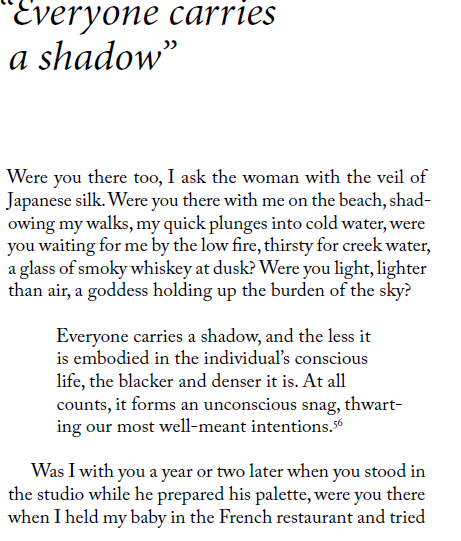
“Everyone carries a shadow”

This morning I had the chance to look at the digital ARC for my forthcoming book, The Art of Looking Back: A painter, an obsession, and reclaiming the gaze. The designers have done a beautiful job of arranging the material. The text is a series of sections, some brief, some longer, many of them in conversation with a portrait of myself, painted when I was 23. I didn’t expect to write a book like this but a few things conspired, in the way that they do, and I realized that I needed to do this work. It wasn’t entirely a happy process. In the course of writing about a story I’ve held for nearly 50 years, I came to understand that it wasn’t really that story at all. It was far more complicated, uglier, and there were times I wanted to quietly give up. But somehow seeing the portrait at the foot of my stairs filled me with shaky resolve, even though there was pain as well. And shame. I didn’t expect to write a book like this and yet I did. And this morning I looked at the ARC as though at a book written by someone else and I realized that it has substance. The form I evolved to carry the story works. Or at least it feels that way this morning.

What gift of counsel would you give your younger self if you could? I ask that with interest and curiosity. Would she listen? Would you have listened? Would I have paid attention to an older woman advising me to be patient, to care for myself, to value myself? Would I (she) have listened as she (me) talked about desire, manipulation, and boundaries? I wonder. I truly do.

Writing this book changed me, in a way. I feel quieter. I understand how the life that we live can be full of darker depths that we are seldom willing to explore. Exploring them is often a murky process and it would easier to simply leave them be. If there are other people involved, you can’t count on them being understanding and generous, though some of them will be, your own husband most of all.

redux: “Everything I am remembering is burnished with moonshine…”

Note: this was posted in December, 2019. Do you remember the (relative) optimism of that time, just before the pandemic, before the Russian invasion of Ukraine? I no longer send gingerbreads to my grandchildren because they bake them now with their parents.

______________________________________

I am preparing some gift boxes to mail to the children I won’t see this Christmas. What goes into them: small gifts, boxes of buttercrunch (to be made this afternoon), gingerbread (made this morning),

gingerbread

some homemade items, and this year, rushnyk from Ukraine. Rushnyk cloth is used for rituals and ceremonies; when we arrived somewhere, we would be met with a tray of tiny glasses of horilka, or moonshine, a little bowl of salt, and a loaf of bread wrapped in the most beautiful cloth embroidered with symbolic elements I learned to decode, or at least some of them. They speak a language I sometimes understand. A little. In churches they draped the ikons. They were also a means for women to communicate. They hold wishes, dreams, history, and the cycles that bind us to each other and our homes: fertility, childbirth, harvest, marriage, death, the afterlife.

rusknyk

Sometimes I can’t believe we were actually able to travel to Ukraine and I’ve dreamed of the moment when my relatives came in the door of our hotel, presenting us with champagne and a beautiful rushnyk I’ll use to wrap bread the next time my family is here. Somehow these threads become more important to me as I age and as the occasions for my family to gather become more complicated. The final essay in the collection I’ve mostly finished is about Ukraine—what I hoped to find there and what I did find.

Everything I am remembering is burnished with moonshine, the taste of cherry-filled varenyky, sweet butter on dark bread. Mornings I swam in an unheated pool, the bottom littered with drowned insects, while all around me mist rose from the valley below our mountain slope. The mountains above me, source of the Dniester, Tisza and Vistula Rivers, the upper streams of the Black Cheremosh and the White, the Prut. I thought of those mountains forming a long spine to the Beskids in the Czech Republic, where my grandmother was born, 2 years after my grandfather, though they didn’t meet until 1919, in the badlands of Alberta, she a widow, and him? I have no idea of his romantic history, though in his small archive of papers there are two photographs, one of two women, taken in Chernivtsi, one of whom resembles him enough to be a sister, and another of a woman with a generous mouth, dressed in a fur vest like the Hutsul women wore. Everything I am remembering, burnished with light too faint to read by, like the moonlight that came through my curtains at Sokilske, haunting the room like old history.

–from “Museum of the Multiple Village”, part of Blue Portugal.

“The edge of the light” (Gary Snyder)

When I opened the curtains and then the balcony door early yesterday morning, I saw the lights and shadows of False Creek, smelled the sting of salt air. Gulls cried. A couple of sculls paused mid-way across, the rowers talking. I’d awoken a few minutes earlier. Where was I? Where was I? The bed was huge and John was still sleeping.

Dinner plans had gone sideways the night before so we winged it, eating at Via Tevere, wonderful pizza and a salad of fresh argula with salt-cured capers and lemony vinaigrette. And then the panto at the York Theatre. Which was fun but not as wildly original as some I’ve seen.

I went back to bed for a bit after opening the balcony door for the fresh air. And then joined John and Evelyn Lau at breakfast where Evelyn was signing the broadsheets John printed last week, her beautiful poem given elegant treatment in Goudy. (We have a few for sale. Contact me for details.) We sat and talked for hours at the window looking out at False Creek, a different angle than the one I’d awoken to, a heron on the prow of one of the big boats docked beyond the hotel. We talked about how writing came to us, still comes if we’re lucky, and the server kept filling my coffee cup. None of us wanted to leave, the talk important, the view changing as the light changed. I thought of Gary Snyder, one of my touchstones, his poem describing the encounter:

It comes blundering over the
Boulders at night, it stays
Frightened outside the
Range of my campfire
I go to meet it at the
Edge of the light

I have been thinking that writing has left me, the last decade filled with excitement as I wrote, then published Patrin, Winter Wren, Euclid’s Orchard, The Weight of the Heart, Blue Portugal, with The Art of Looking Back waiting for spring, and two other manuscripts quietly put away (because it seems no one is interested…). I don’t have that excitement any more. Excitement, or maybe curiosity: to leave the fire to meet it at the edge of the light. I am trying to work out the way forward but standing by the balcony door yesterday morning, I felt the conspiracy of light and scent of ocean, a little glimmer. Maybe a willingness to at least wonder what might be waiting.

Note: the lines are Gary Snyder’s, his poem “How Poetry Comes to Me”, from No Nature.

an advent gallimaufry

Loving:

Does this happen to you? That you open a trunk or a drawer and are surprised to find something you’d forgotten about? In this case, a large length of indigo-dyed (darker than in the photo, and much prettier) fabric, enough for a big project. I spread it over the bed in the guest room to see what it might look like and Reader, I was enraptured. Something I’d forgotten, and now have in mind for a duvet cover because I can imagine sleeping under its beauty, its depths and shadows.

Appreciating:

This morning the life-guards at the pool put on a playlist that might have been created just for me. Imagine swimming to Aretha Franklin singing “Respect”, imagine Otis Redding, Stevie Nicks:

Like a heartbeat drives you mad
In the stillness of remembering what you had
And what you lost
And what you had
Ooh, what you lost

— each song filling the blue space as I swam my slow kilometer and I kept waiting for one song that I haven’t heard in years and it wasn’t on the list so when I came back home, I found it. What would it have been like to glide through the water to Van Morrison and John Lee Hooker’s beautiful duet?

I cover the waterfront
In search of my love
And I’m covered
By a starlit sky above

Yes, I’ve been covered by a starlit sky, most recently standing out in our driveway on Saturday night after returning from supper at the Backeddy Pub, after Joe Stanton singing one request after another (Reader, I confess they were mine: ” Ballad of Pancho and Lefty”,

Living on the road my friend,
Was gonna keep you free and clean.
Now you wear your skin like iron,
Your breath as hard as kerosene.

“Kern River”), and the silver moon caught in the trees beyond our house, the stars close enough to feel their heat.

Remembering:

The afternoon I made two Advent calendars for my grandchildren — teal fabric to hang on a dowel and 25 small felt pockets in different colours, 5 rows of 5, and how that first year I sent the calendars filled with little gifts, but now I send the gifts for their parents to put in the pockets. This year I sent Denman Island Chocolate Santas, tootsie roll pops, chocolate coins covered in gold foil, loonies John polished so that you could hardly tell the real money from the chocolate, tiny flashlights, bath bombs, fountain pens, scrolls of Christmas riddles, origami paper, sparklers, Rubik’s cubes (for two; multicoloured pens for the other two), and other prizes I hope they’ll like.

Wishing:

That I’d seen the grey whale in Trail Bay last Thursday. I was at an appointment and John sent a text with a photograph of the whale spouting and I finished my appointment and walked quickly along the bay, hoping I would see it too. But no.

Reading:

Jón Kalman Stefánsson’s Your Absence is Darkness, a novel that follows 4 (I think?) generations of families living in a rural community in Iceland. It is full of weather, of sheep, dogs, horses, music, an essay about earthworms that changes one family’s trajectory forever, people who are both haunted and encouraged by the past, and it was the perfect book to settle into bed with over the course of a week, four pillows to prop me up, and the curtains pulled against my own absences and darkness.

Thinking:

I am in a position I have not been in for decades, no work-in-progress to settle into, to think about as I swim my slow kilometer, no line to follow, no thread.

Making:

I’ve had in mind some little bags, using velvet and scraps of linen, wool, silk, maybe patchwork with velvet lining, the patches cobbled together in the boro tradition. I brought an armload of fabric out to the kitchen and laid it out on the table but so far nothing is speaking to me. I’m listening, though.

foundational

Yesterday I had a virtual visit to a class reading my novella, The Weight of the Heart. (Thank you, Richard Pickard!) In the course of the discussion, I found myself admitting that the 1970s had been foundational to me — as a writer, as a person figuring out how to live on this earth. I found out the things I wanted and I tried to build a life that would include them. I didn’t realize then how pottery was part of that, pots built by BC potters, using earth and pigment, but looking around my house this morning (begun not quite in the 1970s but close: we started building our house in 1981 after buying the land a year before and spending a year figuring out where we wanted the house and how we would proceed…), I can see the evidence.

This red raku tea bowl was made by Wayne Ngan in the early 1970s. My then-sister-in-law Rosemary Kent (herself a potter) owned a small art gallery in Bastion Square in Victoria. They often had pieces made by Wayne. He’d come to Victoria from his home on Hornby Island with new pots. I fell in love with this one but couldn’t begin to afford it (I was a university student) and Rosemary surprised me with it at Christmas. The glaze is heart-stoppingly beautiful.

This wide shallow bowl was also made by Wayne. I saw it at Rosemary’s gallery and realized that I could buy it with unexpected scholarship money, received after I’d already paid my tuition with earnings from my summer job at Butchart Gardens. You can’t really see it but there’s some blue in the slip used to create the design. We used to eat salad from this bowl regularly, particularly when friends came for dinner (it holds a lot of salad!) and I remember how surprised people were when the last helping of greens had been lifted from the bowl and we could see that engaging little face!

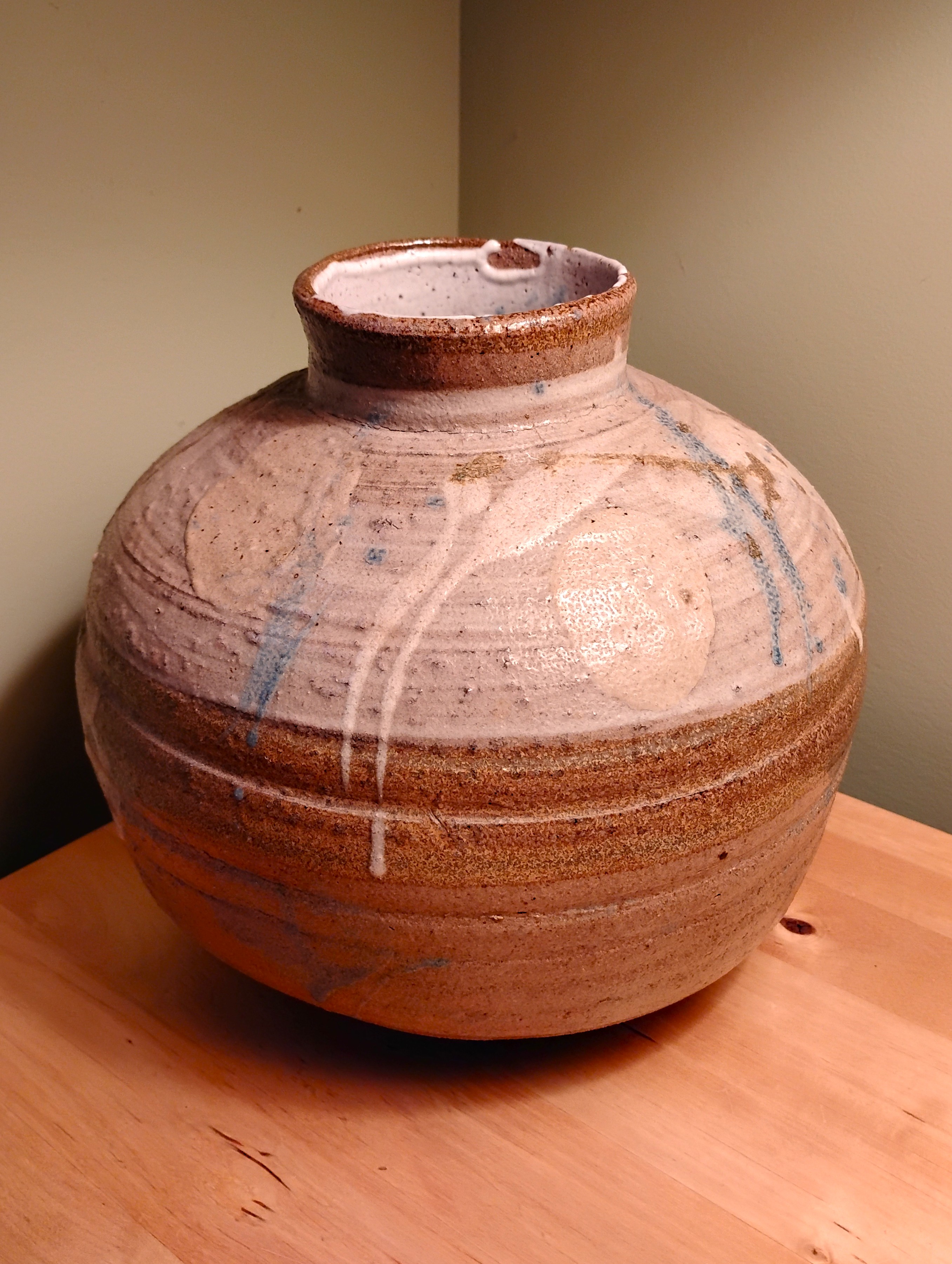
I am not entirely sure if this pot was made by Wayne Ngan. I bought it from a couple who’d set up a table at a huge swap meet at the site of the old Tillicum drive-in theatre (now the Tillicum Mall) in Victoria. They’d come from Hornby Island and were selling everything to spend a year in Europe. They had pots by various artists, including Gordon Hutchens, and they assured me that this large vessel was made by Wayne. It doesn’t have a seal so I can’t confirm it. But it’s heavy in the way so many pots were then and sometimes I put dried rushes or flowers in it. When I lifted it up to check once again for a seal, there was a stick of driftwood sticking out of, left over from wind-chimes I made a few summers ago with my grandchildren, also emblems of the 1970s!

These wind-chimes hang by our front door and a rose has sent out a tendril to join the music before winter. Sometimes I see Anna’s hummingbirds paused on it between sips from the feeder which hangs just to its right.

Sometimes I just take one of the pots in my hands and hold it. There’s life to them, life in their shapeliness, their inner space. In a wonderful interview with Spencer Bailey on the podcast Time Sensitive, the potter Edmund De Waal says this:

I think it’s completely my grounding, really, which is that the making of one vessel and then making another vessel, taking it off the wheel, making another one, has an extraordinary element of rhythm within it. But at the heart of the rhythm, of course, is this interior space of a vessel, which is a breath. And so, there’s an embodiment there. It’s almost a breathing into the vessel. I don’t want to sound like God or Prometheus, but, for me, a vessel, it’s a container of breath.

Surrounded by things made of earth, shaped by hands, I am in the foundational time again, the one I wrote about in my novella, Winter Wren. What mattered then matters now. The quiet of a west-facing house, the view at dusk, finding a way to live a life in which these things have a place, a place known and loved and cared for. I think it’s completely my grounding, really…Yes, and yes, and yes.

“Clay ties itself/in knots for you.” (Jen Hadfield)

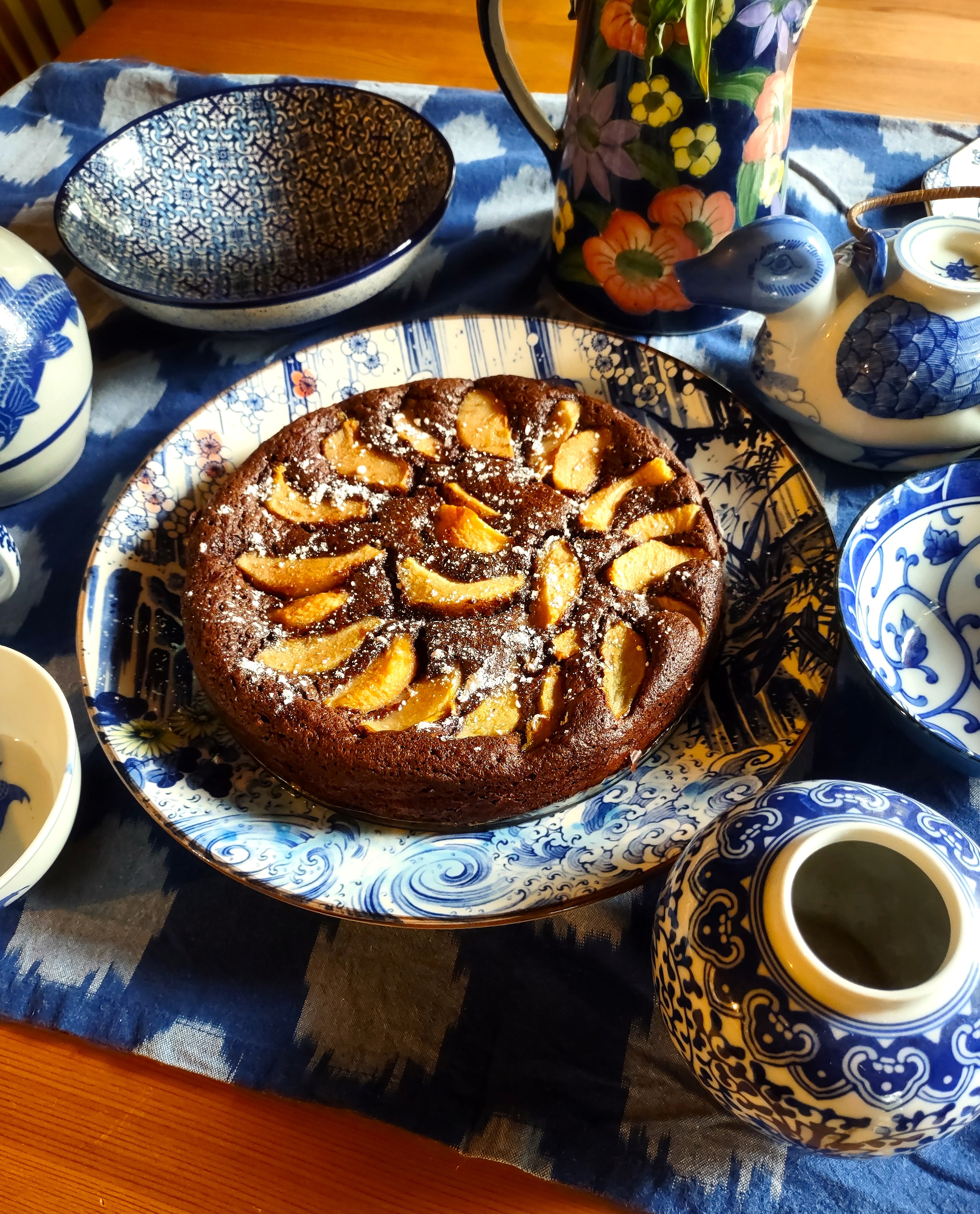
I was just reaching into a high cupboard for a platter — the one with the fish towards the top of this photograph — reaching for a platter to unmold a dessert I baked late morning for a dinner tomorrow evening. And suddenly all I could see was blue. Without ever really intending to, I have accumulated a collection of blue and white porcelain, pottery, serving dishes, little bowls I’ve bought in places like Granada and Porto and wrapped in t-shirts in my suitcase. These pieces are perhaps a third of what I have, not counting two sets of dinnerware, one (incomplete because I never intended to have matching stuff, and also because John once dropped most of the plates when his sleeve caught on a chair-back as he was clearing the table) of Wedgwood Midwinter Moon and one of John’s mother’s Blue Willow, passed on to us at the end of her life.

Clay ties itself
in knots for you.

Clay ties itself in knots. It’s rolled out, turned on a wheel, is glazed, fired, finished. I love the pieces made by hand — the vase at the back with blue fish leaping around its circumference, bought for me when John and Forrest went to Ucluelet at least 30 years ago and brought home gifts for the rest of us. I love the blue duck teapot, perfect for one or two cups, found in Vancouver’s Chinatown for a few dollars more than 35 years ago. I love the little Portuguese plates in the foregound, chosen from stacks in a small shop below our hotel room in Evora in 2015, wrapped, yes, in t-shirts, and brought home intact.

This is how we entertain our Shadow.
How stone moves in to stake a claim in the valley
a silk invasion, oblique, polite…

It’s the colour I love most. Drawn to blues like sun to shadow, drawn to blue and white china like Oscar Wilde, who had an enviable collection. But he also said “”I find it harder and harder every day to live up to my blue china”, a sentiment I understand: the aesthetic quality of these unmatched pieces on my table remind me of my own failings. When was the last time I laid a table nicely for guests? Too long.

But today? I opened a cupboard and saw the beauty. I carefully took down the teapot and platter, moved a few other plates and bowls from the sideboard in the living room, a mug from John’s hand (he’d finished his coffee!) Every piece has a story. Some came to us from our parents, were gifts (the little Chinese pot, the one I love to fill with grape hyacinths in spring, was given to us by the late Lala Heine-Koehn as a wedding gift in 1979), the octagonal plate on the far right was John’s grandmother’s, and the tiny white bowl near the top left is what John calls “foundational”, meaning that when we met, in 1979, I had only a few fish bowls in my kitchen cupboards, the ones you could buy in Chinatown for less than a dollar, and which sort of formed my sense of what beauty and function could look like.

Clay ties itself in knots for you. When you hold a pot or a bowl or a vase, when you cradle a plate in your hand, you are adding to the patina of its history. It has a pulse, if you pay attention. And that pulse is also yours.

From clay we learn to lose our train of thought
in satin whirlpools’ marbling weight
– what was I saying?

Oh, and the dessert? It’s a chocolate, walnut, and pear torte, and it looks beautiful on the blue fish platter.

Note: the lines of poetry are Jen Hadfield’s, from “The Porcelain Cliff”

Friday gallimaufry

Remembering:

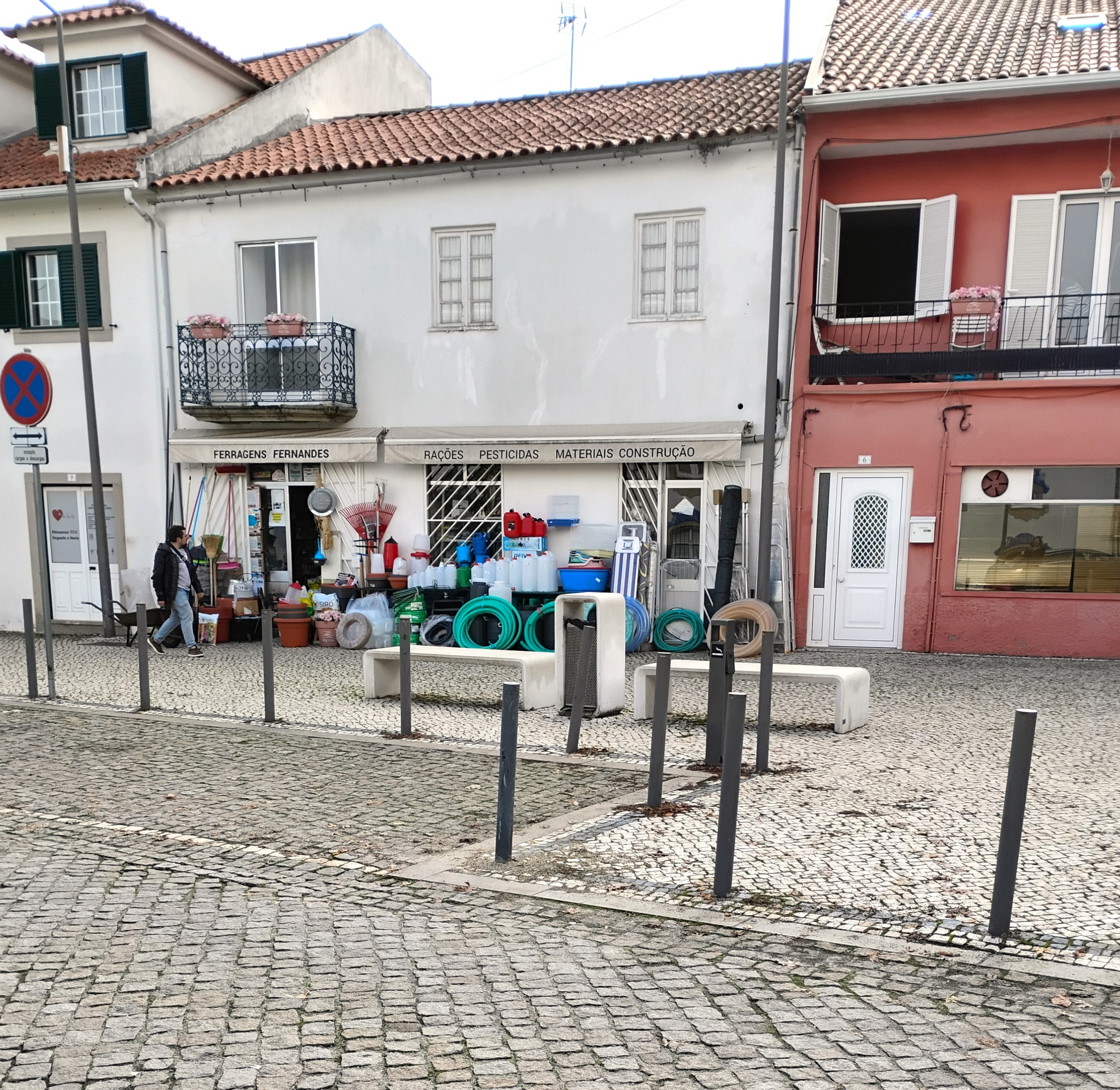
We passed this store in Vila Nova de Foz Côa every time we walked up from our little flat to shop on the main pedestrian street. There were often men standing around outside, talking. Were they discussing politics or house repairs or weather? Who knows. On the day we went into the store to buy a corkscrew (our flat didn’t have one and the kind woman in the little grocery store gave us one to use but we thought we should buy one and leave it in the flat), I’d practised the Portuguese for corkscrew –saca rolhas, saca rolhas — and the man went directly to a wall of boxes and located two for us to choose from. We didn’t need pesticides, didn’t need the sack of alfalfa pellets by the front door; we didn’t need a rake or a coil of pvc pipe.

Eating:

At the Nepalese restaurant in Kew, I loved the dal saag and will try to make it here. At a little bakery in Hampstead, just after we’d been to the Keats House and just before we hopped on a bus to visit Freud’s House, I had the best sourdough toast with soft avocado and a single poached egg, dusted with chile.

Watching:

The sun is going down earlier and earlier. Yesterday we were driving home from Sechelt just after 4 and the whole western horizon was orange with its setting.

Listening:

Somehow I found myself listening to one of my favourite songs led by Dick Gaughan, accompanied by Emmylou Harris, the McGarrigle sisters. Rufus Wainwright, and others. Emmylou breaks my heart (in a good way. I think…).

Finishing:

I’d like to finish this single cloth (two single lengths, actually) I am making, using linen dyed in summer in an attempt to learn more about the dye process. I’ve used indigo (which I’m quite familiar with, although I can never predict the results) and rose madder and sitting with it, a section taut in the wooden hoop, I am back in summer, my dye pot simmering on the little hotplate, the fabric held down in it with a big rock. I am back trying to find in colour a correlative for my wistful sense of the world. I’d like to finish.

Appreciating:

The work done by the team at Thornapple Press as they prepare my book, The Art of Looking Back: A painter, an obsession, and reclaiming the gaze, for publication in the spring. (I love the endorsements…)

Hoping:

As I listen to Emmylou sing, I am hoping that the summers will return to us, warm and sweet, the roses tumbling over the garden fence, bees in the oregano, honeysuckle weaving through the deck railings, scented geraniums brushing my legs as I climb the stairs to the front door.

I will build my love a bower
By yon clear and crystal fountain,
And all around the bower,
I’ll pile flowers from the mountain.

“The door has a creaking latch.” (Pound)

We were sitting in O Freitas, around the corner from where we were staying in Porto last week, drinking Douro wine and talking about corks. The restaurant had a whole structure–a wall, sort of– built of corks in one corner and after the waiter pulled the cork from our bottle of wine, he tossed it into the glass lamp shade over our table. It joined the others there, waiting perhaps for enough of them to accumulate for another wall. In Vila Nova de Foz Coa, Antonio told us that bottles of Portuguese wine were always stopped with a cork, never a screw-top (though some of the ones that make their way to Canada are certainly screw-top). This was after we’d stopped by an oak, Quercus suber, the evergreen cork oak, and I’d fished a few acorns out of the duff at its feet to bring home to plant.

We were talking about corks. I remembered reading in one of Richard Olney’s wonderful books that he’d made a curtain out of corks to hang in the door of his rustic home in Solliès-Toucas to repel flies. I remembered reading that although the house was not grand, one ate very well as a guest at Richard’s table. His wine cellar was legendary. He grew herbs and salad and bought as much as he could from local farmers, olive growers, and so on because he didn’t own a car. An enviable way to live — a house in Provence, beautiful wine, olive oil from around the corner, lights strung in the trees around the terrace, all presided over by a resident toad. And you know I don’t mean Richard Olney. This was a real toad named Victor.

O Freitas had a handful of tables, a charming server who said his mum was the cook and she used a lot of garlic, and a long rough log fastened to the top of one of the walls, the one above our table. It’s from our village, the young man told us. He brought out a platter of sea bream grilled with herbs and garlic and another platter of what he’d described as boiled potatoes and maybe they’d been boiled first but then they’d been smashed and coated in oil and herbs and roasted a bit to crisp their skins.

John surprised me by quoting a few lines of Ezra Pound, ones I wasn’t familiar with:

The haven from sophistications and contentions
Leaks through its thatch;
He offers succulent cooking;
The door has a creaking latch.

We talked about what this meant in a world where the striving seems to be for more and better. A kind of empty perfection. I thought of Richard Olney cooking his sublime stews or grilling the chicken he’d first flattened and then stuffed wild mushrooms under the skin. His doors were fashioned from wooden wine crates, and there was that curtain of corks. When we returned to our temporary home (the same one we stayed in when we met Forrest and his family in Porto, late winter of 2024), I looked up the poem. It was “Hugh Selwyn Mauberley”. I think Pound might have been using sophistication in its old meaning(s):

early 15c., sophisticacioun, “use of sophistry; fallacious argument intended to mislead; disingenuous alteration; an adulterated or adulterating substance,” from Medieval Latin sophisticationem (nominative sophisticatio), noun of action from past-participle stem of sophisticare “adulterate, cheat, quibble”

The meal we had under the rough log was elegant. We ate every morsel of the tender fish, and those potatoes! They were heavenly. And when we left, I can’t be certain, but I think the latch creaked as we closed the door.

meander: the metaphysics of rivers

It might sound dramatic but I went to Portugal to see something I almost couldn’t see. Literally. I’d been reading about Paleolithic rock art for the past 2 years, travelling last fall to see some of the caves in the Vézère Valley, and then after reading more, mostly about the Côa Valley east of Porto where panels of rock were incised with animals and a few abstract forms between 25,000 and 10,000 years ago.

There was one image in particular I wanted to see: some fine parallel lines, two sets of them converging, on a rock above the Côa River, near where the Ribeira de Piscos, a small creek, flows into it. I’d read about this rock last spring in Genevieve Von Petzinger’s book, The First Signs: Unlocking the Mysteries of the World’s Oldest Symbols. Her husband, a photographer, accompanied her on a quest to gather data on the abstract images that often accompany the animals depicted on cave walls or rock panels in open air. In her book, there’s an enhanced photograph of the lines, which she identifies as a meander. For some reason, I couldn’t forget this image.

The morning we drove with our guide Antonio to the Ribeira de Piscos site was quite a nice one, mostly sunny, with big tumbling clouds, though there’d been rain during the week and he warned us that the hike from the parking area to the rock art would be a bit precarious because the ground would be slick. There are some areas of narrow path skirting rocky slopes above the river. You wouldn’t want to fall….The path led through old olive groves, past wild fig trees, feral almonds, Pyrenean oak and cork oak, and the trees and grass were filled with birds: blackbirds, Iberian magpies, horned larks, robins, sparrows of some kind, and when we reached the river itself, swallows were swooping over its surface. I’d asked Antonio if we would see the meander on our visit and he seemed surprised I knew about it. I will show you at the end, he said, though it will be hard to see. Because of its location, and more, it wasn’t usually part of the visit.

Across the river, a shepherd was following his flock. The sound of bells was about as beautiful as anything I’ve ever heard, bells in quiet air, a riffle of water now and then as a cormorant lifted off. We saw the panels of rock engraved or pecked with horses, ibex, aurox, even a human figure with an enormous erection (no surprise there). We talked about style, context, the skill of the artists. We talked about how these animals were not necessarily part of the diet of those who took the time to make their likenesses in rock. The archaeological record seems to suggest that smaller animals were eaten, as well as fish, seeds, roots, and birds. Were they thresholds, then, a way to participate in something divine? We heard bells again as the sheep skipped down a slope with the shepherd at their heels.

When it was time to head back — this was a long morning, more than 3 hours, with a good part of the time spent driving in Antonio’s 4×4 to get to the parking area and back from Vila Nova de Foz Coa — he said he would show me the meander. John, who has an unreliable foot due to a surgical injury, didn’t feel confident about climbing a steep path to the rock. But I wasn’t going to miss it for the world. Antonio had a small laser light and when we reached the rock, he used it to trace the course of the lines delicately incised into the surface. Delicately incised into the surface something like 20,000 years ago. Can you see, he said, and yes, I could, but I knew there was no point trying to take a photograph with my phone. So much depended on sunlight and it was capricious, out for a few minutes, then moving behind the clouds. Can you see, and I could, holding my finger as close to the rock as I was allowed to, following the route. Turn, he said, and I did, looking down the slope to where the Ribeira de Piscos met the Côa.

Some of the signs in Von Petzinger’s book are abstract. We can guess at what they might mean but will we ever know? Will we? I don’t know. But this one, the meander, the two sets of lines converging on a rock set in a high place above the convergence of two water courses, feels like a sign I need right now. Maybe you do too? A sign to pay attention. To take the precarious route up the slope, to learn to concentrate, to focus, to see the gift of water as a kind of holy thing. A dry and sinuous landscape. A river runs through it, fed by another, and another. In the olive trees, Iberian magpies plucking the ripe fruit, larks calling, and everywhere the river.