“There are so many things I want to say.”

echoes

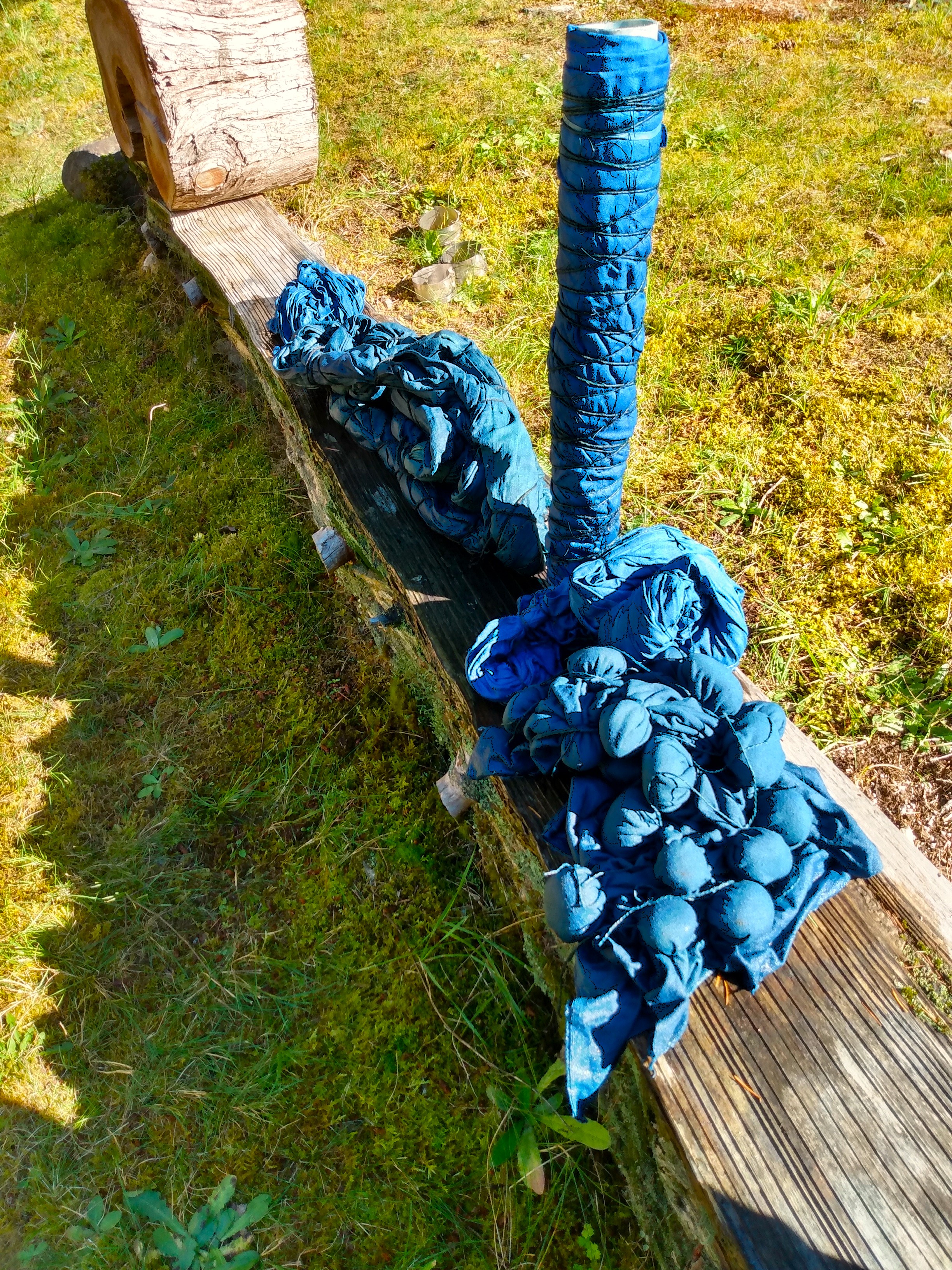
Yesterday we were headed down to the lake for my swim, maybe one of the last lake swims of the year because the air temperature was 8 degrees celsius and the water wasn’t much warmer, and we were talking about the big dye lot I’d done the day before. Actually, as we were on our way to the lake, one last length of fabric was waiting to be dyed–coarse linen I’d batiked salmon onto and then immersed in indigo a few years ago. It was the last of the dye and it didn’t really take. So I thought I’d overdye the linen and see if I could enhance the colour a bit. So we were talking about how the whole experience surprises me over and over again. I know one can approach indigo (and other natural dyes) in a systematic and scientific way, taking ph readings and so on, but my method (if you can call it that) is to give myself up to the process. I tie, sometimes I clamp with little squares of plywood and dollar store clamps (or clothes pegs), sometimes I use wax to make images for surface design. I wrap fabric around pvc pipe or wooden poles. I gather fabric around beach stones and tie them into place, sometimes randomly, sometimes in a grid, and then I prepare a vat of dye. The vat is a big plastic tub that’s otherwise used for garden work and I set it up on a long cedar bench by the vegetable garden. That way I can immerse the fabric into the vat and wait for 20 minutes or so, removing it to rest and oxidize on the bench before repeating the whole thing 6 or 7 times. While the fabric is immersed or while it’s resting, I can check out the cabbages (huge savoys I started from seed bought in the Mercado do Bolhão in Porto in March) or just look at the roses growing over the garden gate.

apricot roses

I never know what to expect. Or perhaps I mean that I don’t expect anything. I don’t know enough about this pursuit to have expectations. I don’t have confidence in my own grasp of technique. And I am always thrilled with what happens–the surprises of pattern, the intensity or not of blue, how string can mimic ripple or eelgrass, how the wrapped stones become snow angels or owl wings or jellyfish. If I knew enough to manipulate more decisively, would I be happier? I don’t think so.

As we went down to the lake, I wondered how the things I’d been preoccupied with all spring and summer found their way into the fabric. Those jellyfish drawn to the light of our boat anchored in Hemming Bay on East Thurlow Island, the ripples generated as a trout surfaced for insects while I swam on a September morning in Ruby Lake, the turbulence of my heart and mind echoing the waterways of the planet, and the memory of a walk on the Brem River estuary in April, watching for grizzly tracks. It’s like writing, said John. We think we are writing about one thing and we discover something else entirely. But the difference, I said, is that when I’m writing, I don’t have expectations necessarily but I do have some confidence in my ability, my knowledge of technique. I know the hoard of imagery and experience I’m trying to access. This is so different somehow. I’m reminded of Ann Hamilton’s wonderful essay, “Making Not Knowing”:

One doesn’t arrive — in words or in art — by necessarily knowing where one is going. In every work of art something appears that does not previously exist, and so, by default, you work from what you know to what you don’t know. You may set out for New York but you may find yourself as I did in Ohio. You may set out to make a sculpture and find that time is your material. You may pick up a paint brush and find that your making is not on canvas or wood but in relations between people. You may set out to walk across the room but getting to what is on the other side might take ten years. You have to be open to all possibilities and to all routes — circuitous or otherwise.

I was dyeing linen and cotton with indigo dye. I was thinking about the life I am living with its beauty, its damage (to myself and others), the lost opportunities, the blessings, the disappointments. In the woods behind the garden shed, a pileated woodpecker was pecking so loudly I thought John must be hammering boards together. In my heart, both joy and bitterness. The disposable gloves kept slipping so that I have rings of blue around my wrists. There are so many things I want to say. This morning, a basket of blue fabric, washed with mild detergent, ready for the winter. I have gathered my sharp needles, my strong thread, the tiny golden scissors shaped like a crane.
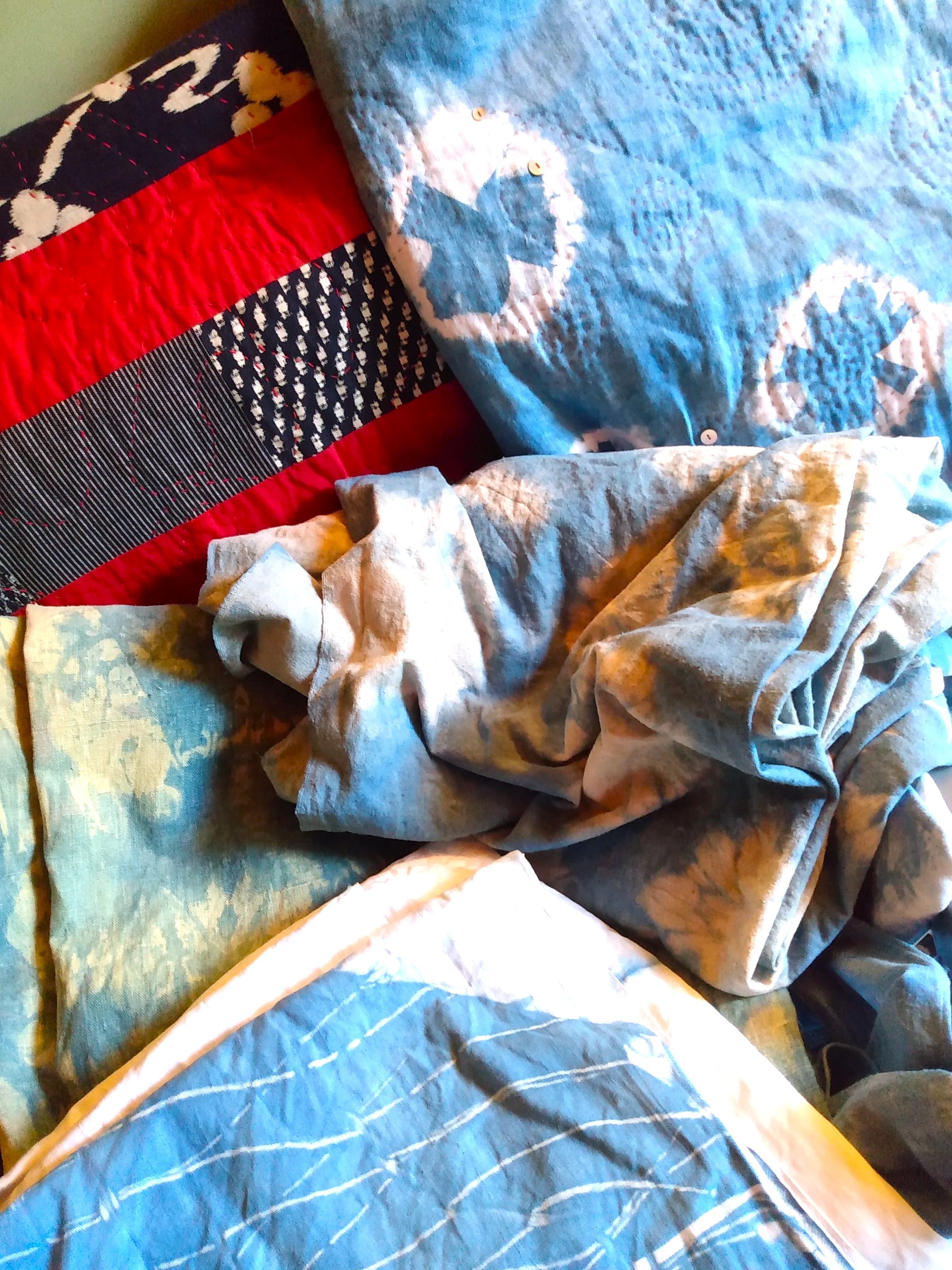
basket of blue

blue morning

ripples

Last spring I prepared some fabric for indigo dye work but other things transpired. I fell into a deep dark hole I hadn’t noticed was there and it took time to figure out how to extricate myself. It was my fault. And it took time. I could not find the time to make a dye vat and do the work of immersing the bundles of knotted or tied or wrapped linen and cotton. But towards the end of summer, the issues were resolved, although of course nothing is ever entirely resolved. Or it is, but you are different. You are more careful. You are quieter.

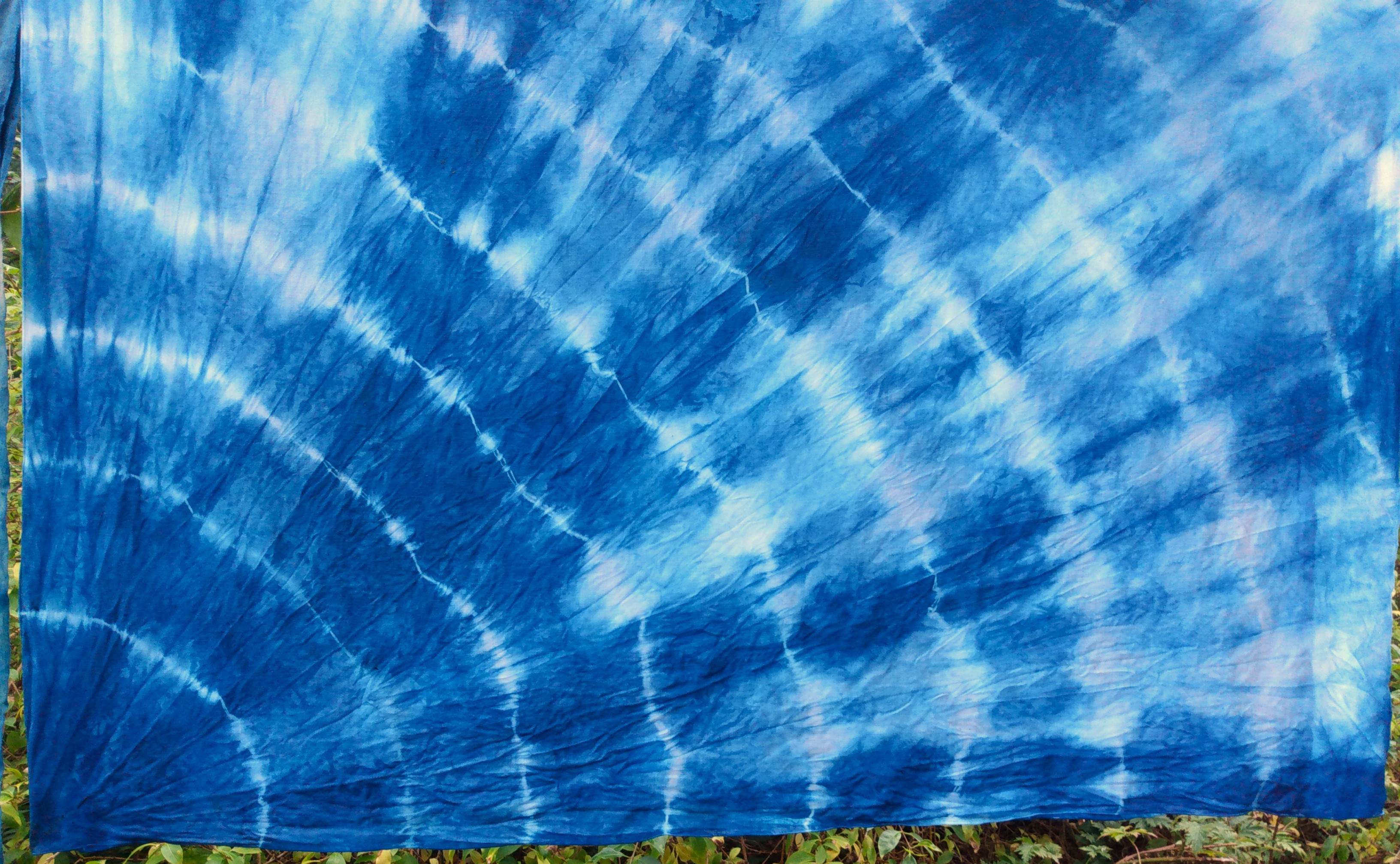
But what you have, what I have, is time. Yesterday, while swimming, watching the ripples after a silver trout jumped out of the water, I thought, Spend the day remembering everything. Remember the ripples, the jellyfish glowing in the lights of the freighter you spent 5 nights on in April (you peered through your porthole after midnight and saw them), the Brem River estuary. An indigo vat takes time. And I love the process of this work, how it begins as a faith in the unknown, because honestly I never know what to expect. I don’t expect anything. I give myself up to the process, the long afternoon of dipping the bundles in dye, then removing them to oxidize, asking myself, Is this the 5th immersion or the 6th, and adding one last immersion just to be sure. All night bundles waited on the long cedar bench by the garden. The tall one is linen wrapped around a length of pvc drainpipe. The knobbly one is beach stones wrapped with hemp string.

7 dips, before rinse

I was awake before 6 but made myself stay in bed because it wasn’t really light enough to go outdoors to begin snipping the string and unwrapping the fabric. But just after 7 I was out in my nightdress with a cup of strong coffee, snipping in excitement, taking each length to the clothesline to hang.

hanging out

The pieces on the right are actually one long length of beige (maybe simply unbleached) linen from Ikea, 5 meters I think, wrapped and twisted and tied with string. After I wash it later today I’ll have to figure out how to hang it to dry because it’s so long. I love how the areas kept from dye with string and tight wraps turned sort of greenish. The image at the beginning of this post is a linen tablecloth, a bit stained, that a mouse had nibbled the exact centre from — it was folded in a drawer. Yesterday, on a whim, I wrapped it on the diagonal, not sure what the result would be. I love it. The little hole will be mended. You can see the linen on the other side of it, spangled with jellyfish. Because of how I’d folded the fabric before tying in beach stones from Trail Bay in Sechelt, some of the relief areas are mirror-images of themselves. Who could have predicted that? A more detail-oriented person perhaps but I’m not her.

And my favourite, or at least my favourite moment, is this:

corner

Eelgrass, estuary, cracked rock.

So this morning the clothesline holds what I learned during the spring and summer, how deep blue can hold both anguish and hope, it can hold possibilities of light in its shadows, and how everything is in flux, ripples radiating out and out and out, gravitational waves, across space and time, and given a place in coarse linen, a radiance.

blue trio

redux: It’s not silence I’m afraid of

Note: 4 years ago today, we were in Vancouver, in the middle of a global pandemic, dealing with the aftermath of John’s bilateral hip replacement surgery. He suffered a surgical injury during this time, resulting in a paralyzed right foot. He has adjusted to this, manages to do almost everything he did before the injury (firewood, regular swims, building projects, walking cobbled streets in beautiful European cities), but I remember the days when he was in a room at the UBC hospital and I was staying nearby, alone, because I was advised to think of him as medically fragile as he recovered; this meant no contact with friends or family. I remember those days, their darkness, and their moments of light.
Note 2: When we were driving down to the lake just now for my swim (John is back in the pool but I don’t want to give up the lake just yet, even though it’s cold!), John said he’d read this post and that he thought his surgery had been in October, 2020, not September. And he’s right! So I am ahead of myself, looking back. Ah, time’s metaphysics…

sunday morning, quilting

Because John is in hospital and visiting hours are limited, I am spending a fair bit of time in my rooms nearby. It’s very quiet here. I brought the wonderful Topeka School to read (Ben Lerner’s new novel) and I also brought two quilts to work on. Reading is best at bedtime, to sink into Topeka, Kansas, and the lives of the protagonist Adam and his parents; and quilting is good by the window in the afternoons when the weight of what’s to come in the next few months is heavy, not just in a metaphorical way but in my limbs, my thinking. I anticipate that John will make a very good recovery from his bilateral hip replacement surgery. It’s the unexpected thing that presents uncertainty. Will he regain the use of his right foot or will he have to learn a whole new way of moving in the world, compensating at every step for the loss of feeling, the damage to his nerve. Whatever happens we will do our best. When it’s light out, the trees brilliant gold and deep orange, the house finches busy at the work of opening maple seeds, I am ready for anything. But when the weight settles, I pick up my quilt and stitch free-hand spirals into the sashing between the log-cabin blocks. The process of moving out from the centre and then letting the thread find its way out into the open space is calming, in the way I suspect meditation might be. My meditations are of the practical sort though; they always have been. Kneading dough, weeding, watering tomatoes and easing their unruly stems around strings leading them upwards. So I’ll stitch and hope that the threads will take me–us–in the direction we need to go now. Sure-footed or not.

Why are you so afraid of silence,
silence is the root of everything.
If you spiral into its void,
a hundred voices will thunder
messages you long to hear.
                      –Rumi

the firewood palpitations

“All to gather the dead and the down.” (Gary Snyder)

firewood palpitations 2

We heat our house primarily with wood. We have an airtight, a Regency (painted blue), in our big kitchen. From about now until, oh, early June, the first person down in the morning makes the fire. We have a mat in front of the woodstove and 3 chairs (2 wicker armchairs and one rocker) near the stove. The part of the house we mostly live in is open, though of differing levels: living room up one stair, our (big) bedroom the entire second storey, with open stairs leading to it. No door. So the heat circulates, with the help of a ceiling fan. There are electric baseboard heaters but they’re an expensive way to heat so we just use them as a last resort. A few years ago we also had a mini split installed.

So firewood is often on our minds. Parts of our land–8.39 acres–had been logged some years before we bought it in 1980 and there was a fair bit of wood around to clean up. And in windstorms, trees would come down. We also had a pickup truck in those early years so when trees came down near the highway, we could take a chainsaw and fill the truck. But now we’re older, maybe even old, and we no longer have a pickup. You’d think it would be easy to just call someone to deliver a couple of cords of good seasoned wood but you’d be wrong. Some years a guy will park at the shopping area in the village near us, an old truck loaded with carefully stacked dry fir, maybe some maple. You talk to him and he follows you back, throwing the wood off the truck so you can stack it in the woodshed. You tell him it’s good wood and you’d like more. Oh sure, he says, holding up a hand with missing fingers. You never see him again.

Or someone knows someone who knows someone. His list is long but he’ll try to get to you. Sometimes he does. Often, not. This year John spent part of the early and late summer cutting up the rounds of cedar remaining from the standing dead (victims of climate change) in our woods. But cedar isn’t ideal. It became, well, a daily topic of conversation.

Then John learned about the Community Forest woodlot. Yes, they can deliver but wow, the price was so much better if you could pick it up yourself. A friend happened to drop by for coffee, someone we love but don’t see often enough because he fishes long seasons, and when we told him about the woodlot deal, he became visibly excited. He and his family are like us. They heat with wood too. And it turns out that they are rich (right now, not forever) in pickup trucks, including one we could borrow. He’d be away but John said we could help them if they needed help with wood. On Friday we went to the woodlot and filled the pickup with stacked seasoned fir (mostly; there was a little alder and cedar mixed in). We also filled the back of our Honda Element, the rear seats removed. The people there helped with the stacking. On our way back home, we stopped for coffee and John took a photograph of the wood and sent it to our friend’s partner; excited texts went back and forth. While we were having coffee, we unexpectedly met with other friends. When they saw we’d filled two vehicles with firewood, they immediately offered us whatever we wanted from a whole lot they had at their place, the result of trees coming down–a big grand fir, hemlock, and alder. They no longer burn wood and wanted to give away other seasoned wood they’d been storing. So this morning, when we were taking the truck back to our friend, we stopped on the way and filled it with wood for her.

firewood palpitations

When we dropped off the truck, we stood in the sunlight and talked about firewood. Two sources! Enough for all of us! Good wood! I could hear the relief in John’s voice, and in Amy’s too. I joked that we were all having firewood palpitations! This time of year, there are things you want. You want the pantry shelves lined with preserves, the bounty of your garden, and you want your woodshed filled. The talk was of hydro bills, the merits of one wood species over another, even the pleasure of splitting big rounds. John and Amy made arrangements to go to our friends’ to fill the truck again, soon, and then we headed home.

As John emptied the Element of its load of dry fir, stacking it in the woodshed in tidy rows, I picked the last of the beans, and removed the stakes from the tomatoes I decided wouldn’t ripen where they were, in the shade of an ancient fir. A big bucket of them came in to be laid out in a box. Returning to the house, I could smell the beautiful scent of fir as the last wood was stacked. Later in the week, if the weather is good and we can work out the truck, we’ll go get a load of big rounds for next year, grand fir and alder and a bit of hemlock. We never forget they were living trees and we are always grateful.

The pantry shelves hold their own bounty and there’s still more pesto to make for the freezer. In the greenhouse, eggplants, cucumbers, tiny olives beginning to swell. But it’s firewood that gives me palpitations, anticipating warm fires in January, a quilting basket by the rocking chair.

beans

redux: “There were other things.”

ivankivtsi church2

When I woke this morning, after a good sleep my first night home after two weeks in Ukraine, I thought of the church in Ivankivtsi, my grandfather’s village. Well, there are two churches, the new one and the old one. The old one was where my grandfather was christened in 1879. No one could have imagined that baby leaving, going to Canada, and more than a hundred years later, a woman trying to find traces of him in a landscape full of beauty. There were fields, a horse pulling a wagon down the dusty road, a baba carrying a pail of water with two apples floating on top. The priest came (summoned by the mayor, who made calls to everyone who might have information for me) and opened the church. He opened both churches and engaged my translator Vasyl in a long conversation about the dates of the green building which might have been 250 years or maybe 300. He would talk to his wife, who spoke English, about me and my search and he carefully wrote down Vasyl’s email address. In a way it was enough—seeing the village where my grandfather was born, seeing the church, decoding the Cyrillic characters of my surname on the WW1 memorial, one П. Кишкан. So imagine my surprise, a few days later, while I was seated at the table of an outdoor Hutsul feast in the small community of Bukovets in the Carpathian mountains where the little glasses of vodka flavoured with golden root (ginseng) were kept full for toasts, to have Snizhana come to tell me that Vasyl was on the phone: the priest and his wife had found some Kishkans in Ivankivtsi. When we returned to our hotel after the feast, they would be waiting to meet me.  I knew it was at least a 2 hour drive, on rough roads for part of the way (our hotel was up a long rubbly track which wound through farms and orchards), so I wondered if they could find us. 7 of them were indeed waiting, with gifts of champagne, a length of intricate textile, chocolates. We spent 3 hours together, with Snizhana bravely translating (because Kishkans are excitable), and although we don’t know quite the intricacies of our relationship to one another, we are confident that we are family.

There were other things. A woman making blankets in a workshop built over a river. Morning swims in cold water. Endless plates of delicious food and glasses of vodka, the red one flavoured with kalyna, the fiery one made with horseradish. Pulling aside the curtain at the end of my bed on the train traveling by night from Kyiv to Chernivtsi to see Orion stretched across the sky. Churchbells in Lviv. The smell of incense in the Armenian Cathedral. Eating bowls of kasha in the morning and remembering my grandmother’s cabbage rolls.

I am sitting at my desk, wondering how I will take the strands of what I found in Ukraine and make them into something approximating the texture and colour of a place that felt familiar. The schoolteacher at the feast in Bukovets said, This is your land. Come again and bring your children, your grandchildren. I wonder if my grandfather ever hoped to return? Or if I will?

ivankivtsi church

essence

“the permanent as contrasted with the accidental element of being”

apple butter

When I walked down the hall, I could smell the apples stored in the back room, in a box on cool tiles. They won’t last, I thought. And I thought of the pies I made a few weeks ago, unbaked, frozen for winter. The crumbles, one for a friend and two for us. The apples eaten with chunks of cheese, sliced into salad, melted with shallots to have with dinner.

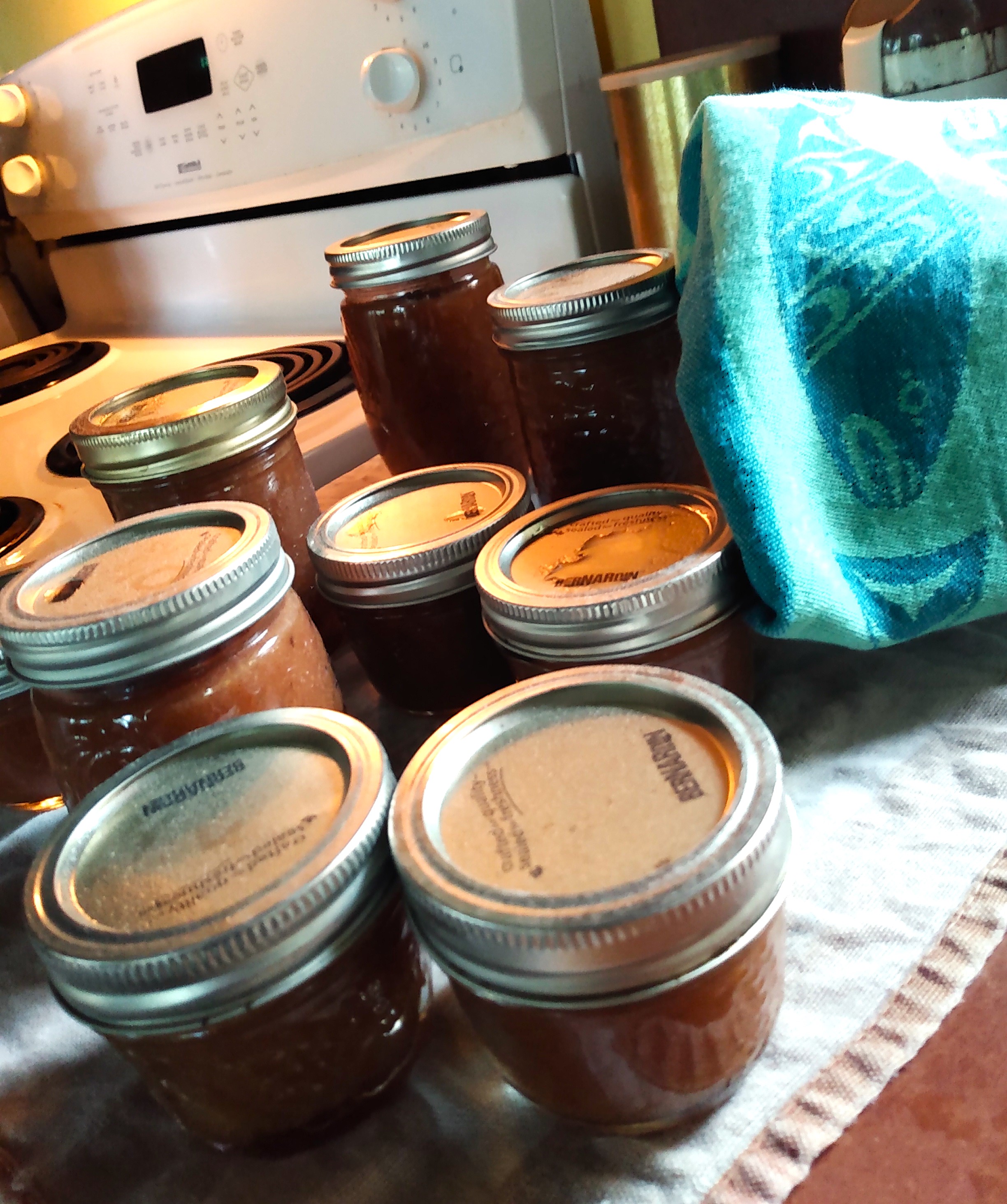
They won’t last. So yesterday I put 5 pounds into the slow-cooker, cored but not peeled, with sugar (cane and coconut palm), preserved ginger, a vanilla bean. 10 hours on low. Then overnight I left the crock by an open window to keep it cool. This morning I used an immersion blender to make a smooth butter (I forgot to remove the vanilla bean until it was too late but the blender is so good that it hardly matters; there are just a few flecks of vanilla here and there), along with a few tablespoons of minced fresh rosemary.

Reader, it’s delicious, the essence of fall days. I processed 10 jars for 15 minutes and there’s half a jar leftover; I’ll have some with my lunch–a chunk of aged cheddar on a slice of cheese and sage bread I made the other day.

This morning, swimming, I wondered how much longer I’ll go down to the lake first thing, before the sun, before anyone else, fish surfacing for insects, ravens loud in the trees, and the sand scribbled with tracks: raccoons, ducks, those ravens, the heart-shaped hooves of deer. The water is cool but not as cool as the air. Yesterday it was 9 degrees. I didn’t look this morning.

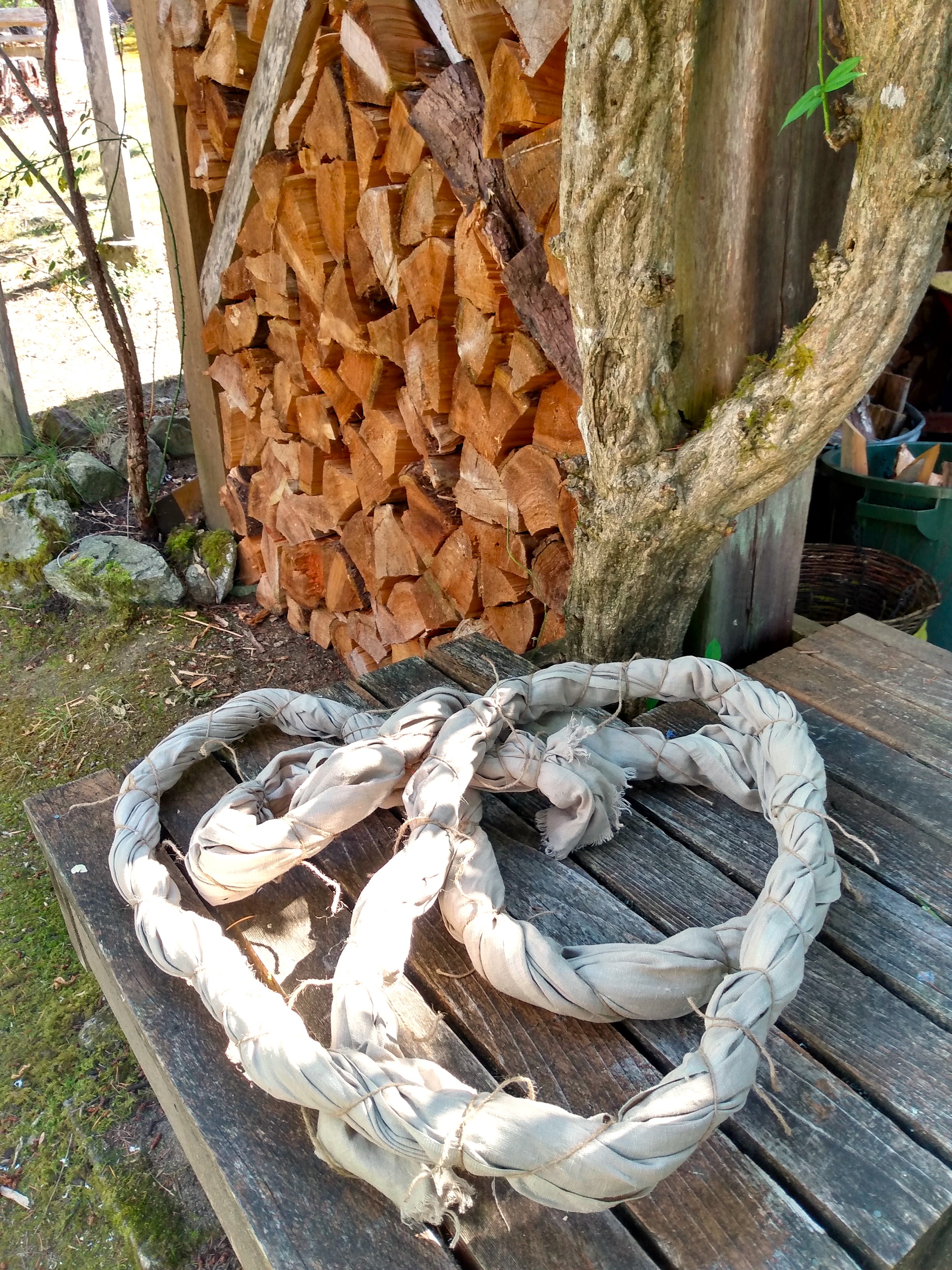
Yesterday I asked John to help me with a long length–4 meters– of coarse linen. When I’ve finished another load of wood, he said. He’s been splitting wood beyond the garden, cedars that we had taken down the year before last because they’d died during the heat dome. (Cedar’s not the best firewood but it will supplement fir and alder.) When he’d emptied the wheelbarrow, he held one end of the linen while I twisted it and wrapped it with hemp string. I won’t have time until the weekend to prepare a dye vat but I have other fabric waiting: more linen, wrapped around pvc pipe, cotton with beach stones tied in a random pattern, and some old damask tablecloths (stained, bought for a dollar each at a thrift shop) to overdye for the texture I’m hoping will result. I am hoping to preserve summer’s sky, the long blue mornings, the reflection of clouds in the surface of the lake. And when the fabric is dyed and washed and ready, I’ll think about how to use it: quilts, curtains, a tablecloth.

wrapped linen

The Merriam Webster online definition of essense:

the permanent as contrasted with the accidental element of being

I like that. Is apple butter more permanent than the accidental element of being an apple? Flavour distilled, concentrated, preserved? Cedar rounds on the forest floor split and stacked into a firewood wall, each piece finding its way into our woodstove where even now, as I write, a warm fire is burning? Indigo powder made into a starter with a reducing agent and a base, the stock added to hot water, and after resting, prepared fabric added, given a number of timed dips with a chance to oxidize, rinsed, unwrapped, rinsed again, hung to dry, and admired over and over again. Then used. I think ahead to beds weighted down with quilts, a few apples remaining in the box in the back room, the fire damped down for the night.

             …there may be two or three
Apples I didn’t pick upon some bough.
But I am done with apple-picking now.
Essence of winter sleep is on the night,
The scent of apples: I am drowsing off.
                        –Robert Frost, from “After Apple Picking”

morning (parenthesis)

morning parenthesis

This morning, at the beginning of my swim, a little silver trout jumped out of the water just beyond where I was heading, the curve of its body an opening parenthesis to my thinking. I was thinking about last evening, going out to the deck to bring in my towel and bathing suit. I looked down to the grass between our house and the woods and a huge bull elk was looking back. He hadn’t yet lost the velvet on his antlers. The sun had set but the sky was filled with pinky-gold light and he was glowing. He still had his summer coat, golden brown, and as he turned, wondering at the best course of action, it was like a moment out of a painting I’ve always loved, Pisanello’s Vision of St. Eustace.

about 1438-42

It’s in the National Gallery in London and when I was in my early 20s, working in Wimbledon, I used to go the museum on its free day (they’re all free days now) to look at it and a few other favourites. Going from room to room was overwhelming but I’d visit the Vision and add several others each time. I was drawn to the dogs, their expressions as they gazed upon the stag carrying a crucifix within its antlers. Not the last time we were in London but the time before, I went to the National Gallery to see if the painting still had its magic for me and oh yes, it did. Sometimes encounters, however distanced in time or space, even from a second-storey deck to the mossy grass below, feel potent. They feel deeply meaningful.

What it did it mean, to see the bull elk looking up at me? I don’t know. Yet. I called to him to go away (I suspect he might have been sniffing out the grape vines growing against the house and I know from experience* that elk can do a lot of damage) and he turned into the woods. I realized then that his harem was just beyond. They crashed away, a lot of them. (A harem is typically around 20 or so cows.)

Within the parentheses of my thinking this morning, the elk, the kingfishers I didn’t see today, the return of the chickadees who nested elsewhere this year but were splashing in the birdbath yesterday as we ate lunch on the deck with friends enroute from Savary Island to Gibsons, the nuthatches waiting in the mountain ash for their turn in the water, the tiny tree frogs, newly hatched and hopping out of the tubs of salad greens, the pots of mint by the greenhouse door, the ferns below the front porch. The elk remind me of walking into Natural History Museum in Dublin decades ago to stand among the skeletons of Megaloceros giganteus, the giant Irish elk (though not actually an elk but most closely related to fallow deer), their huge palmate antlers 11 feet across. It was a moment to feel both small and outside of history. The animals begin to appear in the fossil record 400,000 years ago and the most recent appearance is 8000 years ago. They are beyond us, beyond time, and yet they still exist–as skeletons, as paintings on the walls of caves in France and Spain. In a month, we’ll be France to visit them there. (I’ve wanted to do this since I was 20 and wrote a poem, published in my first poetry collection, about the caves of the Dordogne Valley. When I lamented to John that I would probably never see them, he went upstairs and booked a flight.)

In 2008, in late September, I was drinking coffee on the upper deck, the same one I stood on last night to confront the bull elk below, when I heard the strangest sounds coming from the woods just beyond, the same woods the elk crashed into last evening. Grunting, yes, and a sound like a shrill bugle. And I could hear more, not an echo, but the same sounds a little further away. There was crashing. I called my dad in Victoria (he’d hunted all his life and knew a lot about wildlife) and said, Dad, I’m hearing sounds in the woods and I wonder what they are? I held the phone, an old cordless phone, up to the air. He listened, and then he chuckled. It’s 2 bull elk, he said. They’re rutting and challenging each other for the cows. I remember there was such urgency to the sound. A year later my father died and there are many things I regret but calling him and letting him hear the bulls in my woods is not one of them. He talked about it in the months to come, as he grew weaker, and went into hospital, and never came home.

Sometime in the middle of the 15th century, Pisanello painted a stag with a crucifix held aloft in its antlers. St. Eustace looks in amazement, as do his dogs, though one hound chases a rabbit. The woods are tipped up and when you look closely, you see birds in flight or nesting in dark trees, you see a bear, two more stags, heavy with antlers, and tiny flowers on the forest floor. Sometime around 17,000 years ago, someone, maybe many people, painted animals–horses, giant elk, bears, wildcats–on a cave wall in Lascaux and even though we won’t be able to see the originals of those (though we will visit other caves where we will), I look forward to meeting them with the same astonishment as I met Pisanello’s stag and the elk on the grass below my house last night, the velvet on his antlers golden in the dusk.

This morning, one trout jumped at the beginning of my swim, and another jumped to close my thinking with its silver parenthesis as I finished. On the surface of the water, a maple leaf, some delicate feathers, tiny flies, the first sunlight on the islands beyond.

*elk don’t delicately nibble leaves or browse on clover; they tear trees apart–our old orchard a case in point–and they’ve dragged vines from the side of our house in the past.

redux: “And the world seen through them wavers sometimes, then comes into focus.”

Note: this was posted on September 11, 2016. John and I were talking about that time after our swim this morning. We were talking about calling Henry for his birthday later this morning and how welcome was the call, 8 years ago, telling us of his birth. I was recuperating from a bout of double pneumonia, which strangely I didn’t mention in the post, and what I didn’t know then was that it wasn’t really double pneumonia but a serious pulmonary embolism (apparently the two conditions have some resemblance), and that the rest of the fall and some of winter too I would be undergoing tests and procedures because one thing led to another and the respirologist I was referred to suspected metastatic lung disease. The long and short of it was that I recovered from the embolism, I didn’t have lung disease (the shadows disappeared), and that my life continued. But I was gifted with something: the apprehension of my ancestors in my daily life. In the night when I’d get up and come down to my desk to work by the light of a single lamp, I felt them around me. I felt hands on my shoulders, a comforting murmur of voices. I know how strange this sounds but I am grateful what it was, what it meant. And how it continues.

__________________

For the past two weeks, I’ve had the pleasure of having my son Forrest, daughter-in-law Manon, and 11 month old grandson Arthur staying with us. Daughter Angelica came for a week in there and a few days ago we had a call from Edmonton to tell us that grandson Henry was born to our son Brendan, his wife Cristen, and their 2 year old daughter Kelly. It was a time of intense family activity, immediate and far-flung. Our house thrived on being full of some of its former occupants, the bedrooms lively again and the bathrooms steamy. We kept making meals. Barbecued sockeye salmon, roast lamb, prime-rib beef, pasta with pesto from the tubs of basil on the upper deck, tofu in spicy sauce with Savoy cabbage from the garden, omelettes with smoked salmon and delicious little fresh buffalo milk mozzarellas,  salads made with garden tomatoes and arugula, blueberry pancakes…We kept opening bottles of wine — Prosecco to celebrate births and returns, beautiful Tinhorn Creek Gamay to have with that lamb, Wild Goose Pinot Gris to drink with pasta (and their Autumn Gold for the tofu). Provençal rosé with appetizers of candied salmon and guacamole. And luckily the Persephone brewery is right by the ferry so we could get our growlers filled with their Golden Goddess ale.

This morning the house is quiet. Oh, the washing machine is whirling around with its loads of sheets, towels, diapers (I have a big basket of cloth diapers so that visiting grandbabies won’t have to bring their own)…Quilts will be aired outside today before being returned to the beds.

So a quiet house and a mountain of work to return to on my desk. Essays to finish. A novella to enter again — though that will probably wait for a week or so as we are heading off on a short road trip into the landscape it’s set in: Thompson and Fraser Canyons. I hope to sniff out a few ideas and to make sure I have the geography right.

In the meantime, I just went into the kitchen to get some coffee and saw how empty it was. Well, empty if you can call a cluttered room empty. I was reminded of an essay I wrote last year and need to edit a little before doing anything with it. When I wrote it, I was thinking of all that a house contains, beyond what is immediately visible. I was thinking of attachment and love. And in a rueful way, I was admitting that I will never receive an award for tidiest woman on earth. My mother’s generation had a saying that was very high praise indeed, and it will be never be said of me: You could eat off her floors. But you could sit on them with a baby and roll a ball back and forth. You could build a tower with brightly coloured blocks and have that baby slam it down with his small fists. You could tuck that baby into the space between your knees and read him a story, maybe even Peepo (though it’s called Peek-a-Boo in later editions) by Janet and Allan Ahlberg, in which a baby is surrounded by a loving and untidy family. And that baby would love the book.

kitchen.jpg

A set of old windows over the sink is not elegant but the windows came from the house we left when we moved our lives here. That house was built in the early years of the 20th century and because it was being demolished shortly after we moved, we were invited to take some of the windows, a pair of French doors which we used for a sunroom off our bedroom (and in turn, the sunroom opens to a second-story deck built over an extension of the far end of the house). The windows open with old brass catches, some of the panes have wavy glass, and I love them for their quirky beauty, how they frame pink roses and a birdbath hanging from the eaves, how the world seen through them wavers sometimes, then comes into focus. On their sill, a moonsnail shell, a wooden hen, a garlic pot, the largest goose-barnacle shell I’ve ever seen, and other clutter. Each piece has a story and the stories make up a life.

In magazine photographs of kitchens, there is no clutter. A few canisters. A single flower in a glass vase. Maybe an arrangement of perfect vegetables on polished granite. No children’s drawings and magnetic poetry on the fridge. No newspapers on the table, no quilting projects in a large Ghana basket. We live here. We are not tidy people. We make food, eat it by the fire, read magazines and books which pile up on surfaces, bring in the logs which drop moss and bits of bark and maybe the floor doesn’t get swept as often as it should. Because I have always loved being in the kitchen, I’ve managed to overlook its aging surfaces, much as I overlook my own. I’ve always said, Our place is rustic. I never meant it as an apology. I meant, This is who we are. Who I am. I bring back stones from special rivers and beaches, bones from arid landscapes where animals die and their skeletons are bleached by the sun, fossils, feathers, and these decorate the other windowsills and the top of the pine dresser we use for table linens and bottles of liqueur. Dust settles on them in all seasons. And the world seen through them wavers sometimes, then comes into focus.

Dark River (1962), Dark Lake (2024)

This morning, early, I found myself reading about Lenore Tawney, the American textile artist. I knew a little about her before this morning but now I am longing to spend time with her work. In some ways she hovered in the area between art and craft, though I wonder if the distinction between the two bothered her enough to even think about it too deeply. She did what she did. She figured things out. She moved from weaving to knotting and back again. She made assemblages of stones, bones, feathers, wood. (I think of my windowsills.)

There’s one piece I am drawn to: Dark River (1962) — click to see an image of the piece at MOMA:

Dark River is insistently vertical—an elongated form, composed of some forty sections woven in black linen, that descends almost fourteen feet from the ceiling and calls to mind lancet arches in
Gothic cathedrals. When the work is viewed up close, the particulars of Tawney’s hand take precedence: the deft way she created a selvage edge, or repeated the same knot, perfectly, over a span of hundreds of threads, or how she used a single type of yarn to elevate the work’s formal elements, erasing distracting variations in color, texture, and weight. The overwhelming impression is that of a singular devotion.
— from Christina Bryan Rosenberger, Art in America, May 2020

What I love about it is the structural elegance and the relationship between the materials and the form. Those long vertical lines, the shadows in the linen! It embodies, somehow, a spiritual apprehension. I can’t imagine the patience and dedication required to attend to the materials in this way. Or wait. Maybe I can imagine. During the pandemic, my daughter Angelica taught herself to weave. She used thrift store yarn on a basic loom she made from a picture frame, weaving small tapestries she hung on driftwood, and when she realized how much she loved the work, she and her dad made a larger frame loom. The tapestries grew. I love the lyrical tree!

Angie's tapestry

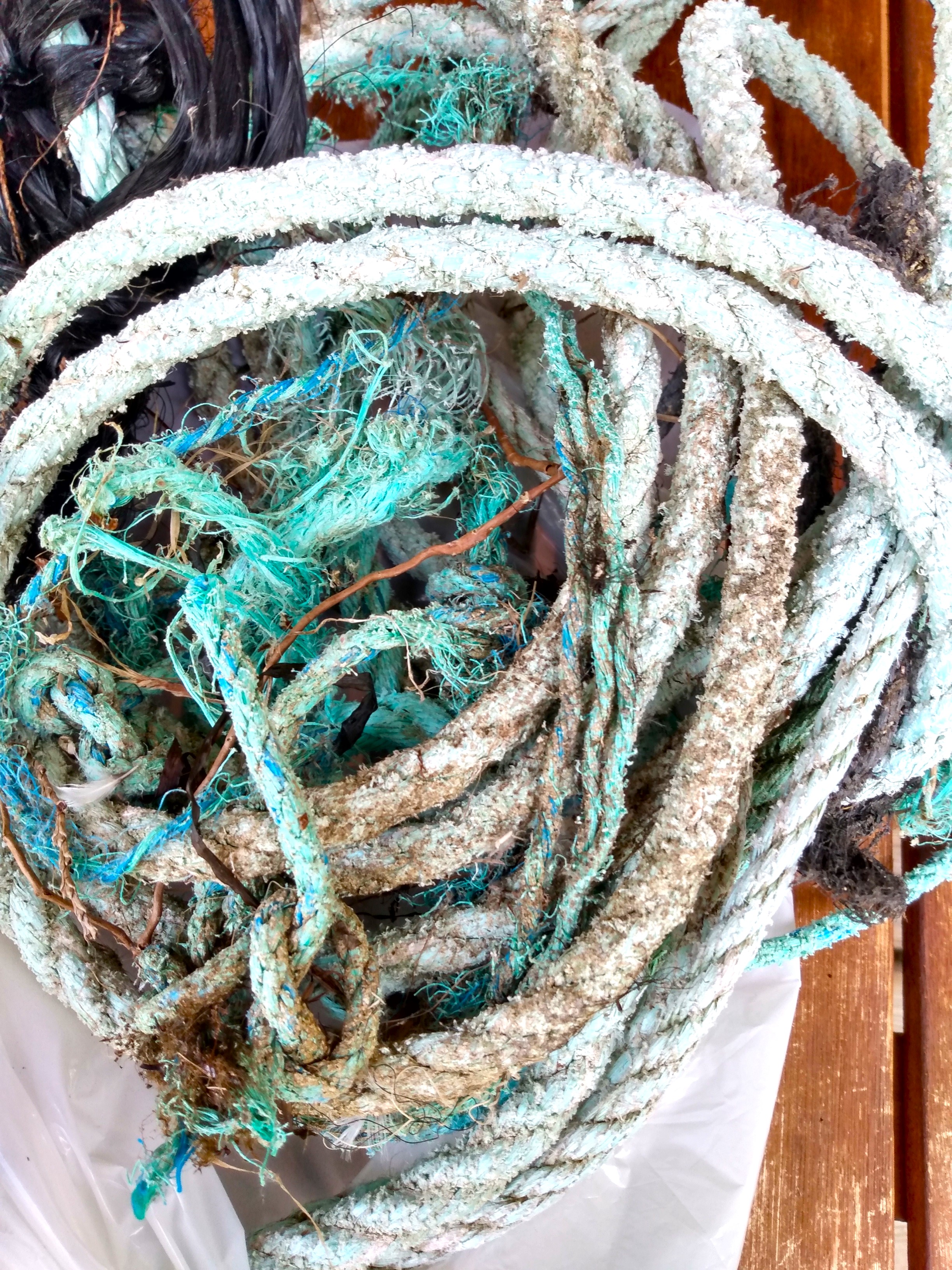
Many years ago, nearly 50, on French Beach west of Sooke, I found two Japanese fishing floats. Two, in one afternoon. I wasn’t looking for them but they appeared before me, cradled in driftwood and strands of seaweed, while beyond, big waves crashed to the shore. (It was late autumn.) I kept one for myself and gave one, the cracked one, to a friend. What did I do with my float? Nothing. I always meant to. In the Egmont Museum in early summer, I saw a group of floats and I spent some time looking at the nets holding the floats, examining the knots. One of the little display cards actually provided a web address for instructions to make the nets. I realized I had some rope that would work and I also had a bag of  raggedy rope gathered on a beach in Bute Inlet in April, hoping to do something with it.

rope

I’m going to commit myself to making a net for my fishing float this fall. I’d actually intended to do it when Forrest and his family were here in early August and he was enthusiastic about helping me to decode the instructions but somehow the days filled with swimming, adventures, chores, making large meals and then cleaning up after them. So the packages of nautical rope are on my desk, unopened. When I opened the bag of Bute Inlet rope to take the photograph, I could smell seaweed and salt. How to knot that into a net for the float and for the memory of gathering both of them on wild beaches?

There are mornings I hang in the lake like a knotted piece of string. After my laps and before I come to shore, I hang vertical, not quite in place — the water carries me a little shoreward. Not the green water lit by the sun but the dark depths. It’s a moment between states: a woman swimming and a woman in place. Could I knot that moment into the net too? Knotted and woven and hung from a branch? The smell of the lake, two kingfishers gliding over John’s head to the cedars, a trout jumping, two mornings ago an otter swimming 50 feet away, and crows arriving to check out our towels.

dark lake       

redux: “There are moments in our lives which, threaded, give us heaven—” (Jorie Graham)

Note: I first posted this on June 8; this morning, swimming under a cool grey sky, it felt like a page had turned, a season had passed. In a way it has. And I’m pulling out my quilting basket, put away for summer. I have in mind the quilt I wrote about here. Swimming this morning, I thought about it, how I could include the drowned wasp, two tiny feathers, one cradled in the other, the sight (yesterday) of an otter swimming parallel to me, 50 yards away, and the tiny tracks at the water’s edge.

________________________

morning lake 1

This morning was my 20th lake swim of the year, not counting the few times I plunged in quickly and briefly over the winter. The water has been cold–a week or so of hard rain (which we needed) and before that, mornings when the air temperature was 6 or 7 Celsius. But the last few days have been sunny and the water is warming up a little. I don’t mind it being cold. I swim for about half an hour. But it’s nice to come out to sun, to stand for a few minutes wrapped in a towel, and remember all the years of light and rain and snow. The birds–kingfishers, mergansers with their young, eagles, the osprey we’d see many mornings, though not lately, swallows skimming the surface of the water, loons.

Last week I had the thought that I was the only one swimming in the lake that morning. No boats, a thin curl of smoke from a cabin on the other shore, no sound. But today John said he heard a big splash as someone dove in from one of the docks at the road end and then someone yelping in surprise. (When I said the water was warming up, I didn’t mean by much…) I liked the idea of being the only one. But this is the weekend that people will begin to come early to stake out a picnic table (there are 3) or a little area on the sand for the day. I swam this morning at 9 but soon it will be 8.

Swimming, this morning, I noticed that the Pacific ninebark was in bloom. Last week, just buds. Where it grows near the little creek, the one where the kingfishers wait on early summer mornings, crying as I enter the water, flying away like darts, where it grows near the little creek, bees are at work, dragonflies mate on the wing and then pause on the ninebark to complete the process. As I swam, a dragonfly was paused on the water and I gave it wide berth until I noticed it was trying to fly. It couldn’t. John tossed me a piece of bark to offer it as a liferaft and I held the bark aloft as I came briefly to shore to let it rest on a warm rock. Like the bee yesterday, rescued on a stick, like the butterfly in panic in the greenhouse when we returned. I open and close my hands as I swim, a kind of magic. See? Nothing. And now? Wings.

I am planning a quilt that will include all of this. Will include my arms in the water, reaching forward, the astonishing sky with clouds like salmon from which all the meat has been removed, long delicate bones spread wide in the sun. Watch them. Watch them open and dissipate, small drifts of white across the tent of blue. Watch the wings of the dragonfly dry in the sun. Planning the textile, blue cottons, and prints, as I have done so many times, sharp needles threaded with fibres, everything gathered together with stitches.

There are moments in our lives which, threaded, give us heaven—
noon, for instance, or all the single victories
of gravity, or the kudzu vine,
most delicate of manias,
which has pressed its luck
this far this season.
So far this season: 20 lake swims, 3 rescues, 4 if you count me.
morning lake 2

Note: the lines of poetry are Jorie Graham’s, from “Over and Over Stitch”.