redux: quotidian lines: is it too late?

Note: this was posted 4 years ago today. And today? I am working to finish the extended work of fiction alluded to in the last section of this. It’s become a novel and the red threads run through it like rivers of connection. (And this year’s garlic is planted.)

rushnyk

1.

I meant to plant the garlic earlier. It’s usually in the ground and mulched with maple leaves by this point in the fall. But this year? Time raced, as it sometimes does, and I held on for dear life as we prepared for John’s surgery in October, clearing paths through the house so he would be able to use a walker from one room to the next. Instead of digging over the garlic bed, I was reading about wound care, making sure we had everything we needed for the months to come. But the other day there was a clear space in the day and I dug the bed. I went out in the rain an hour ago to dig the furrows and plant the cloves of Metechi (my favourite, originally from the Republic of Georgia or maybe Kazakhstan, though ours came from a farmers’ market in Lytton about 5 years ago), Music (from Peter Haas), and Red Russian, strewing the furrows first with kelp meal and bone meal, and tucking the cloves in with fish compost from Salish Soils.  Is it too late? I don’t think so. The fall has been quite mild, though on Monday when I drove out for a swim, there was a dusting of new snow on the mountain and few delicate flakes falling from the sky at the top of the Sakinaw hill.

2.

Yesterday we went to Sechelt for a medical appointment and physiotherapy for John. While I was waiting for him, my hands were exploring the texture of the poppies on my shirt, a vyshyvanka I bought in Kosiv, in Western Ukraine, last fall. This embroidery is hand-done. I bought two shirts on that trip, one with geometric embroidery (machine-done), and this one, with brilliant red poppies strewn across the chest and sleeves. As my fingers traced the shape of one flower, I felt a jolt, a small electric volta, like the moment in the sonnet when everything shifts, when the argument or thesis presented in the first part resolves itself in the second. It is the hinge, the fulcrum. Could the shirt with poppies be my own fulcrum?

3.

I’ve begun a new extended piece of writing, fiction (I think), and I’ve been wondering about how to move between what I know and what I need to find out. I need a device, a strand to follow, to allow me to make sense of material, some of which is historical, some contemporary. (I think of the time brackets, or volta brackets, in music, when a passage is played two or more times, but with different endings.) I need a strand, a length of red embroidery thread to lead me into the early 20th century in Western Ukraine and back again. In my trunk of textiles, I have 4 lengths of rushnyk, the ritual cloths you see in Orthodox churches, wrapped around bread, given at weddings; they are coded, richly symbolic. When distant relatives came to our Carpathian hotel last fall to meet me, they brought champagne and a beautiful rushnyk, chocolate and photographs. Is it too late to learn how to read these cloths, how to run my hands along the borders of stars and berries, sheaves of wheat? One source implies the cloths can be a link between the living and the dead, those who stayed and those who left. Is it too late?
redux: there was good light then

This morning I’ve been thinking of Leonard Cohen, listening to a few songs (though I can’t bear to hear this one), musing about the passing of time, how some days it seems that I am still that 16 year old girl hearing him sing in Victoria, in a small theatre, and wondering where the years go. This is a repost from November, 2016.

___________________________

mountain.jpg

I remember hearing Leonard Cohen’s songs for the first time. I was in grade ten so it must have been 1970. I’d already discovered his poetry. The first poem I memorized, took to my heart, was his “There Are Some Men”:

There are some men
who should have mountains
to bear their names to time.

Grave markers are not high enough
or green,
and sons go far away
to lose the fist
their father’s hand will always seem.

I had a friend:
he lived and died in mighty silence
and with dignity,
left no book son or lover to mourn.

Nor is this a mourning-song
but only a naming of this mountain
on which I walk,
fragrant, dark and softly white
under the pale of mist.
I name this mountain after him.

And the songs, oh, those songs. I was immediately taken by the voice, how it caressed the lyrics. And how the lyrics were so beautiful to a girl of 15, trying to figure out about poetry and why it made her feel she knew a different language, one created for her alone. These were poems but they were also songs and how was that possible? (This was the time of Black Sabbath, the Grateful Dead, Pink Floyd, and even if you liked those songs, it was hard to think of them as literary texts as well, capable of leading you into the world, a traveler, an explorer. Or maybe I mean that the person they led into the world was not the person I wanted to be, knew I was on the cusp of being.)

And it has to be said: he was devastatingly sexy. The voice and the face.

All these years later, he feels like he’s been a companion. Someone thinking deeply and writing beautifully and remembering.

Days of Kindness

Greece is a good place
to look at the moon, isn’t it
You can read by moonlight
You can read on the terrace
You can see a face
as you saw it when you were young
There was good light then
oil lamps and candles
and those little flames
that floated on a cork in olive oil
What I loved in my old life
I haven’t forgotten
It lives in my spine
Marianne and the child
The days of kindness
It rises in my spine
and it manifests as tears
I pray that loving memory
exists for them too
the precious ones I overthrew
for an education in the world

Hydra, 1985

And now it seems he was a prophet too. I’ve hesitated to write about the recent American election results. It matters, of course it does. Power has shifted and someone utterly unsuited (poor impulse control, no record of public service, a history of dreadful employment practices, just to begin the list) to lead one of the most militaristic and  powerful countries on earth has been elected by people who believe him to have their interests at heart. I don’t know what to say. But it turns out Leonard Cohen was predicting it all along. And was he being ironic or hopeful when he said this:

From the wars against disorder,
from the sirens night and day,
from the fires of the homeless,
from the ashes of the gay:
Democracy is coming to the U.S.A.

Ironic, I think.)

But yes, predicting it all along:

Everybody knows that the dice are loaded
Everybody rolls with their fingers crossed
Everybody knows that the war is over
Everybody knows the good guys lost
Everybody knows the fight was fixed
The poor stay poor, the rich get rich
That’s how it goes
Everybody knows
Everybody knows that the boat is leaking
Everybody knows that the captain lied
Everybody got this broken feeling
Like their father or their dog just died

As he said in that first poem I memorized (before Shakespeare’s 29th Sonnet, before Dylan Thomas’s “Fern Hill”), “Nor is this a mourning song.” He lived a good life and he gave us so much. I’m looking at a mountain as I write, “fragrant, dark and softly white/under the pale of mist”, and although it already has a name, this morning it’s for him.

“Westron wind, when will thou blow”

oak

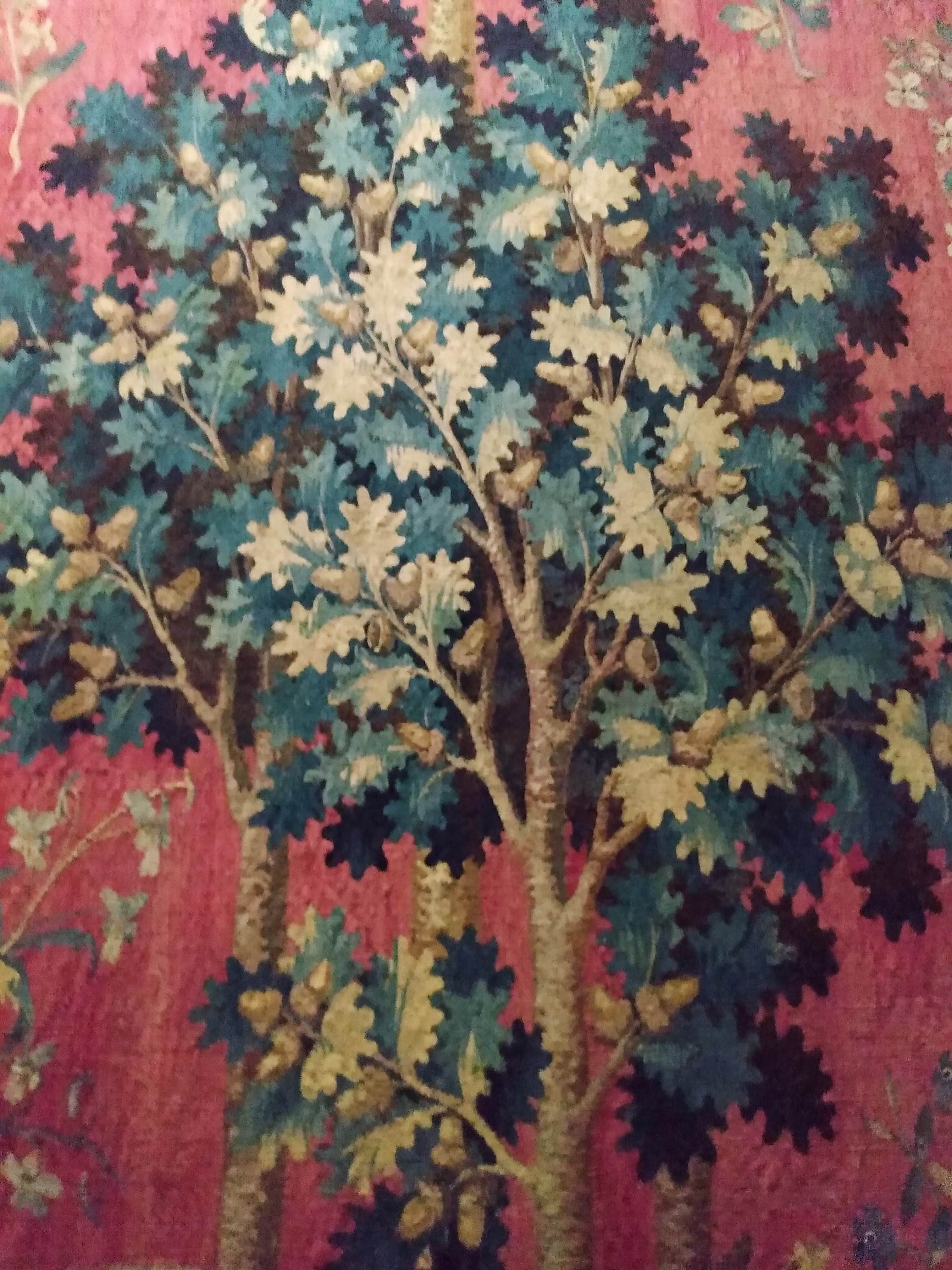
To remember the calm, the tapestries at Musée de Cluny, 600 years old, their colours bright, leaves and flowers so specific you wonder at the weavers who made these wonders. The cartoons or drawings were created in Paris and the tapestries were woven in Flanders around 1511, using silks and wools dyed with rose madder, pomegranate, poppy, weld (or dyer’s rocket, for yellow), and woad. To stand in a room hung with them, to be quiet in their presence, to lean close to see the gillyflowers, primroses, little bellis daisies, poppies as delicate as any growing in a spring garden, to take in the beauty and the skill. I brought back a sprouting acorn from France, wrapped in damp kleenex, and I wonder if its mother tree was related to this one, each leaf so perfectly formed, coloured, created by many hands weaving the weft threads over and under the warp. Listen to its leaves, breathe in the scent of gillyflower, wild violets, strawberries ripening, listen as the bunnies are listening, someone is singing, softly, and it’s one of my favourite poems on earth.

Westron wind, when will thou blow?
The small rain down can rain.
Christ, if my love were in my arms,
And I in my bed again.

bunnies


redux: a morning divination

Note: I posted this in November, 2020. This morning I looked for solace in A Writer’s Diary but couldn’t find anything. (The world feels kind of hopeless today.) On that morning 4 years ago, my favourite coffee cup was still unbroken and I was filled with excitement about writing, about a possible return to Ukraine (the Russian invasion was still in the future), the collection of essays, Blue Portugal, found a publisher and came out two years later, and the novel I was circling around, about two women, textiles, and the threads that connect that world: well, it’s still in progress. I have another collection of essays making the rounds (“This doesn’t fit our list.” We don’t have the right editor.” Or silence.) and a novella based on Mrs. Dalloway and I take to heart Virginia Woolf’s sentence: “The question is how to get the two books done.”

ivankivtsi church

I was sitting by the fire, watching the honeysuckle vine move in the wind. I was waiting for the Steller’s jays to arrive for their breakfast. I was drinking dark coffee in the blue mug with white bears. And thinking, thinking, in a dreamy way, about the book I am trying to write. I opened A Writer’s Diary to see what Virginia Woolf was thinking in November, 1924 (for that was where the book opened):

I must make some notes of work; for now I must buckle to. The question is how to get the two books done. I am going to skate rapidly over Mrs. D., but it will take time. No: I cannot say anything much to the point, for what I must do is to experiment next week; how much revision is needed, and how much time it takes. I am very set on getting my essays out before my novel. Yesterday I had tea in Mary’s room and saw the red lighted tugs go past and heard the swish of the river: Mary in black with lotus leaves round her neck. If one could be friendly with women, what a pleasure—the relationship so secret and private compared with relations with men. Why not write about it? Truthfully? As I think, the diary writing has greatly helped my style; loosened the ligatures.

I am in something of the same position. I have a collection of essays out in the world, seeking a publisher. I have a novella loosely based on Mrs. Dalloway. And I’ve made tentative marks on a page to begin something new, about two women, their relationship a surprise to them both, and involving two countries, Canada and Ukraine, a shared grandfather (or great-grandfather for one of them), and the stories told by rushnyk, the ritual cloths that preserve various kinds of history and act as a mediary between the living and the dead.

The building in the photograph is the old church in my grandfather’s village in Bukovyna. When I entered it last September, I felt the presence of the ones who’d worshipped there, who’d been baptized, married, mourned, my own family members among them. The priest who opened the door was the same priest who announced in the new church that I’d come to the village looking for Kishkans and some of them were present and they found me later that day. Our stories entwine, as the red lines of thread extend from a knot to become a hearth, a field, a tree of life hung with apples, and flowers blooming as beautifully as they bloomed in the tall grass in the cemetery near the church.

“Don’t go back to sleep.” (Rumi)

our rue

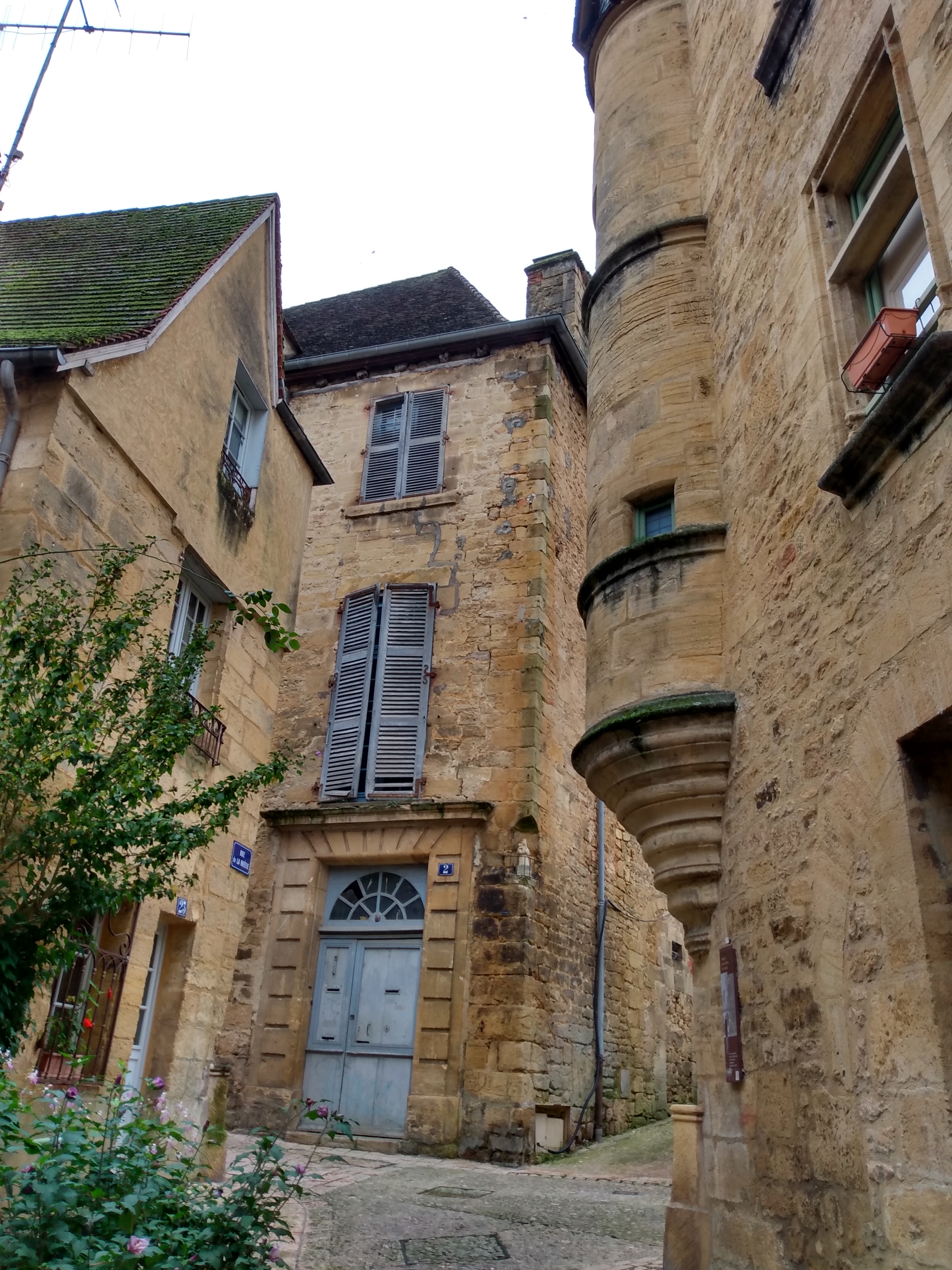
Late Friday, I returned from nearly 2 1/2 weeks in France. Partly I went–we went, because my travelling companion was my husband, John–for sheer pleasure (think pain au chocolate, ancient streets, delicious dinners with glasses of nice wine) and partly to accumulate some material for a piece of writing I’ve had in mind for more than 50 years. When I say I had the writing in mind, I have to admit I didn’t know it was there until I found its source: the paleolithic cave art in the southwest of France. Was it an article I read as a 19 year old, entranced by the photographs of bison, horses, aurochs, and reindeer? I think it was. The images entered my consciousness and have lingered ever since, waiting for me to remember them and explore them. So that was one objective of our travels. In order to visit as many caves as possible, I arranged for a rental car in Sarlat, the small town where we’d spend 8 nights. (The photograph at the top is what we saw each time we opened our door.) I booked time in two caves–you have to do this for several of them because limited numbers of people are allowed in–and had plans to visit several more, the ones which don’t sell tickets in advance but advise you to come early. Imagine my surprise, distress, and anger when the car rental person went quiet and didn’t respond to my increasingly desperate texts and emails. (I couldn’t use my phone.) On the day we were to collect the car and realized it simply wasn’t going to happen, we tried to find another one nearby to rent. No luck. But at the tourist office in Sarlat, a young woman recommended Clara Aussel, a local guide who could drive us to places, the ones we knew we wanted to go to and the ones we didn’t even imagine we’d love. Clara was wonderful. She took us to Font-de-Gaume near Les Eyzies, one of the places I’d arranged tickets for, and we had time in the beautiful village of Les Eyzies afterwards. I will write at length about that cave once I’ve let the whole experience settle. She also took us to Rouffignac on another day and I realized it was the cave I’d read about all those years ago, the one you descend into via a small electric train. We went to Lascaux by bus, before we knew about Clara, and it was both wonderful and unsettling because in my ignorance, I’d bought tickets to Lascaux 11, the first reproduction of the cave, or at least the 2 most important rooms, created over ten years, leading up to its opening in 1983, a necessary development because of molds and massive quantities of carbon dioxide causing significant deterioration to the paintings in the original cave, due to human intrusion. I didn’t know there was also Lascaux IV (Lascaux III is a touring exhibit), a multi-media experience which allows you to experience the entire cave with other displays and so on. The bus stops (infrequently) at Lascaux IV and Lascaux II is a 2 kilometer walk further up the hill. We’d arrived with a little time to spare before our tour with an English-speaking guide but not enough time to actually walk to Lascaux II once I realized I’d messed up. So we bought tickets for Lascaux IV and it was great but oh, how I wish we’d been able to see the earlier iteration. (If we’d had a car, of course we’d simply have driven up…)

The sensation of descending into darkness, at Rouffignac and at Font-de-Gaume, and having a guide carefully shine a light on cave walls, the sensation of seeing the animals appear, as lively and fresh as they must have been when first painted 17,000 years ago (Font-de-Gaume) or 13,000 years ago (Rouffignac), to see them appear racing along a ledge of rock, pausing to extend a tongue to another’s antlers, to gallop up a face of the cave, mammoths and horses circling the smooth ceiling at the end of the cave, as beautiful as the Sistine Chapel. When people tell me that an encounter with something like a painting or a piece of music is life-changing, I tend to wonder what that means. How does a life change by pigment, by the graceful line of a horse’s cheek, a delicate hoof? But now I know it does and I will try to explore that as best I can in language.

I woke early the first morning I was home and I realized I’d dreamed I was still in Font-de-Gaume. It was completely dark but I wasn’t afraid. I knew the horses and reindeer were gathered around me on the walls, antlers tossing, tails streaming behind. I knew something in the dream. I knew there was a way in, and a way out. Damp air, the print of a hand just under a outcropping of rock.

The breeze at dawn has secrets to tell you.
Don’t go back to sleep.

You must ask for what you really want.
Don’t go back to sleep.
                               –Rumi, trans. Coleman Barks

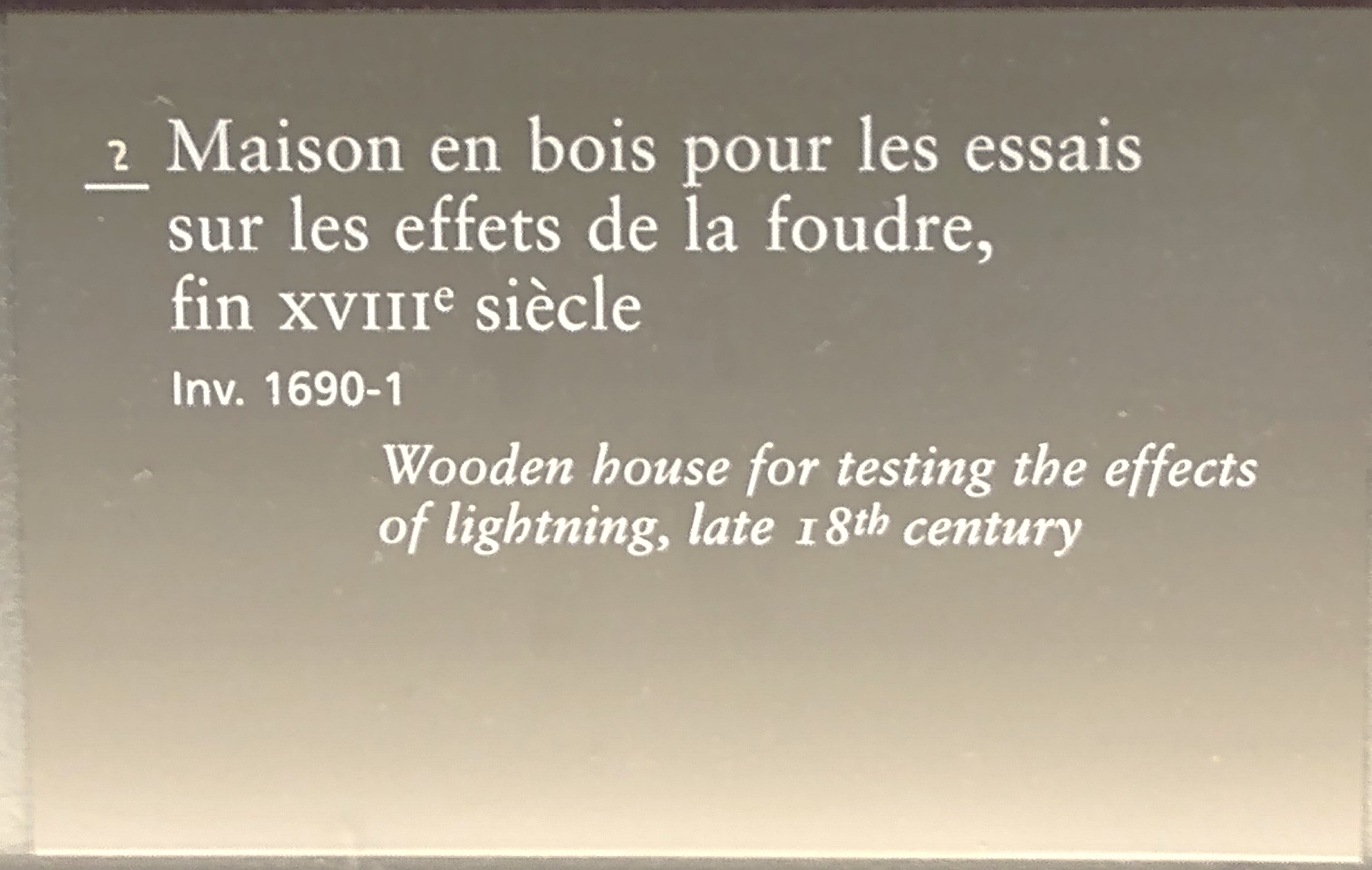
“wooden house for testing the effects of lightning”

wooden house

text for wooden house

I hoped I’d sleep the whole night through, but which night? Yesterday we woke just before 5 in Paris and at 6 we were walking to Les Halles from our little studio near le musée des Arts et Métiers, the streets dark, a few stragglers from Halloween parties heading home. We were heading home, first to the airport, then a long flight, a taxi ride to collect our car, the ferry, a stop on the way to pick up our cat Winter who’d been in residence at Catnip Cottage, and finally up our long driveway to our waiting house. So which day was it when we arrived home?

It’s been stormy on the Coast. We could tell not only by the flooded road signs along Highway 101 but by the rain falling, falling, as we drove home. It was that big full kind of rain and frogs were leaping on the wet road. I was in bed by 9 but what time was it really? It was already tomorrow in Paris.

I hoped I’d sleep the whole night through, the cat’s body warm against my back, but I woke at 2:20, coming downstairs to the familiar scent of woodsmoke. I went out to the woodshed for a few logs to put on the last coals. The rain has stopped, the sky is clear and starry, and I saw Orion spread out over the woodshed roof. I also saw Jupiter just by Mount Hallowell’s sleeping shoulder and then a shooting stars, one of the early Leonids, I think.

Under the stars, I stood for a few minutes in my nightdress in the absolute darkness. Something was rustling in the woods behind the garden. I didn’t wait to find out if it was a bear or maybe a bull elk full of himself in the late fall rut.

Yesterday, or no, the day before, at the musée des Arts et Métiers, I was very taken by the little model of a wooden house designed to test the effects of lightning. It was held together with wires and could collapse in the most ingenious way. I am thinking of my own house, wooden, on its hill below the stars, and how sometimes I see it as a series of cunning walls and rooftops, held together by our own labour. In the woodshed, whole trees felled and limbed and cut into lengths for the woodstove; the radiance of the heat they provide is a distillation of time I can understand. Overhead, Orion strides the sky, the bright stars of his belt radiant in the darkness. A shooting star fell to the north of Jupiter and I was too confused by the hour–is it tomorrow in Paris, or yesterday, or is it morning yet here?–to make a wish. Tomorrow, whatever that is and whenever it arrives, I have work to do. An essay about wild plants on the trail to Font-de-Gaume, a meditation on time in its own way, and another on labyrinths. Another on stars.

postcard, the day after

Yesterday we went by train to Chartres. Walking from the Gare, we used the cathedral as a compass (as generations have, and will). The windows are overwhelming. My little photograph shows nothing of the intensity of blue, of red, and the incandescent yellows. 800 years old, the windows glow with the light they have always held as sacred. This morning, listening to men on scaffolding in the tiny Rue au maire, I am still seeing the Blue Virgin Window on the south wall, just a little way from the South Rose Window, and my eyes are still dazzled with colour.

postcard from the dodgy end of the Marais

We woke on the last morning in our flat in a medieval building in Sarlat, drinking coffee at the polished table, eating pastries from the little place we liked best. Then we waited for the train to Bordeaux at the quiet Gare Sarlat, wild cats sunning themselves in the sunny platform while the ticket woman prepared their petit dejeuner. In Paris, we arrived at a charmless place near the Musee des Artes et Metiers. It’s the size of our porch at home and (strangely) is an “upgrade”. Never mind. Tomorrow we’ll spend the day at Chartres and the day after doing another good thing. And the day after that, the long trip home.

a final Dordogne postcard

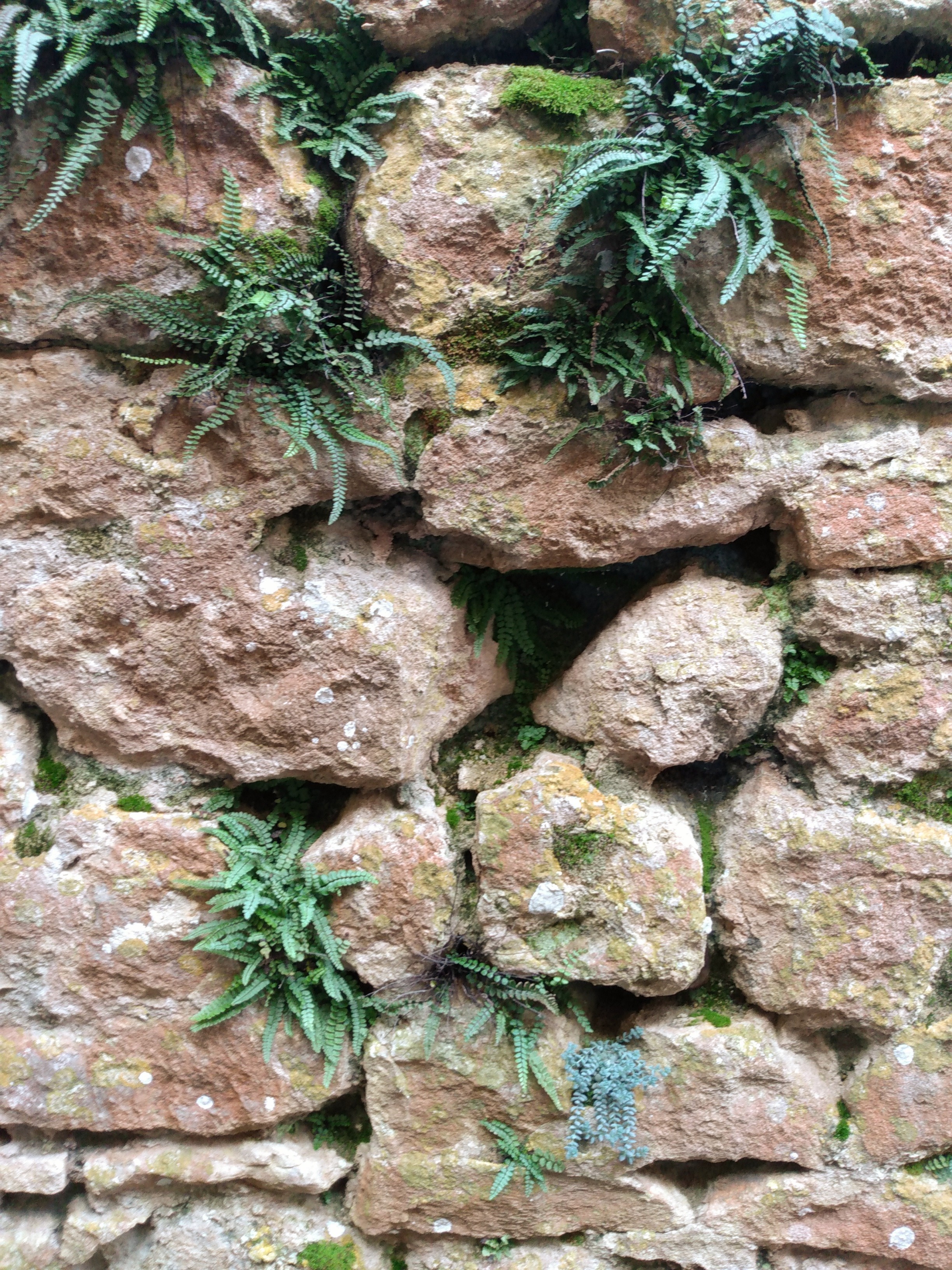
Today the gracious Clara to us to Carlux to look at Robert Doisneau’s photographs and then to the Château de Fénelon to walk up its stairs and passageways, past its ancient defensive systems, its well, the Cedar of Lebanon planted to celebrate the birth of Francois de Salignac de la Mothe-Fenelon in 1651, tiny wall lizards skittering on warm stone, and the view of the Dordogne Valley green and lovely. What the heart will remember, and won’t. As we walked back to Clara’s van, tiny gardens almost unnoticed.

morning postcard: the ancient aspects

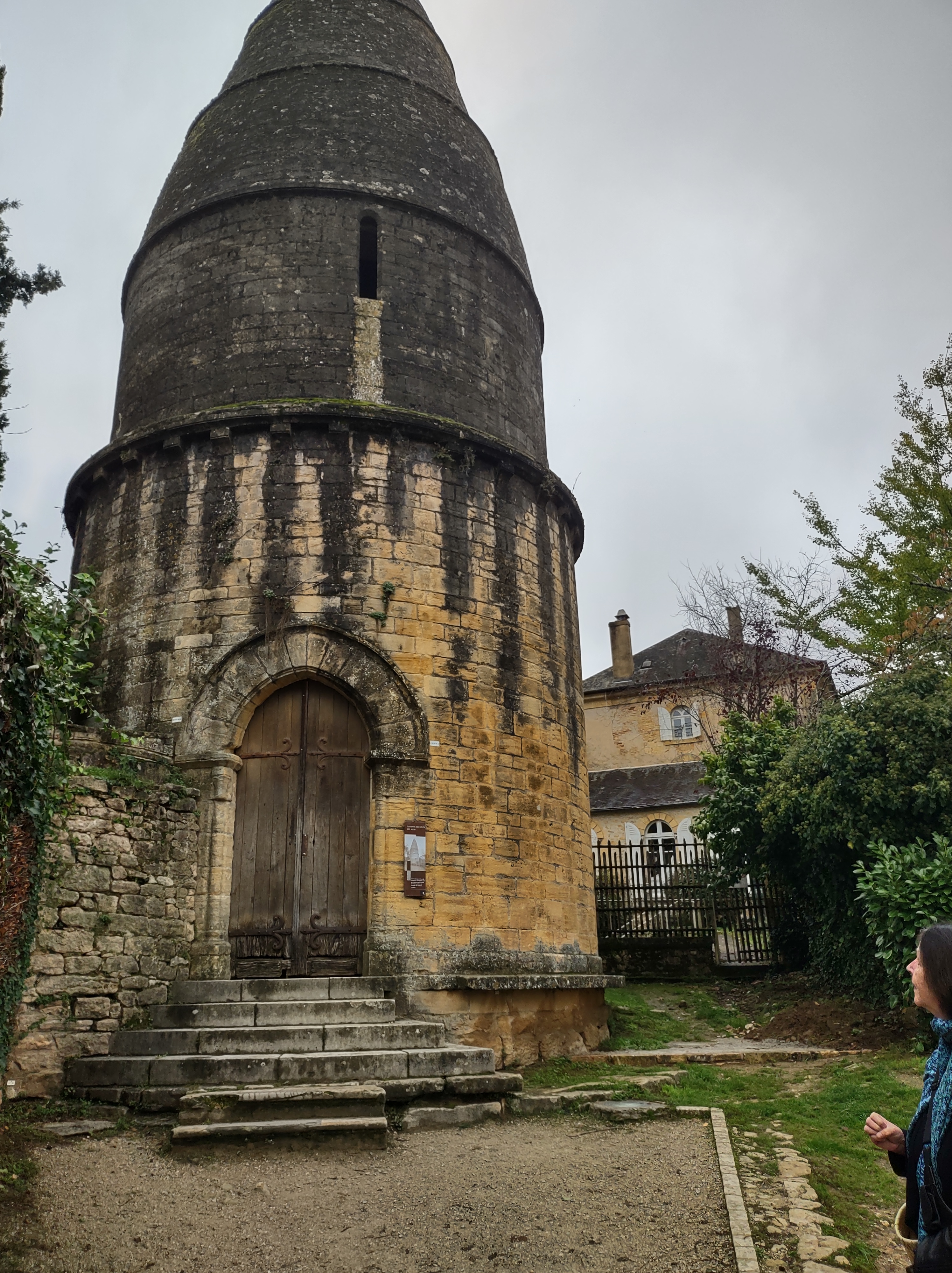
This morning, a walk up behind the Cathedrale Sainte Marie where the sounds of organ and voices floated out of the open front doors, to the 12th c. Lantern de Mort, which may also be a Lantern les Maures, built to commemorate the abbot Bernard of Clairvaux, who played a major role in the Second Crusade and who visited Sarlat in 1147. This morning the air was soft and held every ancient aspect as tenderly as love.