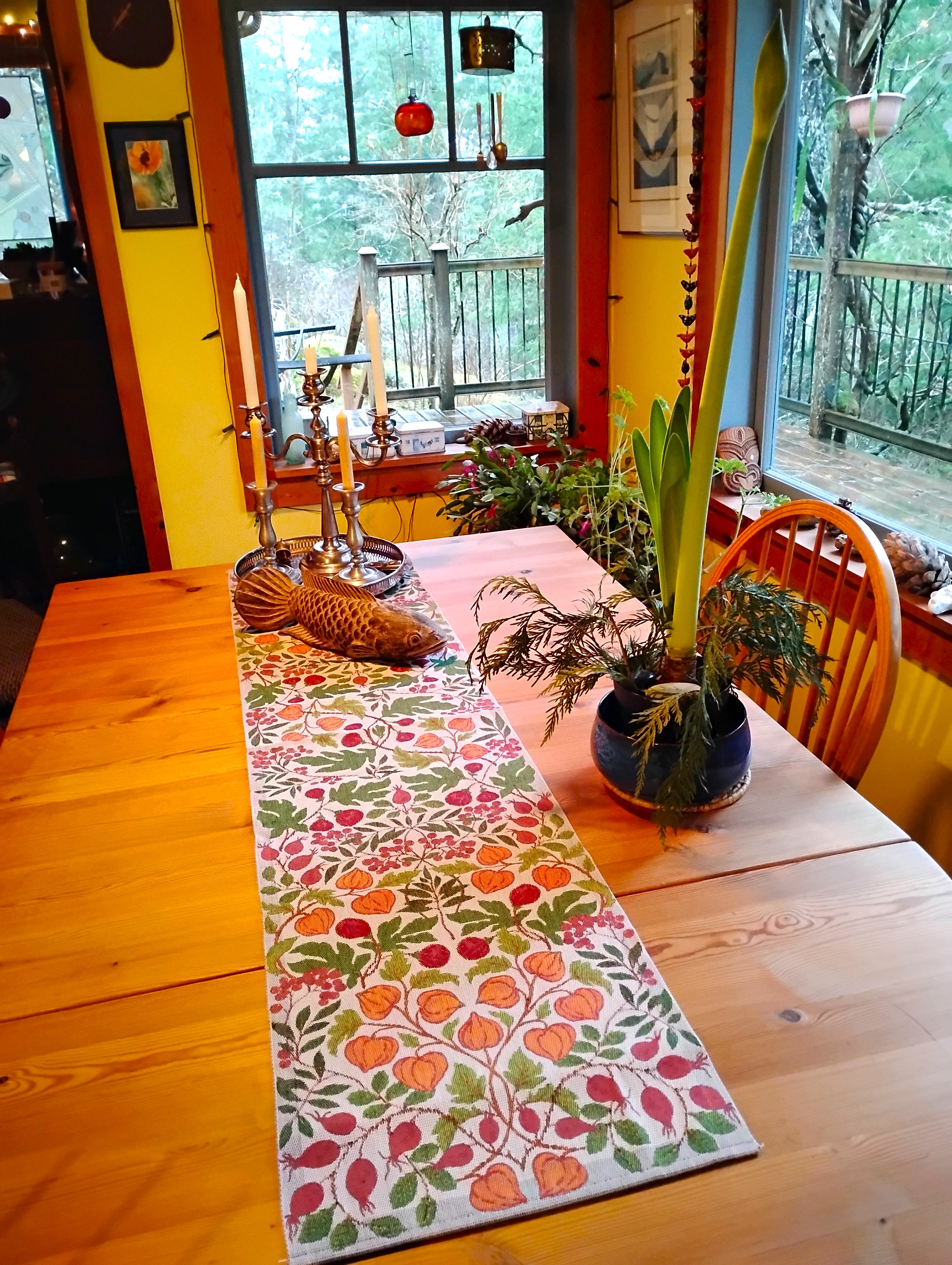
Laying the beautiful new runner on the table, a birthday gift from Manon, Forrest, and their boys (from Sweden, via Genoa), I am thinking how the year begins now, the moon just past full, begins now, my slow kilometre already swum this morning, a bottle of Steller’s Jay brut to celebrate my 71 years, yesterday’s lunch with a book club who’d done me the honour of reading a novel in manuscript (they are all artists and I wanted to know if the painting elements were accurate), anyway, yesterday’s lunch still warm in my heart. The year begins now, in rain, with the table laid with figs and pomegranates woven in fine cotton, the anticipation of lake swims in a few months, my feet firm each morning in the sand scribbled with bird tracks, heart-shaped deer prints, and sometimes bear paws clearly delineated at the water’s edge.
I know this place like the back of my hand The way that it bends and how to get back Concessions and lines, rhythms and rhymes Furrows and rows, rivers and roads Push away under a dusty eye I know my place in the shifting sand
One more dance around the sun To know where to start again One more dance around the sun —“One More Dance Around the Sun”, from Caught Light, the Great Lake Swimmers
I’ve been reading people’s accounts of the year we’re leaving and in my bed this morning, drinking my coffee, I looked at photos and wondered how I’d sum up mine. It won’t be clerical. I don’t keep spreadsheets of submissions and rejections. But I had a few wonderful adventures and some good things happened.
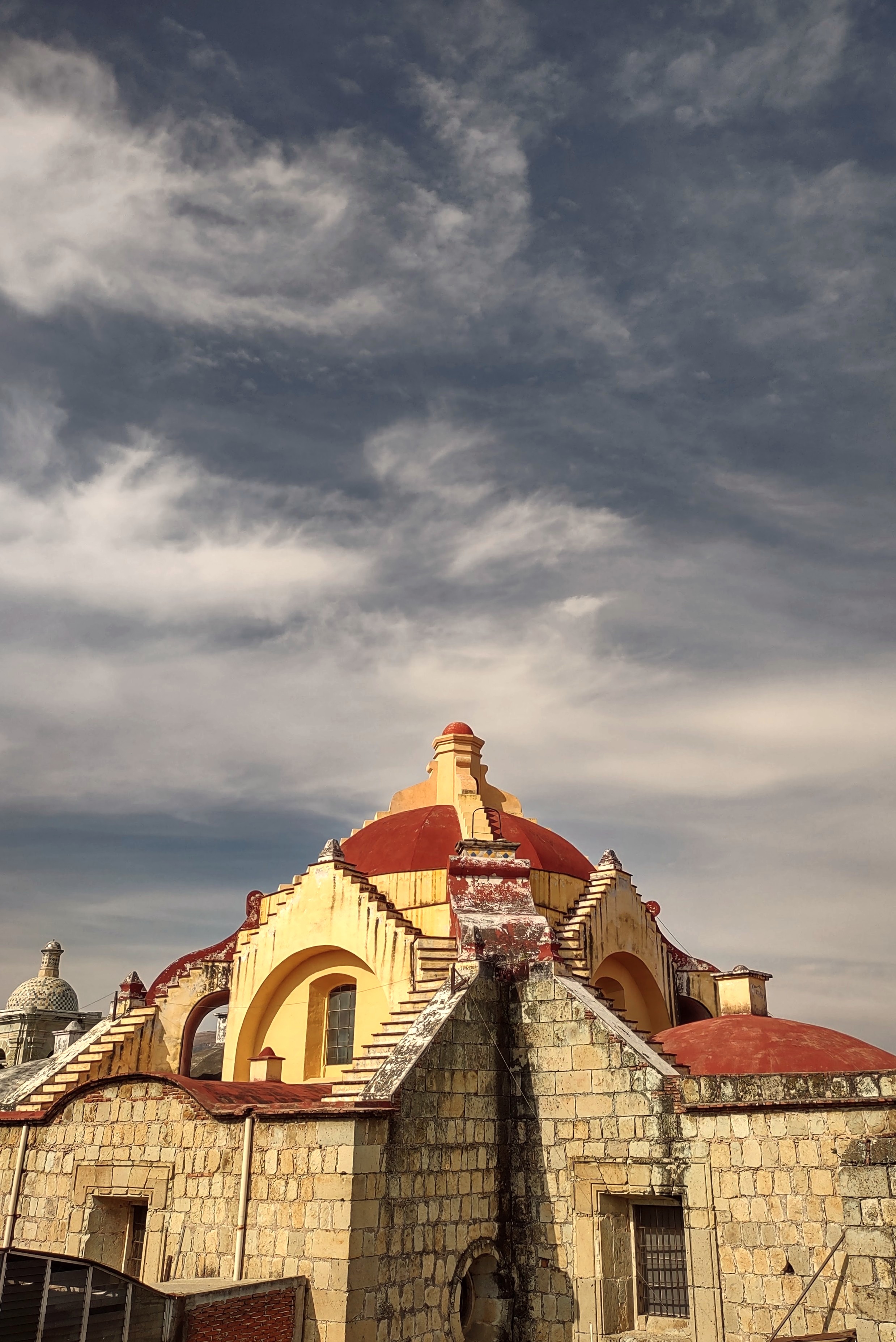
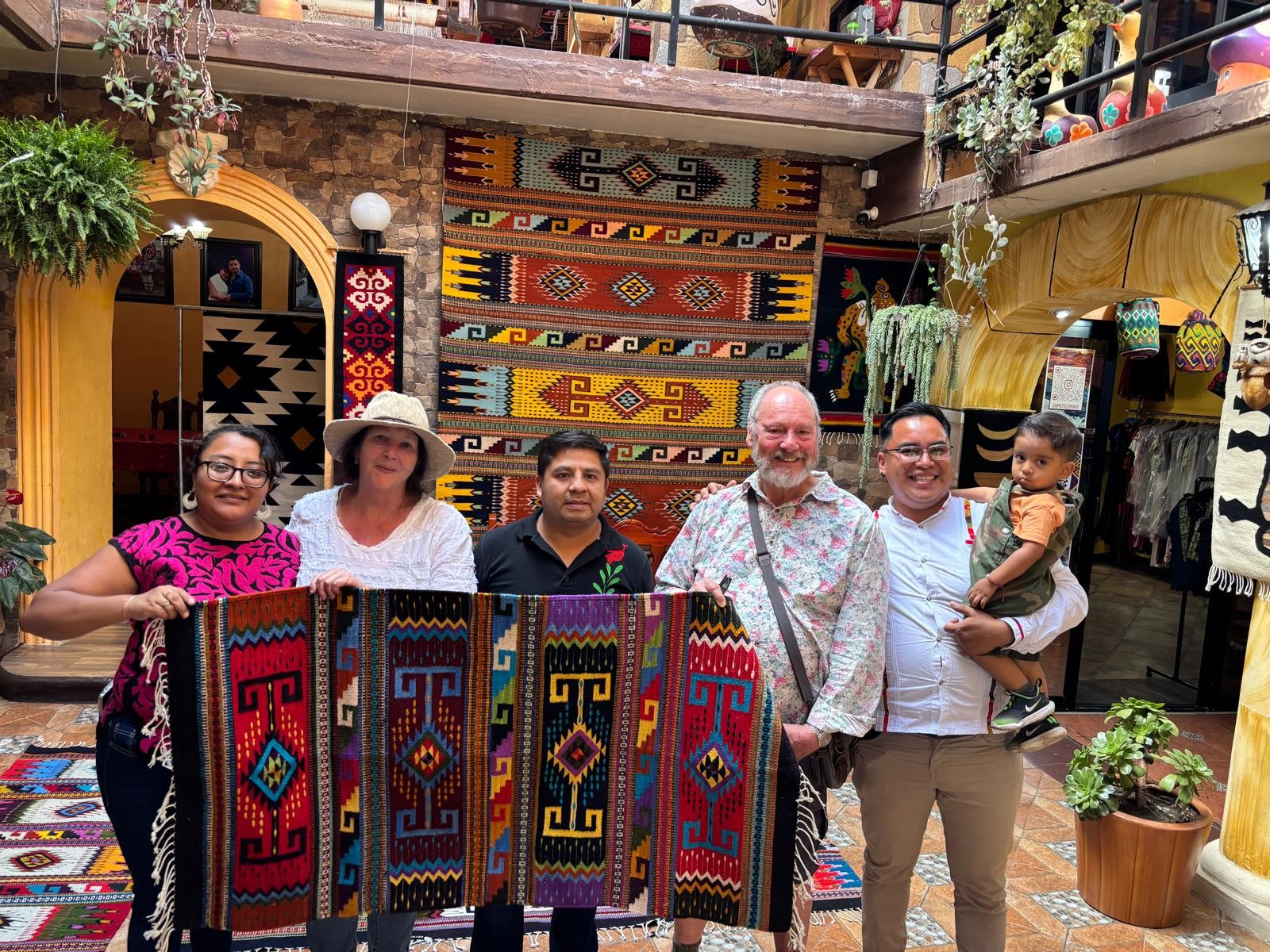
In February we almost didn’t go to Oaxaca. On the morning we were leaving, we woke to more snow than we’ve had had here on the west coast of Canada. Our (long) driveway was completely white and probably not navigable in our Honda Accord. A few phone calls confirmed that although the highway was open, just, the road we’d need to turn off to take our cat to the woman who would care for him was unplowed. But then a neighbour came up our driveway in his truck, chains on the tires, and with a tow-rope, he got us out of where we’d got stuck trying to back up. He pulled us all the way to the highway and no problem with the cat, he said; he’d come up to feed him until other friends could come and take him to the kennel. So when we arrived at last in Oaxaca, we were ready for the sunlight, the wild skies, the museums, each more beautiful than the last, the visit to Teotitlán del Valle to a weaver’s studio,
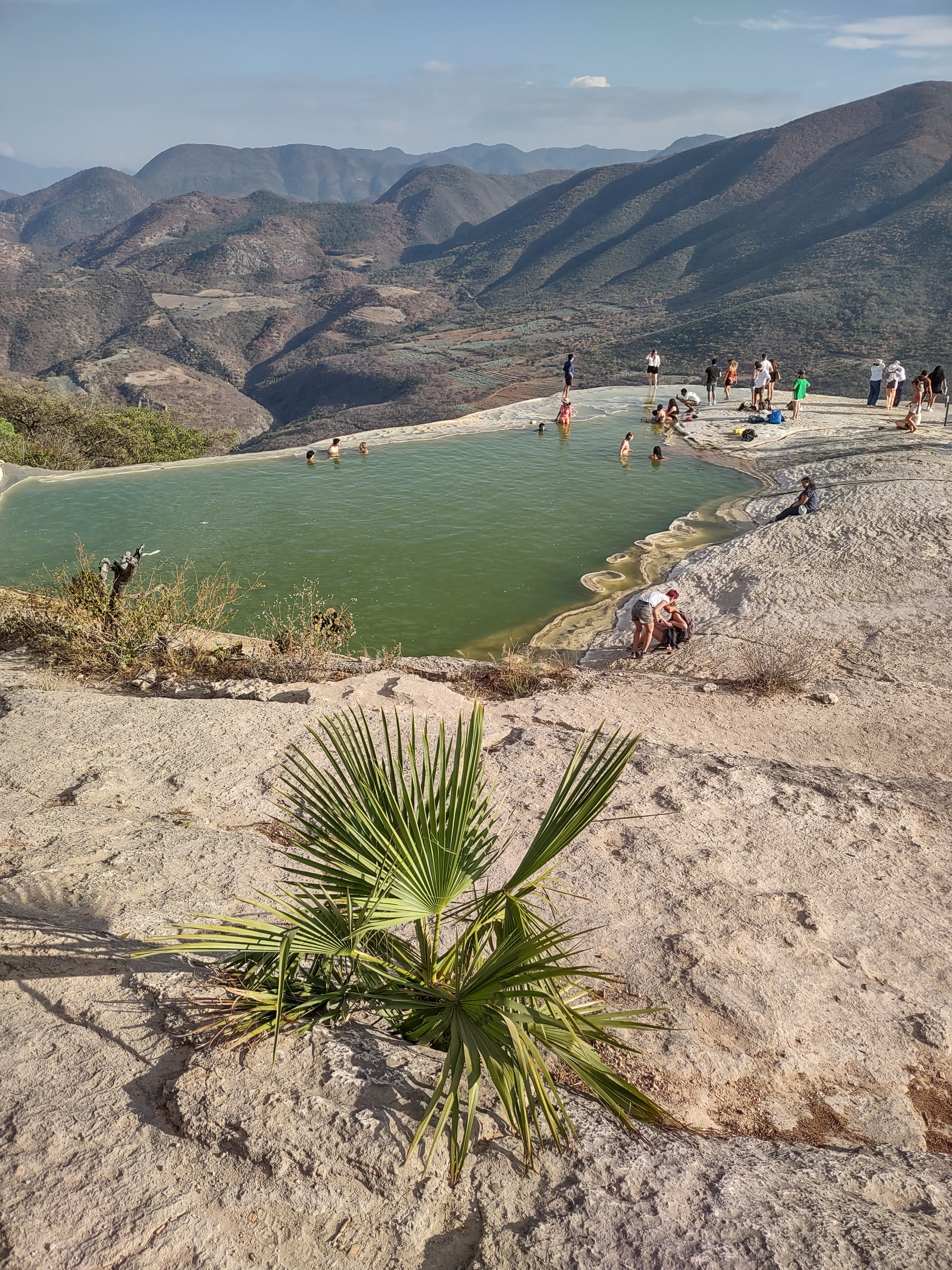
followed by a swim at a mineral pool at Hierve el Agua on the edge of a cliff:
While we were in Oaxaca, I had the pleasure of discussing and then signing a contract with Eve Rickert at Thornapple Press for a memoir. Eve was unfazed by my location — we were doing this virtually after all — because she was on a boat, waiting to land on the Galapagos Islands.
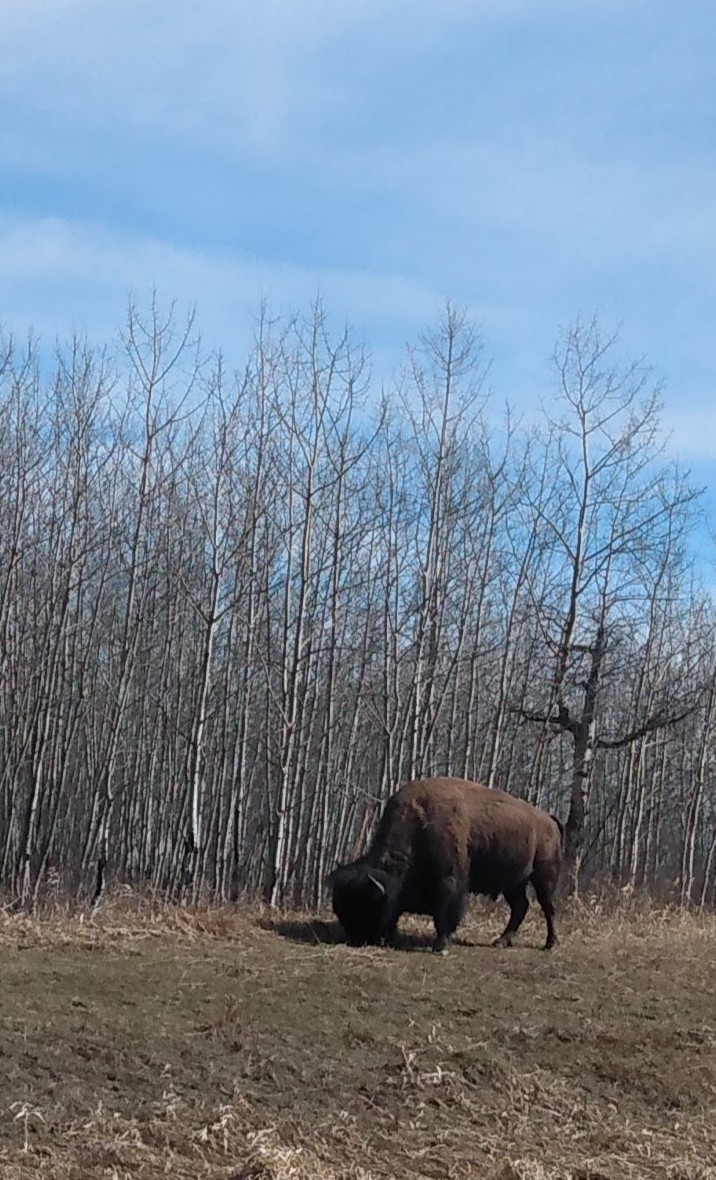
Easter took us to Edmonton to see our family there. There was a visit to Elk Island Park:
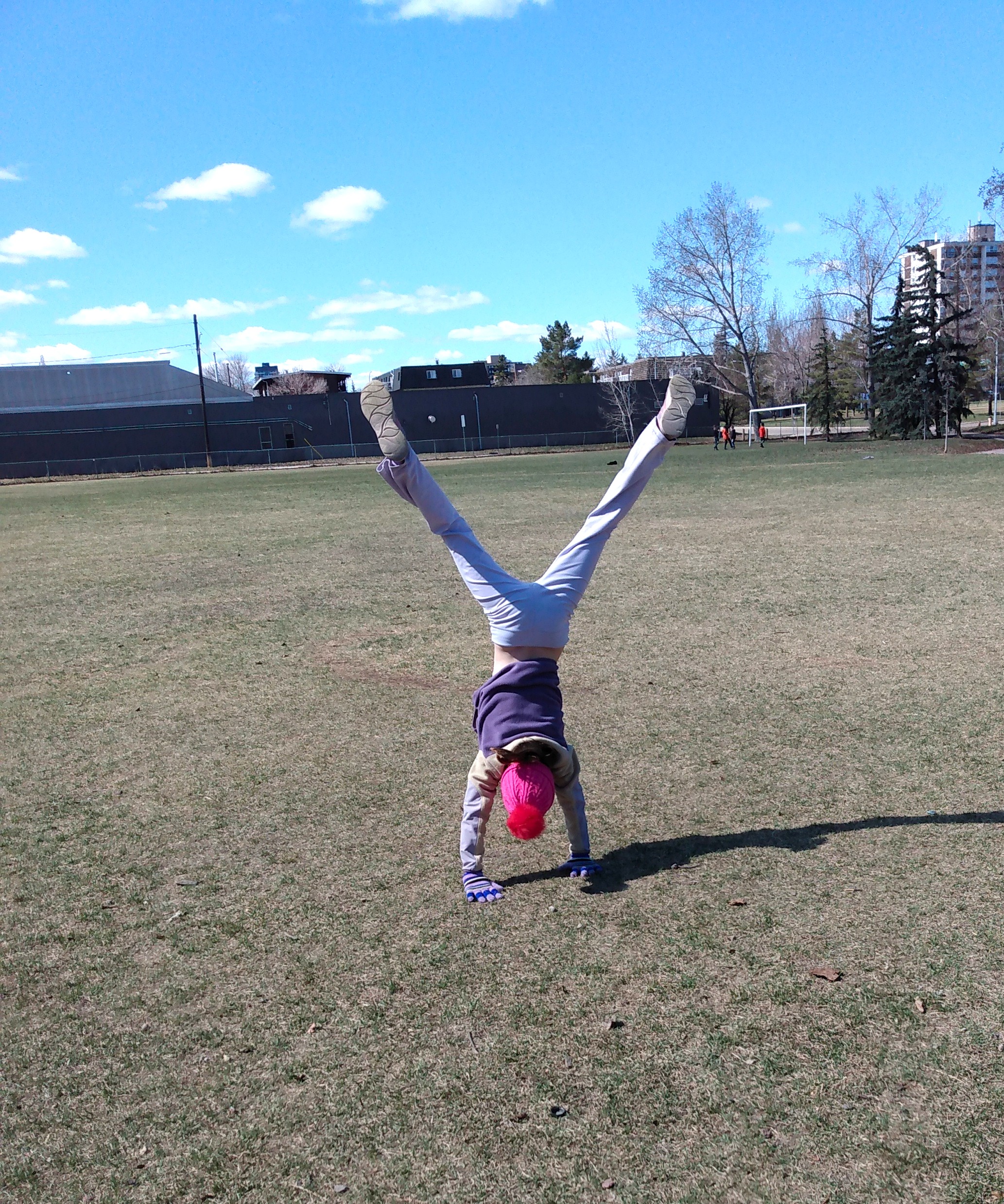
and many many cartwheels, all of which had to be rated. This was pretty much a ten.
In May my brothers and I gathered on the banks of the Thompson River for 3 nights to catch up on our lives and later in May we went to Gatineau to spend time with our family there.
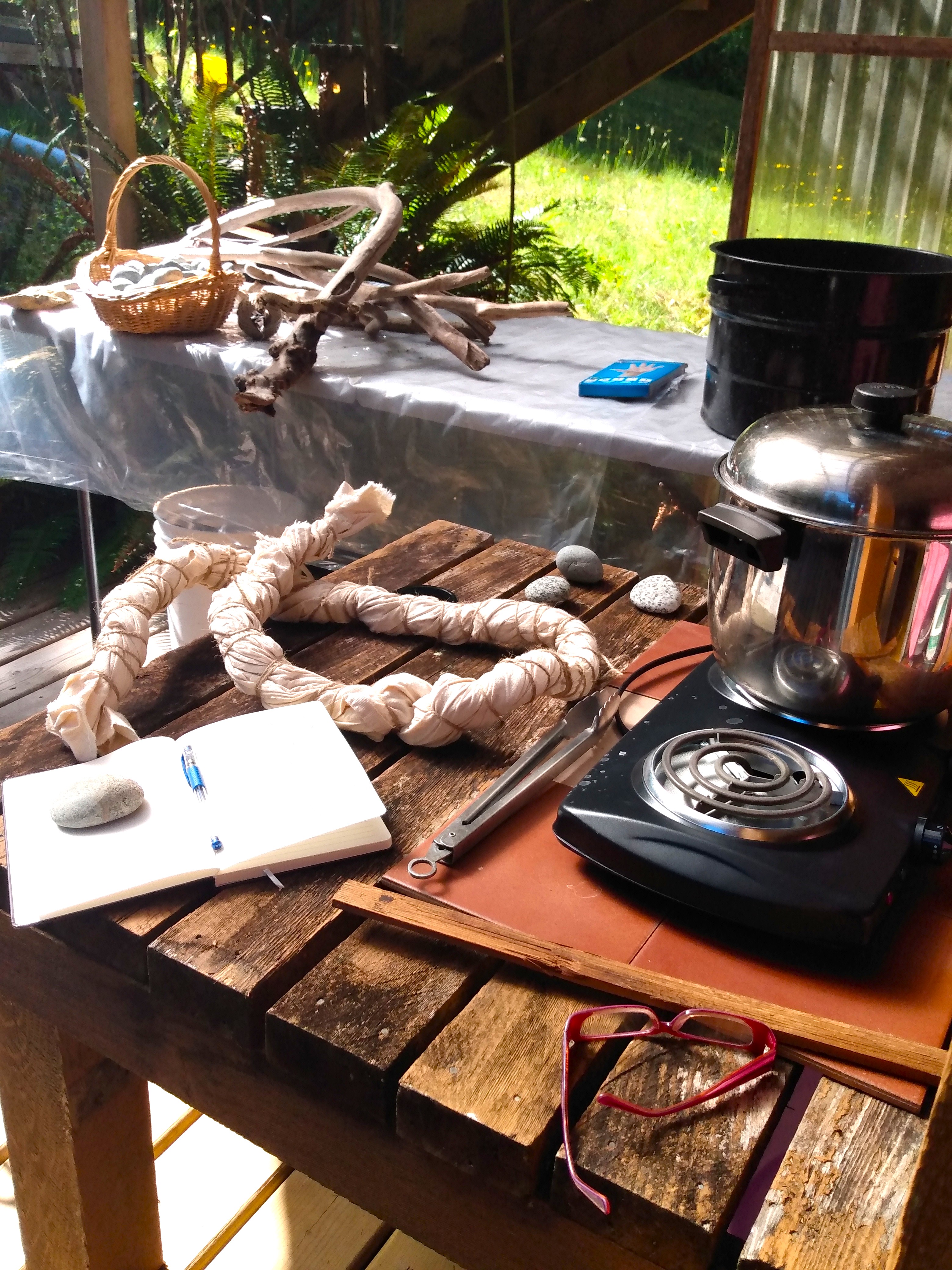
In June, inspired by the weaver in Teotitlán del Valle, I decided to up my own dye work a little by making a seasonal studio on a partly covered back deck.
I did some indigo, which I’ve experimented with for decades, but also experimented with rose madder and marigold. Instead of relying on memory, I kept careful notes and next summer I look forward to using pomegranate and cochineal (there’s cochineal in the carpet we bought from Oscar Perez in Teotitlán del Valle and many other natural dyes as well; he showed us how he prepares them and I thought I’d love to just stay forever, gathering rock lichens, sage, and learning their mordants).
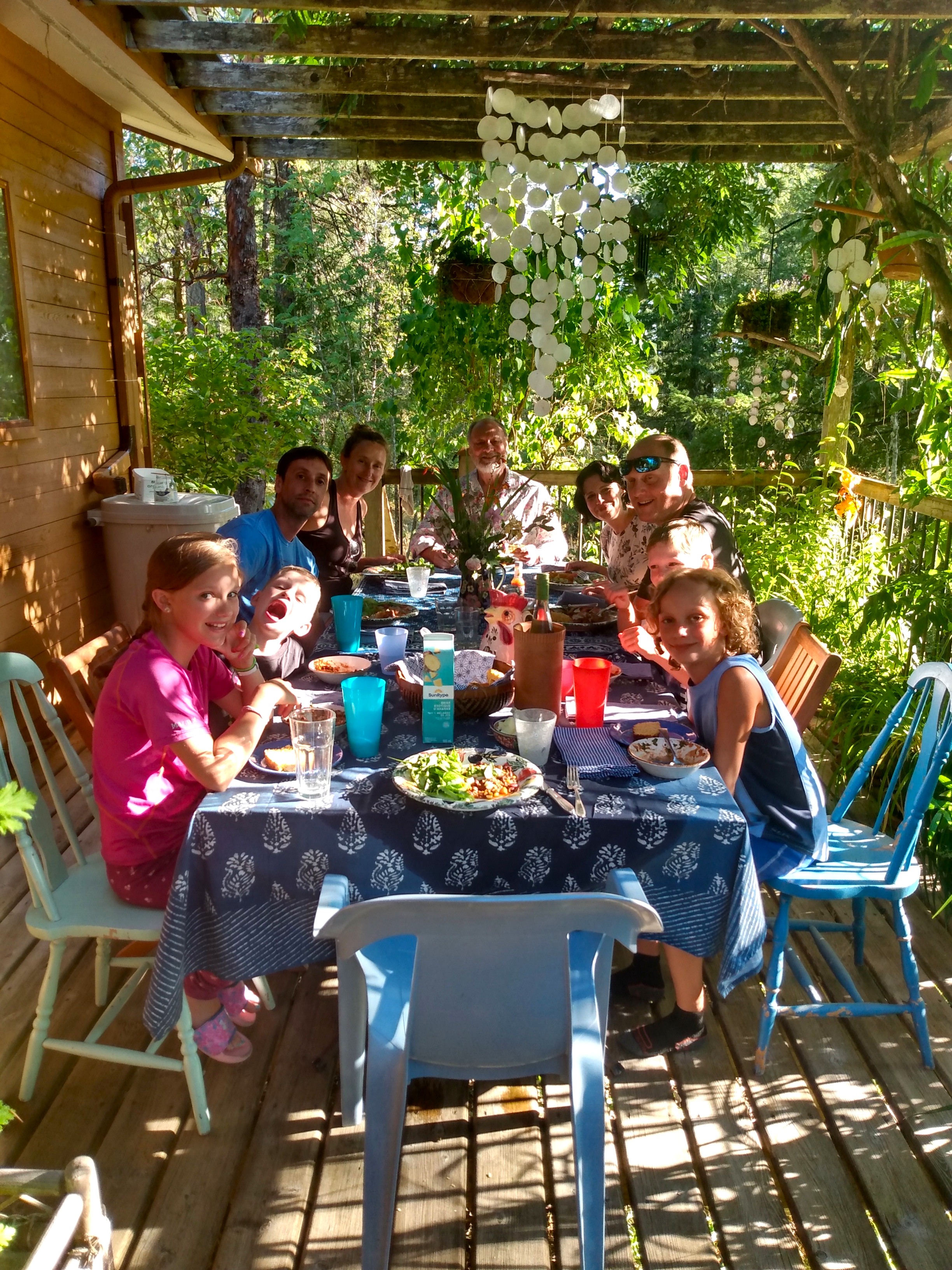
In July and August, two of our families came here, overlapping for a few days, and it was lovely to have them at the table on the deck for a festive dinner.
There was lots of swimming, badminton, quiet reading, archery, hikes, and a visit to the Backeddy Pub where the kids scrambled down on the rocks while we enjoyed conversations with old friends encountered there.
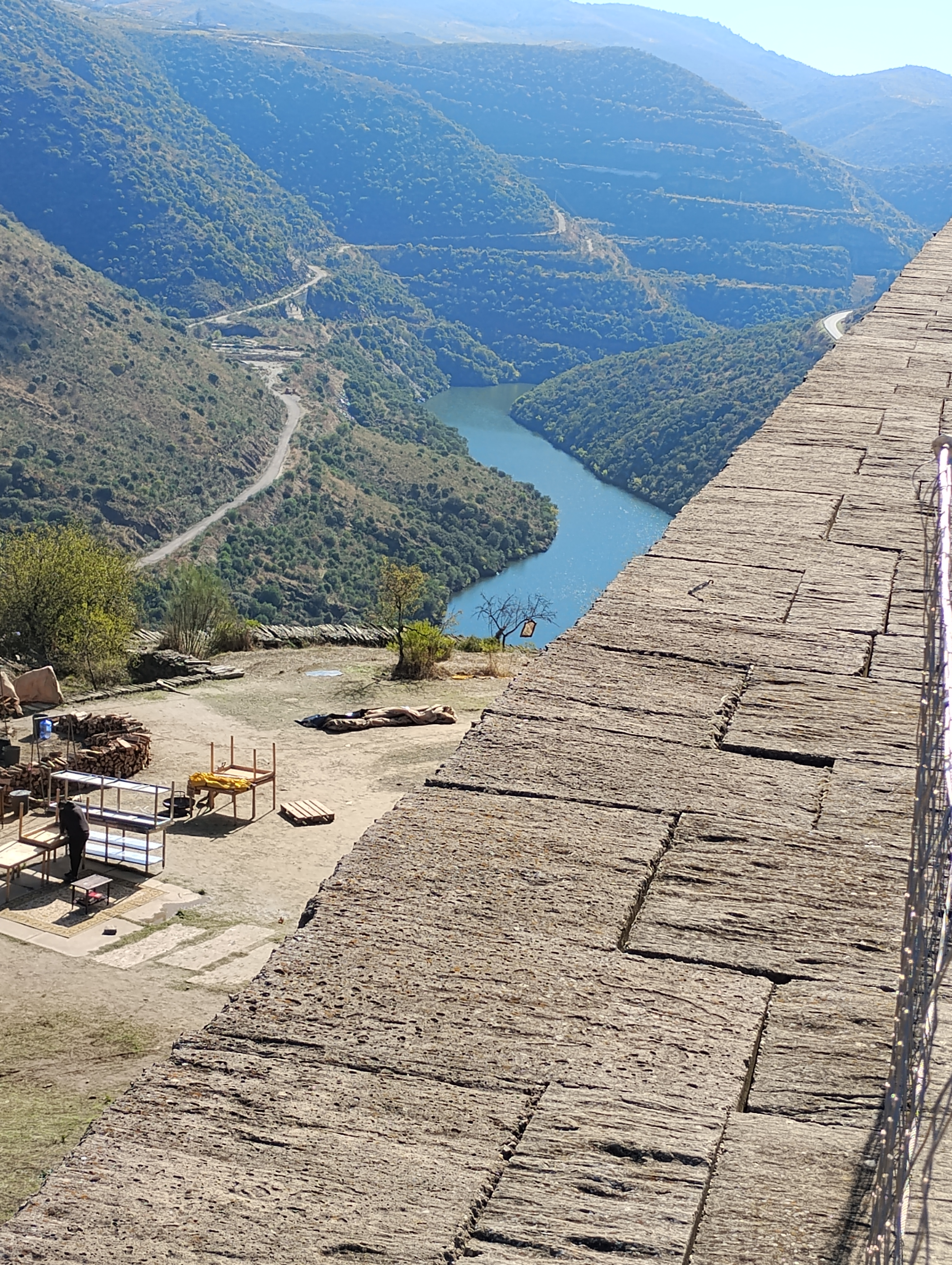
In late October we went to London for a few days of theatre and art galleries and lots of walking and then we flew to Porto, picking up a rental car to drive to the Coa Valley for a week of visits to rock art sites on the river.
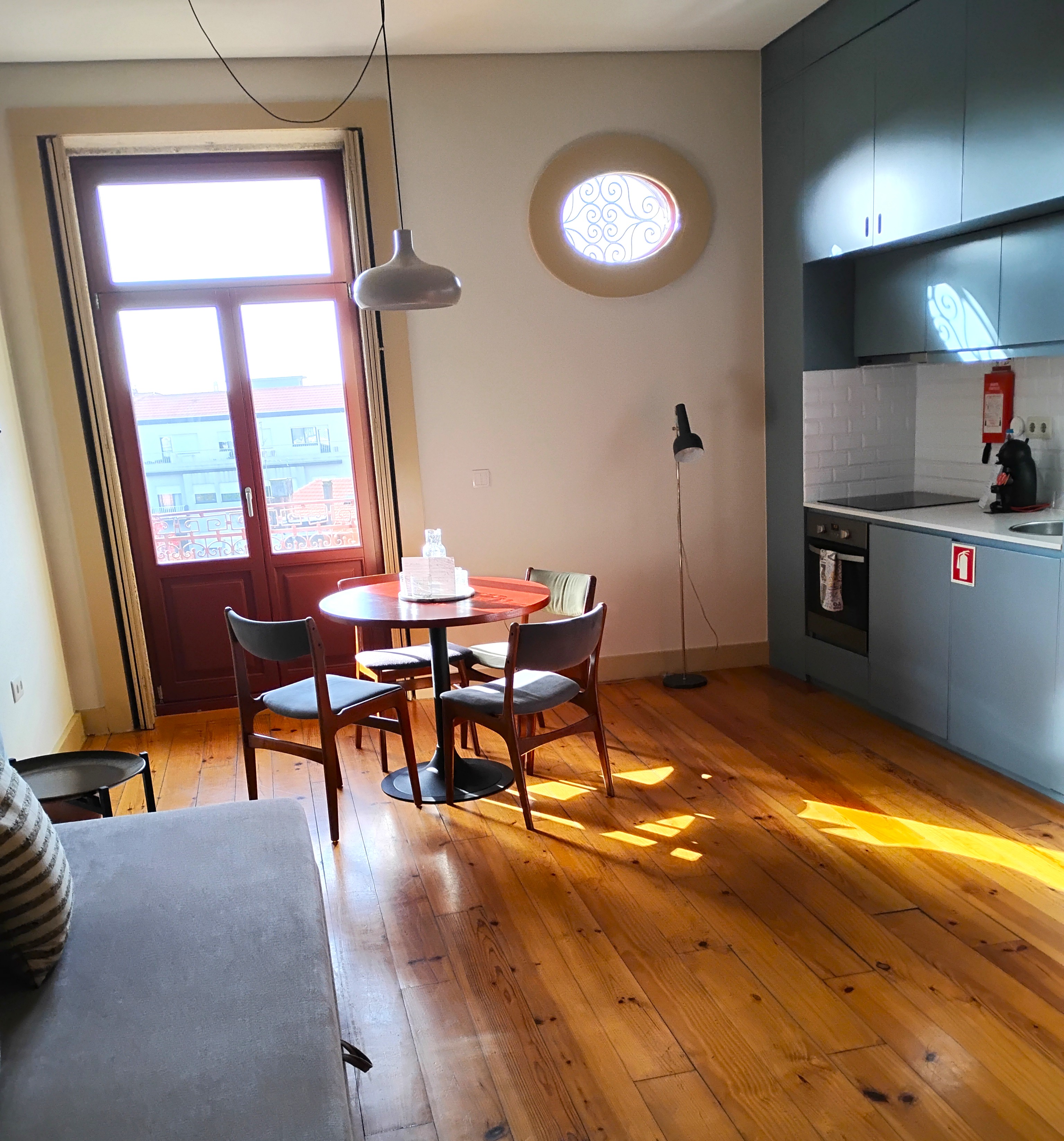
I’ve been to Portugal before but never to a place with such unearthly beauty: high hills terraced with olives, almonds, and grapes, shepherds guiding their sheep along the river banks, the bells sounding in the air like birdsong, the Iberian magpies appearing in the olives, blue as the sky, and the rock panels alive with horses, ibex, aurochs, their horns still exuberant after 20,000 years. And after our week in Vila Nova de Foz Coa, we had a couple of days first in Porto, staying in the same suite we’d stayed in back in 2024
and where I swam in the outdoor pool which was almost too cold. Almost. And when we returned to London for just 2 nights before flying home, instead of our usual Bloomsbury hotel, we stayed in Kew. When I lived in Wimbledon in 1976, I used to take the bus to Kew Gardens sometimes on my day off and I realized I hadn’t been there in almost 50 years. It was lovely to walk through the gardens, the glass houses, to listen to magpies, parakeets, to wonder at some of the really ancient trees, and to buy a few seeds in the gift shop to take home.
Christmas arrived far sooner than I thought it would. Angie and Karna came from Victoria and it was quietly sweet. They had to return on Christmas day itself so we ate a festive meal on Christmas Eve.
Oh, and that memoir I mentioned? All through the year, I edited it (thank you, Andrea!), attended to the copy-edits (thank you, Heather!), worked out the details of images and how to use them (complicated! Thank you, Eve, Hazel, and the lawyer who understood copyright), opened the files to see what the cover and text possibilities could be (thank you, Jeff for layout and Naomi MacDougall for cover) and proofread several times, including queries which arrived on my phone in Vila Nova de Foz Coa and required a bit of squinting (thank you, Alison!). I look forward to the publication in May. (You can preorder here or at your own local bookstore.)
So, a year. Was it a good one? In many ways it was. I thought I’d be more productive somehow and I thought I’d accomplish more in the way of making things. The photographs remind me of what I’ve forgotten. The light in Oaxaca, the walk from our room to the textiles museum where I’d leave my bag in the little wood and rattan cubicle, tuck the key into my pocket, and spend an hour looking at stitches, the scent of the bison from the car window at Elk Island, the sound of my grandchildren’s voices out on the grass they call “the field”, how it felt to open a bound length of dyed linen to find lines like rivers or spider webs. I don’t keep regular journals, apart from when I travel, and looking at my notes also reminds me of something I once read, Annie DIllard on journals:
It’s terrific, having all these materials handy. It saves and makes available all these years of reading. Otherwise, I’d forget everything, and life wouldn’t accumulate but merely pass. –from “How I Wrote the Moth Essay — And Why”
The photographs serve that function in a way. Everything is happening at once, not passing but accumulating.
Note: this was 3 years ago. Last night I was asleep before 9 and woke to hear what I thought was gunshot and realized, No, it was midnight and someone was celebrating. If you’ve found me here, I send you best wishes for the year ahead.
____________________________
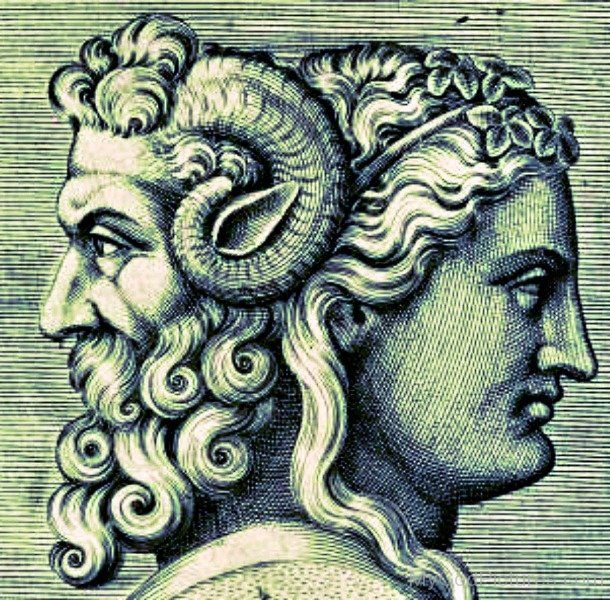
The god Janus gives his name to the month of January, a name meaning passage or doorway. Janus is usually pictured as a two-headed deity, with the gift of seeing two ways; he looks forward and behind, simultaneously. He is bearded and smooth-faced, old and young. On this first day of January, sitting at my desk, I look out at green woods, where animal trails lead away from the house and towards it. Last week a quartet of Roosevelt elk found their way to us, two cows, one lying down in moss while the other kept watch, and their two calves, half-grown, grazed on periwinkle and lichen.
The god of whom Ovid wrote,
Two-headed Janus, source of the silently gliding year, The only god who is able to see behind him
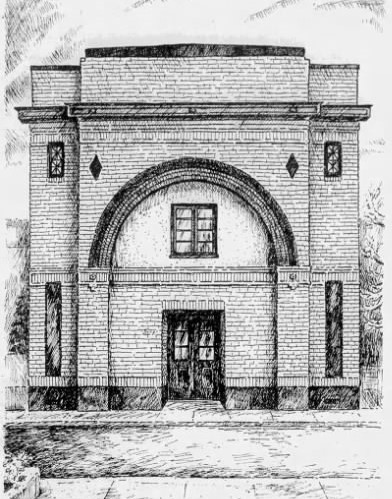
I am thinking of that double seeing this morning, particularly the ability to see behind oneself, having spent a couple of days in Victoria, the city where I was a child. As we drove from the hotel where we stayed to Cattle Point for a walk among the oaks, I kept saying, Well, we’re approaching another Memory Lane, because the city is threaded with them, tangled with them. The road running past the funny old apartment, formerly a movie theatre, a place where I found myself as a writer. (A ground-floor suite, where once someone reached in my bathroom window while I was in the bath to borrow matches from a box on the sill.)
The roads in and around Clover Point where I rode a small blue bike, exploring the edges of the known world, and where I once ventured as far as Thunderbird Park where I watched Kwakwaka‘wakw master carver Mungo Martin working on something, I don’t remember what exactly, but I do remember curls of cedar falling from his hands and how he showed me the sharp adze he was using. (I think it was an adze.) The road leading off the highway to the beach where I swam my horse on hot summer mornings, leaving the saddle on a log at the high tide line. Sometimes I’d ride him bareback along the sand afterwards, to dry out, seaweed trailing from his fetlocks. A curve of Rockland Avenue where I first knocked on a door that opened to something I am still trying to puzzle my way through. On that particular Memory Lane, we slowed the car so I could see if the studio where I sat on a flowered cloth for hours was still there, and yes, it was, or at least its windows were, multi-paned and mysterious.
Later in the week, I will have a birthday. Not a significant one, unless they all are; but one that guides me into the last years of a decade. So much undone still, so much to finish.
Janus is often depicted with a key in his right hand. He could open any door, the one you dream of, the one you stepped through into a new life, and the one you watch for now, the door into the dark.
All I know is a door into the dark, Outside, old axles and iron hoops rusting; Inside, the hammered anvil’s short-pitched ring
–Seamus Heaney
Last night someone was taking the old year into the new with fireworks, not exactly an anvil and hammer striking sparks, but loud bursts like gunshot in the night. It reminded me that Janus is also represents the middle ground between barbarism and peace. Oh, a god we need now, in a world torn apart and burning, to look back at our excesses and perhaps point to the possibilities of our better nature.
I dreamed she was coming back from the dead, coming to a room she’d lived in, a room I hadn’t known about. When I opened the door, I found a bed, not the one she’d slept in with my father for just short of 60 years, but a small bed, covers drawn up over the pillow. I heard giggling and realized my grandsons were under the blankets, hiding. They had been playing in the room and their lego, books, bows and arrows, and little trucks were strewn everywhere. You have to help me tidy up, I told them, as I looked around at the unfamiliar clothing, a painting on the wall, a bag of epsom salts, the plastic shredded with age. A threadbare dressing gown hung from a hook on the door. She was coming back from the dead and I wanted her room to be as she’d left it. Would I tell her what I’d found out about her parents, I wondered. She died in 2010, not knowing. She’d lived from infancy with a woman she called her foster mother. She had her biological father’s surname. After her death, much later, I sent off a DNA sample and waited, waited, for a couple of years as little pieces of her family puzzle fell into place. First her father, then her mother, details revealed in a letter found in a tin box two years ago by the woman who would have been her sister-in-law. Would I tell her? You can never go home, you are never the same person, you are older, you have gone out into the world, you can never go home, but can you come home? She was coming home, back from the dead. You have to help me tidy up, I told my grandsons. Get out from under the covers.
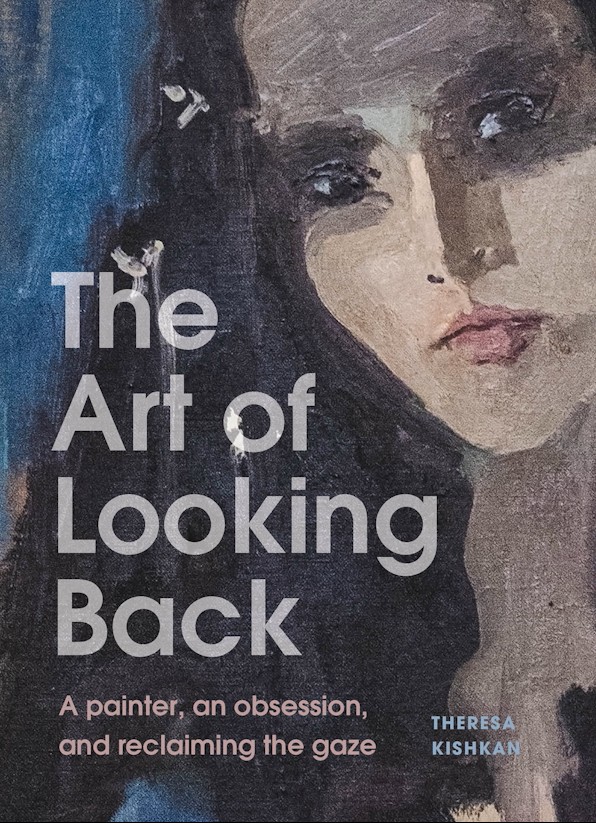
Note: this was posted 4 years ago. I was working on edits for my Blue Portugal & Other Essaysand am kind of astonished that it was both so long ago and so recent, if that makes sense. A book I loved writing in so many ways, each essay different from the next. And now I am anticipating the publication of my memoir, The Art of Looking Back: A painter, an obsession, and reclaiming the gaze, a book I’d not even thought about when I was working on Blue Portugal. (I was hoping to work on a novel-in-progress, Easthope, and yes, I returned to it, finished it, but the future doesn’t look positive for it. So I’m glad to have written something else, something that took me far outside my comfort level, and I’m wondering if I’ll ever return.)
__________________
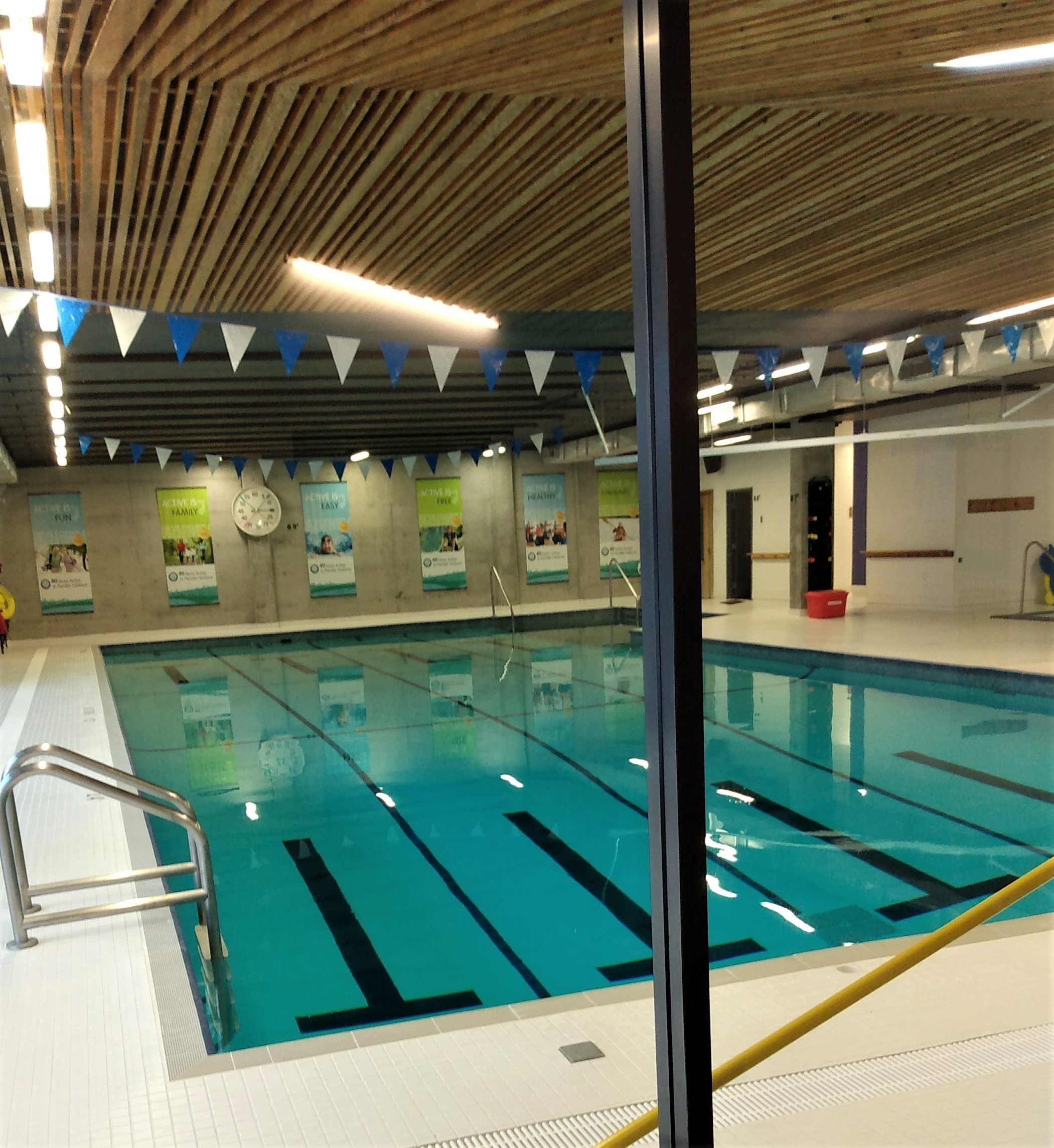
This morning I swam–imagine me in the lane on the left; what you can’t see are the huge windows looking out to snow–and I thought about the upcoming year. What are you hoping for, I asked myself, stroking on my back, looking up at the slatted ceiling, the little flags. (When I woke in the night to pee, I saw a few bright stars glittering above the mountain and I asked myself the same question.) My immediate hope was that the pool stays open during these perilous times and that I can continue my slow kilometre, three mornings a week. And then I hoped for better guidance during this pandemic because there are things I think should happen–free N95 masks (two years into this, it seems to me that in a province with an active pulp and paper industry, there could have been more effort to manufacture masks for our population); better ventilation in our schools; better attention to the needs of vulnerable citizens. We’re told to be kind and yes, yes, we need to be kind. But we need to be smart too. What do we do about people who refuse to be vaccinated but who want to be part of the social fabric? I don’t know. But can we continue the way we are, with people willing to stand outside our hospitals and schools, harassing others?
So I swam and I tried to think my way into the new year. And as I swam, the music played. The lifeguards often ask what we’d like and I tell you that doing a slow kilometre to Mozart’s 23rd piano concerto is sublime. But so is swimming to bluegrass or the Supremes (you can’t hurry love) or Adele. This morning no one asked. Roy Orbison, some other stuff I didn’t recognize, but then when I heard the opening chords of Dylan’s “Like A Rolling Stone” I smiled to myself.
How does it feel, how does it feel? To be on your own, with no direction home Like a complete unknown, like a rolling stone
I swam and listened and thought about the novel I’m finding my way back into after (mostly) finishing up the edits for Blue Portugal, thanks to the wonderful Kimmy Beach, who asks the right questions and knows all kinds of stuff, like diacritics for passages of Greek. I thought about what Blue Portugal might look like now that the designer can apply his magic to completed pages, with text that uses margins like poetry does, with gaps and spaces and passages running down the middle like rivers. how excited I am to see how it evolves, and how I am drawn back to Easthope, the working title for my novel. Easthope is really mostly Egmont (though there will be some differences in both geography and characters) and when the pandemic was first declared, we had just been out for supper to the pub on the edge of Jervis Inlet where we saw whales and where we’ve returned when times felt safer — summer, because we could eat on the deck with wind blowing viruses to kingdom come; and in the fall when one needed to show proof of vaccination to come into the pub. It was never crowded and the tables are set far apart, Twice we sat by a roaring fire and ate steelhead tacos with chowder, feeling both the strangeness of the times and also blessed, if that doesn’t sound too emotional.
You used to laugh about Everybody that was hanging out Now you don’t talk so loud
Now you don’t seem so proud About having to be scrounging your next meal
What are you hoping for, I asked during my last lap, and for a moment it was this, this, this. The water, Dylan, my husband in the next lane, daughter and her beau waiting at home, dough for cinnamon buns rising in the big bowl, our own fire warm as icicles form on our eaves, a novel to write, a book coming out in April with the most beautiful cover, everyone in my family healthy (so far), the world white and mysterious, All the irritations eased out as that kink in my shoulder eased out, the anxieties (for now), the last lap, the final strokes. I’ll do what I can, hope for what’s possible, wear the masks, stay clear of the wild-eyed people with the signs near Davis Bay, and remember the beauty of those whales as we sat by the window overlooking Jervis Inlet, my notebook at hand, the sound of a boat approaching the dock, tok-tok-tok, and cormorants fishing as though nothing else mattered.
You used to be so amused At Napoleon in rags and the language that he used Go to him he calls you, you can’t refuse
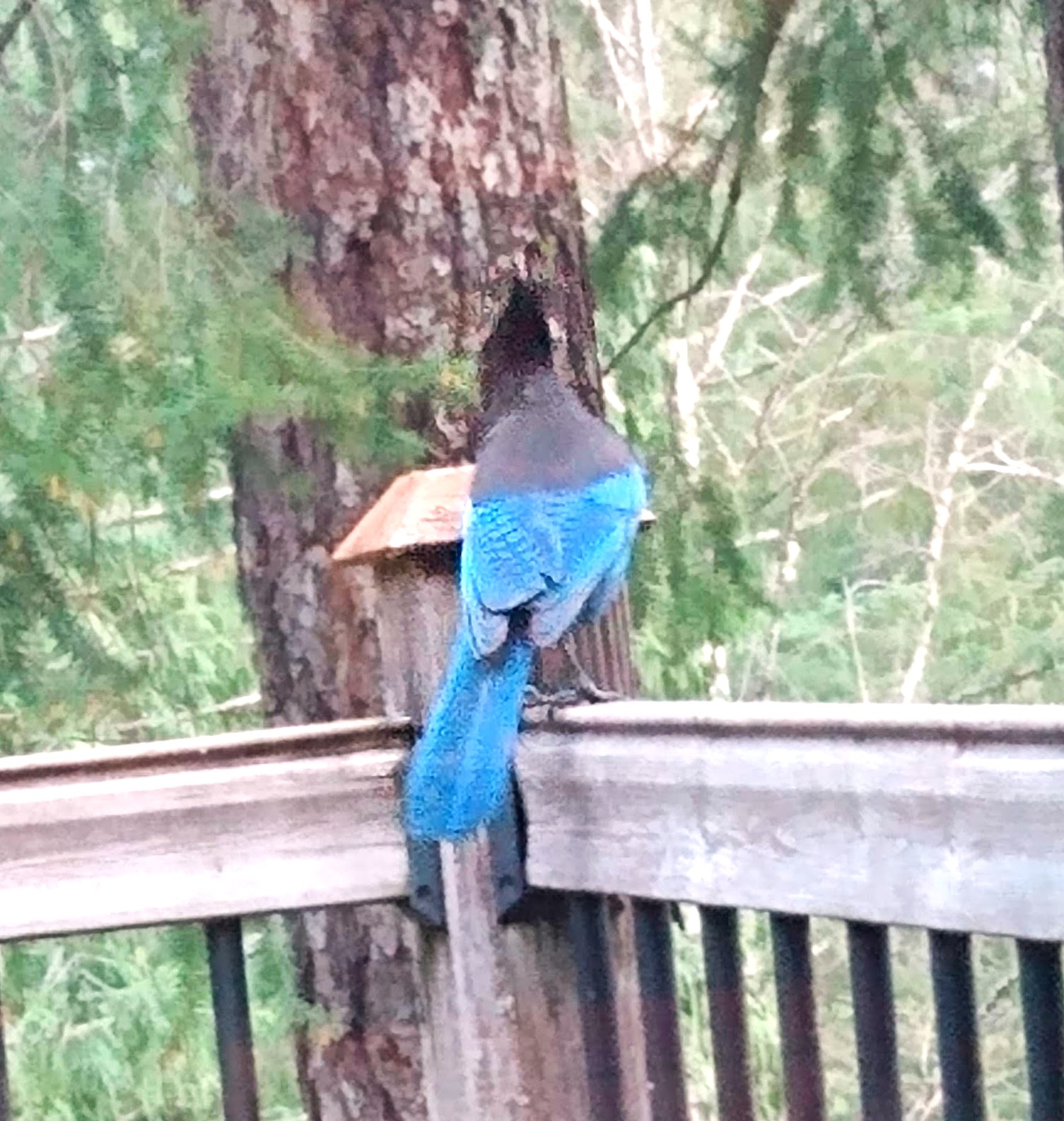
This is not the jay feeding outside this morning. Or maybe it is, but there’s a skiff of snow and today’s jay is a little skittish; I couldn’t get a clear shot. But the jays have been coming most mornings during the fall and winter for more than 40 years. If this jay, photographed last year, isn’t the one this morning, it’s probably a relative. Some days there are as many as 6. I love it in early fall when the ones born in spring are learning how to feed on the posts. (I have a hanging feeder in winter but I can’t use it until the bears den late in November because otherwise they drag the feeder down and bust it to get at the seeds.) Their crests are untidy, the young, and they are nervous. They’re kind of wildly acrobatic. And honestly, is there a better blue in nature’s paintbox? This is the colour I dream of, try to find in my vats of indigo and woad, dipping linen and cotton, 6 times, 7, and letting it rest overnight, untying and unclamping the next morning to see how close I am to the dreamed colour. I think the best morning was this past September when I was patient enough to spend most of the day dipping and removing for the solution to oxidize, dipping and removing, and then again. The indigo process is counter-intuitive: it’s not the length of time you let the fabric soak but the balance of immersion and oxidization.
I’m thinking about words to guide me through the next year. Patience is a good one. I’d like to be more patient. Do you remember Adrienne Rich’s poem “Integrity”? The one beginning with that astonishing line: “A wild patience has taken me this far…”? Maybe that’s the quality of patience I am looking for. Wild, problematic, untidy. The past two years have been hard in many ways. I felt I was shaken off my familiar foundation and I have been trying to learn how to made amends for my failings, to try to find a different way to look at the past and whatever future I have left. I have been trying to find a way to forgive myself. There’s been sadness in this work, and also anger. Also regret. It’s complicated. But patience would certainly be a better resource, particularly a wild patience.
Anger and tenderness: my selves. And now I can believe they breathe in me as angels, not polarities. Anger and tenderness: the spider’s genius to spin and weave in the same action from her own body, anywhere — even from a broken web.
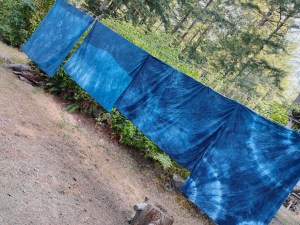
Do you see the spider webs in the fabric on the right? I didn’t know those beautiful arcs of white would be the result of the tying I did to the white cotton I began with. I wrapped with hemp string, tying it tightly in several places. I had faith, I think, that whatever the result would be, it would be beautiful. And on this cold late December morning, I will be patient until the days are warm enough to make a dye vat, to take my lengths of cotton and linen and even the raw silk I have saved patiently for the right time to give it a new life. Maybe this is true for me too. I don’t want a new life but I want to let the anger and tenderness breathe in me as angels now, not the difficult weight they have been for the past 2 years.
A wild patience. Can I choose two words for the new year? Can you? In the meantime, I wish everyone who finds me here a very good year. There is a little band of pinky-gold light on the western horizon, beyond the lake, beyond the trees. The chickadees are fluttering by the door and the jay is waiting in the big fir for more seeds. The morning has a kind of clarity, green, snowy white, the blue feathers of the jay. I wish everyone, even myself. In a little while, I’ll bring in the basket of blue fabric to sew by the fire. Nothing needs doing as much as that.
I have nothing but myself to go by; nothing stands in the realm of pure necessity except what my hands can hold.
Note: the lines are from Adrienne Rich’s “Integrity”,
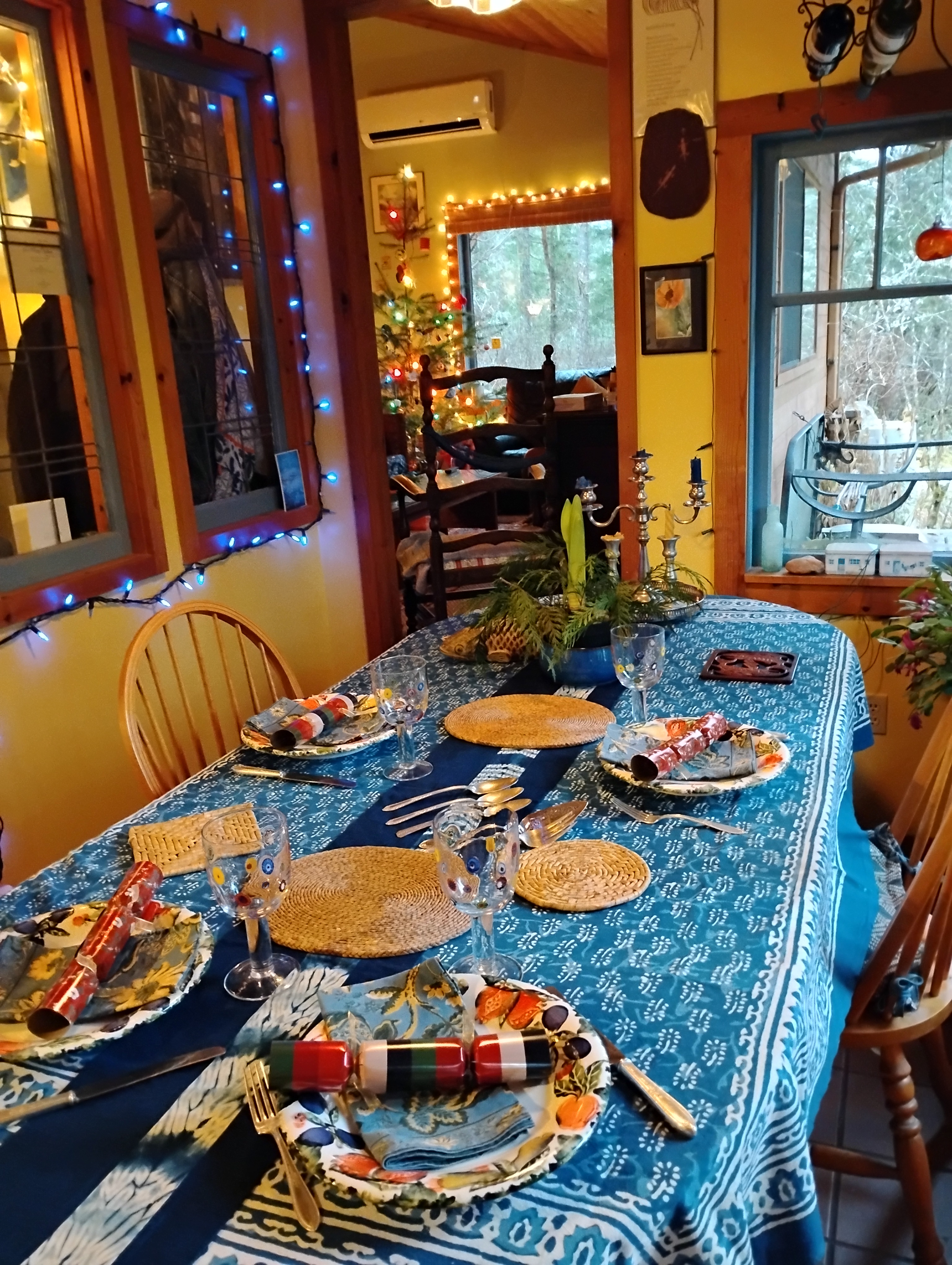
Today is the shortest day, the day when the dark surrounds us, early and late. Here we are keeping the fire burning and preparing a room for Angie and Karna, who will arrive in the dark. On the table, ribbons and tissue for the packages to go under the tree we cut up the Malaspina trail last Wednesday. It’s been waiting in the woodshed, leaning a little like someone tired after a long journey. We’ll bring it in the day after tomorrow. This way, it will still surprise me when I come downstairs on Christmas morning, the Chieftains singing the old carols. So today is the shortest day. How lovely it was the other night to sit at our table with dear friends to celebrate a birthday with the candles burning, their blue wax dripping onto the cloth. I sent my parcels east and on Christmas morning I’ll see the faces of those I love on the screen, showing me what I sent, what others provided. When I read this Rilke poem this morning (translated by Robert Bly), I thought, yes, a circle of light for everyone, because the dark is there, potent as ever: a great energy.
You darkness, that I come from, I love you more than all the fires that fence in the world, for the fire makes a circle of light for everyone, and then no one outside learns of you.
But the darkness pulls in everything: shapes and fires, animals and myself, how easily it gathers them! — powers and people —
and it is possible a great energy is moving near me.
Last night, on his birthday eve, John looked out the window and said, I can see Orion.
The Road was lit with Moon and star –
It’s been damp lately, skies muzzy with cloud. Orion has always been his constellation, hovering over him as a young boy buying his first bow, learning the tension, the release of the arrow. I made this quilt for a grandson 7 years ago when he was turning 3, a swirl of autumn salmon, shell buttons for eyes and for the constellations present in our western sky on the night of his eastern birth crowning the top: Cygnus, Cassiopeia, and Orion. Still in the sky, as another birthday is celebrated.
The Road was lit with Moon and star – The Trees were bright and still – Descried I – by the distant Light A Traveller on a Hill – To magic Perpendiculars Ascending, though Terrene – Unknown his shimmering ultimate – But he indorsed the sheen –
Note: This was first posted five years ago. It was a dark time, the uncertainties of COVID and a surgery gone sideways for my husband heavy in my heart and mind. But sometimes a piece of music can transport one and provide its own sense of healing.
______________________________
Some days are easier than others. For me, for us, for all of us. Yesterday was dark. When we went to pick up mail from the day before, we saw that all the parcel boxes at the community mail boxes had been pried open. This was the second time. Someone has been going around the Coast, stealing parcels from the community mail boxes. In a year when our lives are reduced and constrained, when so many people are depending on Canada Post for parcel deliveries and Christmas mail in general. There was confusion at the Post Office itself when I stopped in to mail my final family parcel. Usually you have a key to the parcel box in your individual mail box if you have a parcel. Or if the parcel is large, you have a card asking you to pick it up at the post office. Can I assume that I didn’t have a parcel in the box that was pried open if I didn’t have a key or a card, I asked. But no one could say for sure. It turned out I did have a parcel card in that day’s mail, for a parcel that hadn’t yet gone out. I wanted to ask if two break-ins in as many weeks meant that the mail person would no longer leave parcels in the community mail boxes but the post lady was already cross with me about a postal code she insisted was wrong on the parcel I was trying to mail so I left in tears.
Tears that were never far from the surface throughout the day. Someone scolded me in the 1st grocery story (long story). I got wet everywhere I went. John was grumpy and although I know he has more reason than anyone to be grumpy these days (paralyzed foot….), I took it personally. In the library stacks I cried. I cried as I loaded groceries in the back of the car from the cart after my stop at the second grocery store, unbagged because the cashier spoke sharply to me when I said I’d use my own bags. You’ll have to put things in your cart, then, and do it out in the mall area, she said. We can’t have your bags on the counter. (I know this. I’ve been shopping at this store for 40 years, and once a week throughout the pandemic. I wouldn’t have put my bags on the counter. But I didn’t want to cry in front of her so I just wheeled my cart out to the car with the groceries heaped in any old way.) Wiping my face with the back of my hand as I closed the trunk of the car, I suddenly stopped. Was that “Wild Mountain Thyme” I was hearing? It was. The older fellow who plays his guitar outside the liquor store, the one who usually plays old Gordon Lightfoot songs, who sings with a world-weary voice, and into whose guitar case I’ve dropped many twoonies over the years, was strumming and singing (behind a face-shield).
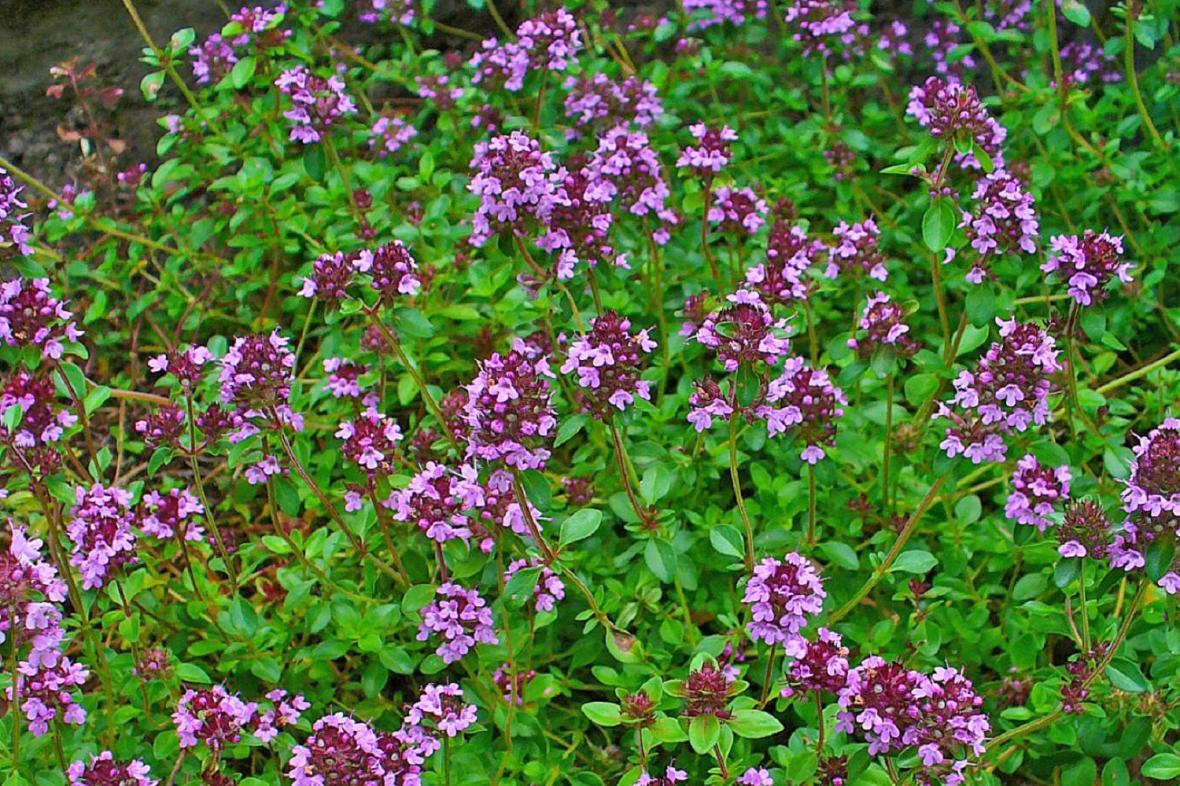
O the summer time has come And the trees are sweetly blooming And wild mountain thyme Grows around the purple heather. Will you go, lassie, go?
Some days are hard. You think of all the people who will be alone this Christmas, waiting for parcels or cards, you think of the cashiers saying the same thing over and over, hoping that someone doesn’t infect them, the nursing staff in the hospitals consoling, consoling (I think of how kind they were to John when he was in pain), the people working in post offices trying to do their best with mountains of deliveries to boxes that are clearly not safe, the families lined up at food banks, and you wish, wish for the beauty of summers in years gone by, the garden flourishing, your loved ones sleeping in every bed in your house, the long pink sunsets, and even the scent of thyme you’ve cut for the lamb you are preparing for the barbecue, enough for everyone.
I will range through the wilds And the deep land so dreary And return with the spoils To the bower o’ my dearie. Will ye go lassie go ?
The other day I was making candied orange slices for panforte and I made some extras to dip in very dark chocolate as a Christmas treat. The smell of them! And the anticipation of eating one at some point, with a glass of wine.
Listening:
Pablo Casals playing the Bach Cello Suites. The story of Casals finding the sheet music for the Suites at the age of 13 in a second-hand store in Barcelona in 1890 is an interesting one in itself, the music relatively unknown and seldom performed, and this particular score (a 1866 concert edition) much annotated by German cellist Friedrich Grützmacher. I have many recordings of these pieces but this is my favourite, or at least it’s my favourite for a mild day in December when the wind is blowing and chickadees are haunting the feeder.
Thinking:
As I swam my slow laps this morning, alone in the pool for half of them, I was thinking about love, how it sometimes fills the heart to the point of pain. I was swimming the backstroke and thinking about how this time of year always contains every Christmas I’ve known, the early ones when my brothers and I woke at 5, the later ones when my children woke early but waited until their dad put on the Chieftains recording, The Bells of Dublin, the title song (with the bell ringers of Christ Church Cathedral, Dublin) bringing our Christmas morning to life. The ones away from home (Ireland, Italy), the lonely ones, the noisy ones, the ones where family and friends, now gone from this earth, ate at our table, the sweet ones, the ones yet to come.
Watching:
I have been watching the Anna’s hummingbirds dart back and forth to the feeder by my kitchen window, the cerise crown and throat of the male brilliant in the grey air.
Enjoying:
The warmth of wood fires, here every day, at the Backeddy the other night, how the heat is unlike any other, reaching the bones.
Finishing:
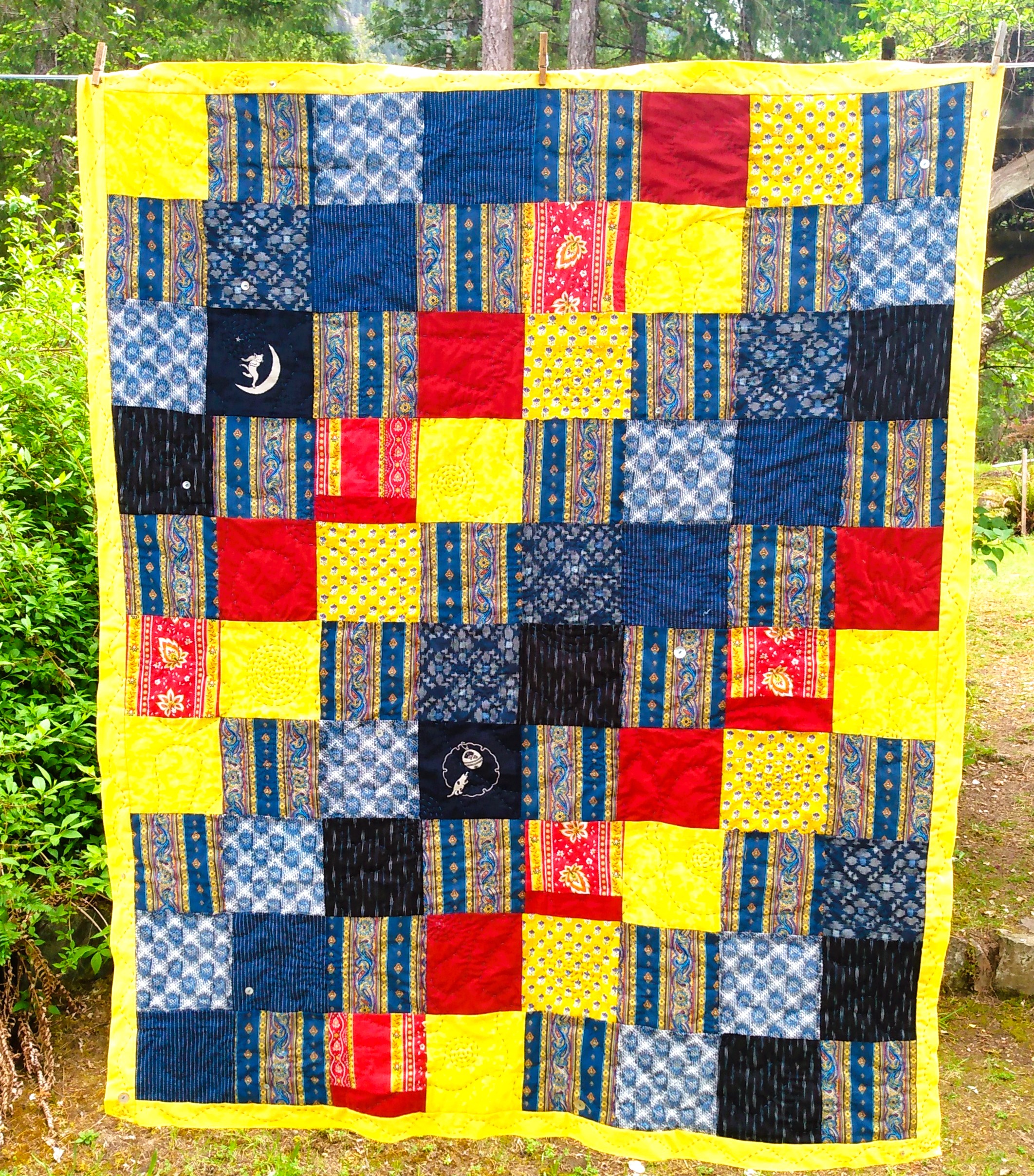
I thought I’d be finished this current quilt by now, thought I’d be working on one I’ve promised a grandchild, but somehow the stitching is slow (like my swimming), my needle finding a meandering line through the indigo-dyed linen, the rose madder-dyed linen, attaching a little shell button here, and here, and here.
Reading:
I somehow missed Leanne Shapton’s Swimming Studies when it first came out in 2012, maybe because I wasn’t swimming regularly then, but I read it last week, caught up in both the prose and the illustrations: swimming pools, bathing suits, old team members from her time as a competitive swimmer. A very original and fascinating meditation.







 ...Theresa Kishkan