“how much their feet look like our hands”

sitting

Over the years we’ve become accustomed to bears. They have their season, which is usually late summer, early fall, when they lurk around, waiting for the crabapples to ripen. The bear in the photograph was one that was around for a couple of years, easily identified by the white patch on its chest. It would climb the tree, feast on crabapples, then loll around in the sunlight on the lane below. It wasn’t a troublemaker. Not like some of the bears who’ve come up onto the upper deck to pull tomato plants out of their pots or else push over the compost boxes. This time of year we leave the boxes open to discourage them from pulling the lids off. But the other day I closed the lid on one of them after emptying the bucket from the house into it. I remember smiling as I looked at the edge of the plywood lid, gnawed and clawed from past vandals. Because some of the bears have been vandals. In spring, one of them waited for us to leave for our morning swim, and then came up the stairs to the deck by the front door in order to pull down the hummingbird feeder. Maybe the feeder had half a cup of sugar water left in it. The bear broke it apart on the patio and licked up the sugar water. It was a reminder that they’d come out from their winter sleep to eat. Mostly in spring we notice they eat fresh grass–their scats are filled with grass!–or they turn over big rocks for insects or pull apart decaying stumps to get at the grubs inside.

Remember I said that I’d closed the lid of one of the compost boxes? It was like a signal! I hadn’t seen any sign of bears around for awhile and there are fish in the local creeks which is usually the food of choice this time of year. But this morning, as we were getting ready to drive to the pool for our swim, John opened the front door and then called to me, Theresa, are you out there? He thought I must be because the car door on the driver’s side was wide open. No, I was getting the towels together. That’s weird, he said. Maybe I left it open yesterday?

When we went out, we saw that yes, the car door was open, and the handle was covered with mud and leaves. What…? Then we realized that a bear had opened the door, looked in, and not seeing or smelling any food (because we don’t leave food in the car, not since years ago when we left a bag of dog food in the trunk overnight after grocery shopping and came out to find teeth marks in the bumper and mud over the trunk lid), it departed, but not before leaving a muddy print of its left paw on the window, where it must have rested it while it opened the door with its right paw. Oh, and it opened the lid on the compost, just in case anything good had been deposited since it visited last. Pineapple stalks, coffee filters, leek trimmings, a few sad beans.

When I’ve seen bear tracks in the sand by the lake on early summer mornings, I always marvel at how much their feet look like our hands. And now they can use them like hands. Interesting.
an archive of woodsmoke

boats

This morning I am in Easthope, a semi-imaginary village on this Coast, I am sitting by the fire with the newly-printed first draft of my novel of the same name, I am using a pencil to make little notes to myself: this needs to happen later or you have to fill in this gap or maybe add a paragraph here or maybe you need to rearrange these bits because they are seasonal. My editing is analog, I guess that’s what I’m saying. And it’s visceral. This morning, making the fire, using some cedar kindling and bark, and a fir log, I remembered a little bridging passage in Easthope, and I realized that it could also serve as a title for the third (and final) section of the novel. So I put a line through the title I was already using and pencilled in “an archive of woodsmoke”.

An archive of woodsmoke: the rich incense of cedar burning; sappy pine heady with spice; an occasional whiff of dark coal or peat, mysterious, until you remember spruce; the sweetness of apple prunings dried for a year; cherry from a tree knocked down by a bear in late summer, also sweet but lasting; little curls of its smoke wrapping around the high boughs of Douglas fir; the urine-y scent of willow; maple with its reminder of syrup.

Once I’ve gone through the manuscript with my pencil, I will lay out the novel like Tarot cards on the dining room table and see what it tells me about itself, about me.

A line here, and here, and here

23

nearly 70

I was just coming downstairs and I looked up to see the old portrait of myself at 23. It is the subject of a long essay I wrote over the past couple of years and is the subject of much thinking on my part about age, about agency, about the past. About artists and what they take, what they give. I looked at myself in the mirror to see how much of that young woman remains. So many times I’ve looked at her (me) and never asked her the questions my essay asks. But now as I’m about to turn 70 (a little more than a month), I’m curious. I don’t have an answer yet but I’m asking the question. I’m asking her if we are still the same woman, lines and all.

I see the haste of this work, the urge to put the young poet down on canvas, the firm line of the right part of my head. I see how he would have sketched with a brush dipped in black, a line here, and here, and here. My friend shows how the eyes are not symmetrical and they are the eyes I see in the mirror every day, not symmetrical, but these are not looking at me, not directly; they are implicating me in something I am only now discovering.

A day later, this morning, I come down the stairs early and look up to the blank wall. A small hook to hold the wire at the back of the frame, which has been dismantled, the painting resting flat in a safe place. Everything has been taken apart, dusted, looked at closely. I have talked and talked and talked. A blank wall, and somehow I don’t know where to look, whose eyes to meet. A line here, and here, and here, and on the face I see in the mirror, a line here, and here, and here.

polish

polish

I was dusting the sideboard and polishing the oak, wiping grime off the silver candelabra (the one found in a junk store in Falkland) and I thought how I’d been doing the same with my novel, Easthope, all weekend. I’d been arranging shells on a windowsill, laying out bits of wood with lichen on them for the main character who was thinking about colour. I was moving some passages around, the ones that were supposed to link sections, and when I read them again, I realized they hadn’t done their job but that they might do it elsewhere. I thought how crowded the sideboard has become with little plates from Portugal (bottom shelf, left hand side), our faux-Murano wineglasses (bottom shelf, right hand side), the platters from our mothers, the tiny bowls from Granada and Porto, the Moorcroft bowl from Angie, the shelf with objects I sometimes rearrange: (left to right) a basket from Wikwemikong, made of birch bark, sweetgrass, and quills; a pine-needle basket made by Hattie Olsen; a pot made by John Reeve; a pot made by someone on Salt Spring Island; a bentwood cedar box with abalone inset made by Shain Jackson; a little rainpot from Acoma, made by Emil Chino; and a Japanese porcelain bowl. The shells on the shelf in the novel are named too: Lewis’s moonsnail, northern abalone, wide lacuna, purple olive, keyhole limpet, blue-line chiton, horse mussel, silvery topsnail, Pacific littleneck, butter clam, smooth cockle, Carpenter’s false limpet…The lichens too. I am dusting and polishing and finding the right names to use in the right places: dust lichens, pencil script, cladonia scales, peppered moon, lettuce lung, pimpled kidney, freckled pelt, dusky fork moss, broom moss, curly thatch moss.

“the distance of the past doesn’t exist”

pool

I knew from John Berger’s essays that there are swimming pools in Paris but I have to say on a recent trip, I wondered where they are. There were mornings in Paris when I would have loved to swim my slow kilometer, to engage in the kind of immersive thinking that swimming allows, and to explore another aspect of French culture.

When I saw Swimming in Paris: A Life in Three Stories, by Colombe Schneck, translated by Lauren Elkin and Natasha Lehrer, on the library’s shelf of new books this past week, I grabbed it. I took it home and read it in one night. What is it? Three stories? Three novellas, as the author suggests in her preface? Three movements? It reads as memoir, though that’s a problematic term for Schneck. In an interview about the book, she says this:

In the U.S., you have a category called memoir. I don’t understand it. People change things. They make it better, more suspenseful. It’s not the truth, though “truth” is very important in the U.S. I made the character of Gabriel such a kind and wonderful man, though he was cruel when he dumped me. I just wasn’t able to write that. Gabriel became a fictional character.

When I write, I try to recount everything as closely as what happened. But as soon as I start, I’m lying, inventing. I could say: “Colombe was doing this” or “was like that,” and it would be more accurate. My material is autobiographical: I use the story of my family and I make something of it, like a painter.

So a book, then, using autobiographical material to explore memory, shame, love, and in the final movement, the importance of swimming to claim her body’s own strength and resilience. (“But there, in the pool’s liquid embrace, I need only an imperceptible flicker of my thighs, an arm reading effortlessly into the air, toward the other shore, and I am borne on its infinite waters.”)

The opening novella (or movement or story) describes an abortion the author had at age 17 and how it was the event that took her, perhaps reluctantly, into adulthood, how it gave her insight into her liberal upbringing and education, and how she comes to realize, in her fifties, that the event has resulted in an absence in her life, though she went on to have children. The second novella, narrated in the third person, is a stunning portrait of a friendship, its difficulties and riches and secrets, all of them intensified as Schneck’s life-long friend dies of a terminal cancer.

Swimming in Paris is so beautifully located in Paris, in the Left Bank neighbourhood surrounding the Jardin du Luxembourg. When I was in Paris, I met my friend and publishing partner by the garden gates for a quick visit–she was enroute to the south of France from her home in the Netherlands–and walking around the area before and after, I looked at the beautiful old apartment buildings and wondered at the lives within them. I even (I swear this is true!) wondered where one might swim if one lived here. (I have become that person, always wondering where I could swim.)

Does it matter what we call a book? Do the terms matter? Auto-fiction, meta-fiction, memoir? I wonder. The French are perhaps less didactic about these distinctions than we are in North America. (Annie Ernaux appears in the Bibliography for Swimming in Paris.)From my own perspective, I don’t much care about hard and fast definitions of genre. A book is a book is a book. Memory is always selective and most of us understand that we don’t need to know everything, that leaving things out or embellishing others is simply what writers and artists do.

I put this book aside the other night and I’ve been returning to it ever since, picking it up, finding phrases I remembered and wanted to note down. “I could write an encyclopedia of swimming pools.” “I was twenty-three, my father died, and I became invisible to all men who were not him.”

When I’m swimming, I think about the past, the present, and what I hope for the future. I work out writing problems. I try to remember the lyrics to favourite songs. The act of moving one arm ahead of my body and following its trajectory is an act of memory, of muscle memory. In the interview linked to above, Schneck says this:

When you read Proust, you understand that the distance of the past doesn’t exist. Something that happened thirty years ago can be in your mind like it happened this morning.

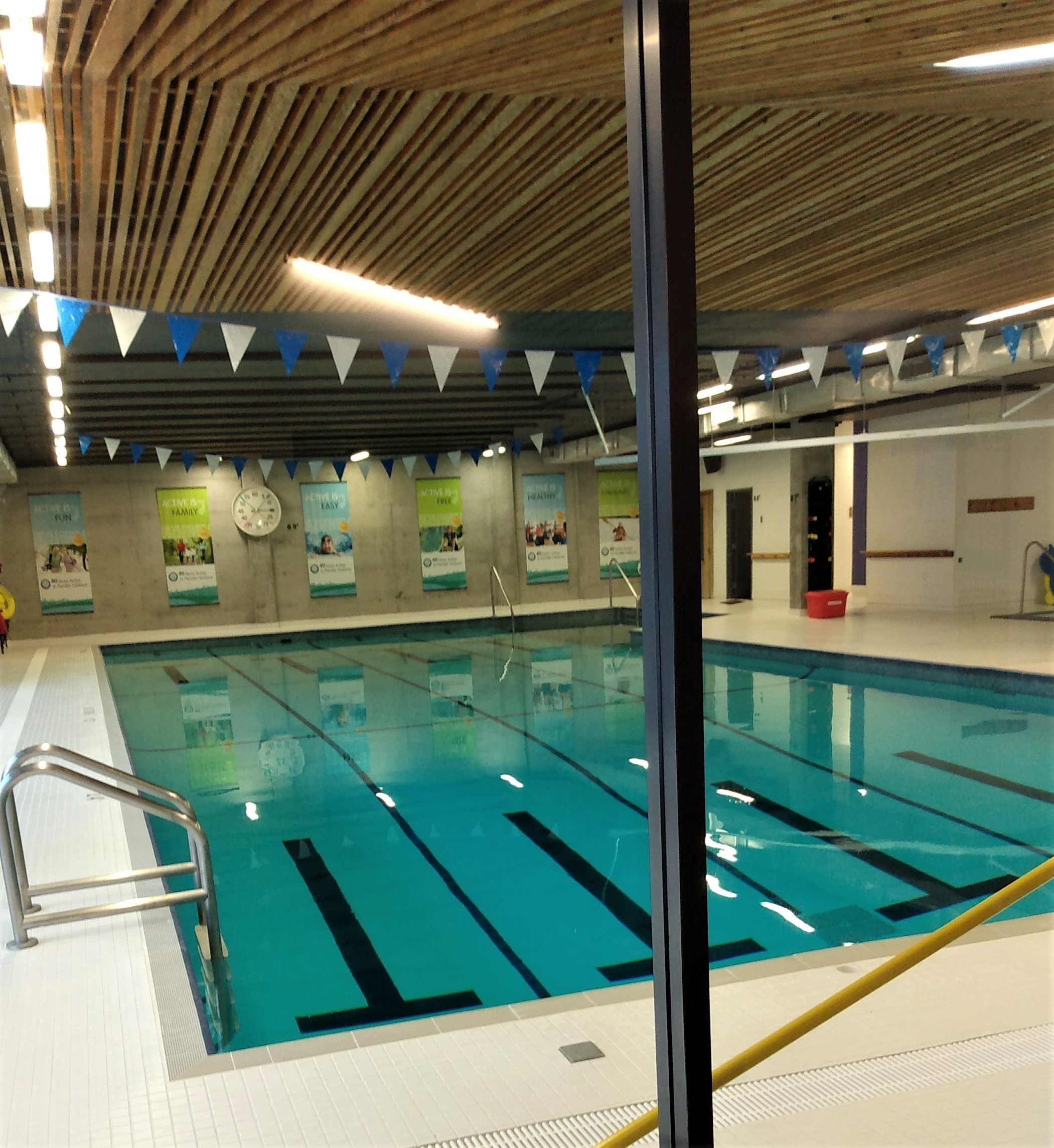
Note: the image above is not a swimming pool in Paris but the one 10 minutes up the highway from my home on the Sechelt Peninsula. My lane is the one on the left, closest to the windows you can’t see just beyond.

redux: “Deep waters cannot quench love,nor rivers sweep it away.”

Note: Hard rain overnight but not like 2021, when I wrote this as a response to the atmospheric river event in our province.

crossing highway 8

The first time I remember driving Highway 8, the road between Spences Bridge and Merritt, was in, I think, 1982. John and I were heading to a family event north of Kamloops. Angelica hadn’t been born, Forrest and Brendan were small boys, and we still had Friday, our English sheepdog cross. Our usual route would have been Highway 1 to Cache Creek, then east to Kamloops, then north to where we were meeting my parents, brothers and their families for a few days of camping. Why don’t we take this road instead, John said, as we reached Spences Bridge and the turn-off to Highway 8. He’d travelled in the Nicola Valley before, with his family, when he was a boy. He remembered how much he’d loved the Nicola River and he thought I’d love it too. That was an understatement. I’ve never forgotten the drive, every moment of it. We stopped for a picnic at a forestry site along the highway and it was like the Emmylou Harris line: “Speaking strictly for me, we both (all) could have died then and there.” Not that I had a death wish, not then, but the river, the aspens, Ponderosa pines resiny with heat, the scent of sage, the dry hills around us: it was a landscape that entered my heart and never left.

In the years since, I’ve put characters in a novel on that road, just so I could travel it again over and over, as I wrote, as I revised, as I edited, and they are there still, in my novel, Sisters of Grass. I’ve put us there, in an essay coming out as part of Blue Portugal and Other Essays in the spring.

I imagined us staying there, making some sort of shelter to extend our small tent, I imagined a life by the river. My husband had his fishing rod, I knew a little about edible plants. Already I watched the sun for its own time.
…the beams of our house are cedars,
our rafters, cypresses.
We spread out our maps and planned the rest of the drive, eating sandwiches and apples, tipping our cup into the river itself (this was before anyone worried about giardia), drinking the cold water as sweet and satisfying as wine. There were outhouses and we used them, one of us staying with the boys as the other entered the little shed in order to at least have the opportunity for privacy and toilet paper (there’d been a stop or two along the way to crouch by the highway behind the door of the brown Toyota station-wagon). John stretched out on the table for a short nap while I helped the boys to skip stones on the surface of the river. A small herd of mule deer were grazing on the opposite side, in a pasture under the shadow of the mountains the Nicola River cut through.
I adjure you, Daughters of Jerusalem,
by the gazelles and the does of the field,
Do not awaken or stir up love
until it is ready.

I changed diapers, rubbed sunscreen into the arms and legs of my children, the tops of their feet in leather Clark’s. (How beautiful are your feet in sandals…), and packed up our picnic leavings to return to the back of the car. We had several hours of travel ahead of us and as it turned out, a stop in Kamloops for an emergency car repair, so it was time to leave, though I’ve never forgotten the smell of the dry grass and sage, the sound of the water, and the arms of my small boys, golden and downy, as they tossed their stones as far as their arms could fling them before I settled them into the car.
Deep waters cannot quench love,
nor rivers sweep it away.

I’ve just been looking at photographs we’ve taken on that highway and the memorable ones are from October, 2014, when John and I were on one of our road-trips. We had a few routes, meandering through Lillooet, Pavilion, Cache Creek, over to Kamloops, down Highway 5A through the Nicola Valley to Merritt, west to Spences Bridge. We were nearly at Spences Bridge when we encounted a herd of bighorn sheep, a single ram and a whole passel of ewes. We pulled over to the side of the highway and watched them, the scent of them in air earthy and warm.

During the recent and catastrophic weather events in this province, major highway systems were damaged, some of them badly. Rivers flooded them, undermined them, and huge sections washed away. I knew Highway 8 had been closed because of wash-outs but it wasn’t until yesterday that I saw the really awful images of sections of the highway simply gone. This morning I saw some video footage and it broke my heart. One of the voices in the helicopter flying overhead:


“But this is all the road here…it’s gone. Not gone in one place, it’s gone in all the places. This huge section of road here is all gone…”

We are still there, I hope, in what I’ve written, what I’ve remembered. (Speaking strictly for me.) We are wading in the river, skipping stones in the heat of the day. A day that has lasted forever.

bighorns


redux: “a wagon at dawn” (Milosz)

Note: I posted this two years ago. And I still ask, not out of sorrow but in wonder.

P1140291

How is it that you can be two places at once, awake and dreaming? How can you be in the house you built and love, and also on a road coming down from the Carpathian Mountains where you swam in a pool just at sunrise, mist in the valley below, on the road coming down from the mountains, feeling such sadness at leaving? You remember how you felt. As though you’d found a missing strand to your complicated DNA, part of the twisted ladder of your self, the molecule that allowed you to sit at a table under the apple and pear trees at the farm you passed each day on your way back to the hotel in the mountains, talking quietly about the harvest. It could have been Tiudiv, Kryvorivnya, Bukovets, Yavoriv. You are allowed to stroke the white horse’s neck. Someone else goes into a church to pray. Stooks in the field. The scent of burning spruce in the chimneys nearby. It could have been another life. Yours.

P1140288

So you read the poem someone posts on social media and you begin to weep.

We were riding through frozen fields in a wagon at dawn.
A red wing rose in the darkness.

What will happen to the man with the white horse, the hands that shaped the hay, leaning on rakes part way through the work to catch up on the news? You cannot be two places at once. You are in your kitchen, blueberry muffins in the oven, wisteria leaves falling quietly on the deck. Three days in a row the young buck came to your window. Everything is white with frost. What will happen in that life, in this one? Those mornings you swam in cold water were a kind of ecstasy, chickadees in the sunflowers black with the coming of winter. Looking down into the valley felt like falling.

From the Hutsul wedding

Oh my love, where are they, where are they going
The flash of a hand, streak of movement, rustle of pebbles.
I ask not out of sorrow, but in wonder.

Note: the lines of poetry are from “Encounter” by Czeslaw Milosz, translated from the Polish by the poet with others.

the weather

springboard

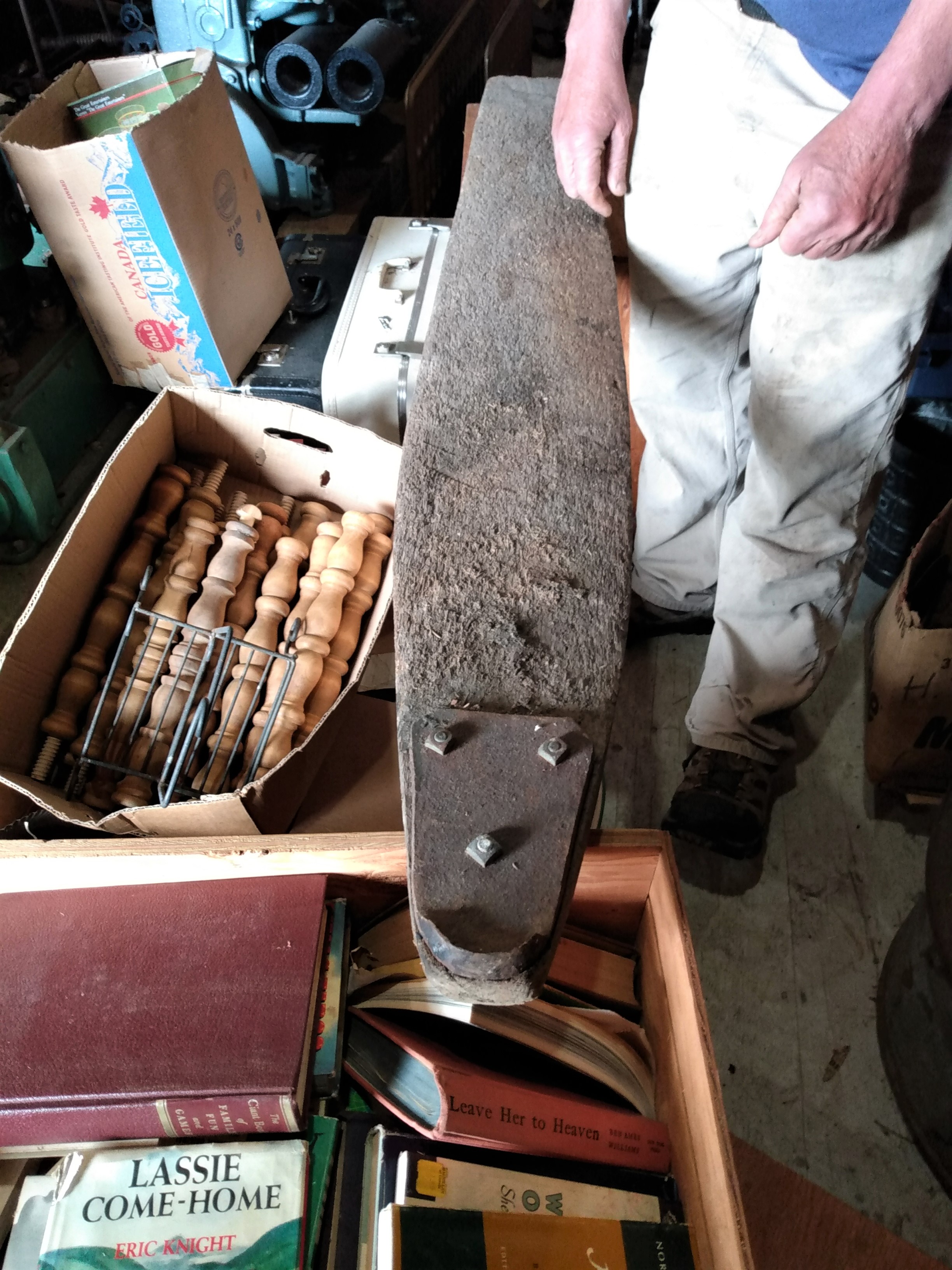
Someone in the novel I just finished (typed the final sentence on Sunday and am now going over the draft to fill in the gaps. There are a lot of those…), anyway, someone in the novel finds this springboard in the woods. Or not this one but one like it. This one is part of Bert Mackay’s collection of old marine engines and logging equipment and spending time in his collection a couple of years ago, courtesy of his nephew Ian (those are Ian’s legs and hands in the photograph), was like entering the chapter of a book. It’s a book I’ve been reading all my life and it never finishes. A page turns, a section concludes, and then I find more to read. In a way the novel I just finished writing is a kind of reading. I certainly did a lot of reading as I was writing but I also felt I was learning to decode a dialect I was only marginally familiar with. And now? I’m not fluent but I have a working knowledge.

A working knowledge of engines, of life in a small community, of relationships, of the kind of seeing that allows an artist to make art. The main character is a painter and through her, I learned to prepare canvases, to layer impasto, and to plan an exhibition.

Last week we had one of those weather systems move through our area. Earlier, maybe three weeks ago, a small tornado hit the south end of Redrooffs Road and caused considerable damage. Driving by, I was shocked by swath of trees it had shattered. And last week it was our turn. Between our house and the high school where we swim each morning in the pool beneath the school, there were 10 separate areas of the power line damaged. Poles were down or broken or leaning, huge trees fell on the wires and snapped the lines, sections of wire fell to the highway and made it impossible for ferry traffic to proceed south on Wednesday (I think it was Wednesday) morning. We lit our oil lamps and candles and made sure the fire didn’t go out. This morning I heard that something called a bomb cyclone is headed our way, with 120 km winds. I’ve filled water jugs, John filled huge buckets to wait by the back door for flushing toilets, and the lamps are clean and full. Last week’s storm damage had been sort of repaired when one of the lines, the fibre optic one, died; this meant a day and a half without our landlines, without internet (though John’s cellphone had data so he could check progress from time to time). I spent the day working on the gaps in my novel, writing two new scenes, realizing as I returned to the manuscript after dinner that I’d somehow lost that new material. So this morning I’m re-writing, hoping I can figure out what I knew and wrote yesterday.

One of the scenes involved the springboard. At least I have a photograph. At least I can still imagine the moment when it’s found in the woods and the main character learns something new. She turns a page and there’s a new chapter still to read. Today I’ve had my swim and have just put bread in the oven: you’ve heard that tale before. But there’s a new chapter still to read. I think. I hope.

She was thinking about her paintings. She was thinking about what had happened with Leah. Alone in her head, she was thinking too much. So one late fall morning she put on her hiking boots and her rainjacket and drove up the Easthope road to where she’d first seen one of the ghost trees Richard had painted. She parked on the side of the road and scrambled up the bank to the remains of the tree she recognized from one of his canvases. The little notches cut just below the flare of the trunk for the springboards, the buoyant growth springing from the remains of the tree. Here, this was the one in the painting she loved, the grey-green lichen-crusted wood, the elegant roots clinging to the ground like the hands of someone reluctant to let go, and a maple growing vigorously from the decayed rubble in the centre of the stump. She leaned against it, imagined Richard in this place, trying to see the stars he knew were there, in daylight and darkness, imagined him making notes in one of the little books he’d stored away in a drawer in the studio: colour, texture, compass readings (which she realized were references for star readings). Then she heard something scrabbling in the bush, coming closer. She held her breath. People reported cougars regularly in this area. And quite often at night, driving home from the lower Coast, she and Marsh saw elk crossing the Easthope road. The noise was closer now. And then Tog emerged from the undergrowth, dogs snuffling and yipping a little as they saw her by the stump. Tog was holding a big machete.

Should I be scared, she asked him, a little breathless. Her heart was beating so rapidly under her rainjacket that she expected he could hear it. He was talking quietly to the dogs, telling them to settle.

Scared? Oh, because of this – and he stuck the machete blade-first in another stump and laughed a small gutteral laugh. Nah, this is for salal. It’s how I earn a bit of a cash now and then. Are you looking for Richard?

Let me catch my breath, she replied. And after a moment or two, she said, That’s an interesting way to put it. In a way I was. I’m getting ready for a show of Richard’s work and mine and it seemed like a good idea to come to the source of so many of the paintings I found in a little room off his studio.

He’d come to these woods for the ghosts, he said. The echoes. I guess I knew what he meant because I’m here for the same reason maybe. Sometimes he’d find stuff. An old springboard he passed along to the museum. A ball of old wire. Once a boot with copper nails holding what was left of the sole to the rest of the boot. Whose was it, he wondered. And we knew that the story wasn’t a happy one. He came at night, with a flashlight. He painted the stumps under the stars to give them everlasting life.

“And here’s the record of the whole proceedings, socks and all.”

Egmont Hall

After the terrible news of the US election results and the resulting noise, noise, noise, I decided to take a break from the news. I don’t know how long it will last but I am finding quiet again and the best thing about that is that I’ve been working on Easthope, a novel-in-progress. I am a handful of pages from finishing it and I have to say I’m drawing out those pages. I still don’t quite know how it will end. I’ll find out by going there. It’s a novel about a small village and how it allowed two people to find a new life in an old house they’ve inherited from a bachelor uncle. There are old marine engines, a community hall that acts as a hub for dances, handwork circles, political meetings, weddings and funerals, and a seafood dinner held every year. A few years ago I had the idea that it would be good to gather together profiles of community halls around B.C. and I began trying to get the project off the ground. A number of people said they’d love to write the history of a particular hall but didn’t want the job of editing the project. I have to say I was one of those people. My skills aren’t up to the organization required to keep the whole thing moving forward. Instead, as a consolation prize, I began a novel.

Tessa continued to sketch ideas for new paintings. The man floating down the Sovytsya River, away from his little family on the bank, the cow grazing nearby, her horn tied to a tree to keep her close. The summer kitchen with its abundance, the women carrying platters, the branches of dill and strings of peppers against the weathered wood. And the latest sketch, a small shadowy house, night sky overhead, a lit window showing a woman, a child, and the cow again, this time lying in straw by the door. Outside, the glint of a rifle held by a man pausing by the gate.

At the handwork circle, she brought her embroidery and described what she was learning about the symbolism entwined with the usefulness of the ritual linens. Making one, she told the others, is an act of safeguarding the traditions and also of creating something, well, like an amulet in itself, a way to encode messages and events. I have to confess I’m not fluent in this kind of work yet but my cousin says that the best teacher is the act of doing. So I think of this as a language lesson, though to be honest I’m trying to learn Ukrainian too online and it’s really hard. Rebecca Warren looked up from the socks she was darning and said it was good to think of the doing as the best teacher, though what lessons she was garnering from repairing the worn heels of her husband’s work socks was still unclear. After everyone laughed, she added, But I know that doing this work with others is really good. I watch what you’re sewing or knitting or weaving, find moments of inspiration for a time when I might actually have time to do creative stuff, and I think of women gathering like this for all those centuries, handwork itself almost a code for so much that would have been forbidden or dismissed. We’ve solved so many of the world’s problems here with our needles, yarn, scraps of cotton patched together until there are enough for a quilt. And that means something, even if the powers that be aren’t exactly listening to our solutions.

I know we’re laughing, said Marty, but to be honest, I think this is a very important thing to talk about. We’re not designing cluster bombs or planning stealth missions. Ever since a woman invented string, and I’d stake my life on it having been a woman, we’ve been doing this work. Our handwork is practical, yes, but it’s also a way of making a world we want to live in. We knit our families together, we keep them warm, we keep the stories stitched with red thread in linen – Tessa, I’ve loved hearing about your newly-found relatives in Ukraine and how you continue to get to know them by stitching – and we keep our communities intact by caring about each other.

Oh, we’re a philosophical bunch today. Sonia looked up from her sketching, turning her clipboard so they could all see the paper she’d been quickly moving her charcoal pencil over. And here’s the record of the whole proceedings, socks and all.

things you can do when the power is out

power's out

On Tuesday, a big storm blew across the Sechelt Peninsula, a storm like the ones in the old days when we first lived here. I remember power-outages of more than a week. Nearly 2. We had 3 young children and I remember that it was fun for a day or two. When the house got cold, we brought our sleeping bags into the living room–open to the kitchen where the woodstove is–and it was like camping. But then? Not so much fun. Opening the fridge as few times as possible, storing perishables in a cooler on the deck, filling the oil lamps and finding more candles. When the power went out at 10 Tuesday night, that was fine because I’d already been asleep for an hour and John was just about to put his book down to turn out his reading light. Yesterday huge trucks were parked along the highway at 8 when we tried to go out for a swim. Power lines were draped low across the highway and one truck driver told us cars were getting through but it was impossible for a semi. He’d been there since the first ferry from Powell River docked at 6:30. We chose to turn back. Yesterday the crews were busy down near Gibsons, I think, because there was no sign of them at our end until late afternoon, too late to begin the work of replacing shattered power poles and broken wires. I’m in Sechelt now, charging my computer at the Library, and late morning we passed 4 crews on the 13 km stretch from Garden Bay Road north to our house where at least 10 major repairs had to be made.

But there are things you do when the power is out.

  1. You can wake up every few hours to put wood on the fire because it’s the only source of heat. Around 4 a.m., you can put a kettle on the woodstove and hope it’s boiling when you get up at 6:30.
  2. You can put a stockpot under the eavestrough to catch water to heat for the dishes. (You have drinking water in two big containers as well as a couple of gallon-sized apple juice bottles but it’s too precious to use for dishes.)
  3. You can fill the oil lamps.
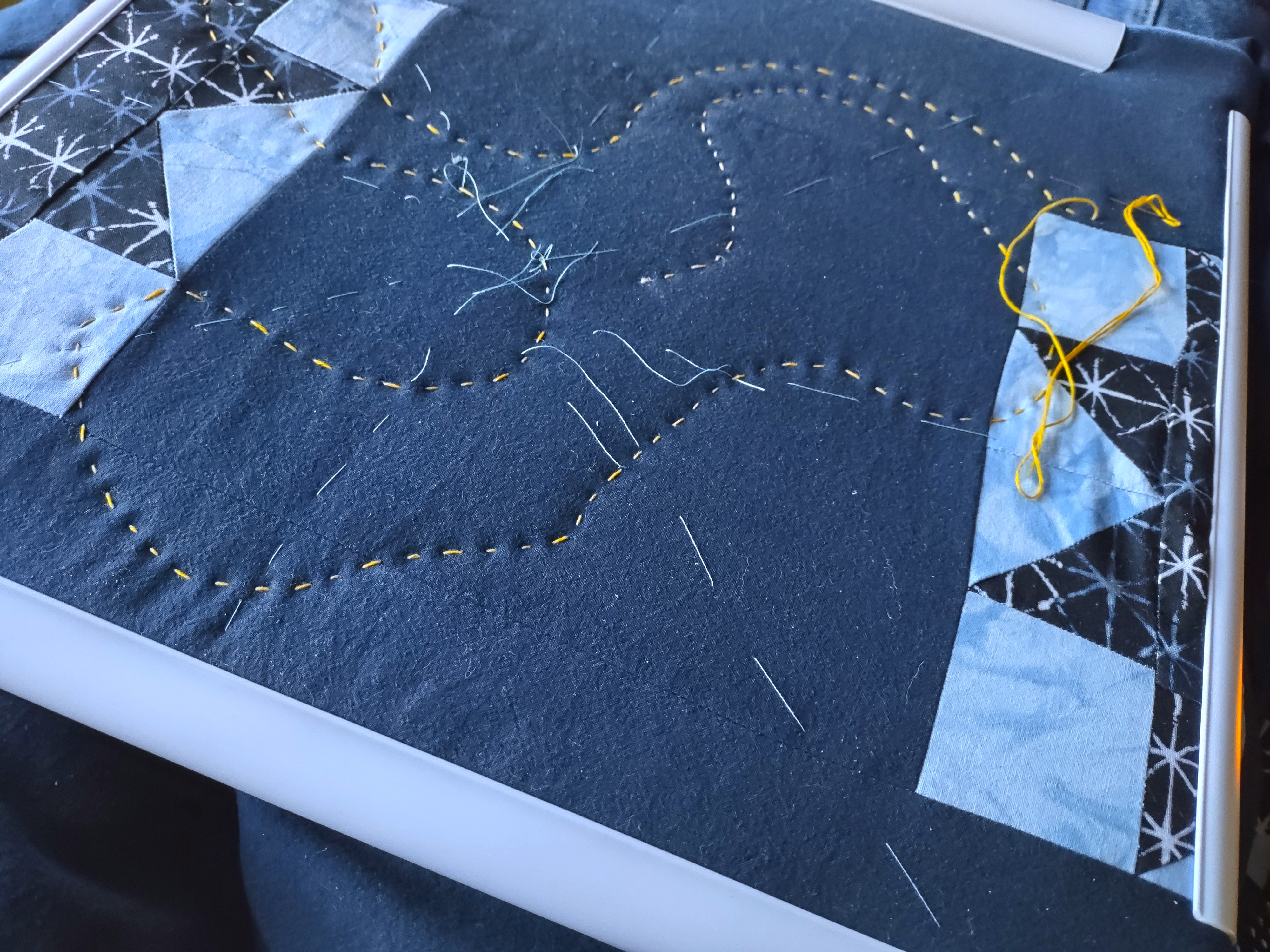
  4. You can pull your chair close to the fire and begin quilting the new project you pieced together and basted last week. Light comes in through the sliding glass doors until about 4 and then it’s too dark.
  5. You can ration your laptop battery, the one that’s charging now, and you ration reluctantly because you are on the home-stretch of the novel you have been writing for 4 years and you don’t want to stop now. By moving the laptop from your study to the kitchen, you can work by lamplight, by candlelight, and because you are writing about a small coastal community in winter, it feels right somehow. (You still don’t know how it will end.)
  6. Because your house is the home of a quiltmaker and woodcutter, there are warm quilts for the bed and a woodshed full of dry fir and cedar for the fire. You keep replenishing both.
  7. Yesterday you heated soup on the woodstove. You can do that again tonight if you need to.
  8. You can sit in the rocking chair and do nothing but look into the fire. The flames tell you everything you need to know about your life.