redux: the physics of candles

Note: this from December 29, 2016. I am still wondering. And the medical tests I was anticipating in the first week of the New Year had the best results possible (under the circumstances).

________________________

Yesterday John wondered aloud where candles go as they burn. Some of the wax drips down, of course, but some candles burn so beautifully clean that you turn and they’re gone, dematerialized into thin air.

We burn a lot of candles. In winter they are a way of keeping the light present and close. We found a silver candelabra in a junk shop in Faulkland years ago, its silver hidden under half an inch of blue wax. I could tell it would lovely once it was cleaned and polished so we bought it for 20 bucks. On that particular road trip, we’d been listening to Ian Tyson and I kept pressing Replay when “The Road to Las Cruces” came on: “Does the wind still blow/Out of New Mexico?/ Does the silver candelabra still shine?” So it was fitting to find what we call the Ian Tyson candelabra and when the candles burn in its shapely holders, I think of Faulkland, and New Mexico, and roads leading to mythical places. When we went to New Mexico a few years ago, we didn’t drive as far as Las Cruces but we did recognize Las Vegas from the song, and the cow boss of the big ranch nearby.

candles.jpg

But where does the wax go? I was awake early wondering. It must be the same place firewood goes when it burns, only part of the log reduced to ash. It goes to heat and smoke, to water, to carbon dioxide. Are you awake, I asked John. Just, he said in a sleepy voice. It was 6:18 and we spent half an hour discussing the physics of candles and firewood.

And time. Where it does. Because yesterday we were caring for our grandson while his parents and his auntie Angie went down to Sechelt for sushi and Arthur spent an hour outside with his granddad, doing stuff. Throwing stones into the little pond where the yellow irises bloom so beautifully in summer. Exchanging sticks. Picking up boughs brought down by wind and taking them to the burning pile. And as I looked out the kitchen window, I thought I saw Arthur’s dad Forrest following his dad as he did those same things 34 years ago. When I told John this, he said he’d had the same sense of time. That he was outside with his son, showing him the woods, the birds, the long curve of the driveway down and out into the world.

In our bed before the rest of the household woke, I confessed that I feel I’m in a place between worlds these days. Part of it is due to the presence of part of my family, the way they occupy the rooms in the back of the house as others once occupied them, their younger selves, their brother who is in Edmonton with his own young family. When I wake in the night with the feeling that the house is full again, I have to stop to parse what that means. Who, where, when. Part of it is because I’ve been writing about my parents and my father’s family, new immigrants to Alberta in 1913, and the difficult lives they led there. They’re all mine and I hover between them, the different worlds, the time passing and accumulating, so that I don’t recognize where I am in that continuum. Part of it is because I’ve been anticipating some medical tests after the holiday and maybe I’m closer to those who’ve already passed from this world than I’m ready to admit. But I feel strangely comfortable with that thought.

When I read Michael Cunningham’s By Nightfall, I noted this:  “A stray fact: insects are not drawn to candle flames, they are drawn to the light on the far side of the flame, they go into the flame and sizzle to nothingness because they’re so eager to get to the light on the other side.” Is this what candles know, as they burn and transform to water and heat? Is this what we know as we gaze at them, wondering?
5 pounds: a late divination

a writer's diary

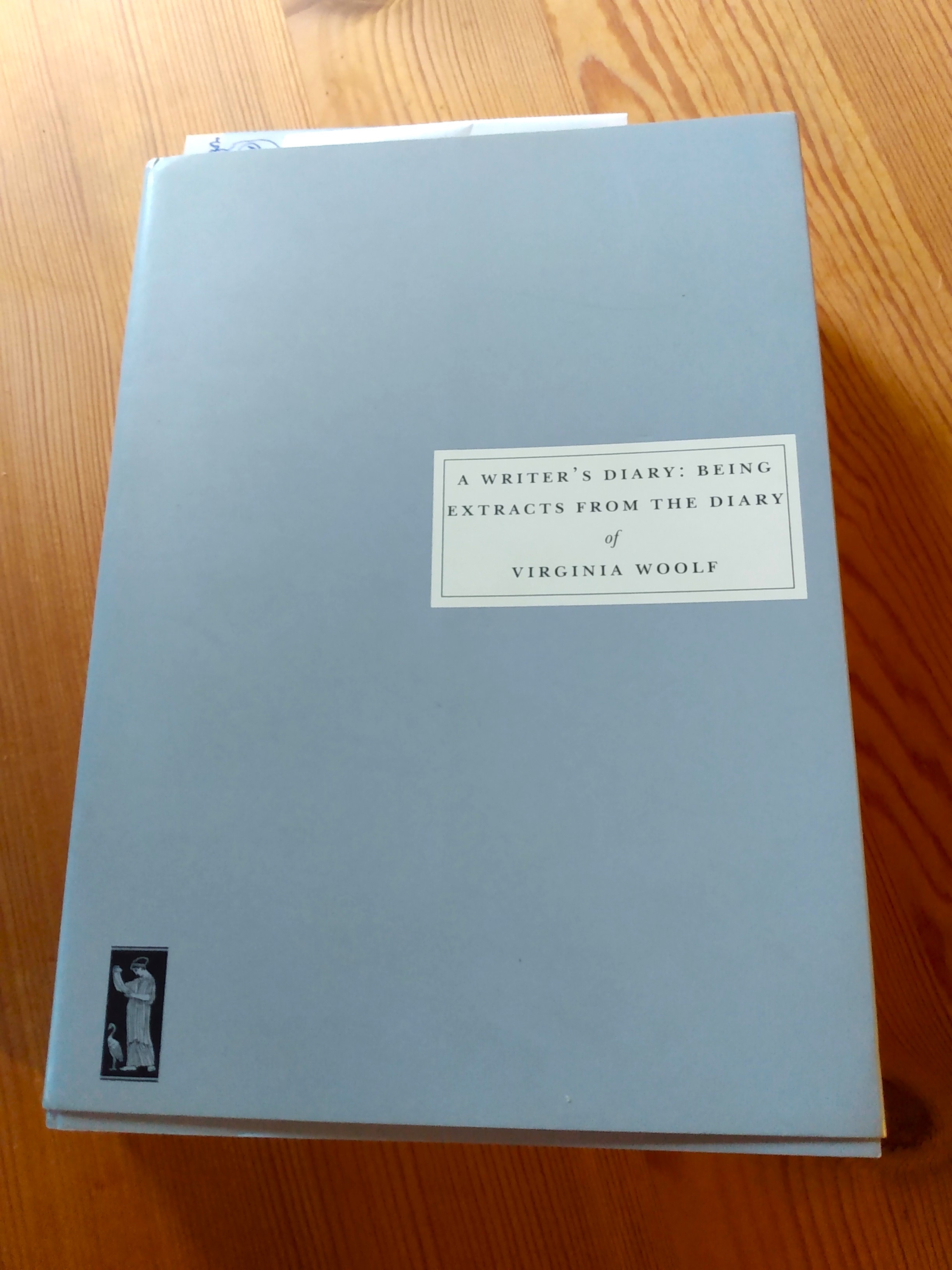
I keep Virginia Woolf’s A Writer’s Diary on my desk. Many mornings I look through its pages to see what she was thinking in 1921 or 1925 or even as late as March, 1941, with her own death just weeks away. She has been my writing companion since I first read The Waves in 1972 or 3. I’ve written before that a kind friend who was both a librarian and a bookseller once gave me a first edition of this book, with cover design by Vanessa Bell, and I treasured it. I lent it to a promising student in a course I once taught in Victoria in 1978 and then I never saw her, or the book, again. But never mind. This Persephone Books edition has endpapers based on that cover design and it serves me well. Some mornings I use it as a kind of divination. What advice will Virginia have for me, what will I learn about both writing and about faith, about confidence, about perseverance?

This morning, as she was finishing The Waves, in late December, 1930:

What it wants is presumably unity; but it is I think rather good (I am talking to myself over the fire about The Waves). Suppose I could run all the scenes together more?–by rhythm chiefly. So as to avoid those cuts; so as to make the blood run like a torrent from end to end–I don’t want the waste that the breaks give; I want to avoid chapters;that indeed is my achievement, if any, here: a saturated, unchopped completeness; changes of scene, of mind, of person, done without spilling a drop. Now if it could be worked over with heat and currency, that’s all it wants.

Yesterday and the day before I printed out hard copies of all the writing I’ve done in the past 4 years: a novel, a novella (sort of my own Mrs. Dalloway, a day in the life of a woman planning a party), one very long essay (35,000 words), and 6 shorter essays. I put them all in an accordion file folder and then, as I was about to tuck the folder away, I thought, Wow, this is quite heavy. So I weighed it. 5 pounds. 5 pounds of writing from the past 4 years. To be honest, the novella was begun earlier but then put aside, and for a lot of reasons that made sense (and still make sense), it was the perfect thing to work on in those early lonely days of the pandemic when my thoughts regularly turned to the cherished past. This work is very much mine. And that poses something of a dilemma because it seems that none of it is particularly publishable. One of the essays appeared in a literary magazine and another was part of an anthology. But the other work: I have a list in a notebook of publishers sent to, of silences and rejections, and it has grown to a rather shocking length. Which tells me something, if I am paying attention. In late October, on a train from Bordeaux to Paris, I took advantage of the free WiFi to send queries to those who hadn’t responded. And it was a little surreal to read replies coming in as we passed fields shorn of their crops and chateaux on distant hills. No, and no, and no.

So on a shelf near my desk, an accordion folder with 5 pounds of text. And a new essay well-underway, one that tries to wrangle some feelings into order, what it was like to finally encounter the animals I first learned about when I was 19 (nearly 50 years ago), on a mild morning in October at Font-de-Gaume in the Vézère valley in France. In a book I’m reading, The First Signs, paleo-anthropologist Genevieve von Petzinger talks about the period when our early ancestors became us. When they used signs and made images that were sophisticated records and responses to the world. And when we entered Font-de-Gaume on that morning, I think I knew I’d found my own people. I stood in the dark, looking at the drawing of a male reindeer bending forward and licking the forehead of a smaller reindeer, probably a female. There is tenderness in this moment, and also such artistic skill. The stag’s tongue is engraved. I am writing about that moment. I am writing something that will probably join the other pages in a file folder on a low shelf, a note on its flap: Unpublished work. But maybe what happens after is irrelevant. I wrote the story of a woman planning a party, I wrote about the strange legacy I carry of having been the subject of an artist’s obsession, I wrote about stitching a life back together after a surgical misadventure, about swimming and the origins of string, about kingfishers and Russian atrocities in Ukraine, about a family rupture that made me see the past 40 years in a very different light, a dim sad one, and in every sentence I wrote there was love.

John took this photograph of the entrance to Font-de-Gaume. It’s an opening, a door into the dark. But I found such beauty there and a kind of deep solace. This morning, reading divination in the words of Virginia Woolf, this is what I have.

entrance

wrapping the year in silver tissue and raffia ribbon

window lights

  1. Cooking: Last night, nodding to our old tradition of Mexican food on Christmas Eve, I made steelhead tacos for two, topped with salsa of oranges and cilantro. Today, a duck waits to be roasted, potatoes wait to be sliced and baked with cream and cheese (dauphinoise), and a few vestigial Brussels sprouts will be steamed and buttered, garnished with lemon zest. Lemon zest left over from lemons juiced for mousse (tonight’s dessert)…

2. Sipping: Côtes du Rhône for the duck, maybe limoncello to have with dessert.

3. Reading: I finished reading Paul Harding’s Tinkers last night, a beautiful novel that kept surprising me with its leaps from one consciousness to another. Or maybe I shouldn’t have been surprised because I think the point is that nothing is lost, that we all carry those we have come from inside our hearts and memories. I cried when I read this passage:

When his grandchildren had been little, they had asked if they could hide inside the clock. Now he wanted to gather them and open himself up and hide them among his ribs and faintly ticking heart.

Where have I read something like that before, I wondered. And then I remembered this passage from my own novella, Patrin:

My grandmother told me once that her father had worn a cloak, a loden cloak, given him by a man who’d bought some of the copper pots. It repelled both wind and rain. Sometimes he’d open it to allow two or three of his children to shelter within, she said. We sat under trees while the rain poured down, and it was our own tent, warmed by our father’s body.

4. Thinking: I am thinking all the old thoughts.

5. Remembering: This morning, John came downstairs first and made the fire and the coffee. Then he put the Chieftains’ Bells of Dublin on. It was our old signal to the children that it was time to come out to open their stockings by the fire. So this morning I was filled with those memories, more than 20 Christmases begun this way. When I reached the last step, I was…

6. Wishing: See above.

7. Eating: Already today–salty caramel fudge, shortbread, an apple, an orange, a handful of nuts.

8. Finishing: I am sewing the binding around the starry quilt.

9. Watching: Last night, “The Tailor of Gloucester”, and there is always something new: the look on the cat’s face as he places the cherry-coloured twist into a teapot on the sideboard, takes it out, puts it back. He doesn’t know whether to be resentful or generous. (Does this sound familiar?)

10. Wearing: Today I am wearing a plaid flannel shirt, a size too big, baggy jeans, red merino socks. I might change for dinner. My hair is braided into two pigtails. I am nearly 70.

11. Loving: Every song on Bells of Dublin. My family. The tiny Anna’s hummingbirds seen through the window over my kitchen sink.

12. Hoping: For a better year, for all of us, for our poor damaged planet. I saw a funny cartoon this morning, Santa standing on an ice-berg, talking to one of his helpers as they looked out on a city dense with smog, tall industrial chimneys emitting black smoke. Maybe I should have given the bad children solar panels instead of coal, he’s saying.

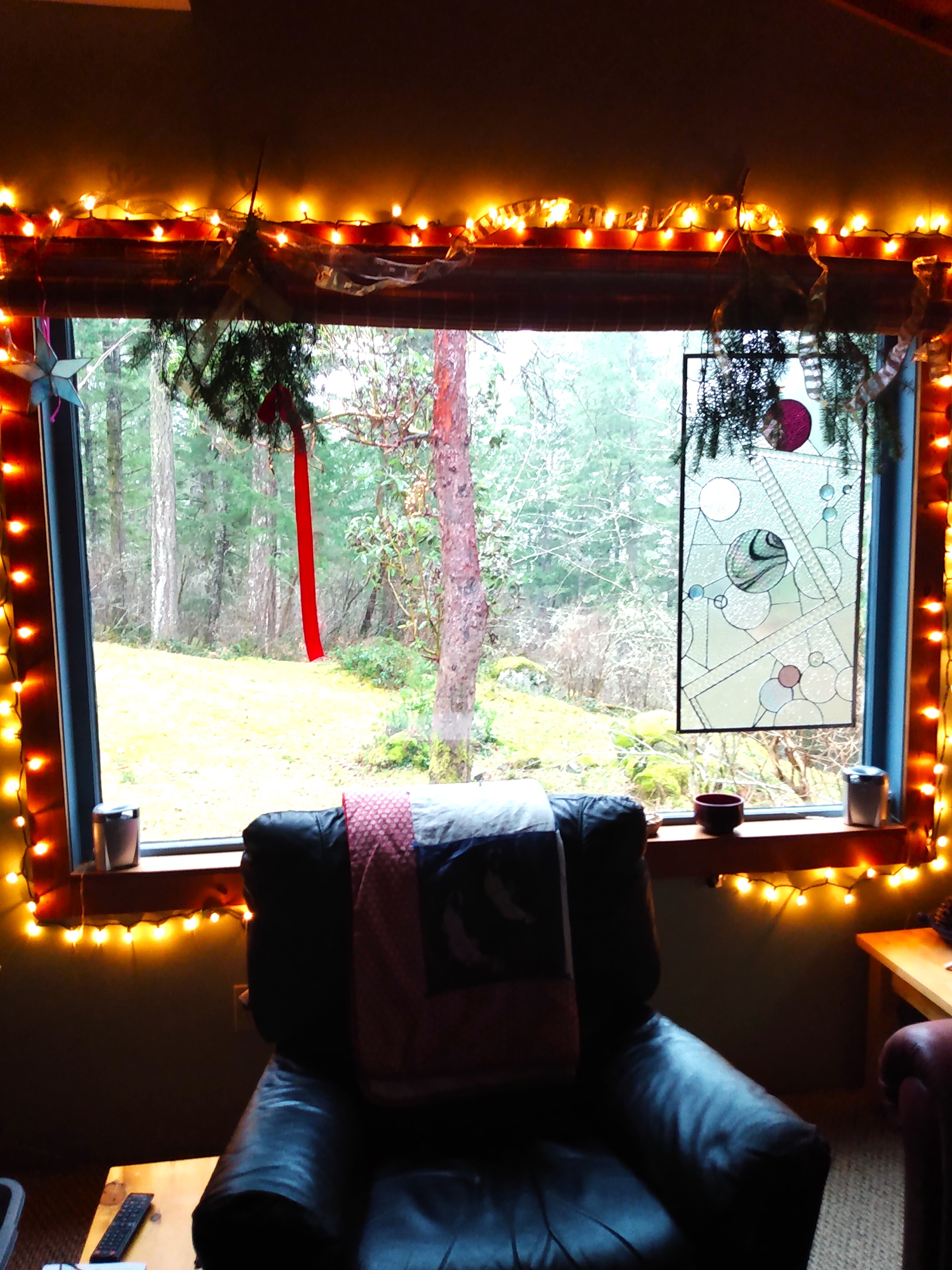
13. Enjoying: The tiny lights John has strung around interior windows, shelves, paintings.

14. Appreciating: Photos of grandchildren, their beautiful faces.

Merry Christmas to all who celebrate.

blue solstice

detail

I was asleep at the moment of the winter solstice, 1:20 a.m. Pacific time. Yesterday was a long day. We went to Vancouver for a medical procedure for John, to the same facility where I went every few weeks for 5 months last year to have my threadbare retinas stabilized and repaired. On our way down the coast, we stopped to pick up our mail from the previous day. Finally things I ordered in early to mid November are beginning to arrive so I was happy to open a package containing a copy of Christine Desdemaines-Hugon’s Stepping Stones: A Journey Though the Ice Age Caves of the Dordogne, recommended to me by Clara Aussel who took John and I to Rouffignac and Font de Gaume in late October.

I was 19 when I first read about the caves in the Dordogne Valley. I wrote a poem about them, tucked away the memory of seeing photographs of animals alive on limestone cave walls, and finally we went to France this fall in order to actually visit the caves. It was wondrous. I felt I’d found my people, the ones who’d given us the gift of reindeer, bison, horses, mammoths. We were only able to visit two caves as well as the Lascaux reproductions but I knew then, and know now, that we’ll go back.

On the ferry from Langdale to Horseshoe Bay and in the medical facility waiting area, I read about the Vézère Valley where Clara took us and where I’ve actually found a little house I want to buy (but probably won’t). I was thinking of how humans make their mark. I was thinking about the night before when friends came for John’s birthday dinner. Amy and I were talking about indigo and I took her to the back of the house to show her the pieces I dyed in September. She was most taken by a 5 m. length of linen I’d twisted and tied. I remember that John held one end of the fabric on the patio while I twisted it as tightly as I could and then tied it with coarse hemp string, hoping it wouldn’t slip or loosen. I was curious to see what would happen when I immersed the length in the indigo vat, 7 or 8 dips, with long oxidation periods between. The linen was wheat-coloured so I didn’t think I’d get a clear blue. And I didn’t. It had sort of greeny underlights, or at least the parts of the fabric kept away from the dye from string were greeny. Here it is, recently removed from the last dip, rinsed, and hanging on the clothes line. (It’s the fabric on the right, with an untwisted middle section, because I didn’t want it to drag on the ground.)

hanging out

Amy loved this piece. What will you do with it, she wondered. And I wondered too. 5 m. is a lot of cloth. I don’t really want to cut it, though it would make a beautiful quilt, I think. We spread it out in the back room and looked at it closely. You could see water in its movements, shot with light. You could see the inside of an abalone shell. You’ve obviously figured out this stuff, Amy said, and I replied that I absolutely haven’t. I have no idea when I begin what the results will be. And in a way I don’t care. I am committed to the process, though. Each twist, each stone I tie into a piece of fabric (the length second from the left is the result of beach stones tied into coarse cotton), each piece of string I cut and wrap: I am interested to see where they take me. In a way it’s a cave of my own making. Surrounded by blank linen and cotton, remnants of old damask tablecloths (the two small pieces at the far left), sheets, I begin to make a mark without knowing what it will be.

We each held the end of long length of linen across the bed in the back room and brought our ends to meet the other. Women have been doing this for centuries. Millennia. They’ve been immersing cloth in dyes made from roots and leaves, hoping for beauty, for light, smoothing out the wrinkles, folding the cloth afterwards. It’s been a dark year for a whole lot of reasons. I haven’t known how to find the light. though as of 1:20 this morning, it’s coming back. The other night, light shone through the linen we held and folded, it rippled like ocean water, the water I swam in off a little bay in Bute Inlet in April, the water I swam in almost every morning from the beginning of May until the beginning of October, entering Ruby Lake’s green depths, the linen held those moments, and others, and now folded, it waits for me to know what to do next.

redux: “the long calendar of the year” (Dickens)

Note: this was 4 years ago. I’m still waiting for the joy but maybe it will come later today when I can finally wrap and send the gifts I have accumulated in my study for my far-flung family. The boxes will almost certainly not arrive in time for Christmas Day but perhaps we can anticipate day in late December when we can think of each other and remember the ghosts of Christmases past, the mornings of stockings, eggs Benedict, and chocolate.

northwest window

But I am sure I have always thought of Christmas time, when it has come round—apart from the veneration due to its sacred name and origin, if anything belonging to it can be apart from that—as a good time; a kind, forgiving, charitable, pleasant time; the only time I know of, in the long calendar of the year, when men and women seem by one consent to open their shut-up hearts freely…

I’ve always loved Christmas. I’ve loved the carols, baking the foods we love to eat this time of year, the parties, the lights we string around windows and through ivy draped over top of the leaded windows in our entrance area. I love choosing presents, making them when I can, and I love preparing the bags we give to our friends: jars of marinated olives, small loaves of white chocolate fruit cake, shortbread, little bowls. I’ve loved the anticipation of family members arriving, often in time for John’s birthday on the 19th; traditionally this has been the start of our season, a party for 6 or 10 or 25, depending.

This year I couldn’t feel the spirit enter my heart for the longest time. Why bake when we’re not going to be seeing anyone? Why prepare the olives (though the huge jars bought at the Parthenon in Vancouver on the day before John’s surgery in October were waiting in the cool porch). Why. I did shop. I packaged up gifts for my children and their children. I made a quilt for a daughter-in-law’s birthday (today!), stitching by the fire, and at least for that time I found a kind of peace in the movement of the needle in and out, pulling its blue thread along. When we sat down to work out charitable gifts, it felt overwhelming. So many who need help and a limited budget to work with. It’s just been a hard fall for a number of reasons, for so many of us. I wasn’t unhappy but perhaps I was too busy and stressed to understand that what I always loved about Christmas was still potent and waiting. I wasn’t even sure I’d bring a tree into the house to hang with the old ornaments, a star on top.

…the only time I know of, in the long calendar of the year, when men and women seem by one consent to open their shut-up hearts freely…

Last week I made the gingerbreads to package up for children young and not so young. I made shortbread. Not the white chocolate fruit cake, golden with apricots, Smyrna figs, hazelnuts, and jeweled with dried cherries. Not this year. And little by little, I began to feel moments of joy. Was it when I was filling the birdfeeder and a cloud of chickadees descended, one landing on my hand, the elegant nuthatch who travels with them keeping its distance? Or when I realized that we still needed to celebrate John’s birthday properly, even if it meant setting the table for just the two of us? A blue cloth, our Midwinter Moon plates (bought in Bath when we first knew each other and wanted to make a home together), napkins with sunflowers, the candles lit, the Waterford glasses shining. There was even cake—hazelnut torte with ganache (I scaled back my usual method for 8…). We raised our glasses to health and happiness for all.

Through the magic of gadgets, we watched The Tailor of Gloucester on Friday night with two of our grandchildren. It’s such a lovely story, full of music, mice making tiny buttonholes with cherry-coloured twist, the rats who find the kegs of wine singing and carousing in grand style, and courtly dancing. Do you have a Christmas tree, my grandson asked, and I told him, no, but we’ll go up the mountain like we always do and cut a small one. He described theirs and his voice was full of joy.

In the long calendar of the year, there are the dark days and then the ones rich with light. I was awake at 2:02 a.m. at the moment of the longest night. I was awake, filled with hope. As the days grow longer, I am hopeful that we will come together again, all of us, in person, to take up our lives in community again. As friends, as families, as citizens. Hopeful that a small tree will hold the riches of the year.

When the last of the spirits shows Ebenezer Scrooge his own gravestone, his name on it serving to shake him finally to a new realization of what could happen if he remained miserly and tiny-souled, Scrooge has a true change of heart, from the man who asked, “Are there no prisons? And the Union workhouses? Are they still in operation? The Treadmill and the Poor Law are in full vigour, then?”, to the man who becomes a model of generosity and good will.

I will honour Christmas in my heart, and try to keep it all the year. I will live in the Past, the Present, and the Future. The Spirits of all Three shall strive within me. I will not shut out the lessons that they teach. Oh, tell me I may sponge away the writing on this stone!

Next year, I won’t put off making the white chocolate fruitcakes or scale down the birthday torte preparations but plan the feasts for all those who have traditionally come and those who might like to again.

a Sunday miscellany

panforte, dressed up

On Friday I made panforte, one large one rather than several small ones. Cut into wedges, wrapped with brown paper, tied up with ribbon, tagged with pretty card. There’s a wedge left for us, wrapped and stored in a tin. Already a seasonal staple in 14th century Siena, this particular Christmas treat is one of my favourites, a liking that has spanned two centuries. (I first had it in Siena in 1976.) Honey, nuts, figs, orange and lemon peel I candied earlier in the week, almond flour (so those who are gluten intolerant can enjoy it too), a little cocoa, spices that filled our kitchen with their scent: cloves, cinnamon, white pepper, coriander…

Yesterday the power was out for 12 hours after a wild coastal storm. We burned the Advent candle, kept the oil lamps low, brought in firewood. When we tried to drive out for a craft fair down the Coast, we discovered the highway was closed because a tree had fallen on the wires and cars were lined up all down Misery Mile. We turned around and came home.

The Anna’s hummingbirds are mating and nesting. What bird chooses to lay her eggs in the dark of winter? And why? The females are constant visitors to the feeder and I hear them in the yellow mahonia blossoms too. When I brought in their feeder yesterday morning to add more sugar water, one of the females kept darting at my hands.

In one corner of my study, bags of small gifts. Maybe this will be the week I can finally wrap them and mail them to distant families. Maybe this will be the week I feel the spirit of the season enter my heart, asking in a quiet voice for the old carols, the poems and books I always loved at this time of year. e.e. cumming’s Little Tree, Burgess Meredith reciting Don Oiche Ud I mBeithil with the sweet accompaniment of the Chieftains.

I sing of that night in Bethlehem
A night as bright as dawn
I sing of that night in Bethlehem
The night the Word was born

redux: “her heart was like a bird’s nest” (Dylan Thomas)

Note: this was from two Christmases ago. In my study this morning there’s a pile of gifts I can’t mail to my family. I am having a difficult time finding any Christmas spirit but re-reading this has me determined to make panforte today. (That’s what wrapped in the packages in this photo.) Boughs again this year rather than a tree. Maybe some eggnog. Certainly chocolate.

basket of goodness

I am first up this morning. Coffee, a warm fire in the woodstove, some work on the quilt in progress. On the radio, Dylan Thomas reading “A Child’s Christmas in Wales”.

All the Christmases roll down towards the two-tongued sea, like a cold and headlong moon bundling down the sky that was our street; and they stop at the rim of the ice-edged, fish-freezing waves, and I plunge my hands in the snow and bring out whatever I can find.

How old was I when I first read that wonderful accumulation of Christmas memories? Probably 12 or 13. I remember that a friend gave me the recording as a gift and I remember I bought a little edition of the–well, it’s not a poem, but certainly a work of lyrical prose–anyway, I bought an edition illustrated with wood-engravings. One year in my late teens or very early 20s, I batiked some small cotton squares with images from the book–the sea, with its waves like commas; a few simple buildings–and made them into cards. I didn’t keep one for myself but wish I had. Listening this morning, I was reminded of all our Christmases here. We always put our tree up on Christmas Eve afternoon after an expedition up the mountain in search of the right one. Sometimes that happened on the day before Christmas Eve and I’d see the tree waiting in the woodshed for its grand entrance. We draped ivy around the leaded windows in our entrance hall, made garlands for the sliding glass doors, and put strings of little lights everywhere. (For the last 10 or so years, we’ve left the strings of little lights up year round.)

Quilting and listening, I wondered how many of my Christmas memories are layered with the images in Dylan Thomas’s wonderful prose?

“Were there postmen then, too?”

“With sprinkling eyes and wind-cherried noses, on spread, frozen feet they crunched up to the doors and mittened on them manfully. But all that the children could hear was a ringing of bells.”

“You mean that the postman went rat-a-tat-tat and the doors rang?”

“I mean that the bells that the children could hear were inside them.”

One year John and I were awake in bed long before the children. We were lying in the warm covers, listening for their voices, but instead, we heard…bells? Sleigh bells? Church bells? Here, in our woods, many miles from a church, and the woods green that year as no snow had fallen. It took us a few minutes to realize we were hearing a wind-chime hanging from the eaves of the sun-room off our bedroom, the long metal tubes ringing lightly together to make a most bell-like sound. We were willing to believe in something more magical, though, for those first moments.

In our house, no one came out to the kitchen where the stockings were hanging by the woodstove until John put on the Chieftains’ “Bells of Dublin” cd. The first cut, a grand ringing of bells at Christ Church Cathedral in Dublin, ushered in our morning as the tree lights came on, a fire was made, the coffee beans were ground, the scent of oranges filled the kitchen, and we opened our stockings by the woodstove.

This year, we are on our own. We were invited to Edmonton, Ottawa, and Victoria for Christmas itself but our travel experiences over the holiday haven’t been smooth (one year one of our toddlers spilled coffee over someone’s new leather coat on a crowded ferry, one year everyone got sick, one year we were stranded on the Malahat until we figured out it might work to follow a snow-plough all the way down to Victoria). Given the chaos in airports and ferry terminals just now, after the big snow fall and freeze-up, I think we made the right decision. Today we’ll bring in boughs. Not a tree, because there’s too much snow to go to our usual place, but yesterday John gathered a huge armload of Douglas fir, cedar, and huckleberry branches. They’re waiting in the woodshed and we’ll decorate them with some of the special baubles and stars. I feel a bit wistful. (Of course.) But the wonderful archive of memories–Dylan Thomas’s, my own– is a rich source of colour and music and even the unexpected sound of bells. I always identified with Auntie Hannah, the one who laced her tea with rum (because it was only once a year), who loved port and sang like a big-bosomed thrush, and who was in some ways the presiding muse of the piece.

Auntie Hannah, who had got on to the parsnip wine, sang a song about Bleeding Hearts and Death, and then another in which she  said her heart was like a Bird’s Nest.

My heart is like a bird’s nest this Christmas Eve morning, a winter nest, emptied of its little chicks, but open to the weather, still ready for the possibility of shelter. I wish every reader who finds this post the richest and warmest holiday, and a good sleep to follow.

Looking through my bedroom window, out into the moonlight and the unending smoke-colored snow, I could see the lights in the windows of all the other houses on our hill and hear the music rising from them up the long, steadily falling night. I turned the gas down, I got into bed. I said some words to the close and holy darkness, and then I slept.

winter stars

early spiral

1.

Last night I was awake, troubled by the old dilemma, and I was looking out at the sky, hoping for stars. It wasn’t raining but there was cloud or mist. It was quiet. I was awake and thinking. We are approaching the bleak midwinter, the darkest moment of the year. Awake and thinking, trouble heavy on my shoulders.

2/

I had my swimming lane to myself this morning. Up and down, the blue lengths. In the rhythm of my strokes, I was half-hearing the old admonitions. Put away your hope. Put away your pride. Up and down, cap pulled over my ears.

3.

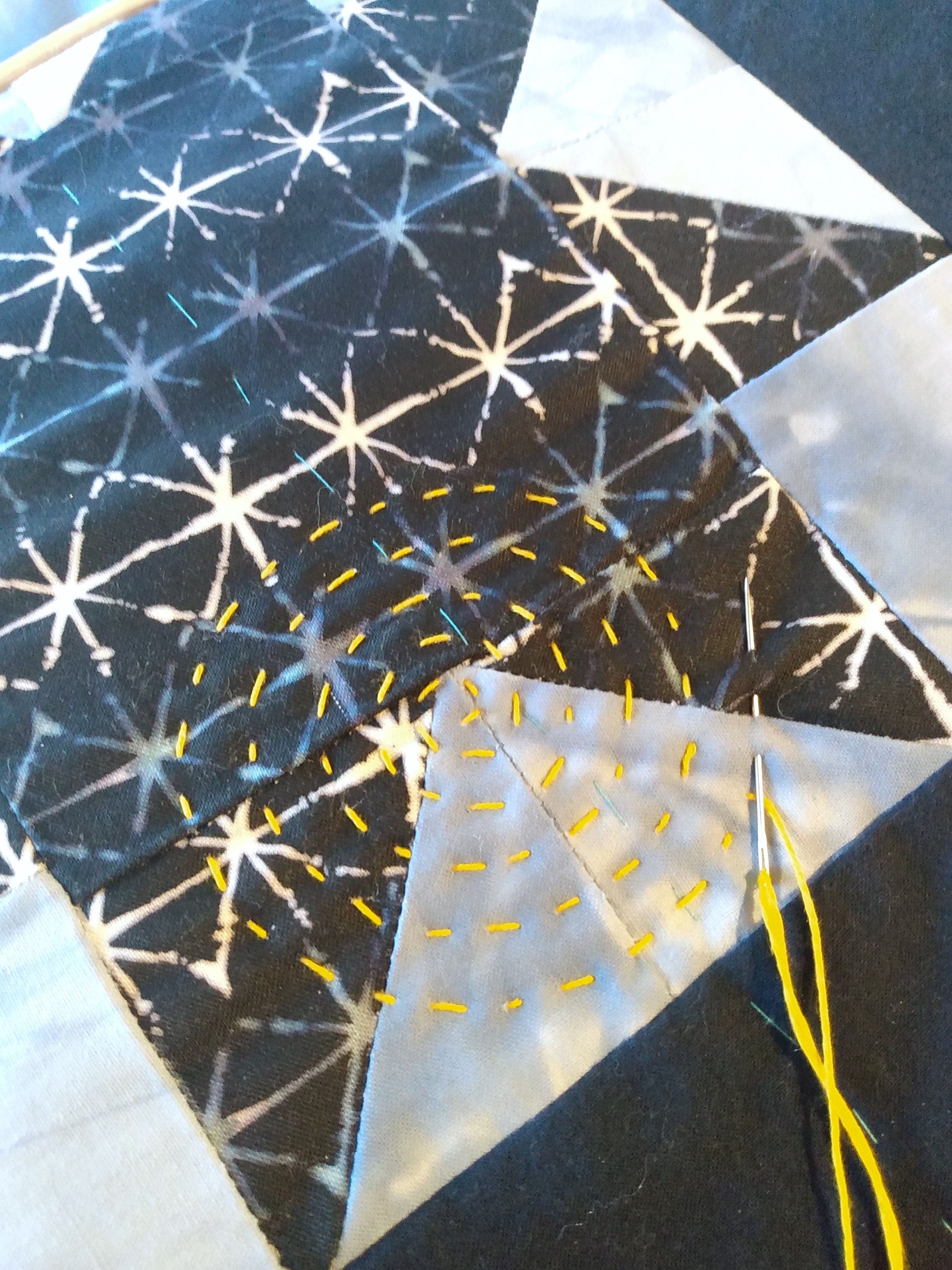
Coffee by the fire, bark tossed in for extra heat. I don’t know what to do. The old dilemma. I think about that word. A double (di, meaning twice) proposition (lemma, meaning premise), with neither option being desirable. The fire blazes. I begin a small spiral with yellow thread on the edge of a blue star. Sometimes this is a way to think. And I remember a poem, also a way to think.

God, give us a long winter
and quiet music, and patient mouths,
and a little pride––before
our age ends.
Give us astonishment
and a flame, high, bright.
       –Adam Zagajewski, trans. Clare Cavanagh

4.

Stitch in the heat of a good fire. Listen to Valdy on the radio, remembering his kindness a few summers ago when I met him at Salmon Arm, how we talked of the dances in the Shirley Hall, near Sooke, and he played a couple of those old sweet songs.

early spiral 2

redux: winter swimming

Note: What was I doing 4 years ago tomorrow? I was swimming in the lake near my house. And I think it’s time to begin winter swimming again.

__________________________________

Everything truly changed here on March 16, 2020, because that was a day when we would have gone to the local pool for a swim but it closed that day due to Covid-19. We swam on the 14th. I noted in my daybook that my distance was 1.3 kms. We went for supper to the pub in Egmont that evening and the tables were widely spaced. Joe Stanton was playing his guitar and singing in his wonderful gravelly voice. But even then we realized it probably wasn’t a good idea to be in a restaurant and when we drove home along the dark Egmont Road, we knew we wouldn’t have a meal away from home until it was safe to do so. What does safe mean? I keep adjusting my measure. We did have some meals out in the summer at the pub in Madeira Park because we could eat on the deck with an ocean breeze blowing viruses away (we hoped); we met friends there very occasionally until September when it no longer felt like a good idea.

december lake

We started swimming in the lake near us in late May. The water was cold but the days were often warm and it just seemed necessary to swim again. We went down every morning before anyone else was there and the green water, holding early sunlight, was such a solace. I think in water. I swim back and forth, planning how I will proceed with particular writing, or I order essays in a collection I am working on, or I tease out a problem of some other sort. The water warmed up as the days moved into summer. And by late September, when the water was cooling off, the pool was open again. You have to book times and often you are the only people there.

And in October we were preparing for John’s surgery mid-month. The time went by so quickly. There were 10 days in Vancouver, him in hospital or spending two nights at the little suite of rooms we’d reserved for me nearby, and me in those rooms or else walking back and forth to the hospital. A few fraught trips to pharmacies for various pieces of equipment that were deemed necessary because the surgery went sort of sideways. And then home. A return to hospital, this time in Sechelt, where our family doctor and others worked out a plan for some issues that developed after John’s surgery.

Sometimes what you lose is a sense of being alive yourself. I don’t mean I’ve been unhappy or anything dire. A little lonely from time to time–in those rooms in Vancouver when I couldn’t sleep and the branches of the maples brushed the window of the bedroom. Or driving back and forth to the hospital in Sechelt, again on very little sleep, hoping I was up to the task of caring for us both. Once he was home again and I was confident he would be ok for an hour or so, I began to swim again in the pool, rushing out and rushing home. As soon as John’s surgeon said it was ok, he came too. We try to book 3 swims a week.

The day before yesterday I told John I was going to begin swimming in the lake again, too. He wasn’t happy about it. What if something happened, you’re 65 years old, what if you ran into trouble, he said. I won’t be able to help you. (Right now the only footwear that works with his paralyzed foot is a big snowboot with the felt liner removed.) I listened but I was still going to go. Not for long. Not the first time. I knew it was a good idea to wear a tuque and gradually increase the time I spent in the water. Reluctantly he agreed to come along.

I did wear a tuque. And it was very cold. But also exhilarating, the water silky the way it is in summer. I felt every cell in my body rejoice. And then I didn’t feel much because I was numb. But I did a few strokes back and forth and know that I’m going to do this at least twice a week. I quietly said to the water as I entered it yesterday, I’ve missed you. It’s a lake I’ve known for 40 years and I want my relationship with it to continue through these winter months when so much of our lives is constrained and a little fearful. When I was stretching my arms into the cold water, I thought of the mornings I swam in an unheated pool in Ukraine, frost on the sunflowers fringing the water. I felt alive then too, at home in a body that often feels old and kind of lumpy. The memory of those swims sustained me through the first part of the pandemic when I was making a little book of the essay I wrote about that trip and these swims will guide me through these dark winter months, the lake bottom dreaming of how the sunlight gathers there on June mornings, mergansers leading their young from stream-mouth to stream-mouth, and the kingfisher alert on one of the sentinel cedars I use to mark my progress.

Everything I am remembering is burnished with moonshine, the taste of cherry-filled varenyky, sweet butter on dark bread. Mornings I swam in an unheated pool, the bottom littered with drowned insects, while all around me mist rose from the valley below our mountain slope. The mountains above me, source of the Dniester, Tisza and Vistula Rivers, the upper streams of the Black Cheremosh and the White, the Prut. I thought of those mountains forming a long spine to the Beskids in the Czech Republic, where my grandmother was born, 2 years after my grandfather, though they didn’t meet until 1919, in the badlands of Alberta, she a widow, and him? I have no idea of his romantic history, though in his small archive of papers there are two photographs, one of two women, taken in Chernivtsi, one of whom resembles him enough to be a sister, and another of a woman with a generous mouth, dressed in a fur vest like the Hutsul women wore. Everything I am remembering, burnished with light too faint to read by, like the moonlight that came through my curtains at Sokilske, haunting the room like old history.
(from “Museum of the Multitude Village”, an essay from Blue Portugal)

morning lake 2

filling in the blanks

first day of advent

Sometimes people use a template to update readers on their lives (www.picklemethis.com) and I like the idea of filling in the blanks.

1. Cooking: Late last week friends came for lunch and we had coq au vin, potatoes mashed with celeriac, salad, and cherry clafoutis for dessert. It reminded me of the meals we ate in France, enough of everything but not too much, delicious but not too rich.

2. Sipping: I have been enjoying an Australian Pinot Grigio, Tread Softly, which is from a winery devoted to sustainable wine with a slightly lower alcohol level so I can have a couple of glasses and still do what I need to do.

3. Reading: So many books! Last week, Colombe Schneck’s Swimming in Paris, Julia Alvarez’s The Cemetery of Untold Stories, Louise Erdrich’s The Mighty Red, and right now I am finishing The Letters of Oliver Sacks, a wonderful profile, through his correspondence, of an dazzling intelligence. I’ve been waking up around midnight and reading for two hours in the small hours.

4. Thinking: As I swim my slow kilometre each morning, I’ve been thinking my way through a personal conundrum and also thinking my way through a few difficult wrinkles in the novel I keep saying is finished and then revisiting again, after my swim, to tease out a thread, to patch a jagged hole.

5. Remembering: All the Christmas preparations in the years when my children were young. This year, because of the mail strike, I am wondering how much of anything to do.

6. Wishing: See above.

7. Eating: That French lunch, cauliflower cheese from the freezer, reheated with extra aged cheddar and fresh basil, sauteed prawns with lemon and garlic, risotto with sage-roasted squash.

8. Finishing: I finished the first full draft of Easthope the week before last and then I finished the first revisions and am now fiddling with those.

9. Watching: Last week we went into Vancouver for a night, in part to shop, in part to have a little dose of bright lights, and in part to see the Arts Club’s staging of Dolly Parton’s Smoky Mountain Christmas Carol, which was a lot of fun. Also watching the Advent candle burn down to its designated line each day and taking a photograph to send to my family because this year no one got the little treats I bought for the cloth Advent calendars I made the grandchildren years ago. (See 5. for further details.)

10. Wearing: Layers! I have one very worn merino wool long-sleeved undershirt and I’ve been wearing that, holes and all, under a thrift store cashmere turtle-neck, which (it turns out) is the way to stay warm.

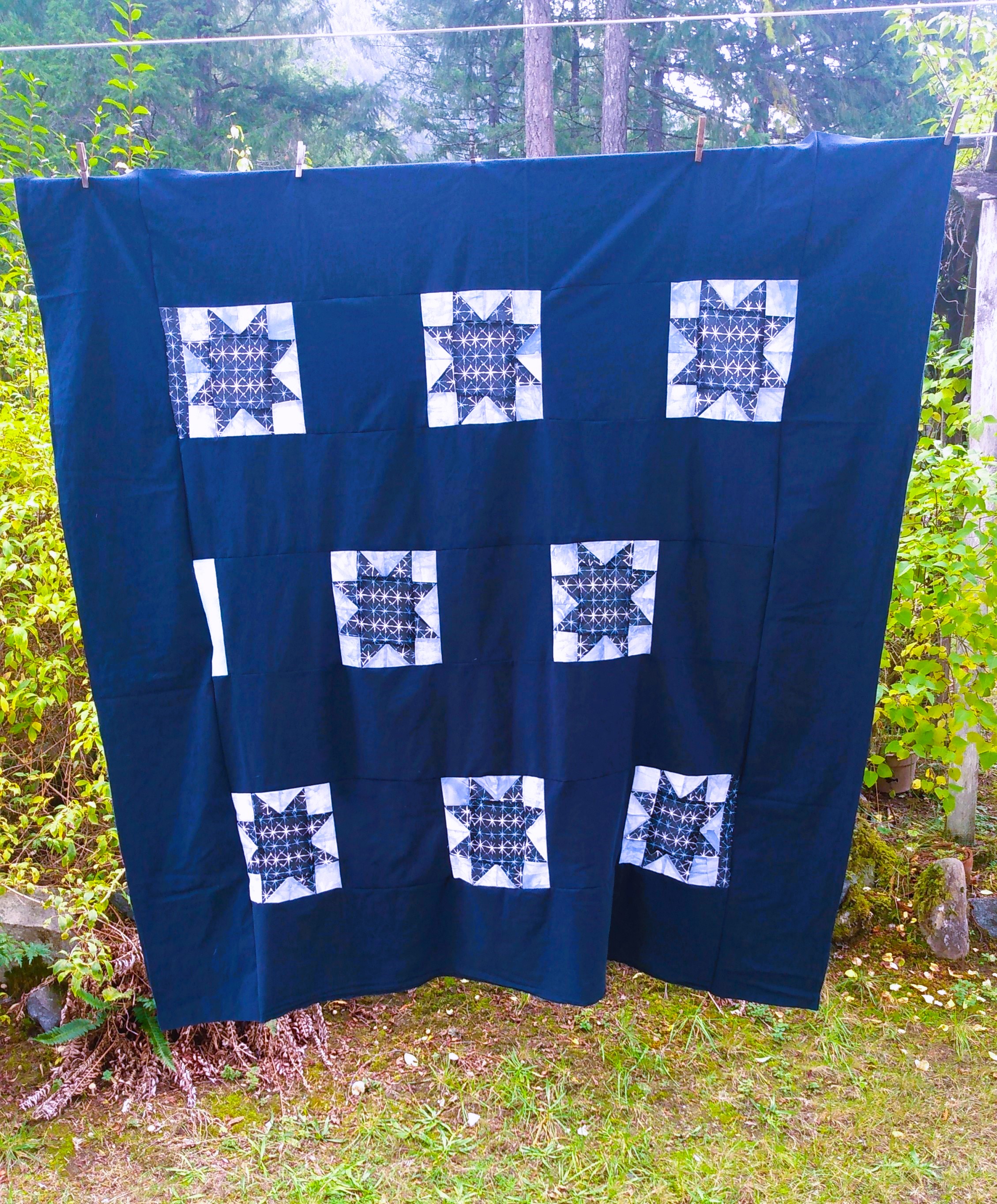
11. Loving: The stitching I am doing, in yellow sashiko thread, to quilt the layers of a variable star quilt, pieced together with Japanese print, woad-dyed cotton, dark blue cotton-linen, and backed with some of my indigo-dyed linen. It’s a perfect thing to do by the woodstove when my novel baffles me.

12. Hoping: I have many hopes but not enough faith these days.

blue stars

13. Enjoying: The Anna’s hummingbirds arriving for their breakfast just beyond the window over my kitchen sink and the Steller’s jays arriving for theirs on the deck=posts on the other side of the kitchen.

14. Appreciating: My husband’s patience and love as I work through my personal conundrum, even to the point of finding a beautiful hotel in Oaxaca for us in Febrruary, with a pool, and not minding my reading light turned on at midnight.