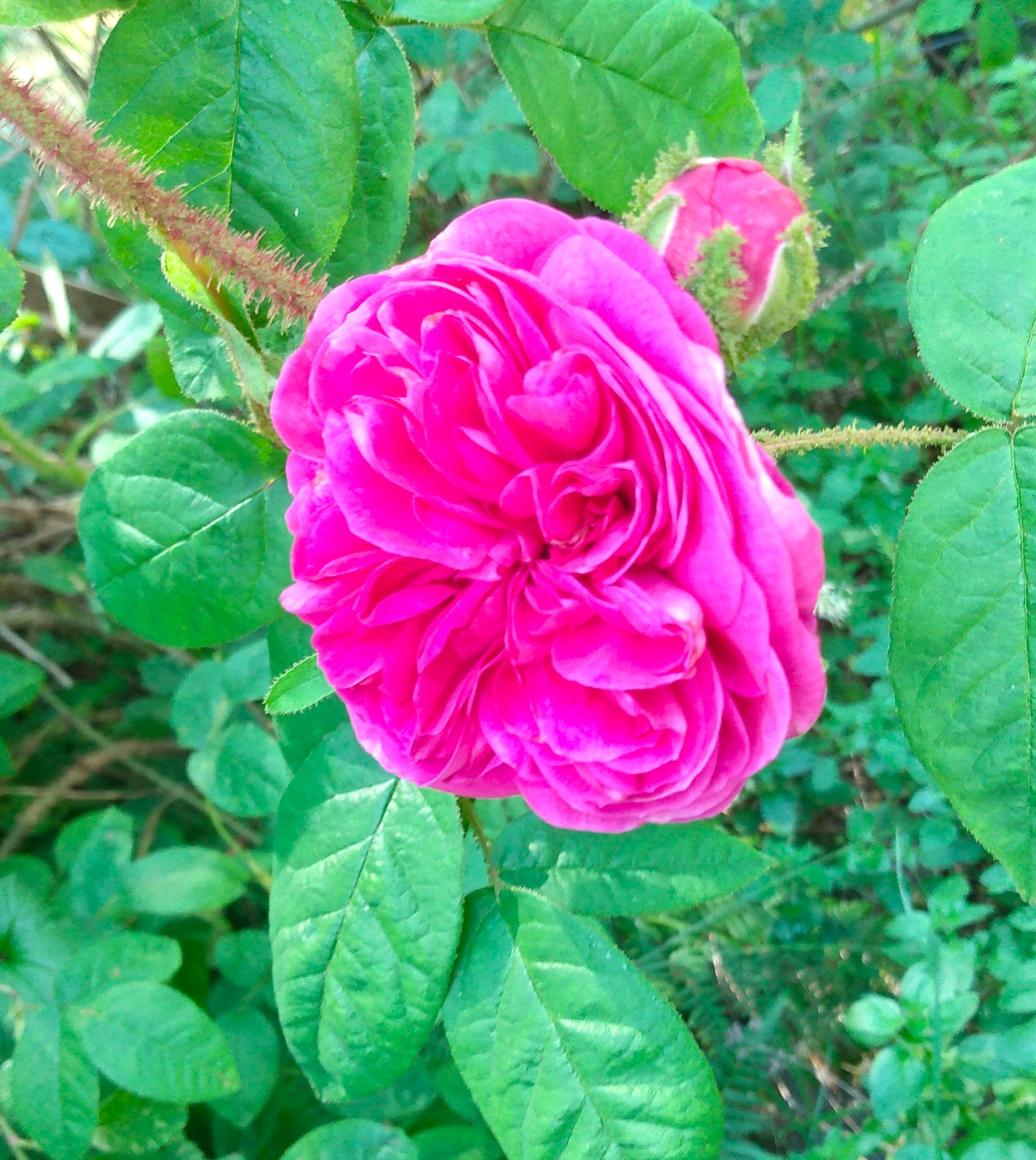
They are reaching through the fence, the deep pink moss roses I was given 35 years ago by Vi Tyner. There are so many on the heavy canes that the sturdy stake holding them upright has toppled. The canes are walking into the grass, shaking off my attempts to keep them confined.
2.
Day 17 of my lake swims. This morning I thought that the water was textured, like silk. I wasn’t so much in the water as within in. I thought of all the books and talk about whether rivers are alive, whether water and glaciers have rights, whether mountains deserve personhood, and I wondered why we can’t see that this continuity we are part of but which we still claim ownership of, stewardship over, isn’t ours to decide for. Why we can’t simply give ourselves up to its abiding sentience. A river doesn’t need us to decide if it’s alive or has rights equal to those we accord other species. (Who are we to accord?) We could remove ourselves from the need to make decisions for this great living entanglement and let ourselves drift in the body of water as it drifts in us. We could learn the grammars of respect and love.
3.
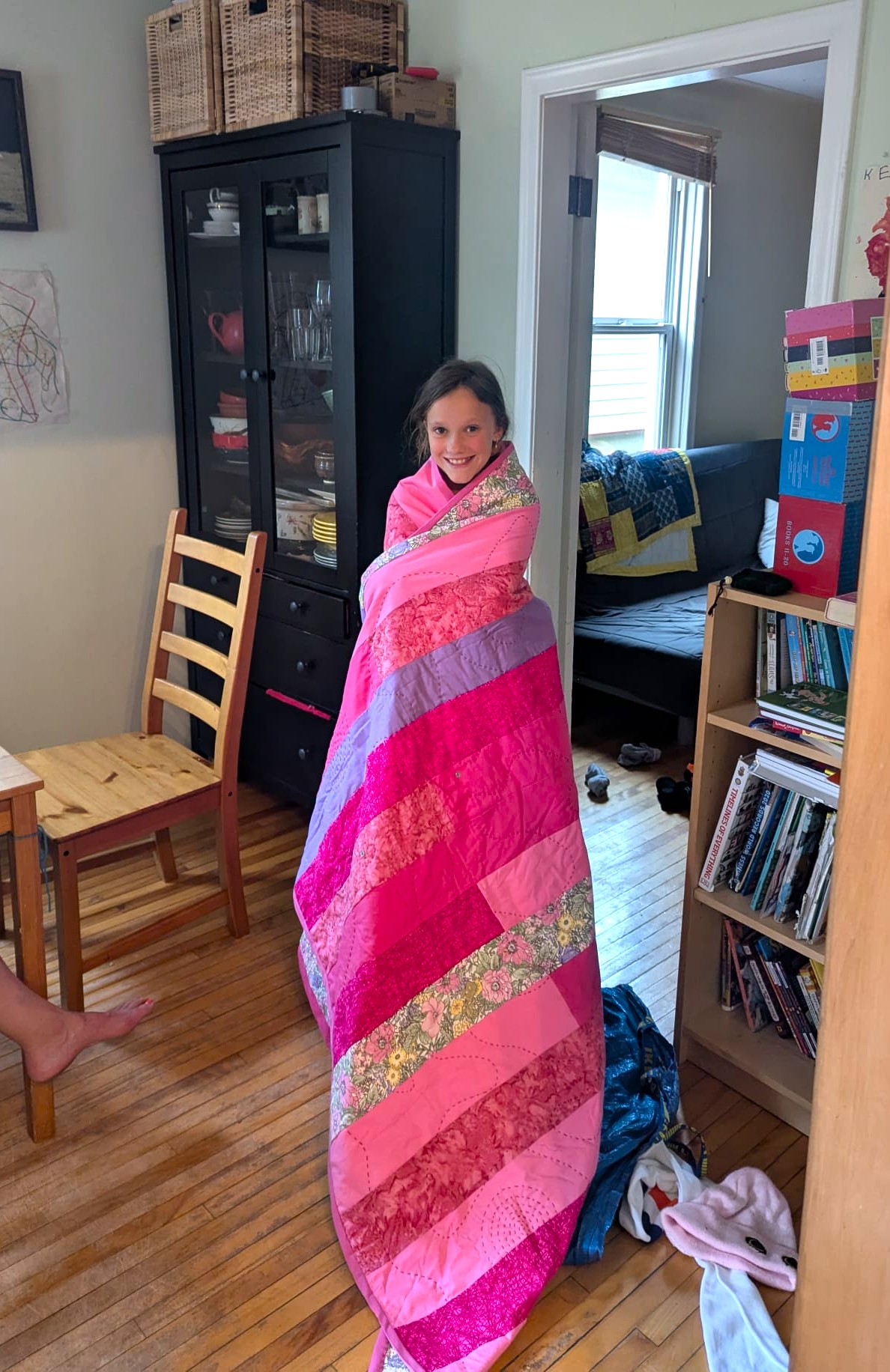
Her father sent a photograph as proof of the quilt’s arrival, the one I finished last weekend, sewing the last pink stitches, so that she could see how the bar graph she sent to tell me the colours she loves best had inspired me.
4.
Walking back to the car after my swim, I stopped to watch a butterfly in the grass. It adjusted its wings, then floated over to land on my foot. Was I the air, the grass, the chitin of its wing?
These are days of sunlight after rain, days when the lake water returns me to something like my old self. (The self I have become accustomed to over the past year feels so reduced…) Last night–a late swim because the parking lot at the little beach area was completely full when we went down after lunch so we couldn’t even park, let alone swim — anyway, last night I was out in deep water watching two loons about twenty feet away, one warbling a little, then the other, I was treading water, watching them, the sun moving further along the western horizon, when John said, Do you see the geese? And yes, I saw them, a parent at either end of a long moving line of goslings, crossing the lake now that the boats had all gone quiet. The geese crossing, the loons making a low tentative sound, the water green around me, crows alighting on the sand in search of scraps now that all the picnics had been packed away, a raven in the cedars saying a word insistently over and over, so that John said it back, the conversation continuing until we’d returned to our car, a little sand clinging to my feet.
A hundred years ago today, she was thinking about Mrs. Dalloway, which had sold 1070 copies. (“Doing surprising well,” she wrote.) I have just come in from the upper deck where the dog roses are coming into bloom, this one fully out, sweet-smelling. I never planted it. Well, I guess I did: I planted a rugosa, “Alba”, perhaps 35 years ago, and it didn’t last long, but its rootstock took over, climbed up the side of the house to join the wisteria on the railings. Brief seasons, though there will be a few wisteria flowers later in the summer, and in autumn, the dog rose canes will droop with long elegant red hips. (“I have had high praise,” she said, after Mrs. Hardy wrote to tell her that Thomas was reading The Common Reader with great pleasure.) When I bent to smell this open flower, I thought of Mrs. Dalloway, buying the flowers herself.
2.
A hundred years ago. Two weeks later, she said, “I think it is possible that we may sell 2000.”
3.
I wrote a novella in homage to Mrs. D. but–you can imagine.
4.
“The world wavered and quivered and threatened to burst into flames.” Do I need to say more?
5.
I have been trying to wrangle my garden into order. Each year it becomes more impossible because how do I weed out the self-sown columbine, the spreading Japanese anemones, how do I grow things in rows? Short answer: I don’t. And live, or don’t, with the consequences.
6.
“Fear no more, says the heart, committing its burden to some sea, which sighs collectively for all sorrows, and renews, begins, collects, lets fall.”
7.
Some mornings it is hard to imagine what comes next. The manuscripts out in the mail, the long days that fill up with digging, weeding, carrying compost to laggards who might not deserve it. Some mornings we still make a fire, though it is nearly summer. And today will be Day 12 of my lake swims.
8.
The days pass. Or accumulate. It depends.
9.
I think a real gardener wouldn’t let a thorny climber take over the side of her house, not when it only blooms for such a short time. But this morning I bent to smell the open flower, so sweet I wiped a few tears away, quickly (tears for a simple flower?), and it meant everything.
10.
“All the same, that one day should follow another; Wednesday, Thursday, Friday, Saturday; that one should wake up in the morning; see the sky; walk in the park; meet Hugh Whitbread; then suddenly in came Peter; then these roses; it was enough. After that, how unbelievable death was!-that it must end; and no one in the whole world would know how she had loved it all; how, every instant . . .”
Note: this was posted 5 years ago. Last night we had hortopita made with exactly the same ingredients. And it was delicious: an essay in green.
…gathering ingredients together to make a dish is like assembling images, lines, phrases in order to make an essay or a poem. Signals, emblems. On a May afternoon, I cut a huge basin of kale, buckhorn plantain, a leafy perennial chicory I planted years ago for its spring leaves and later for its blue flowers the colour of the sky. I cut dandelion greens, spinach, rapini going to flower, a few leaves of blood-red sorrel. I cut a sheaf of chives, a bouquet of parsley, long strands of the mint that came from John’s English grandmother in his mother’s summer suitcase, dill as green as the spiny wood ferns on shady trails. A tub of feta cheese, 4 brown eggs, filo pastry as delicate as a child’s skin, and greeny-gold olive oil. An lyric essay, leaving the confines of its syllabic lines, the rhetorical device of repetition emphasizing the soil, sunlight, a quick rinse in cool water with a dash of salt to deter snails, a essay in bitter green. Hortopita, from χορτα, horta, a term meaning weeds, and πιτα, pita, meaning pastry*.
Note: this was posted four years ago. The other day, swimming in probably the same place exactly as the woman in this photograph (and spoiler: she is me), I thought to myself, Would anyone see me if I was not waving but drowning? John took the photograph from his chair under a Douglas fir on the shore but would he know? Sometimes I do wave at him but as of now, I was not drowning.
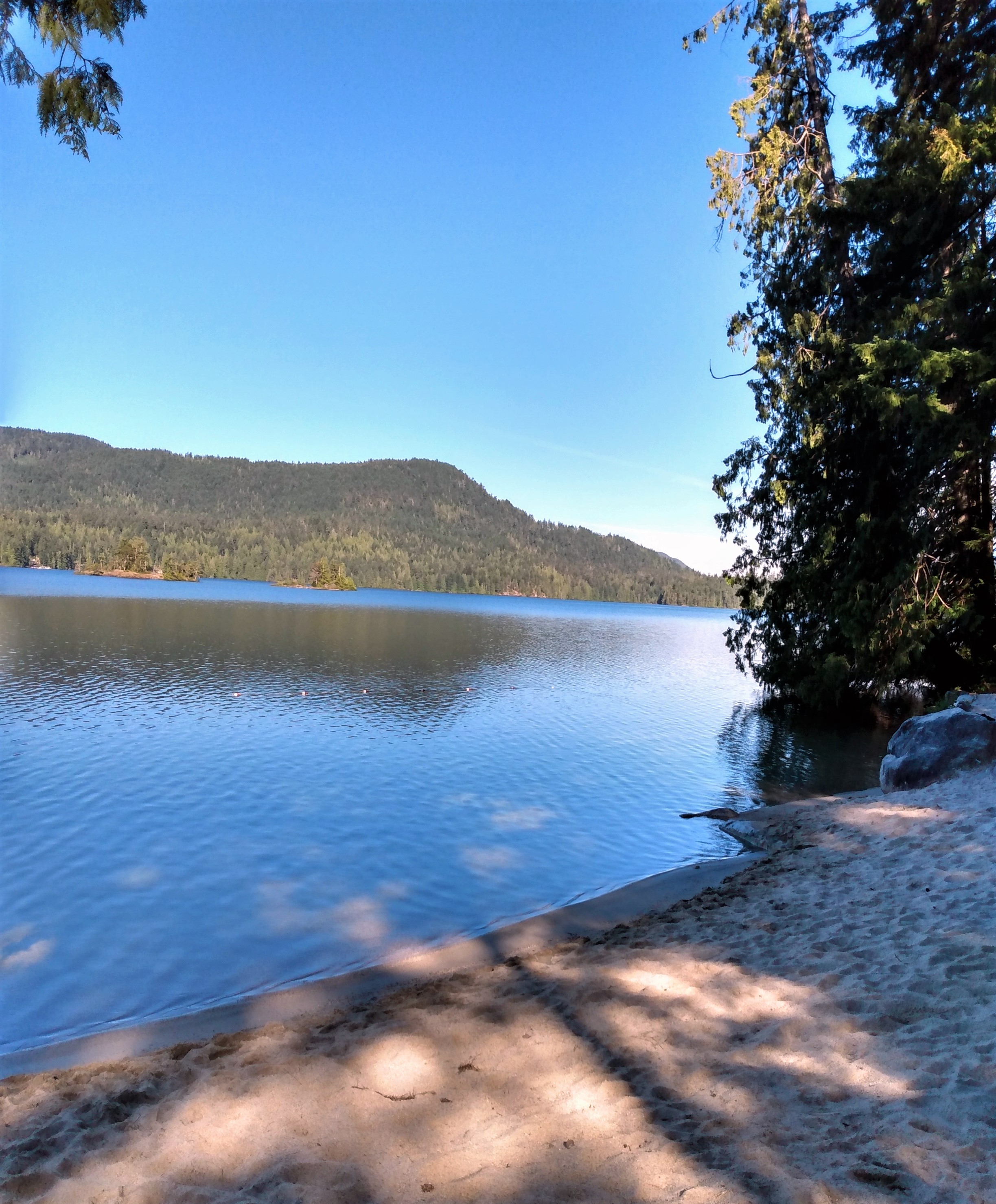
Friday was the last day our local pool was open. We’ve had the luxury of swimming 3 times a week since September — last spring they were closed during the first part of pandemic but found a way to open safely, with strict protocols regarding numbers, etc. We’ve been swimming there since 2016, though many years ago we also swam pretty regularly when our children were in school. Summers we swim in the lake, though I spent years not going with John and the kids because I don’t like crowds and there were always quite a few people at the little sandy beach area late afternoons. And who could blame them? A clean lake, good access now that a parking area has been put in and the regional district brings in sand every year? When we first began to swim in this area, 40 years ago (and even earlier for John, who came for years before I knew him), anyway, when we first began to swim here, you parked in a little area off the highway and walked on a rough trail to where you could get into the water between native willows and wild spirea. The lake bottom was a bit mucky but the water was lovely. It still is. When I began to go again regularly, about 5 summers ago, I realized that it was quiet first thing in the morning. We’d arrive around 8:30, mostly to kingfishers and the prints of deer and bears in the sand before the maintenance guy arrived to take away garbage and rake the beach. The sight of the sun coming up over the mountain, behind the cedars, as I swim in deep green water is something I cherish on summer mornings.
Nobody heard him, the dead man,
But still he lay moaning:
I was much further out than you thought
And not waving but drowning.
It’s not quite summer yet. But the pool, as I mentioned, is closed until July for some upkeep work. When you swim regularly, you need it. You need the feeling of your aging body in water, you need the buoyancy, the silkiness as you reach out your arms to propel yourself forward and back. Lake swimming is heaven. I tried to keep it up over the winter but honestly it wasn’t really swimming, the times I went down, wrapped in towels, a toque on my head. It was more a waking. The water was so cold and I’d immerse myself, doing a few circles until I couldn’t feel my feet or hands, and come out. I felt spectacular, so alive, and I loved the sense of knowing the lake in winter. I’ll do it every year. But this morning the water was not that cold. Cool, yes, but once I did a length or two, I felt the way I feel in summer: strong, purposeful, held by water.
Poor chap, he always loved larking
And now he’s dead
It must have been too cold for him his heart gave way,
They said.
The lake has its stories. It was used as a holding pond in the early years of the 20th century and sometimes if you are out in a boat and the light is right, you can see the huge logs that never got removed. People have drowned in the lake, several over the years we’ve lived here. Last summer one person died of carbon monoxide poisoning in a cabin. A few months ago, someone at the pool told us about an accident he’d been involved in which his boat ran over a swimmer. It has happier stories too. Families whose children have grown up swimming in the lake each summer, families who now have grandchildren who come to the lake each day they are staying with their grandparents. When I hear a young girl calling to her father as she swims, I remember our Angelica diving from the rocks near where we swim, asking her dad to score her dives. 8! 9! That’s a 10!
It might be just rumour or legend but supposedly there are drowned bodies still in the lake. I think of them now and then, wondering what’s left of them. It’s rumoured that the lake is salt at the bottom and that makes sense. It drains into Sakinaw Lake which was once connected to the ocean; the top 100 feet of Sakinaw is fresh and the bottom 350 feet is salt. Some years we’ve found jellyfish in the lake. There are fresh-water clams. Lots of geese. Loons. Ducks of several species. A special race of fall-spawning cutthroat trout—our family knows about these because Forrest once conducted a census of the trout population as a science fair project in grade 8 or 9.
Oh, no no no, it was too cold always
(Still the dead one lay moaning)
I was much too far out all my life
And not waving but drowning.
If a lake can be haunted, so can be its swimmers, the ones who come in toques in January, the ones with the plastic buckets and swim rings in July, and the ones like the woman who is the tiny dot in the middle of the photograph at the top of this post. (She talks to the water as she eases through it. Does it talk back? She’ll never tell.) As I swam this morning, I felt like myself again, the self that almost feels she could circumnavigate the lake without stopping. Almost.
Note: the poem is Stevie Smith’s “Not Waving but Drowning”, from her Collected Poems.
This morning I have been thinking of the soft landscape around my grandfather’s village in Ukraine and how my photographs from a 2019 visit helped me to write the Ukrainian sections of my novel, Easthope. In the novel, the main character visits a village very like my grandfather’s, though her family history is not mine, and what she discovers there, the long threads of connection, some snipped, some tangled and knotted, inspire her to paint her way into a greater understanding. Her name is Tessa (and if you’ve read my other novels, you might recognize her as the child in The Age of Water Lilies) and I’ve given her an adjacent life, if that makes sense. She and her husband live in a house on the Doriston Highway, the first house John and I looked at in 1979 when we were trying to work out a way to live here (though we didn’t quite know that then; we thought we could spend summers, maybe a week or two in other months of the year too). We didn’t buy that house but Tessa and Marsh inherited it. Fiction lets you do that. And so it goes. She paints. (I can’t.) Marsh has a refurbished Columbia River gillnetter. (I don’t.) Tessa’s Ukrainian relations are not mine.
My novel is out on submission and maybe one day it will be published. I keep opening the file to read particular passages, maybe just to make sure they’re still there. That Tessa is still there, making her art, in the house on the Doriston Highway, the one with a secret room off the studio, filled with….Oh, you’ll have to wait to find out.
As the date for the show at the Arts Centre approached, Tessa found herself painting daily. Not work she intended to include in the show—those choices had been made with Sandra and she was happy with the selection they’d decided on—but new work. The dream of the Sovytsya River, her grandfather floating away. She’d painted Stepaniya brushing her hair, baby Olena tucked into a basket. Over them, silver fir and beech. She’d cut a scrap of pink wool and carefully edged it with satin ribbon and if you lifted the edge, you could see Olena’s smocked nightdress and a tiny stuffed duck she’d made of yellow felt. Her grandfather floated on his back, eyes closed, and ahead of him, in the undulating surface of the water, she made a little pocket. She thought about how to do this for days and opted for cotton and adhesive, painting the cotton the same colour as the river. Silk thread, green as waterweed, allowed you to open the pocket. Inside: a tiny photograph of her grandparents and their 9 children in front of their house in Drumheller, the dry hills behind them. A chicken strutted in front of them and a washtub hung on the outside wall of the house. She was also working on a big canvas of a lean-to in the woods beyond West Lake, a woodcutter’s axe propped on a stump. And she was making sketches for a diptych: on the left, a portrait of the boot Richard had found in the woods, battered, with copper nails holding what was left of a sole in place; on the right, a series of images of a man’s life, from birth, to migration across a wild sea, to the skid row of a big city, to a remote forest, and finally a death under the roots of a fallen fir, one foot shod in a leather boot (she would use leather embedded in impasto, with tiny copper furniture tacks tapped in), one foot bare to the weather.
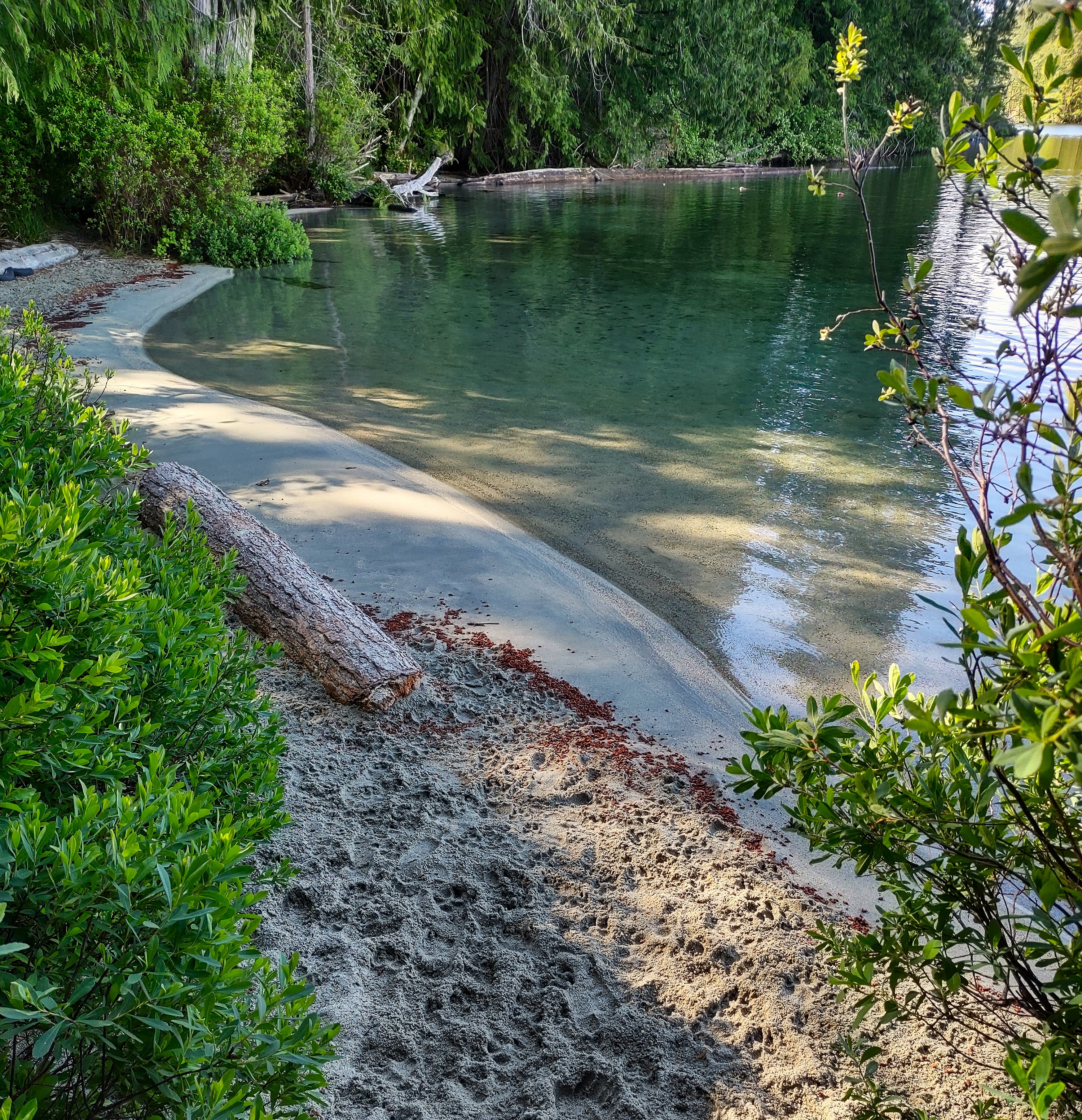
Although the mornings are still cold, although the rains are more like early spring rains, I’ve begun swimming in the lake again. A few weeks ago, I swam in Nicola Lake while there on a picnic with my brothers and their wives; last Friday morning I swam in Meech Lake, in Gatineau, swatting black flies as I entered the water and left it. But this lake is the one I’ve known since 1979 when John brought me here, to a place I’d never been, and wondered how I’d feel about living in the area. There was no beach then. I’ve written this before. You pushed your way into the water through hardhack and wild mint. Now there’s a small beach area, enhanced with sand trucked in by the regional district every winter. Every winter but this one, for some reason. (The photograph is from last year. This year the sand near the water’s edge has washed away and you have to avoid the rocks on your way into the water.)
Yesterday, something quite large jumped as we approached the water. A fish! And then I noticed the surfacings everywhere. A hatch of something — mayflies would be appropriate, wouldn’t they, on the 22nd of May? — was providing good feed for the cutthroat in the lake. As I pushed out into deep water, I could see little flies on the surface. And there, and there, and there: trout rising.
The water was cold. The weather is still uncertain. Yesterday afternoon it got quite warm so I’m hoping the lake will be warming up, just a little. I like it cool. While I swam, I was thinking, trying to come up with a title for the memoir coming out next year. From my perspective, it has a title, the one that I recognized as soon as I saw the phrase in the Julia Kristeva essay I was reading, partly in preparation for writing the long essay of my own that became a memoir.
Let a body venture at last out of its shelter, take a chance with meaning under a veil of words.
But it seems that it’s not right for marketing a book so the publishing team (I’m included in this) are trying to find something that is, well, more obviously on topic. I’ve just worked through the second round of edits and nothing suggests itself. So far, nothing has. When I read the manuscript, I am back in those years, bittersweet.
Under a veil of words, I wrote about something that happened 47 years ago. 46 years ago I’d begun to swim in the lake that is just around the corner from the house I built with my husband (this matters: my memoir references it; and it is central to my life, then and now). And now, late morning, my body ventures into cold water, where trout are surfacing, and all the old memories too.
Yesterday, late afternoon, we returned home after spending 5 nights in Gatineau. Each day was full: swimming in Meech Lake, walking, making large meals, reading stories to the young grandsons, looking at A’s stamp album in which he detailed each stamp (it took awhile but what a lot he knows about geography and history at age 9…), helping plant the tomato seedlings in between pours of rain.
I was unpacking groceries and putting together a simple supper when John came downstairs to say that there was something beautiful on the upper deck, the one off our bedroom. While we were away, and while the cat was being cared for down the coast, a robin had built a nest on the elbow of downspout by the sunroom window.
You can’t see the perfect bowl, ready for eggs, but you can see the casual drape of lichen (and the little raw area above the blue window where the bear tore off the trim last weekend when we were in Kamloops for a few days). We used to have robins nesting around our house, on angles of grapevines under eaves, above a window in the printshop, on a beam carrying wisteria over the patio, and once on a railing by our front door. We’d stop using those doors and windows, delighting in the care the parents took as they kept the eggs warm, then the nestlings fed, then, when we were lucky, we’d see the young leaving the nest, encouraged by their parents perched in nearby lilacs.
I wondered if this nest was made by one of the descendants of those early robins, the ones before the cat (who is 10 years old), and I thought how careful they are in their choice of location: an east-facing downspout, sheltered by the eaves, looking out at the morning sun. There was no sign of the robins last night, though, and (more importantly) no eggs in the perfect bowl of dry grasses.
I walked around, thinking and remembering. Remembering the robins, their young. Our own young, their voices in the twilight. The young in Gatineau, calling in French and in English, wondering if the trampoline could be set up now, the swings on the big maples in the front yard. I thought about the work ahead — potting up more tomatoes today and tomorrow, replanting the arugula (the first pots have already provided us with spring salads and are now going to seed), coaxing the tendrils of sweetpeas to the netting I have wrapped around railings behind them. And yes, leaning down to smell the first yellow daylilies, as sweet as honey, a bee already sleeping in the throat.
Memories of the outside world will never have the same tonality as those of home and, by recalling these memories, we add to our store of dreams; we are never real historians, but always near poets, and our emotion is perhaps nothing but an expression of a poetry that was lost. –Gaston Bachelard, from The Poetics of Space
planting tomatoes (including some from home, brought in my suitcase), eggplants, peppers, flowers, herbs, under a confetti of apple blossom, the sound of the rapids, robins, boys at play, cooking, swim in Meech Lake, trilliums in the ravine
Note: this was posted 6 years ago. The little oak didn’t survive its transplanting and the clematis died back one cold winter but has returned to life and is clambering, as I type, into the lower strands of the green grape growing over the pergola.
__________________________
This is one of the first things we planted when we built the west-facing deck: a montana clematis. In my memory (not always reliable), it was blooming on Forrest’s 3rd birthday; friends came up for the day from Vancouver and we celebrated in spring sunlight on the new deck. It’s very rampant and has covered an entire section of railing and climbed up to join a grapevine and a wisteria on the trellis over the table we use all summer.
Last September, after we’d picked the grapes, I heard a commotion on the deck and looked out to see a young black bear climbing into these vines. When I shouted at it, the bear dropped down to the herb trolley below and ran off, but only momentarily. All month it hung around, eating crabapples, ambling around the place like a family dog. (Except it wasn’t.)
When I looked at the clematis just now, I remembered so much. That birthday party, with chocolate cake and the helium balloons our friends brought for the boys, one of which escaped on the ferry across Jervis Inlet a day or two later and probably still circles the earth. (The balloon, not the boy.) The Pacific willow that grew in front of the deck and how the clematis sent tendrils into it, embracing it and eventually smothering it to death. When it fell, the clematis fell too and died but luckily came back from the roots. And when we moved the willow off the bank the fall after it died? We saw that there were old bird nests tucked into the dense shelter created by its branches and the thicket of clematis vine. We couldn’t see them while the tree was living.
When the deck was rebuilt a few years ago, John realized he could use the existing beams and joists but he could extend the surface by cantilevering. The vines were all carefully untangled from their places and laid back on tripods to wait for construction to finish and then they were ceremoniously replaced. The clematis sulked but eventually accepted its new supports.
I remembered the rose we bought at the same time as the clematis, now long gone. And so many dinners on the deck, so many years of parties and conversations (one just last night!) and weeks of watering in the heat of summer. So many raccoons in fall, a bear, generations of hummingbirds, western tanagers, Steller’s jays, warblers.
When I planted the clematis, I wasn’t thinking about the future. The boards of the deck were raw and new. I had two sons, one turning 3 and one a year old. The days were filled with caring for them and helping John with building projects. We don’t plant for the immediate moment but for the future, whether that might be two months or twenty years away. Or thirty-five. While I was taking the photographs of the clematis, I stubbed my toe on something and I looked down to see the Garry oak I am growing from an acorn gathered at Rithet’s Bog in Victoria 5 or 6 years ago. It took nearly a year for the acorn to germinate and each year it’s put on a single set of new leaves. I’ve repotted it once and next year I’ll look for a likely place to put it in the ground.
This little tree is a sort of double mnemonic. When I look at it, I remember walking the trail around the bog with my husband and daughter, something we often do when we visit Victoria. But I also remember the area before it was a park managed by the Rithet’s Bog Conservation Society, when it was farmland still, before the Broadmead subdivision, before the shopping centre and the churches.
In the late 1960s, I used to saddle my horse early on weekend mornings and ride him across the Pat Bay Highway to a gate leading up onto the old Rithet’s farmland. I was in my early teens, a lonely girl in search of lonely places. Someone had told me that it was fine to ride there, but that the gate had to be kept closed, as there were cattle grazing in the area. I don’t really remember the cattle, but I occasionally saw deer in the tall grass. There were many oaks growing on the slopes. In the spring, there were expanses of blue camas, yellow buttercups, and odd speckled flowers that I now know were chocolate lilies.
I loved the open beauty of those meadows, where pheasants roamed and flew up, sharp-winged as we approached. The meadows smelled intensely dry, fragrant as hay, though not dusty. I’d let my horse canter up the long slopes and loved the way sunlight filtered through the trees.
So we plant for the future and for the past and for the moment that contains both of these. I will probably never see this tiny oak grow into the fullness of time but it’s not why I planted it. Rubbing one of its new leaves between my fingers, I am riding through that gate into Broadmead meadows, my black horse’s neck already damp with sweat.







 ...Theresa Kishkan