
This morning it’s raining softly, after a long dry spell. A spell of heat, the grass brown, the birds insistent on their bowl being filled, a chickadee almost landing on my hand the other day in its urgency to drink and bathe.
I swam in the light rain just now. There’s a place we can leave our towels under the wide span of an ancient Douglas fir and swimming in the rain is a no-brainer: you’re going to be wet anyway…Around me, tiny pocks on the water’s surface, tiny flies, fish rising. On the other side of the lake, the pair of loons I see some mornings were calling, calling into the cool air, maybe as relieved as I was to feel the rain on my shoulders.
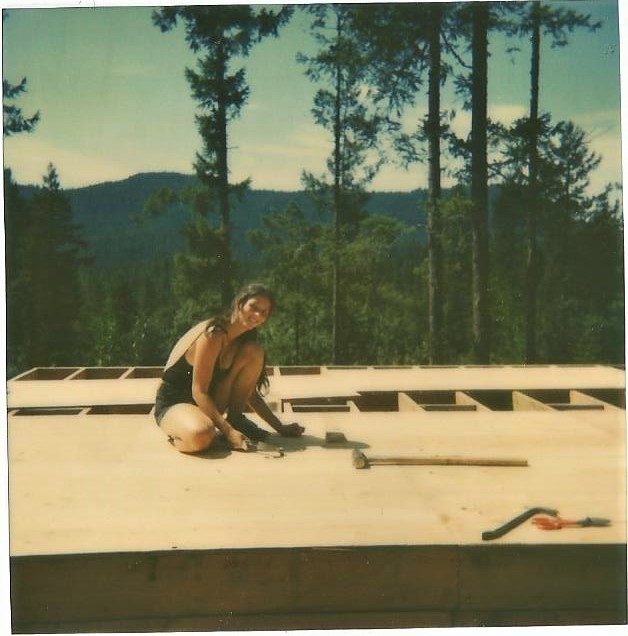
When I’d finished my swim, before getting out, I paused for a few minutes in the deep water, perpendicular, a column. How it is that I could stay in the position and not sink? Maybe I’d sink if I didn’t flutter my hands just briefly from time to time but honestly it felt like a kind of magic. I was thinking, as I hung in the water, about strength. 44 summers ago, I was nailing down the plywood that was the subfloor for our kitchen while John framed the walls. When I’d finished nailing and he’d finished framing, we’d lift the walls into place and I’d hold them upright while he’d drive the spikes through the bottom plates into the joists below. Sometimes we used a 2×4 as a brace though for the smaller sections, we didn’t bother. We had a baby who was either in the tent, asleep, or in a stroller in whatever shade we could find for him. I was 26 years old.
The reason I was thinking of that summer, the work of building a house, and how it felt to hold up a wall is because I’m figuring out some details related to my book, The Art of Looking Back: a painter, an obsession, and reclaiming the gaze*, due out next year. And to check on the details, I’ve been revisiting the manuscript. Before I knew John, before I knew the painter, before I knew much about my own strength, I spent time in Greece, mostly on Crete, but also in Athens. And I vividly remember walking up the Acropolis to visit the Erechtheion where the beautiful Karyatids hold up the south porch. I spent hours that first visit just walking around them to marvel at their bodies, their enormous dignity. I was 20. I had wide shoulders that I wished were narrow. I had a sturdy body that I wished was slim. I’d come from Crete where I wore a yellow bathing suit into the sea each morning and where I floated under a sky the models for the Karyatids would have known: blue as a book of hours.
This morning I was a column in the green water, rain falling around me, and I was remembering the shoulders of the women holding the weight of the entablature of the south porch of the Erechtheion. They are symbols of what women can do and endure. I don’t do much now but there was a time when I held up the walls of my house while a baby drowsed in the tent nearby.
I climbed the hill of the Acropolis in winter, a hill I never expected to climb, my family forgotten. I knew exactly how to find it because the hill was illuminated after dark and I could see it that first night from the rooftop of the guesthouse. The marble steps were slippery under the sandals I’d bought in an Iraklion street market. Dry stalks of summer plants fringed the path – wild oats, henbane, the desiccated leaves of coreopsis. A few seedpods from spring’s poppies. At the bottom of the hill – cypresses, pines, olives, with the prickly leaves of acanthus under their shade. Did I pay? I must have, though I don’t remember. But I do remember the Odeon of Herodes Atticus just off the path, the five gateways to the Propylaia, the temple of the Athena Nike, the Parthenon (of course) with bereted men taking photographs of tourists highlighted against it. What I remember best and most was the Erechtheion complex—the temple of Athena Polias and the Tomb of King Erechtheus, and the porch of the Karyatids or Kore. There were originally six of them, though one was removed by Lord Elgin in the first decade of the 19th century and sold to the British Museum; a replica of the lost sister stood in her place when I was there. In 1978, the remaining five maidens were removed to the nearby Acropolis Museum and replicas installed in their place. But in 1976, they stood in their original beauty, holding up the entablature of the porch on the south side of the temple; and for me they became profound emblems of strength. Their bodies were foundational, structural; they were not the objects of anyone’s gaze, or if they were or had been, it was immaterial after 2500 years. Their own eyes were farseeing. Their clothing closely fit their strong bodies, one leg taking the burden of the building’s weight, that leg bent forward to demonstrate their strength. From behind, I could see the intricate braiding of their long hair, thick and bold, serving to enforce the strength of their necks as they support the burden of the entablature.
*I have written about this book in the past, using its earlier working title: Let A Body Venture At Last Out of its Shelter. But it will be published by Thornapple Books as The Art of Looking Back: a painter, an obsession, and reclaiming the gaze.

 ...Theresa Kishkan