

1.
Here, and here, and here: a swallow dipping down to the lake surface, the thread of its flight almost visible. As I was swimming on my back, nearly my final lap, the bird almost touched me, almost stitched me into the water. Nearby, a raven calling the same name over and over. It wasn’t mine.
2.
The garden has begun to feed us. Peas, salad greens (and reds, burgundies, and the beautiful pink-edged leaves of Chenopodium giganteum, or magenta spreen), basil for last night’s pesto sauce, and this morning, I noticed the beans are in flower, there are tiny golden squashes forming, small sweet peppers in the greenhouse, tomatoes forming, garlic thriving (the scapes are delicious), every other herb imaginable. In tubs, French fingerling potatoes. When I turned on the sprinkler this morning, I ate a handful of raspberries.
3.
I don’t want to think about world events. Not today.
4.
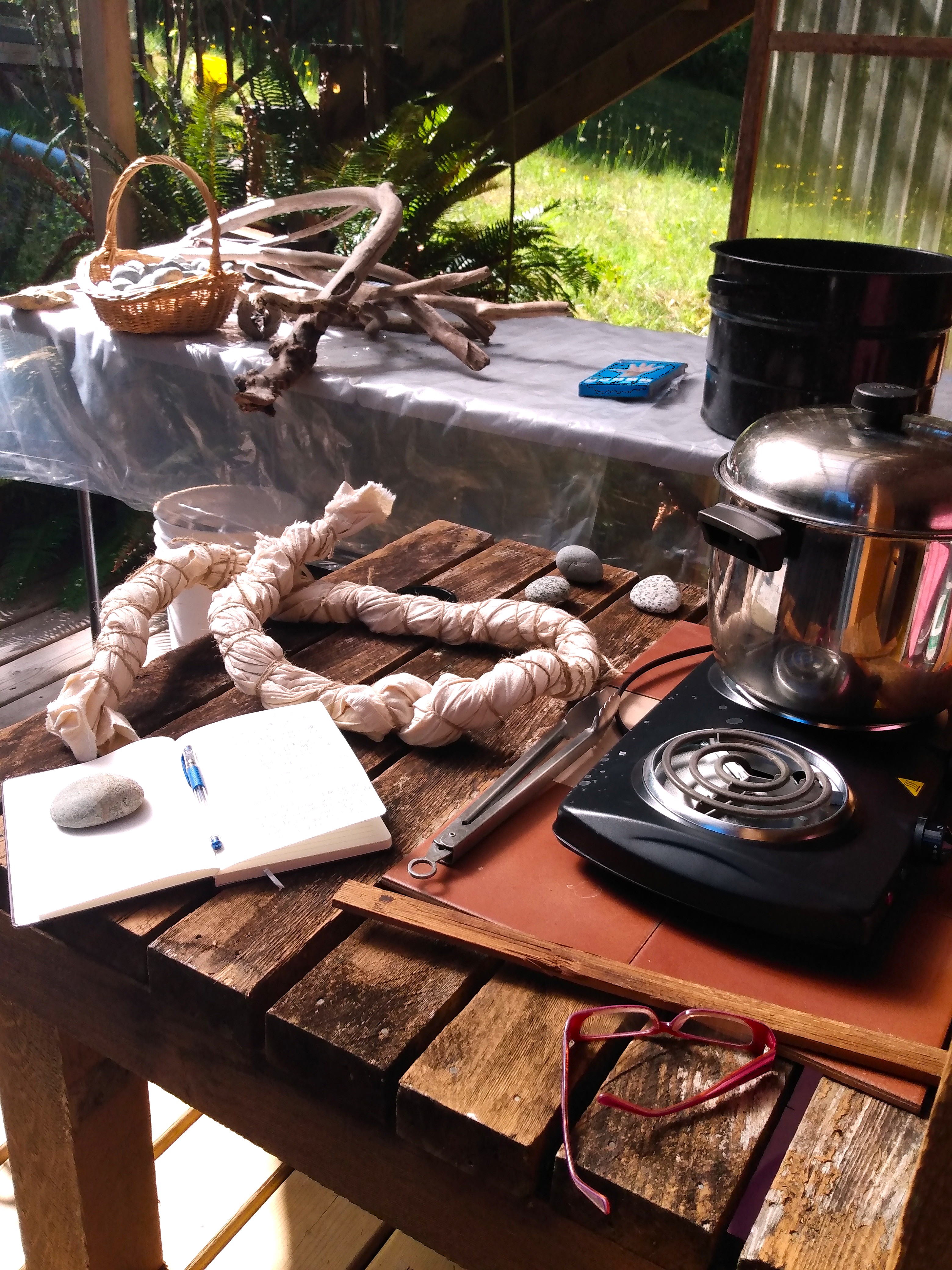
This is the day I will dye the cloth I’ve scoured and mordanted, tied with hemp string, the day I will immerse it in rose madder, my first attempt at a dye other than indigo. In my dye area, I have marigold, pomegranate, a little jar of cochineal. I have a bag of mahonia wood, as yellow as butter, a jar of old iron bolts and wire soaking in water and vinegar, and still enough indigo for something large. I have a basket of beach stones, some wood brought home from Trail Bay, old sea-battered rope I found in Bute Inlet last April, and a notebook to keep track.
5.
there is a sense of having crossed
over an unhurried river where there was
a drawbridge but no operator and the undulant
grasses on the opposite bank emulate
the whish of a sleep application that could be
the rhythmic wash of rain or of some sinister
approach or the strain of an unutterable
weight from a swinging line of hemp
Note: the lines of poetry are C.D. Wright’s, from her poem “Imaginary Rope”.

 ...Theresa Kishkan
Years ago I worked as a gardener in a pioneer museum garden, in charge of the the ‘dye bed’, which fascinated me with its madder and wode and had me researching various other forms of dye at the time. Your post brings back those memories… and reminds me that where once I had an inkling of an idea to grow the plants and dye my own fabric, it was best not realized. The closest I’ve come is dying tea towels with the berries I pick, which I like, and it’s enough. I’m happier reading your posts as you travel that road so beautifully. Also, I’m glad you ate those raspberries when turning on the sprinkler…
I’ve dyed with woad, Carin, and it’s ok but I prefer indigo, even at its most washed-out! This is something I just need to do right now, can’t explain, but maybe I’m hoping that the dye, the colour, will act as a quiet mediator between me and, oh, something.
Woad. Thank you. (I just looked up ‘wode’ and see it means mad, crazy, frantic.) I remember finding it interesting to learn that woad was used by those pioneer folk who didn’t have the means to access indigo. Such a small thing but a class divider nonetheless, the richness of blue. I look forward to future posts on the power of your quiet (and colourful) mediations…
The whole world of these dyes–how they were discovered, used, modified with mordants (including urine, which I will probably try but maybe won’t post the details…), adjusted with heat, light–has always fascinated me. But somehow I only ever used indigo and woad. Ready to expand my practice! Marigold next?