
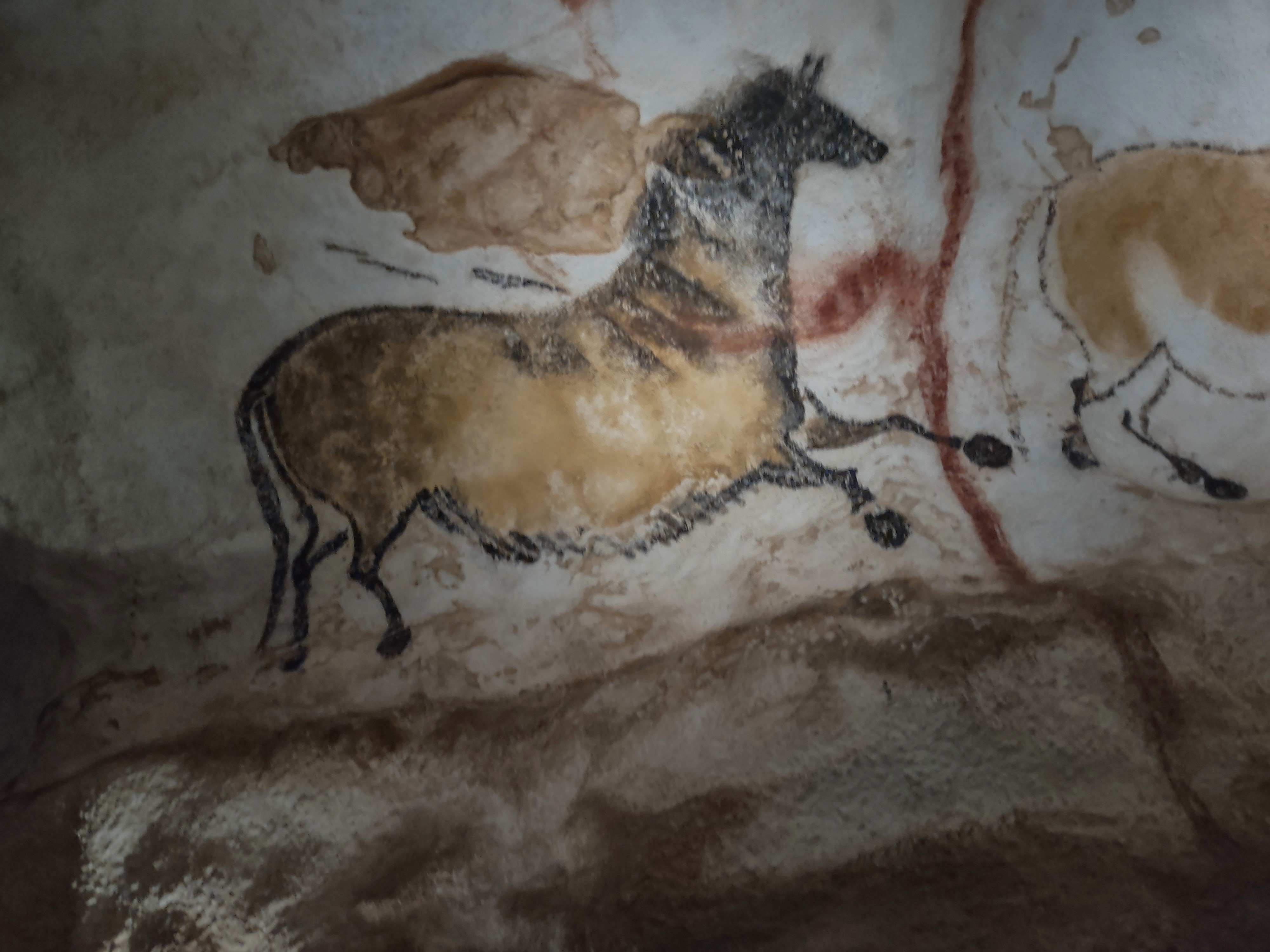
In late October we were in France, in the southwest, looking at animals in caves. In some ways I waited my whole life thus far to see these wondrous places, these horses, bison, reindeer, herds of aurox. I’d read a lot about the caves and since coming home I’ve read a lot more, enough to realize how much I don’t know. Is it too late for me to return to university to do paleoanthropology, I wondered to John yesterday. And he said, It depends on how serious you are about doing it.
How serious am I? I don’t know. I read and I yearn for more opportunities to enter those spaces, to study how the early artists used the contours of the cave walls to give their creations such vitality, such palpable life. I want to know more about the pigments, their textures while wet, the differences in ochres sourced from different places. In one of the books I’ve been reading, there are detailed descriptions of how the contemporary craftspeople replicated the galleries at Lascaux once it was determined that the original images could not survive the constant exposure to crowds, the growth of algae, molds, and calcite veil that threatened the climatic and biological equilibrium inside the cave. We visited Lascaux 1V, which was a wonderful experience, though I’d actually booked tickets for us to go to Lascaux 11 (long story…), and I’d like to go back so we can go there as well as to Bernifal and some of the other sites in the Vézère valley in particular.
At Lascaux 1V, I bought two of my grandsons a simple craft, slabs of limestone with the outline of animals replicated in the centre’s galleries and tiny packets of pigments to be mixed with water for painting the animals. When I got home in mid-November, I ordered them books about the discovery of the Lascaux cave in 1940 by 4 boys and their dog out treasure-hunting in the hills above Montignac. I hoped they’d find the story as exciting as I did, boys in the woods with German planes flying overhead, finding a world so ancient and beautiful in the midst of war. Maybe I should have bought myself a little kit so I could sit at our table and dab red and yellow ochre and black manganese on stone to make horses and bison and a delicate reindeer licking the muzzle of its mate.
One of the books I’ve been reading is Genevieve von Petzinger’s The First Signs: Unlocking the Mysteries of the World’s Oldest Symbols. In it, she details the 32 signs that appear over and over again in caves and shelters during a 30,000 year time span of the Ice Age across Europe. It’s deeply fascinating work. But maybe my favourite moment in the book is towards the end when she is in the Côa Valley in northeastern Portugal and after a scramble up a hill to an outcropping on a ridge where she is shown a slab of rock with a meander incised into it, pairs of double lines running above one another and then converging into a single pair of parallel lines. From her position on the hill, she can see a brook joining the Côa River below; later the Côa converges with the Douro River. It’s hard not to see the meander as a geographic marker. This is a site perhaps 25,000 years old.
I am hoping we can return to France, Spain, and Portugal next fall (at the earliest; next spring if we can’t manage the fall) to explore some of the sites von Petzinger describes and some of the sites in the Vézère valley, ones we couldn’t get to because our rental car arrangement fell through. (Next time I’ll be more careful.) In an ideal world, I would have found my way to these places years ago, I’d have worked out the feelings that they evoke in me, the dreams that I wake from in tears because I can’t believe I’m not there now, dreams where I am entering Font-de-Gaume through the beautiful opening into its limestone depths, entering to stand among the horses, the bison, the black aurox, where I know so much more than I did in late October, where the windows of the car are open and the scent of pine, chestnut, dry grass comes to me as a palimpsest, an invitation.
Is it too late for me, I asked. And maybe I am as serious about this as I’ve ever been. I just didn’t know.
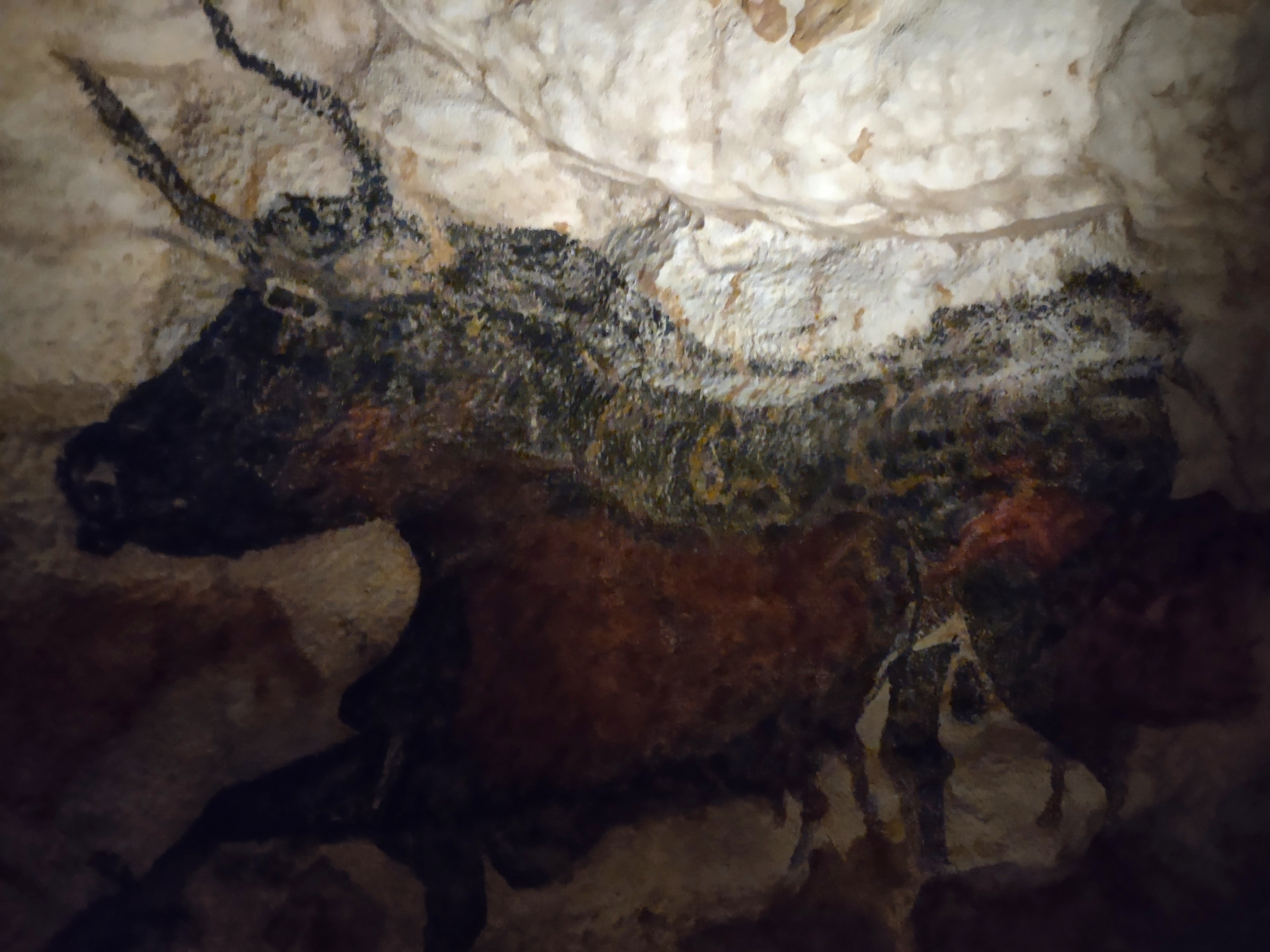
Note: the photographs are John’s, taken at Lascaux 1V.

 ...Theresa Kishkan