
Note: I posted this two years ago. And I still ask, not out of sorrow but in wonder.
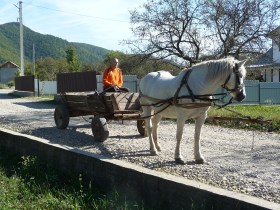
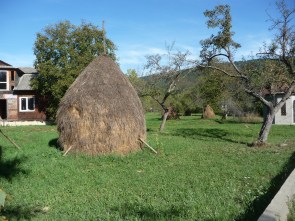
How is it that you can be two places at once, awake and dreaming? How can you be in the house you built and love, and also on a road coming down from the Carpathian Mountains where you swam in a pool just at sunrise, mist in the valley below, on the road coming down from the mountains, feeling such sadness at leaving? You remember how you felt. As though you’d found a missing strand to your complicated DNA, part of the twisted ladder of your self, the molecule that allowed you to sit at a table under the apple and pear trees at the farm you passed each day on your way back to the hotel in the mountains, talking quietly about the harvest. It could have been Tiudiv, Kryvorivnya, Bukovets, Yavoriv. You are allowed to stroke the white horse’s neck. Someone else goes into a church to pray. Stooks in the field. The scent of burning spruce in the chimneys nearby. It could have been another life. Yours.
So you read the poem someone posts on social media and you begin to weep.
We were riding through frozen fields in a wagon at dawn.
A red wing rose in the darkness.
What will happen to the man with the white horse, the hands that shaped the hay, leaning on rakes part way through the work to catch up on the news? You cannot be two places at once. You are in your kitchen, blueberry muffins in the oven, wisteria leaves falling quietly on the deck. Three days in a row the young buck came to your window. Everything is white with frost. What will happen in that life, in this one? Those mornings you swam in cold water were a kind of ecstasy, chickadees in the sunflowers black with the coming of winter. Looking down into the valley felt like falling.

Oh my love, where are they, where are they going
The flash of a hand, streak of movement, rustle of pebbles.
I ask not out of sorrow, but in wonder.
Note: the lines of poetry are from “Encounter” by Czeslaw Milosz, translated from the Polish by the poet with others.

 ...Theresa Kishkan
I have been drawn to Geography in school, later as a professor and now in retirement because it deals with “real” things one can see and touch. Mountains, rivers, farms, cities. But I, and the discipline of Geography, increasingly recognized that there is also a Geography of the mind and of the imagination. It guides us, for better or worse. It enriches us and changes. Accordingly, even during a day, we can be perceptually in more than one place. Ukraine or B.C. Abroad or at home. We can wallow nostalgically in the geography of our past and daydream or worry about our future geographies. Even asleep most of us have geographies, albeit confused, in our dreams.
Have you read Gaston Bachelard’s The Poetics of Space? It might feel a little dated now — published in, I think, 1958– but in many ways it anticipates the later preoccupation (by Guy Davenport and others) of the relationship between geography and imagination. In the Bachelard, it’s sort of about domestic architecture and how it influences our dreams, our imaginative state, and I guess I think that the domestic architecture is a kind of geography too. Thinking too of the dream maps of Indigenous people — Hugh Brody’s Maps and Dreams was my first encounter with these and I reread it from time to time….
thanks. I will check Bachelard and Davenport. Have read and enjoyed Brody.