
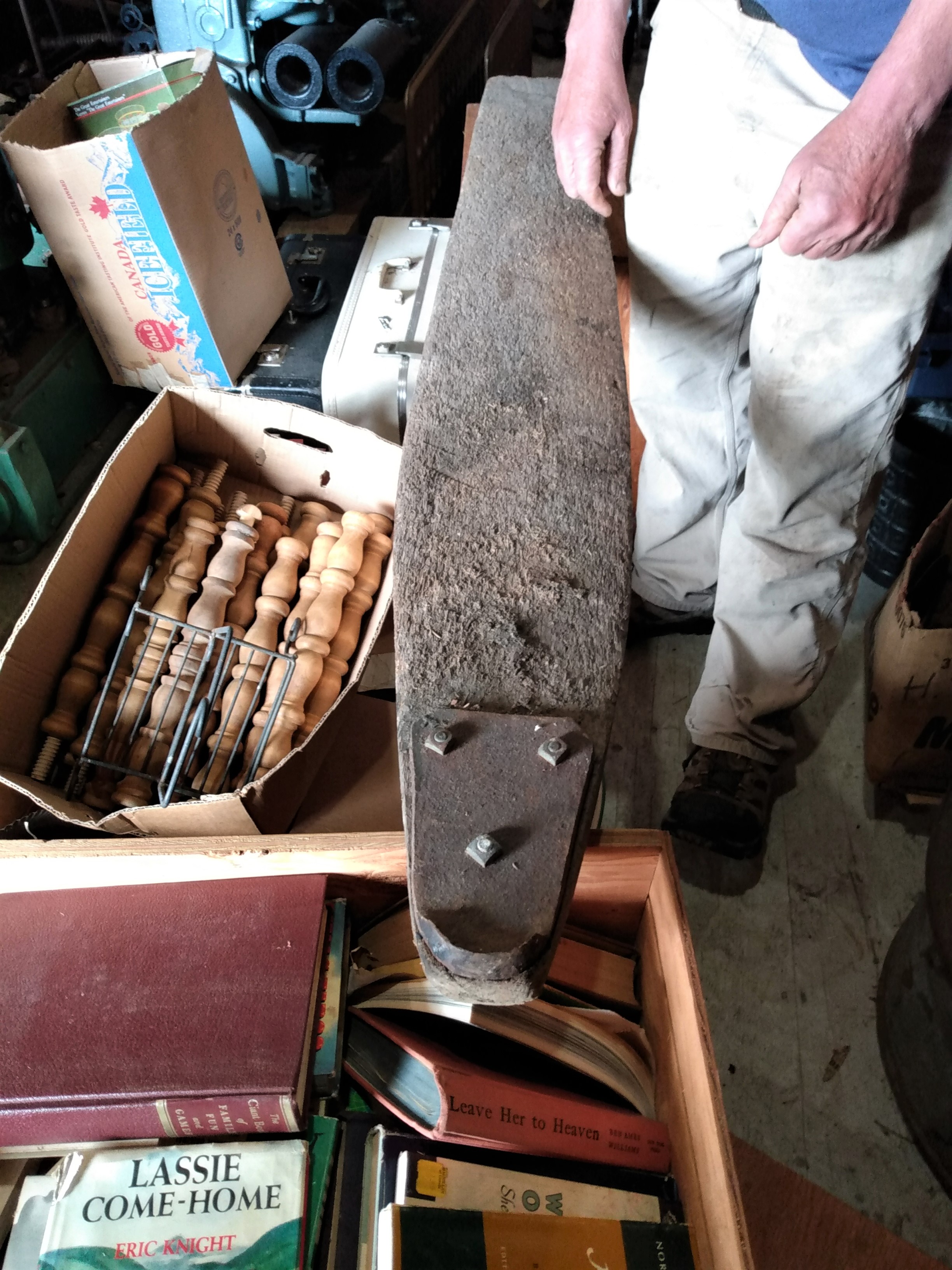
Someone in the novel I just finished (typed the final sentence on Sunday and am now going over the draft to fill in the gaps. There are a lot of those…), anyway, someone in the novel finds this springboard in the woods. Or not this one but one like it. This one is part of Bert Mackay’s collection of old marine engines and logging equipment and spending time in his collection a couple of years ago, courtesy of his nephew Ian (those are Ian’s legs and hands in the photograph), was like entering the chapter of a book. It’s a book I’ve been reading all my life and it never finishes. A page turns, a section concludes, and then I find more to read. In a way the novel I just finished writing is a kind of reading. I certainly did a lot of reading as I was writing but I also felt I was learning to decode a dialect I was only marginally familiar with. And now? I’m not fluent but I have a working knowledge.
A working knowledge of engines, of life in a small community, of relationships, of the kind of seeing that allows an artist to make art. The main character is a painter and through her, I learned to prepare canvases, to layer impasto, and to plan an exhibition.
Last week we had one of those weather systems move through our area. Earlier, maybe three weeks ago, a small tornado hit the south end of Redrooffs Road and caused considerable damage. Driving by, I was shocked by swath of trees it had shattered. And last week it was our turn. Between our house and the high school where we swim each morning in the pool beneath the school, there were 10 separate areas of the power line damaged. Poles were down or broken or leaning, huge trees fell on the wires and snapped the lines, sections of wire fell to the highway and made it impossible for ferry traffic to proceed south on Wednesday (I think it was Wednesday) morning. We lit our oil lamps and candles and made sure the fire didn’t go out. This morning I heard that something called a bomb cyclone is headed our way, with 120 km winds. I’ve filled water jugs, John filled huge buckets to wait by the back door for flushing toilets, and the lamps are clean and full. Last week’s storm damage had been sort of repaired when one of the lines, the fibre optic one, died; this meant a day and a half without our landlines, without internet (though John’s cellphone had data so he could check progress from time to time). I spent the day working on the gaps in my novel, writing two new scenes, realizing as I returned to the manuscript after dinner that I’d somehow lost that new material. So this morning I’m re-writing, hoping I can figure out what I knew and wrote yesterday.
One of the scenes involved the springboard. At least I have a photograph. At least I can still imagine the moment when it’s found in the woods and the main character learns something new. She turns a page and there’s a new chapter still to read. Today I’ve had my swim and have just put bread in the oven: you’ve heard that tale before. But there’s a new chapter still to read. I think. I hope.
She was thinking about her paintings. She was thinking about what had happened with Leah. Alone in her head, she was thinking too much. So one late fall morning she put on her hiking boots and her rainjacket and drove up the Easthope road to where she’d first seen one of the ghost trees Richard had painted. She parked on the side of the road and scrambled up the bank to the remains of the tree she recognized from one of his canvases. The little notches cut just below the flare of the trunk for the springboards, the buoyant growth springing from the remains of the tree. Here, this was the one in the painting she loved, the grey-green lichen-crusted wood, the elegant roots clinging to the ground like the hands of someone reluctant to let go, and a maple growing vigorously from the decayed rubble in the centre of the stump. She leaned against it, imagined Richard in this place, trying to see the stars he knew were there, in daylight and darkness, imagined him making notes in one of the little books he’d stored away in a drawer in the studio: colour, texture, compass readings (which she realized were references for star readings). Then she heard something scrabbling in the bush, coming closer. She held her breath. People reported cougars regularly in this area. And quite often at night, driving home from the lower Coast, she and Marsh saw elk crossing the Easthope road. The noise was closer now. And then Tog emerged from the undergrowth, dogs snuffling and yipping a little as they saw her by the stump. Tog was holding a big machete.
Should I be scared, she asked him, a little breathless. Her heart was beating so rapidly under her rainjacket that she expected he could hear it. He was talking quietly to the dogs, telling them to settle.
Scared? Oh, because of this – and he stuck the machete blade-first in another stump and laughed a small gutteral laugh. Nah, this is for salal. It’s how I earn a bit of a cash now and then. Are you looking for Richard?
Let me catch my breath, she replied. And after a moment or two, she said, That’s an interesting way to put it. In a way I was. I’m getting ready for a show of Richard’s work and mine and it seemed like a good idea to come to the source of so many of the paintings I found in a little room off his studio.
He’d come to these woods for the ghosts, he said. The echoes. I guess I knew what he meant because I’m here for the same reason maybe. Sometimes he’d find stuff. An old springboard he passed along to the museum. A ball of old wire. Once a boot with copper nails holding what was left of the sole to the rest of the boot. Whose was it, he wondered. And we knew that the story wasn’t a happy one. He came at night, with a flashlight. He painted the stumps under the stars to give them everlasting life.

 ...Theresa Kishkan