
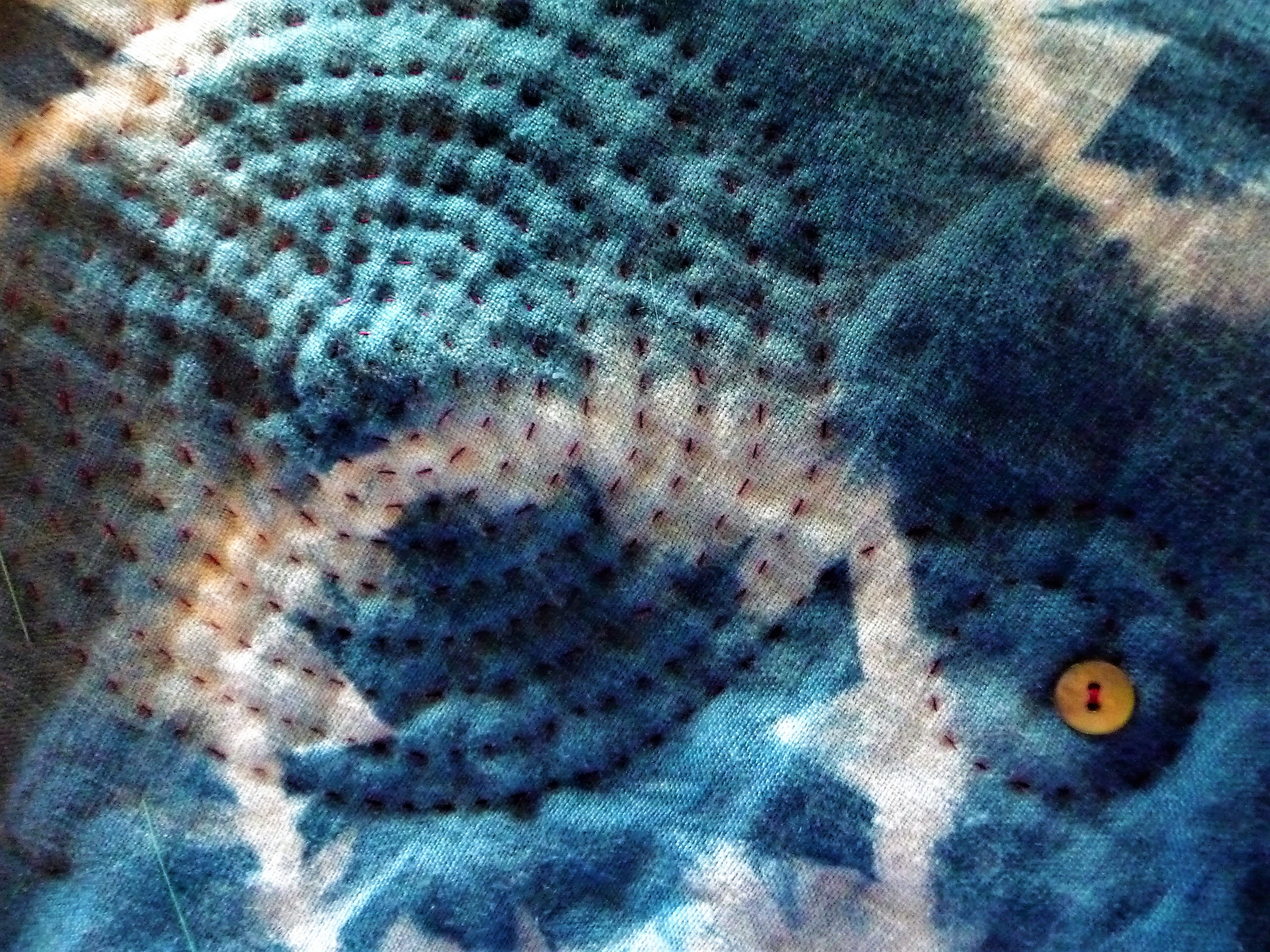
From “On Swimming and the Origins of String”, an unpublished essay:
I unwrap the skein from its package and drape it over the back of one of the oak dining chairs. I draw off a length and snip it with my small crane-billed embroidery scissors. I have beautiful wide-eyed sashiko needles and I thread two at once so I can continue the work when the thread runs out, or at least I can continue two needles’ worth of work. Knot the end and make a start. Stitch around the beginning, stitch, circling the beginning, your fingers easing the needle along an invisible path. The secret is that there is almost nothing as satisfying as the feel of a spiral developing as you stitch, outward, outward, the spiral growing, the texture as you stitch marvellous in your hands, and when you have had enough of following the thread around and around, you let it venture forth into the body of the quilt, finding its way as you are finding your way, your thoughts becoming clear. The beginning of a circle is also its end. In your imagination, you are entering at the widest point and walking toward the centre. Which you have made yourself, with a knotted cotton thread.
20,000 years ago, people living in caves above the Inya River in southwestern Siberia made eyed needles sharp enough to perforate animal skins. (Bone awls, precursors to needles, were used as long as 76,000 years ago in Africa.) I think of those women, because undoubtedly they were women, threading a bone needle with fine sinew or twined flax fibre or gut or vein, and pushing the needle in and out of a skin, with the intention of making a garment rather than a simple covering. One of them had figured out how to make a single strand of fibre stronger by twining it, one of them had the patience to finely braid, one of them observed the intricate weaving of a bird’s nest and tried something similar with long stems of reed and the resulting basket was so handy and so beautiful that soon she was making them for her sisters. I think of her. I think of the one who mended a hole in a cape and took the time to use two different shades of thread and how she began to do that with all her mending. The one who took care to make her stitches even, the edges lining up. These are seams that changed us forever.

 ...Theresa Kishkan