

Over the past ten years, I’ve lamented the loss of the orchard we planted in 1983, clearing about half an acre below our house, buying trees– heritage apples, two pears, two cherries, two plums, hazelnuts–, fencing not once but maybe 3 times, because bears and deer figured out how to find ways into the space. They figured out green wire, electric wire, barbed wire. (The trees were originally surrounded by old fishing net, found at the landfill.) We did get fruit, though not as much as we thought as we dreamed of cider, among other possibilities, and we got a lot of pleasure from the orchard itself, its slope of grass, its wildflowers, its sun pockets. But after the elk didn’t just eat the fruit but broke the trees, we realized we couldn’t keep up with that particular dream any longer. In May I wrote about how the orchard and what it represented to me echoes other failed dreams or memories that don’t coincide with reality. And in 2017, I published a book, Euclid’s Orchard, in which the title essay meditates on the orchard, family, love, coyote music, mathematics, and quilting. So that original cleared area with its trees and flowers takes up a lot of space in my consciousness. Trees, how they shape us, what they represent, how we remember them in both their real and imagined architecture: I don’t think it’s an exaggeration to say that this is foundational to my life. (I also wrote a book about trees and memory: Mnemonic: A Book of Trees.)
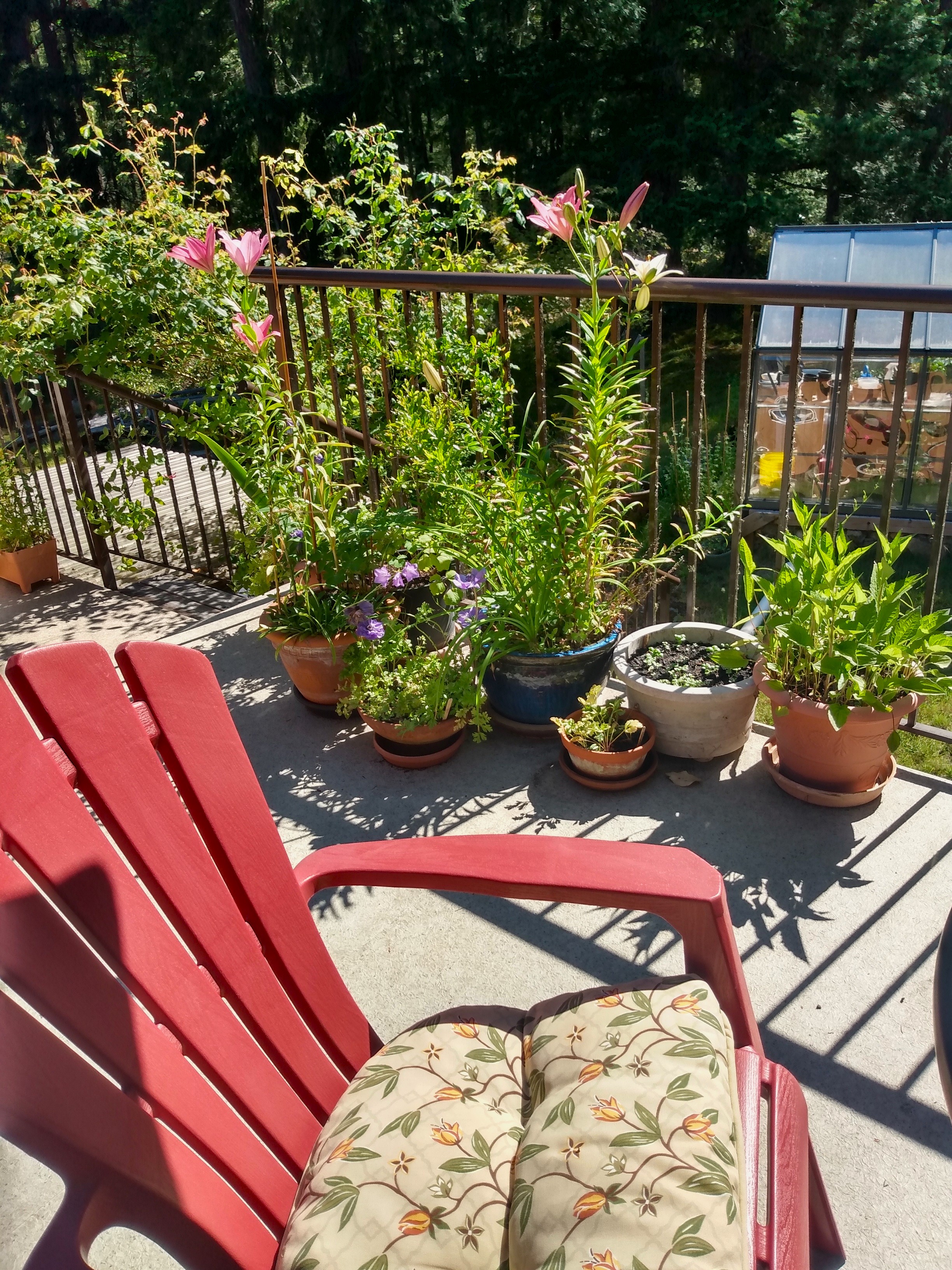
Yesterday morning, after my swim, we were having coffee on our upper deck, a series of 3 levels that wraps around 3 sides of our house’s second storey. There are stairs leading up to it from the ground beside the greenhouse and we can also walk out French doors from our bedroom, through a small sunroom, onto the deck. In spring I move out the plants that overwinter in the sunroom–a Meyer lemon, a calamondin orange (given me for my 50th birthday by Edith Iglauer and Frank White and which provides fruit, along with the lemons, for the Winter Sunlight marmalade I make every year), scented geraniums, bougainvilleas, and other tender plants that might not survive in the greenhouse. There are other plants on the decks: roses, a Desert King fig, tubs of lilies and other perennials, that we push under the eaves of the house for a bit of protection in winter. I grow basil on the upper deck, big tubs of salad greens in an area facing east that only gets morning sun, and for years I grew most of the tomatoes along the walls, though now I just have 10 pots of them up there because with the shift in climate, it gets too hot after about noon, and they need to be watered more than once a day. (I’m willing to water them once a day but with everything else, more than that is too much. I have 38 more plants down in the vegetable garden this year, in a big bed I freed up from other stuff.) The grapevines are lush and green, a Chardonnay which makes delicious jelly flavoured with rosemary, and a red wine grape whose name I’ve forgotten. Marachel Foch maybe? They are planted in the ground on the south side of the house but clamber up into the railings to make a cool shade for the potted plants on the deck. There’s a big Brown Turkey fig down there too; its branches have reached the upper deck and looking down, I see the figs swelling in the sun.
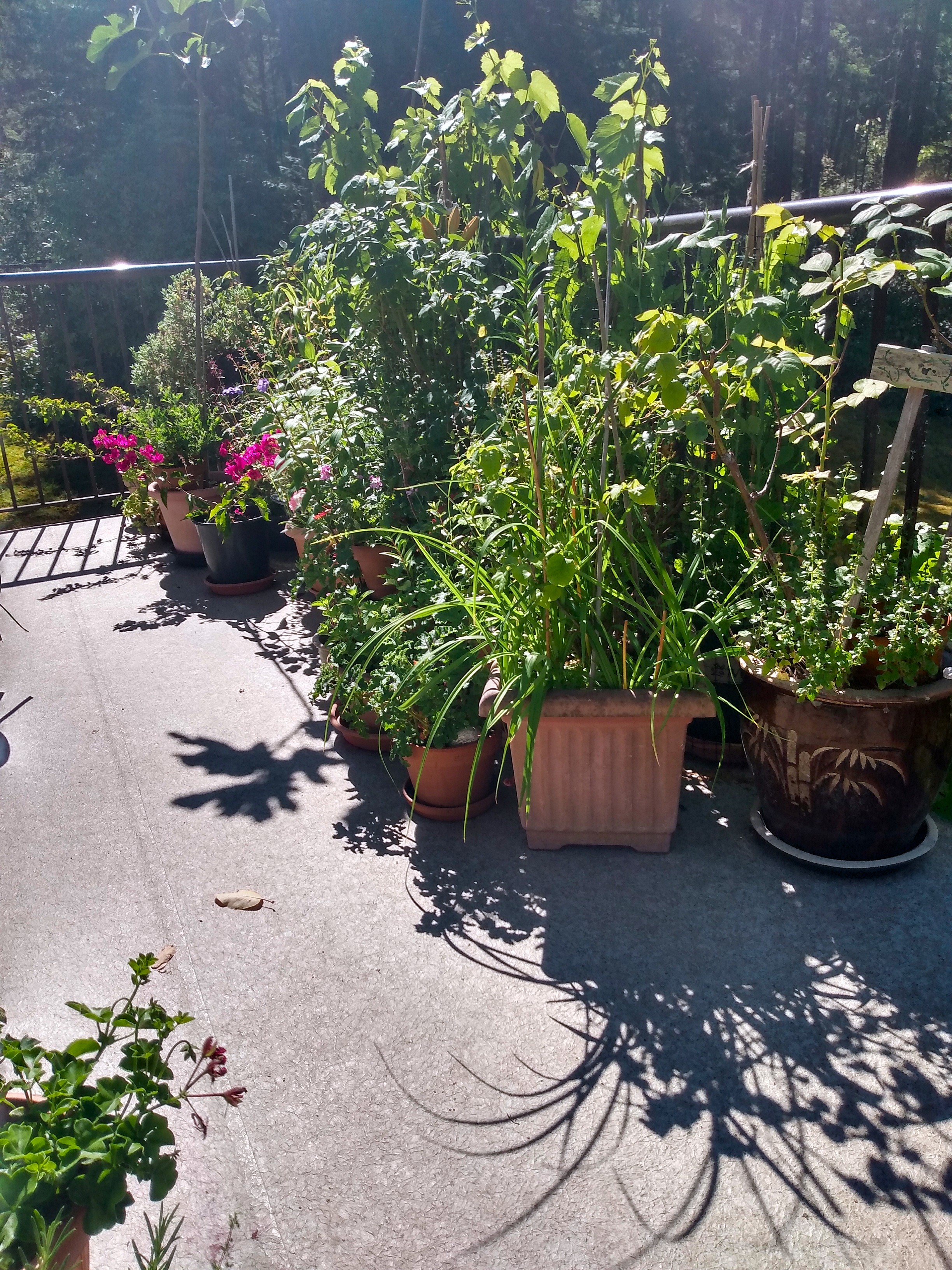
Every year there’s something new. Two years ago it was a pomegranate, which has doubled in size and I’m hoping it will fruit next year. It’s quite hardy and survived the polar vortex in its pot against a south wall. In fact I bought another this year so who knows. I also bought a dwarf cherry, developed at the University of Saskatchewan to survive cold winters, and suitable for growing on decks. It’s a cross — Prunus cerasus x fruticosa (the Mongolian cherry) — and promises 25 pounds of cherries at maturity. (The cherry cultivar is, appropriately, “Romeo”.)
Sometimes you think you’ve lost something and then you realize you still have it in another form. Another shape. A warm grassy slope, trees laden with fruit, wild violets and strawberries scattered in the grass like a medieval embroidery: gone. But what you have now is a close and domestic beauty, smaller, still with its own sweet promise. Lemons and oranges, a future with cherries and pomegranates, figs, and everywhere roses. You just need to pay attention. It’s already there.
Come just after the sun has gone down, watch
This deepening of green in the evening sward:
Is it not as if we’d long since garnered
And stored within ourselves a something…
Note: the lines are Rilke’s, via Seamus Heaney, from Heaney’s District and Circle.

 ...Theresa Kishkan