
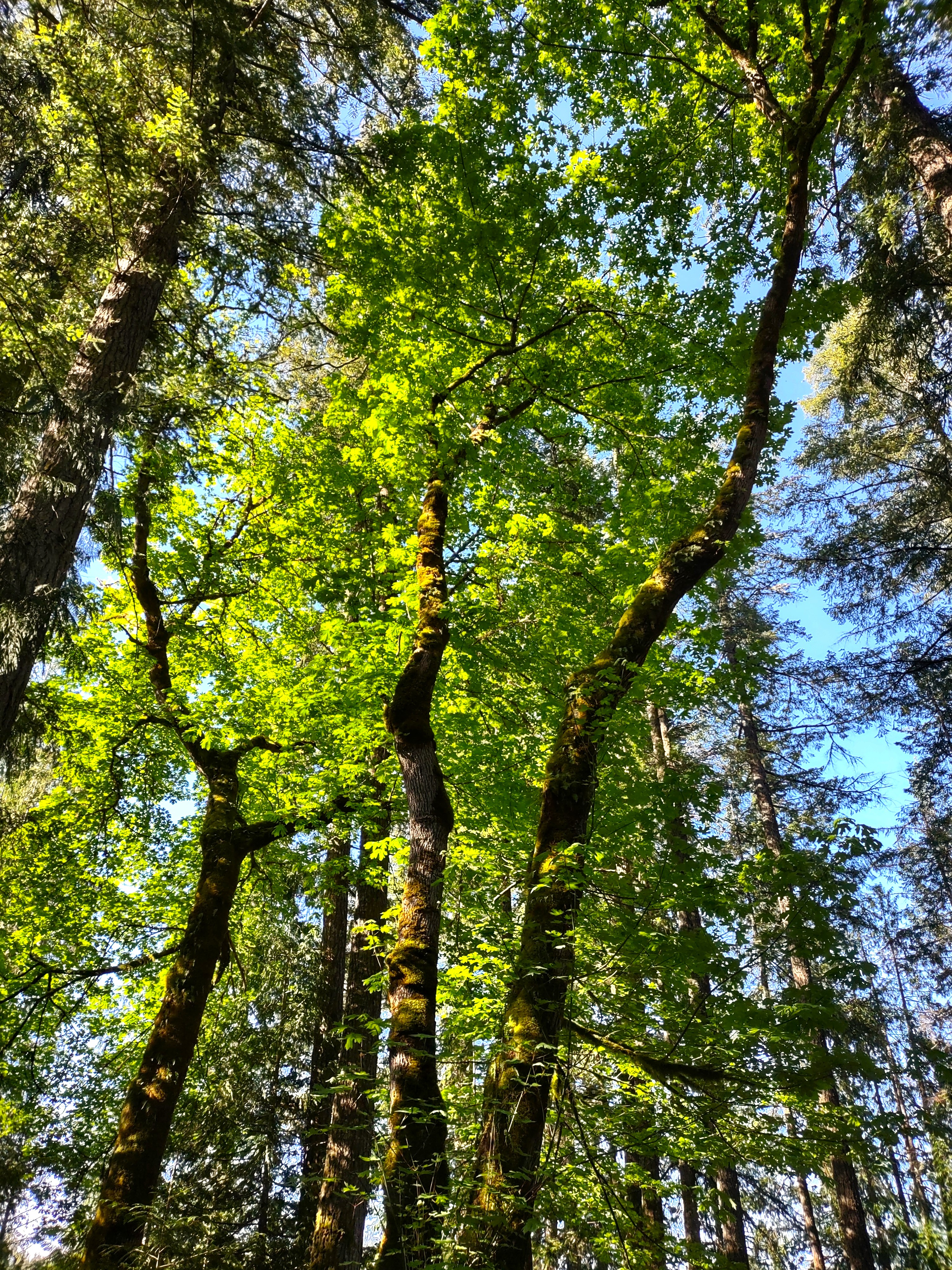
Every morning as I walk down to the lake for my swim, I look up at the big-leaf maples growing beside the path. They are huge, as big as a maple can be. There’s a gathering of really old trees in the little park where the beach is. A really big Douglas fir grows, seemingly, out of the sand, though in truth the sand is brought in every year and the fir grows in what has always been there. Yesterday I swam in a little window between rain showers and the sand was wet, except for a wide area under the fir, shaded by its generous branches. Every morning I look up at the maples and it wasn’t until yesterday that I said to myself, the branches are fractals.
I’ve been thinking about fractals lately. Thinking about how rivers look from the air, as a plane crosses the Rockies or the prairies or as I flew from Madrid to Granada in March and looked down at what was both unknown and also kind of familiar: the s-shaped curves, the smaller bends echoing the larger ones. Thinking about them in relation to family relationships too. And trying–that old word, the one at the heart of essay itself–to write about the patterns of our relationships to others. The Y of the maple branch that grows into air and breaks into another Y and another and another. The rivers meandering and bending and curving.
So the maples and the memory of rivers are guides, if I allow them to be. If I pay deep attention to their strength and purpose. Their potential as models. The ferns by the door–maiden hair, spiny wood fern–are also fractals: their complex patterns repeating the length of the frond. And the pine cones–Ponderosa, the longer elegant western white pine–on a bench in the dining room: also.
How these patterns are everywhere, when you pay attention. And how they can be taken apart. “How with a few strokes a river can be diverted, if one understands the line of its current,” wrote Leonardo da Vinci in his notebook (only backwards and in Italian). And maybe the obverse is true also. That one can restore a river to its course by removing the obstacle.
Thinking about the lace of a leaf’s veins, mountains and lightning, the ridges of a clam shell, the inner chamber of a moon snail shell, clouds above me as I swam, doubled in water, the petals of the moss roses opening to the morning.

 ...Theresa Kishkan