
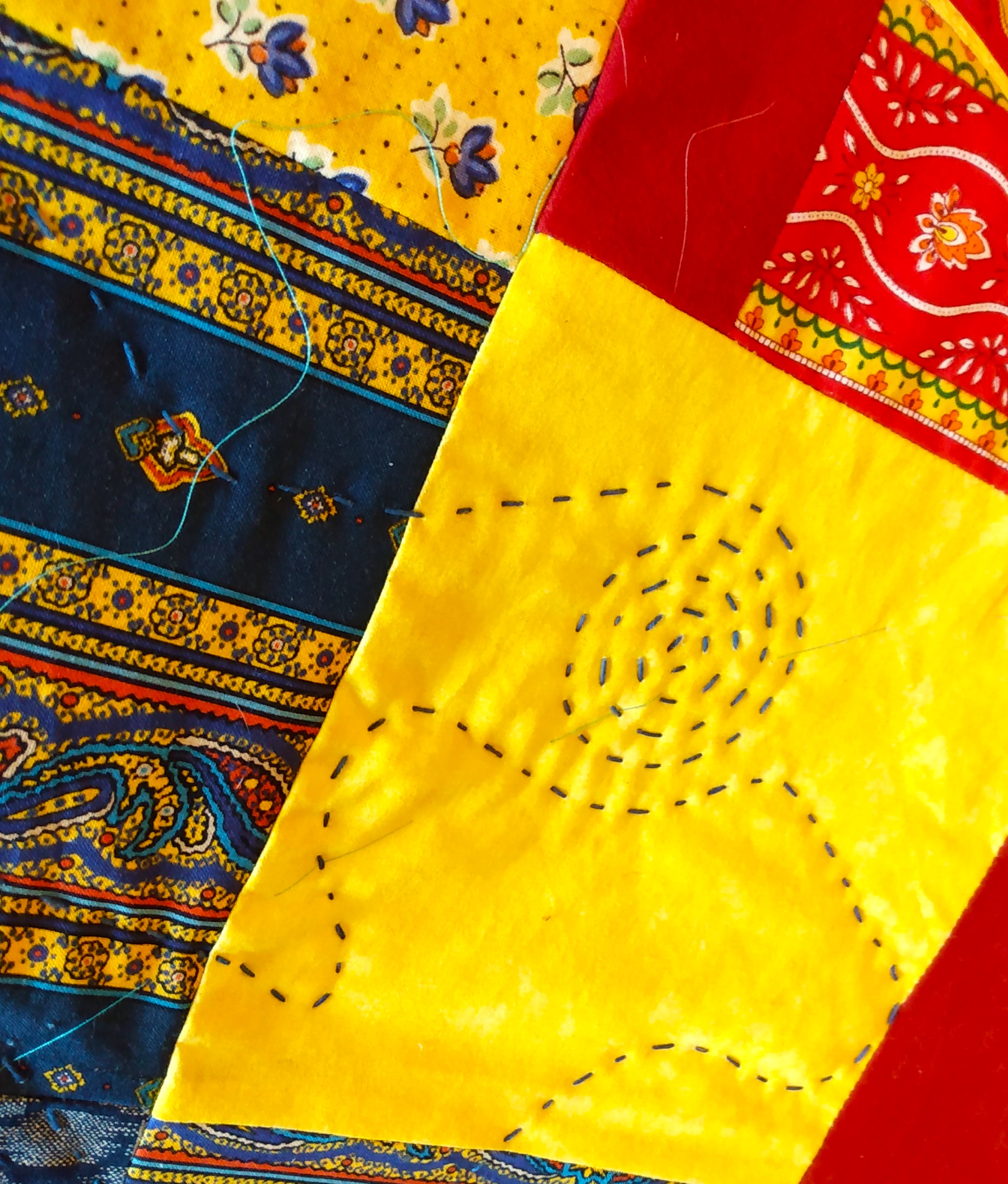
I was glad to have a quilt to work on during the cold spell we’re just coming out of. Once I’d finished my chores in the morning, I’d take a break by the fire, with a cup of strong dark coffee, and thread my needles. I’d thought of trying some different way to doing the actual quilting–the drawing together of the 3 layers: patchwork top, batting in the middle, and backing–but once I’d pushed the first needle into the cloth, I was making a spiral. Not the one you see above in the yellow cotton–that’s the conclusion of a run–but a large spiral in the middle square of the quilt, that lovely Provençal cotton on the left. If you are a perfectionist, you will wince at the way the corners of the squares don’t quite meet. But honestly it doesn’t matter. Or least it doesn’t to me.
Almost as soon as I’d begun this new quilt, I also began to write an essay. “On Swimming and the Origins of String”. I wrote the first sentence last week and it’s now more than 6000 words in length, and not finished. I’ve wanted to look at the evolution of string for a long time. Like others, Elizabeth Wayland Barber, Ursula Le Guin, and Elizabeth Fisher among them, I think that the creation of string was foundational to human culture. So I want to think about that, and I am: the essay considers some of the earliest examples of string and how these were used, what they led to, and how for so long no one bothered to pay much attention to what was considered “women’s work”.
For the past ten years, I’ve been using sashiko thread for quilting. Often I draw the three layers of a quilt together with spirals, beginning at the centre and working outwards until I have the sense that the spiral is big enough. I don’t plan. Sometimes I finish off the end of the spiral with a tiny shell button. Sometimes I continue the thread on a path across the surface of the quilt, meandering and turning, until it meets the path leaving another spiral. This is all intuitive and trying to describe what I do has me realize how little I know about the hows and whys of my quilting process. While I am sewing, I enter a meditative state, not unlike the place my mind goes when I am swimming in ideal conditions. By this, I mean that I am swimming in the lane I prefer, there are no distractions, there’s no turbulence in the water, which means that the alpha male swimmers have finished and are in the sauna or the hot-tub. One in particular thrashes his way up and down the pool, creating waves everywhere. Another swimmer, a woman, described it as “beating the snot out of the water” and she’s right.
It’s a good place to be, this house, with its fire, its baskets of fabric, a little box of sashiko thread and needles that just arrived in my mailbox, its enormous quiet so suited to the kind of work I’m doing. I don’t know what I’ll find out by stitching, by writing, but half the beauty is in the mystery.

 ...Theresa Kishkan
Your history of string reminds me of this excerpt from Nicole Krauss’s novel The History of Love:
There was a time when it wasn’t uncommon to use a piece of string to guide words that otherwise might falter on the way to their destinations. Shy people carried a little bunch of string in their pockets, but people considered loudmouths had no less need for it, since those used to being overheard by everyone were often at a loss for how to make themselves heard by someone. The physical distance between two people using a string was often small; sometimes the smaller the distance, the greater the need for the string.
The practice of attaching cups to the ends of string came much later. Some say it is related to the irrepressible urge to press shells to our ears, to hear the still-surviving echo of the world’s first expression. Others say it was started by a man who held the end of a string that was unraveled across the ocean by a girl who left for America.
When the world grew bigger, and there wasn’t enough string to keep the things people wanted to say from disappearing into the vastness, the telephone was invented.
Sometimes no length of string is long enough to say the thing that needs to be said. In such cases all the string can do, in whatever its form, is conduct a person’s silence.
~ Nicole Krauss, The History of Love (W. W. Norton, 2005)
Thank you for this, Leslie. Astonishing passage. Oh, this: “Sometimes no length of string is long enough to say the thing that needs to be said.” I’ve been planning to have my grandchildren measure the distance from our house to the highway next summer — I think it’s about 1/4 mile –and John suggested measuring a piece of string and having them do it that way. I’ll choose carefully!
I’m excited now to show my grandson how to measure with a piece of string on my next trip to the island. Thanks for this idea!
We should share results, Leslie! Mine come in summer. I have plans…
“those used to being overheard by everyone were often at a loss for how to make themselves heard by someone.” So much here. And, I agree, an astonishing passage. I’m now interested in the book. Thanks, Leslie!
It’s really wonderful.
Theresa, your words are always a trip. Destinations lovely and surprising. As ever, thank you.
(Also, just how long IS a piece of string??) (:
Maybe long enough that it’s not too short to save? When I read Donald Hall’s memoir, I was reminded on every page of my mother’s thrift. My dad’s too. Nothing was thrown away. My dad would come home from my brother’s hockey games with the broken sticks and he’d make little camp stools with them, the ones with canvas seats (he always had a stash of old tents to cut up) and wooden legs that folded up. If the rope he needed was too short, he’d splice another length to it, some sort of process I wish I’d paid attention to! He knew knots (he’d been in the navy) and actually had a sailmaker’s needle.
Thanks for the bright colours of your quilt. We need some colour here in Ontario to offset the gray and dreary days. Though I do have the Ukrainian flag flying in the driveway which ironically provides colour while reminding us of the dark days there.
Now you have got me going thinking about string! I recall a humorous record by Spike Milligan about an auction where every item was sold “with extra string.” Also reminded of a friend of mine who always carried string in his pocket so he could readily perform string tricks – even if not called for! Finally, phrases like “stringing along,” or being “strung out.”
I’m glad you have the Ukrainian flag flying, John. We are having borscht tonight and it reminds me that we had it twice a day in Ukraine in 2019! Always a little different, sometimes with beef, sometimes with duck, but always delicious. And colourful. My son in Gatineau sewed small Ukrainian flags for his family when they went to one of the early protests in front of the Russian embassy in Ottawa and those flags have pride of place over their fireplace.
And string: the American poet Donald Hall published a memoir called String Too Short to be Saved, with wonderful passages about his thrifty New England grandparents and their farm. I think of string as so humble and practical yet holding a rich historical legacy. (We are reading the Iliad right now, out loud, a fairly grisly experience, and I am waiting for the expression, “Another string to the bow…”)
Lovely quotation from Krauss’s novel: I loved that story.
Those are such striking colours: perfect for all seasons.
The colours sort of draw me to the basket where I keep the quilt near the fire for working on. And yes, isn’t that a gorgeous quote. I haven’t read much of her work but will look for it now.