
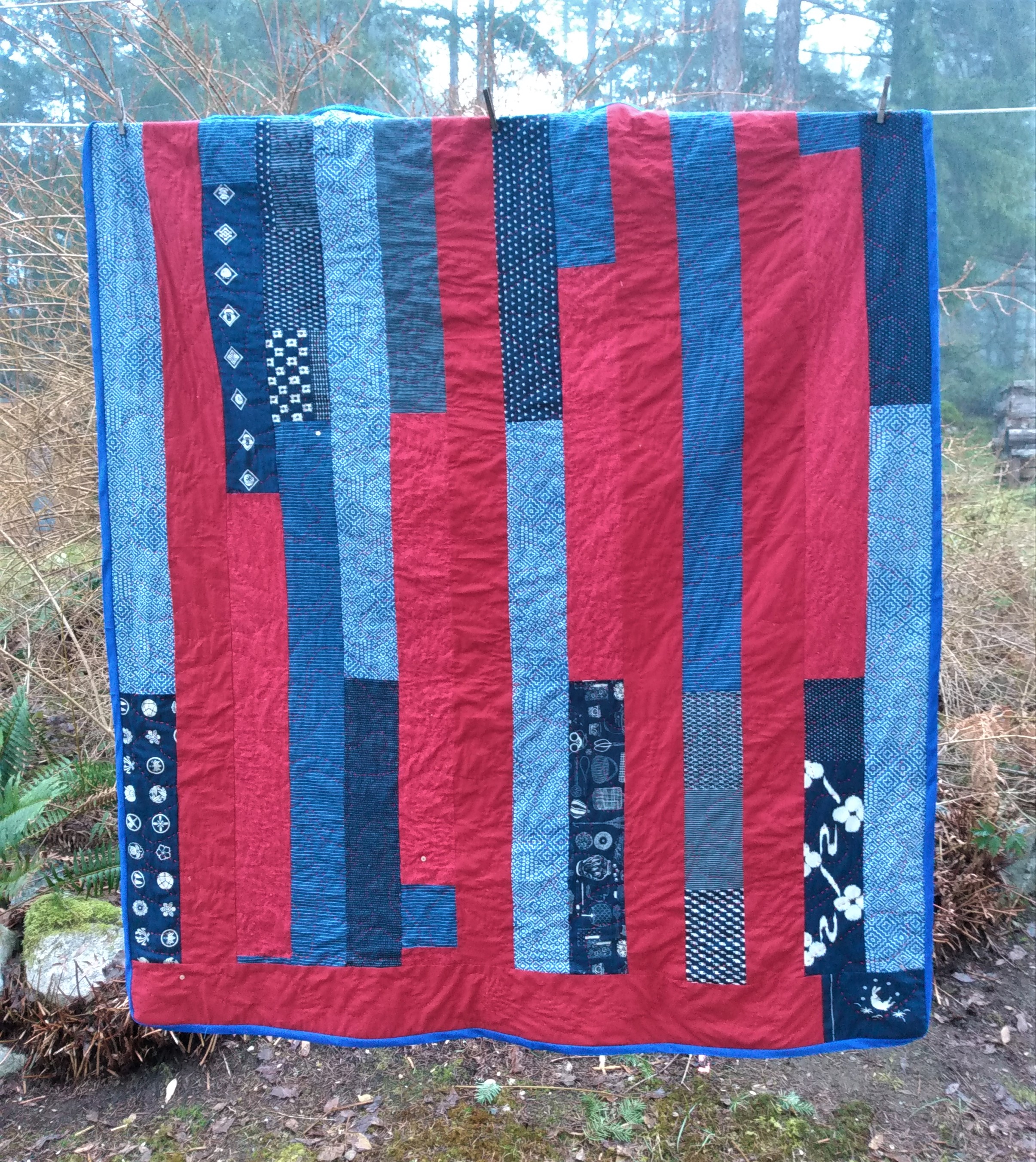
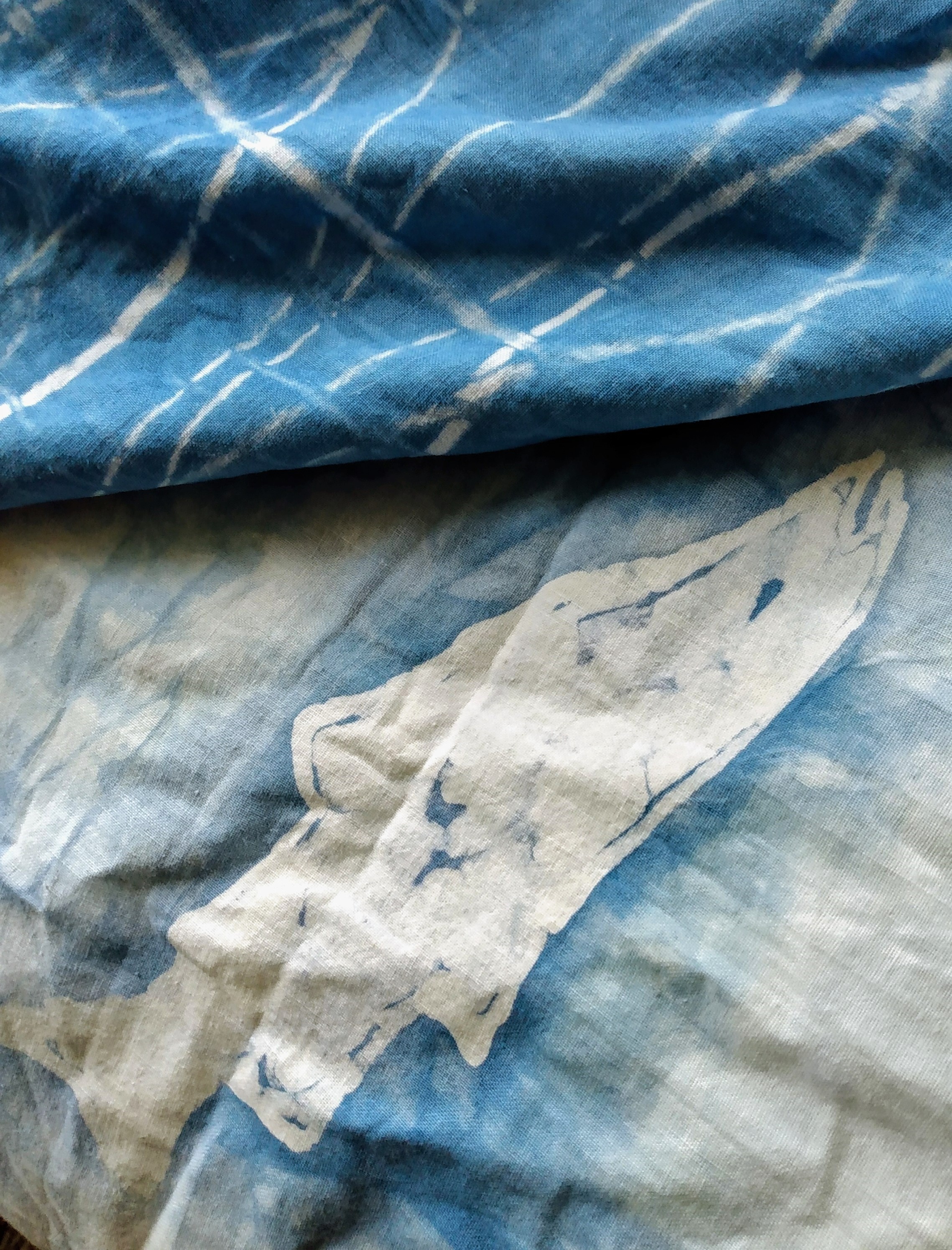
I was tidying the living room (guests tomorrow….) and noticed this quilt, quietly folded on the back of a couch I seldom sit on. I began it in November of 2021 and was sewing the strips together, Japanese cottons, some other cottons from the trunk where I store fabric, and suddenly our province was in the midst of a weather event called an atmospheric river system. Unprecedented rainfalls caused extreme flooding of the major river systems, highways and railways were damaged, portions of highway 8 between Spences Bridge and Merritt were simply washed into the Nicola River, roadsigns finding their way into the Thompson River, then the Fraser, and finally the ocean, communities were evacuated, and daily the news was filled with one disaster after another. As I listened, and sewed, I realized that I was arranging my strips in a pattern that would commemorate the rivers. See them leaving their banks, snaking across fields, washing away barns, animals, fish redds, and see the colours of their waters darken with turbulence. I chose a piece of indigo-dyed cotton for the back and didn’t even notice the salmon at first. Once I did, it seemed particularly appropriate that they should be there.
I quilted rivers all over the quilt, trying to echo the routes, the oxbows, the chaotic systems of those days. I listened to the news and quilted, hoping to find a way to see something positive in what had happened.

So the quilt is folded on the back of a couch, light rain falls, our area recovers from a windstorm that knocked out the power for thousands, though remarkably ours was only out for about 10 hours, and I contemplate a new quilt. I have fabric, I have sharp needles, but I don’t yet have the end of a thread that will lead me into the possibilities of design and mystery that are my touchstones when I make something.
I was looking something up in my book Blue Portugal & Other Essays yesterday and I found myself reading something I wrote well before the atmospheric river event but which almost anticipates it. And I thought how we live with rivers and they live with us, entwined with our activities, damaged by them, but also capable of their own agency. Later in the week I’ll be going to Edmonton, not driving this time, not stopping at Rearguard Falls, but maybe there will be an opportunity to look out the plane window and see the tangle of rivers in the mountains, running both east and west, and maybe an idea for a quilt will come to me then. Here’s a little section of the essay “How Rivers Break Away and Meet Again”:
4. The Fraser River at its origins high on the Continental Divide
A dripping spring just west of a pond at Fraser Pass is the source of British Columbia’s longest river.1
We stopped at a Point of Interest on the Yellowhead Highway near Mount Robson and walked along a rough trail to see the river, newly tumbled down from its origins. The colour of the water was almost tropical, greeny-blue, not the sludgy brown of the river as it courses down through the Fraser Valley, dense with sediments and effluents from every industry along its banks. Dense in season with the bodies of fish swimming strongly towards their own origins. Dense with the drowned, the damaged, the fallen-from-cliffs, the hopeless. Trees washed away in spring run-off, a fence post, a canoe pulled from its mooring. “Proceeding up the River at length we had the pleasure of camping on ground clear of snow, but the Mountains have all the appearance of winter…”2
But at the lookout, it was aqua, it was light over rocks, it was fresh. Further downstream, we saw rafts in white rapids, notices for helicopter tours of the source. It was not yet far enough west for the point where Simon Fraser began his exploration of what he believed to be the Columbia River, leaving Fort George on May 28, 1808. We were driving east, over the Divide, where the rivers changed direction. And we stopped. Walked along a rocky trail to look into aqua-green water, wondering how long a stick dropped into it would last on the river’s long journey to the Pacific Ocean.
1 “Fraser Pass,” Wikipedia. https://en.wikipedia.org/wiki/Fraser_Pass.
2 This comes from the 1848 section of David Thompson’s writing on his travels. Thompson, 196.

 ...Theresa Kishkan