
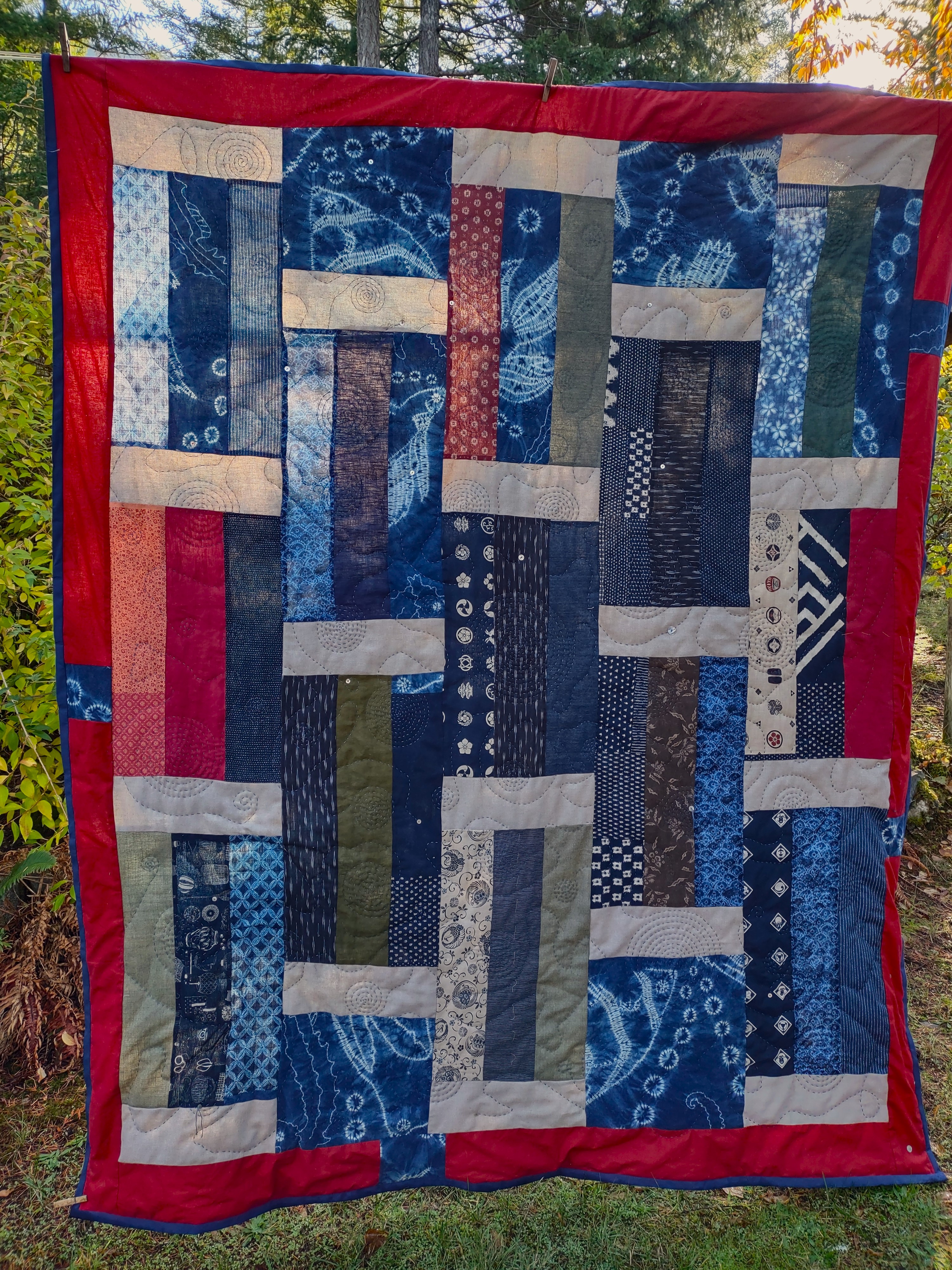
Half an hour ago, I sewed the last of the binding on this quilt I’ve been working on, sporadically, for 2 years. I made another quilt during this period, an easier one to begin, and finish. This one is big — about 100 inches long and 85 inches wide — and I began to do a complicated series of spirals and trails using sashiko thread so that the stitching would show up. Here’s the back so you can see what I mean. (The back is two sections of old cotton sheets, indigo-dyed, pieced together.)

I’ve written before that the inspiration for this quilt was the memory of framing our kitchen during the summer of 1981. I wanted the vertical strips to echo the studs we used for the walls. The horizontal strips of beige linen are the top and bottom plates and the lintels over the doors and windows. I wanted the quilt to be structural and I built it, strip by strip, until I felt it was big enough. I had some red and peach lengths of Japanese cotton I wanted to use here and there to remind me that when we were building our house, I couldn’t “see” what it would be like, couldn’t translate dimensions to actual space. So I’d ask, Will the window sills be wide enough for geraniums? (Red and peach geraniums…) The whole time we were building, we saw the sky. I chose a blue paint later for the window trim and the doors and anything else that needed to be painted, apart from walls. So even though the lumber we were using to frame the kitchen was various shades of brown, my memory of the summer of 1981 is blue. In an essay I wrote last year, a long essay about a painter, the experience of being his model and muse, I kept in my mind the Kore or Karyatids holding up the entablature of the porch of the Erechtheion, on the Acropolis in Athens. When I was 21, travelling in Greece on my own, a large-bodied young woman, I remember thinking that here were models for the life I hoped to live, strong, purposeful, taking the weight of stone on their shoulders.
When I held up the raw walls of my kitchen, when I cradled my baby in the night in a chilly tent, wrapping him in a blanket my mother had crocheted, when I pushed a wheelbarrow full of sand to be mixed with cement and water to become the footings of our house, I was using my body in its strength and purpose, the width of my shoulders an entablature of my life to come. I removed the cap from a 5 gallon receptacle and lowered it into the lake for water because we didn’t yet have a well, let the container fill, bracing my legs in the soft earth at the shore as I lifted it to bring it back to the work-site, a little water splashing on my feet. (from “Let a Body Venture At Last Out of its Shelter”)
Does anyone need to know this when they look at my quilt or when they come to visit and sleep in a bed with its red and blue piecings as a counterpane? No, of course not. But like paintings, my quilts are attempts to work out both visual and metaphysical riddles. They have a useful practicality — three layers, strong stitching–but I also know they are surrogates for the art I’ve never been able to make, never having been gifted with graphic ability. It hardly matters as I sit and sew, thinking my way in and through things I have no other way of sorting out.
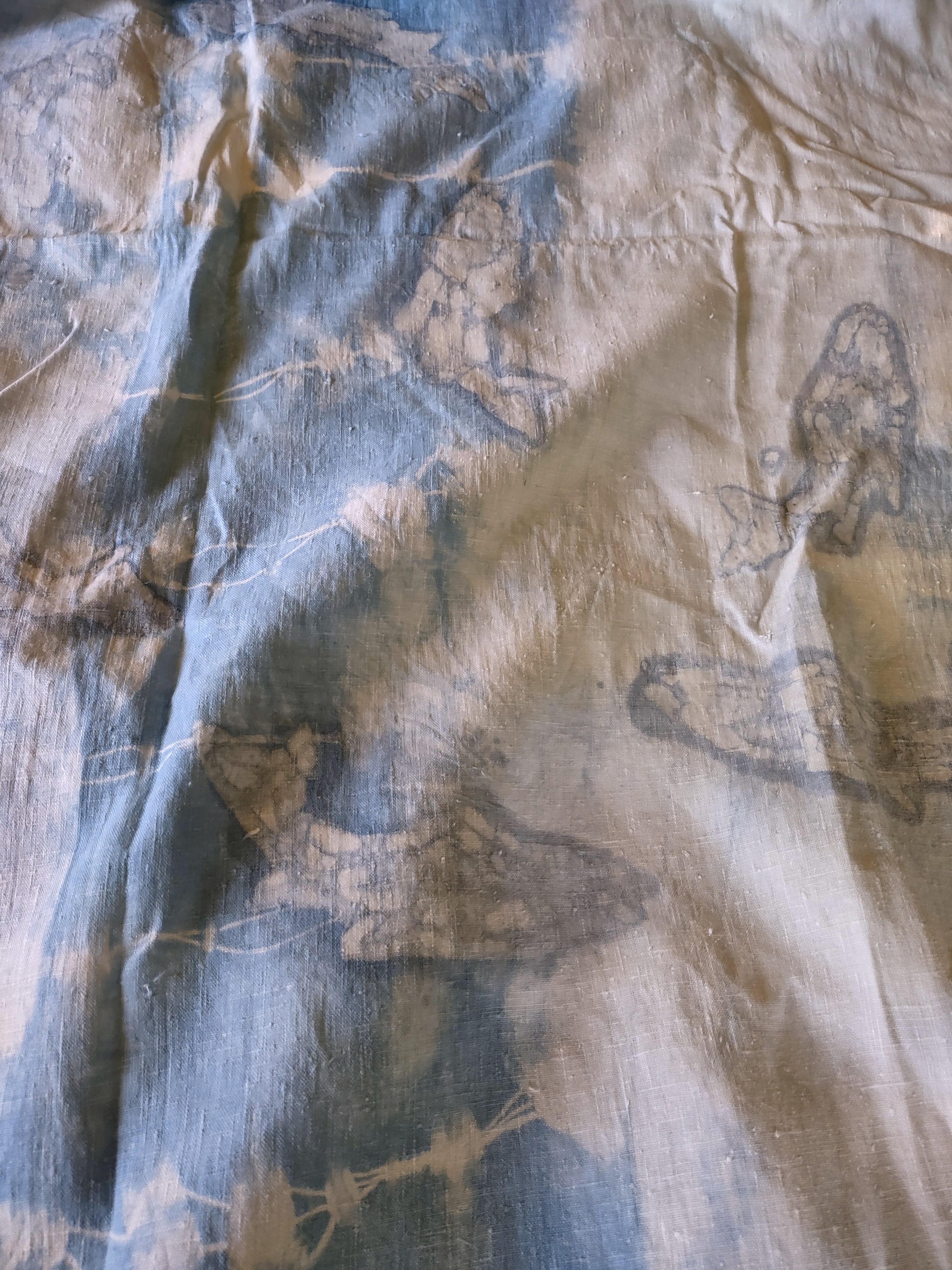
What’s next, I asked myself, going into the back guest room to put some of the sewing supplies away. What’s next? On the bed, a length of coarse linen I’d waxed a swirl of salmon onto and then dyed with the last of a vat of indigo. The dye is very pale. I’d laid the cloth out to see how I might over-dye it to deepen the colour. But seeing it now, with sunlight pouring into the room, I thought it was lovely just as it is. I’ll build a quilt around it, somehow. I don’t know quite what I’ll do just yet. But there are riddles and deep mysteries hovering in my consciousness lately and this is the best way I know to ease them out, to tease them into the light. Often there’s writing to do too, the textiles and words serving as companions. The structural quilt has an essay, graced by a young woman who couldn’t have imagined she would sit by a fire and sew. What’s next? I’m waiting to find out.
I would like to say that I carried the influence of the Karyatids home with me as an inspiration, a touchstone of strength and selfhood; I can’t help but think how much easier my 20s would have been if I’d known to keep them always in mind. I do remember them, though, and have thought of them often since, though not in relation to myself. That dedication to a purpose, in their case, the task of holding up the roof of a temple porch, the temple housing the Palladium (an olive wood effigy of the goddess Pallas Athena). Against one outer wall of the temple, an ancient olive tree, a moria, sacred to Athena. Above the temple, the same blue sky that Sappho saw, and Homer.

 ...Theresa Kishkan