

Yesterday I went to Vancouver for a procedure to repair retinal tears. These have been an ongoing occurrence for me, ever since I fell on ice in Edmonton in winter, 2018, and without knowing it for a few days, began the process of retinal detachment. I have regular check-ups with an ophthalmologist and when he finds a tear, he repairs it with a laser. It’s uncomfortable but part of life, I guess. The last time he repaired one, about a month ago, he asked me to come back in a month to see if the repair had worked because he was a little uncertain about his particular instrument given the location of the tear. And sure enough, when I went last week, he said he needed to refer me to a specialist in Vancouver for immediate treatment. Immediate meant within a week and within a week I was on the ferry heading to the specialist. I was nervous. These are my eyes, my only eyes. I’d been told my appointment would be 1 1/2 hours. John and I had lunch before taking the Skytrain over to the Eye Care Centre at VGH. (We couldn’t bring our car because by the time I had the appointment, there were no convenient ferry reservations left. We’d have been returning on the last ferry last night: 11:30. So we left our car at Langdale, went across Howe Sound as foot passengers, and then took the bus and Skytrain to our destination.)
To make a long and complicated story short, I didn’t have one retinal tear. I had four. I had a team of 3 ophthalmologists, all very purposeful, and I have to believe I was in good hands. But the procedure took 3 hours. Instead of sitting in front of the laser, as my usual doctor does, viewing my eye through a lens he fits on first, these doctors used q-tipish things to ease my eyelids away and the lasers were different. They felt different. There was so much pressure on my face and eye sockets from the sticks that were prying my eyes forward so they could get at the periphery of each retina. The intention was to seal the edges, I think.
Because of the intense lights they used, and the mirrors, I could see my eyes in the way I saw them in 2018.
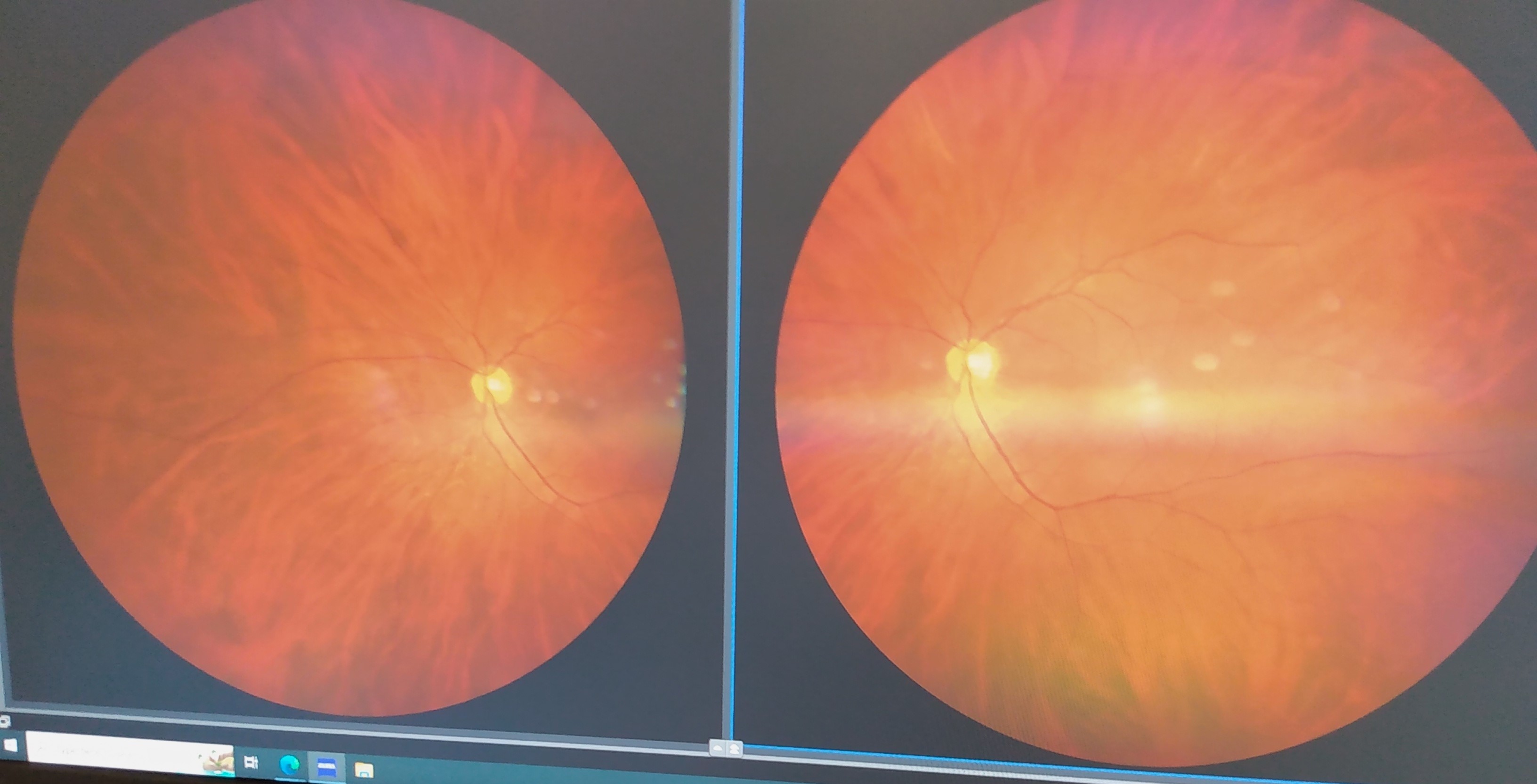
When I explained to one of the ophthalmologists what I was seeing, he said the line I was describing was the optic nerve. It was an extraordinary moment. And when the lasers were zapping the tears, the light was yellow, with tiny blue lights, like the fairy lights we have running through our vines.
When they were finished the procedure, 3 hours later, my whole face hurt. John said my eyes were swollen and red (I didn’t want to look in a mirror) and today there’s swelling below my eyes and around the lids from the pressure of the q-tips used to make it possible to work inside my eyes. My whole head hurt.
This morning my head still hurts and my eyes aren’t pretty. But I can see. When I swam, I was looking up at the sky and I remembered my first experience with someone examining my retinas in 2018. That time I saw the most beautiful indigo. The ophthalmologist explained it was an entoptic phenomenon.
Looking at the piece of paper later, after the drops to dilate my pupils, after the laser surgery, after the long drive home, my husband quiet and me reclined, my eyes closed, I parse the word “entoptic”: from the Greek, εντός οπτικός or “within vision”, i.e.,vision within the eye itself. I read about blue field entoptic phenomenon or Scheerer’s phenomenon, in which moving white dots are actually white blood cells flowing in the capillaries in front of the retina. Some people think that the experience is like seeing heaven, an aspect of consciousness, an apprehension of angels. I saw billowing clouds in the deepest blue sky, and the clouds were moving across the sky just as clouds move when one looks up for a sustained period at a summer sky. But my experience of that blue and its white clouds was brief. Brief, and as beautiful as anything I’ve ever seen. And it was within my eye, apprehended in the light of an ophthalmologist’s instrument. When she removed the instrument, I was in an examining room in a high tower while snow whirled around the windows and the river froze under the bridge we would have to cross on our way home.
–from “The Blue Etymologies” in Blue Portugal & Other Essays
On that occasion, I didn’t feel pain, or at least not much of it. In his book, Chroma, the artist Derek Jarman says, “I have walked behind the sky.” I did that too, the first time I saw my inner eyes. I was in a chair in an examining room in Edmonton and I was also moving through and behind the sky. Yesterday there was more pain, though maybe it was discomfort rather than actual pain. (After 3 hours, it was hard to distinguish between the two.) I didn’t walk behind the sky. I walked with John along Willow Street and over to the Broadway City Hall Station to begin the long journey home. Emily Dickinson had retinal problems. I thought of her this morning when I came home from my swim.
I’ve seen a Dying Eye
Run round and round a Room—
In search of Something—as it seemed—
Then Cloudier become—
I hope my eyes aren’t dying. Yesterday in a chair, it was as though they were being pursued, contained, held in place with sharp sticks, burned with intense laser beams. Today, closing them, I want the clear solace of blue: blue skies, blue cloth, the Steller’s jays floating down from the fir to settle on a post for their lunch. I want my old world back.

 ...Theresa Kishkan
Oh Theresa, how frightening, how gruelling. But it sounds like you are getting expert care from doctors who care about your eyes almost as much as you do. Long may they shine – the eyes, and the doctors.
I never thought the situation would just go on and on, Beth. But here we are. The silver lining is that I’m learning what really excellent care is out there, readily available. 3 stellar specialists, all hovering around my eyes, explaining and comforting.
And – thank you Tommy Douglas, as I say every time we have a medical event – free! Still, I hope it’s done. Who knew what havoc a fall could wreak, not on the torso but the retinas?
I know! Such gratitude for his vision ( pun not intended but appropriate,).
I love the description of ‘like seeing heaven’. “…an aspect of consciousness, an apprehension of angels…” I love how even in great discomfort there is a path to art and to a place where nothing else would ever take us. Thank you for writing it like you do. I’m sorry, though, that you had to live it… (glad you are on the other side and back in your beloved water, looking ‘up’).
Thanks for this, Carin. I’m glad the procedure is over (though my face is still kind of battered…) but the whole experience of damage and repair has been an interesting one. I would never have seen such beauty if I hadn’t fallen and had an impact injury. And this morning, again, swimming, I thought of how extraordinary a thing vision is — both kinds of vision. So I’m lucky in so many ways. (With swollen eyes…)
Sorry to hear you had to go through all this, but glad to know you got excellent and timely treatment. You will still be able to appreciate the visual splendour of the world from butterflies to the stars, the faces of family and friends, even ugliness for comparison!
I once had an eye injury, seemingly minor, but went to the doctor. I recall he looked like Alfred Hitchcock, big and severe! Upon checking my eye, he quickly and abruptly said: “you should be in hospital.” Admitted to hospital immediately, for three days I had to stay flat on my back, eyes covered, imagining what everyone and everything around me looked like, and worrying. Fortunately, my eye recovered, my sight intact. But none of the lovely nurses looked like I imagined from her voice! I have been forever grateful for the expert, caring and free attention I received then and on some subsequent hospital visits.
I think eye issues come out of the blue! Perhaps this is fitting, given my obsession with that colour. I honestly didn’t anticipate the severity of this recent diagnosis. But I’m hopeful that the worst is over. For now. And today’s sky was beautiful. Lilies are spectacular. A little yellow warbler by my study window as vivid as saffron.
While I was reading this post, I wasn’t sure which I was feeling more: sadness and sympathy about your eyes or marvelling at how beautifully you write, even about a difficult situation. I hope your eyes do well. Your writing needs no well wishes. It is superb.
Thank you so much for this, Pearl. Vision is a gift and we don’t always remember that! Or I don’t. Until I have to. I keep touching my eyes, feeling grateful that they’re more or less ok. (For now.)