
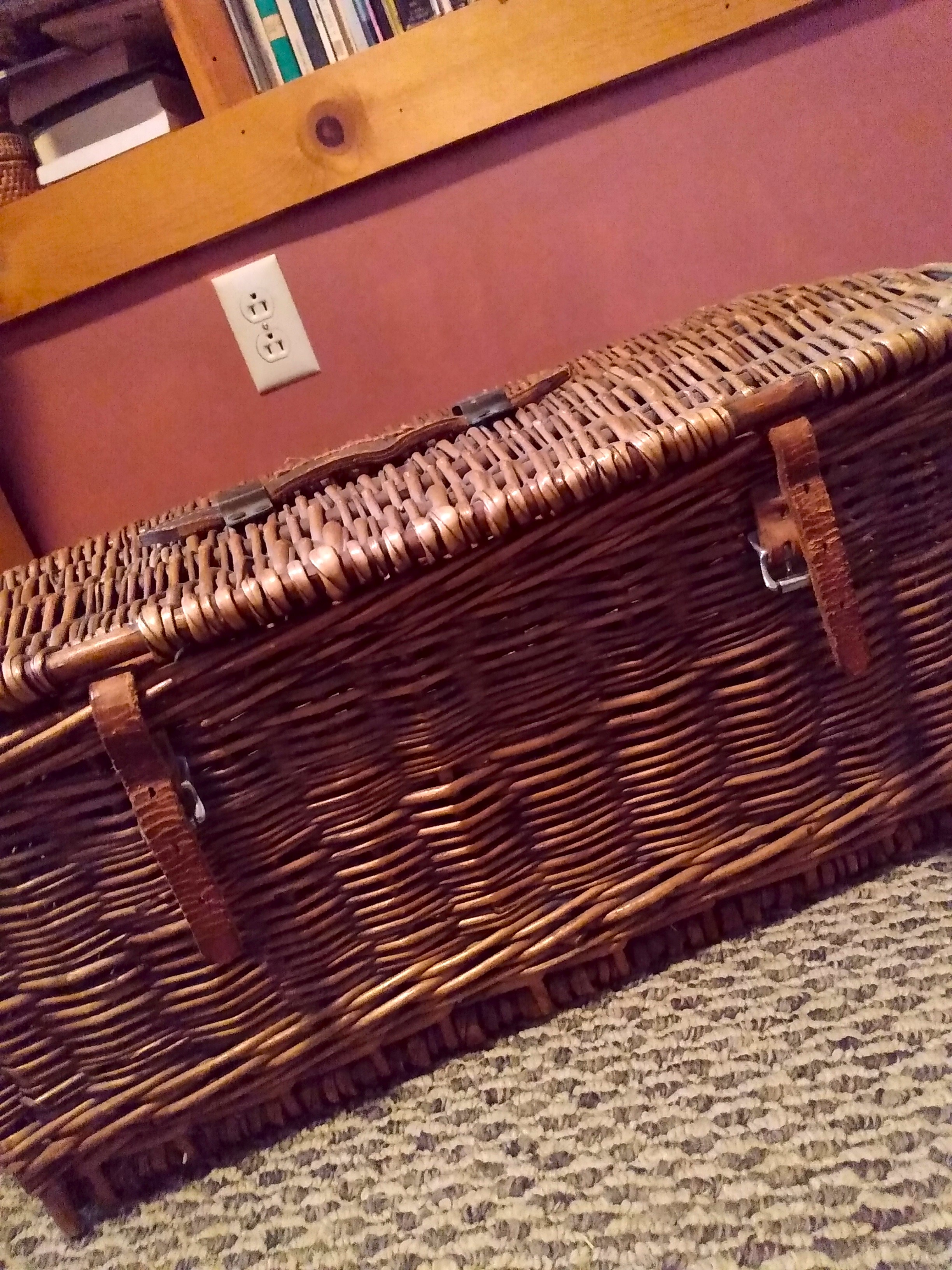
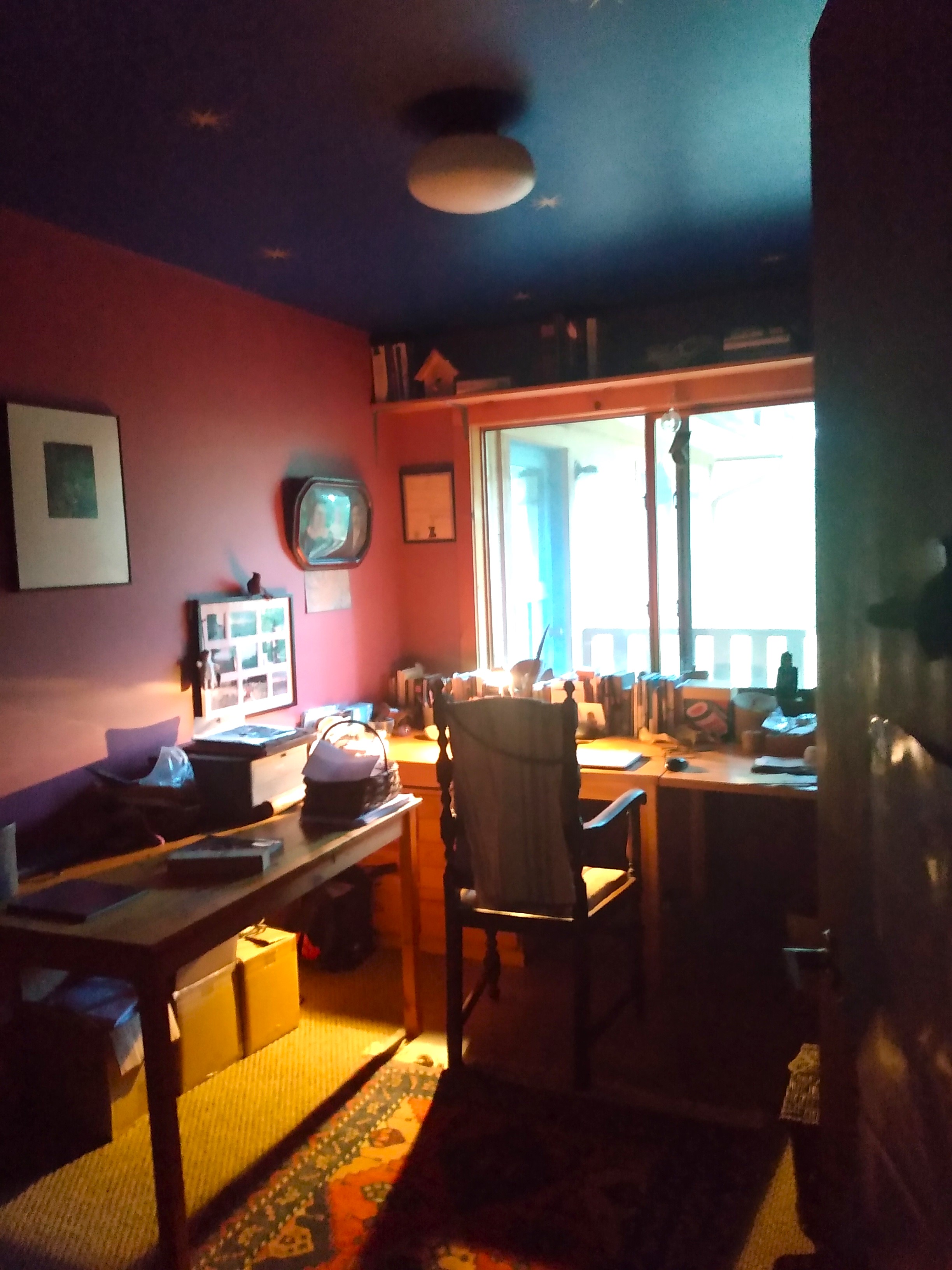
This morning I am going to continue the work of tidying my study. I have the prettiest room–deep rose walls, a Giotto ceiling I painted years ago after visiting the Scrovegni Chapel in Padua and somehow wanted to keep close so I took a guidebook to the local hardware store to have them scan the colour and then I planned a pattern of gold stars to paint on afterwards, a small wool carpet from Turkey. I haven’t really done any sorting or cleaning for more than a year, apart from vacuuming and dusting my desk when I found I was sneezing while sitting at it. This is because I was working on something, working in that way where you need your materials around you, close to hand, piles of them on either side of your computer, a jar with a dead moth, a few ikons, a big rock filled with Oligocene fossils, a basket of paper scraps so you can write notes to yourself, and dates, and somehow this is the best way to settle in for writing. For me anyway. Yesterday I cleared out a whole passle of paper, I sorted some letters and filed them away, and I got rid of old Gourmet magazines that I found in the beautiful picnic basket given to us years ago by an elderly neighbour of John’s mother. I vacuumed behind things, discovering (I hate to confess this) two desiccated shrews, brought in by Winter and left to race around until they found a place to die, and today I’ll do my desk and the worktable where I stack books I’m using and also a lot of stuff I’m not using but don’t have a place for. A piece of old tin ceiling from Granite Creek, a rainstick, pine needles that are probably too old to use for a basket, and oh, more paper.
This is how I transition from one book to another. Or at least from one manuscript to another, because I am not entirely sure there’s a place for what I’m writing now. The completed manuscript of a book-length essay about the male gaze, relationships between artists and models, and obsessive love: I wrote it because I needed to but I don’t expect to publish it. A novella set more or less where I live, about a party, friendships, illness, and family: a homage to Mrs. Dalloway, in a way, and that book sounds a faint echo through mine. And my current work, the one I’ve returned to after putting it aside to write the long essay, a novel set on the edge of Jervis Inlet. This is the one I need to spread out around me now, my reference books, field-guides, a scan of a 1930s school report on Doriston, and notes about pigment (because two characters are painters). The marine charts are coming. I know it’s a privilege to have this space to myself and I know I ought to take better care of it but somehow this is how I’ve ended up finding my way into and out of books as a writer.
Last night I was up for a couple of hours, my old habit, and I saw how to move the novel I have returned to, the one I’ve called Easthope, set on Jervis Inlet, anyway, I saw what to do with it next. A man who died and left a nephew and his wife a house in Easthope was a retired longshoreman from Vancouver and he moved to a small village to paint and look at stars. Along with some paintings in a studio in the house, he also left a hidden room, like a walk-in closet, filled with a suite of 27 canvases. A local curator is interested in a mounting an show of these works. Last night I wrote about her visit to the house in Easthope:
Sandra, there’s more. I didn’t know about this little hidey-hole for ages. Over here. Watch your head. Tessa led the way into the little room, lit by its skylight. And the 27 paintings hung on the walls. She backed out again so that Sandra could look at the work on her own. Over at the long worktable, she sorted some recent drawings, put cleaned brushes back in their places. When she looked up, Sandra was standing beside her. I have an idea, Tessa. I hope I’m not completely nuts but I think the show should try to replicate that little room. What do you…? And before she could finish, Tessa was saying, Oh, yes, that would be perfect. But is it impossible? I actually don’t think it is, Sandra murmured. We have someone who does some work for the Art Centre who has produced film sets, stage sets. I think…well, maybe it’s too soon to go into details but could we talk about this seriously? For the winter, if possible?
And now this lets me move in that direction, south, and to winter, the details of replicating a room with walls washed with pale green and grey, faint shapes on trees on them, hung with lichen and moss, and the canvases themselves:
Each painting—and there were, what, 25, no, 27 of them—was of a stump. A huge stump, almost filling the canvas; its wood runnelled and lichened and sometimes green with moss. Tiny plants grew up from the flaring bases. Most of the stumps were notched with horizontal cuts, some barely visible under the lichens, carefully detailed. Against one stump, a long board with a metal tip. Against another, a long crosscut saw, rusted, with worn wooden handles. Trees—hemlock, whippy cedars, even a supple maple—sprouted from some of the stumps and around them, the newer growth, long green boughs, tall sword ferns, delicate huckleberry. She knew she’d seen some of the stumps alongside the Easthope Road. She and Marsh had even stopped once to take a photograph of one beauty. On each canvas, the lower left corner, a small jewel-like image of a tree. Tessa figured Richard had imagined each stump back to its original majesty, determining the species from its bark or odour or any characteristic he could determine from what remained. She knew she’d seen some of the stumps alongside the Easthope Road.
And what remained? A sturdy ghost, a presence in the green woods, a reminder of what the forest had looked like before the huge trees had been felled, with considerable skill and effort, and hauled away to become houses, factories (Marsh had bought some Douglas fir beams reclaimed from a factory in Gastown to shore up the floor on the netshed), schools, windows. Together, a gallery of ghosts, hidden away, lit by their own grey quiet light. She found a light switch just to the left of the door. With more light, she could see something else, something extraordinary. Just visible through the boughs surrounding the stumps, silvery stars. No, silvery constellations. Actual constellations, because she recognized Ursa Major, Orion, the Pleiades. She called Marsh to see. This house, she told him, is full of the past, but somehow it’s alive too. Look, Marsh, look. There are even stars in these. How did he do that? I thought I’d seen every room but now there’s this one, these canvases, 27 of them. Truly beautiful work. What else will we find? I don’t even want to think about it.
But first I have to finish cleaning
Note: finished!

 ...Theresa Kishkan
My God, Theresa, you are such a beautiful, vivid, imaginative writer. This is gorgeous work. How could it not eventually be published, so the world can enjoy it?
Coincidentally, I too tried to clean up my office today. But I’m stuck in the last book and not ready to open the massive files for the next. So, bits and pieces, lingering half-heartedly.
Beth, this is so lovely to read. I am deep in the work of this and the prospect of ever publishing it — or the other completed manuscripts — seems to far away. But the older I get, the more I realize not only am I not the next best thing, but I’ve never been her. I don’t have line-ups of interested publishers or agents at my door. Ha! And the idea of trying to wrangle what I do into the new template, the new query, just seems impossible. And maybe it doesn’t matter.
Don’t forget, Theresa, there are all kinds of new publishing options – ebooks and audiobooks and online publications. I understand not wanting to submit – love how that word has two meanings – to publishers and go through all that torment, but that doesn’t mean there aren’t other ways to get your words out there. Because they do matter.
Thank you for this, Beth. All worth thinking about…
I love this post so much. The ‘glimpse’ into your sacred writing space (stars on the ceiling!), the need to refresh as you begin a new project and, best of all, the motivation to write the manuscripts because they need to be written. So much is published that shouldn’t be. Thank god for those who continue to make art and literature despite the bizarre workings of an “industry”. I so enjoy your writing for a thousand reasons.
Thank you so much, Carin. I’ve come in this morning to a clear desk and a tiny glimpse of Sakinaw Lake from the window. Let the wild rumpus begin.